Wednesday, 5 August 2026 Stay informed. No noise.

Do You Have The Patience To Make Money In Property?

Everyone wants to make a quick buck here and there, but property investment is a long-term game. Let’s hear a real-life case study on how you can make money in property.

In the early 1990s, a client bought a condominium unit that is 1,396 square feet, comprising three bedrooms and two bathrooms at Taman Tun Dr Ismail. The price after the Bumiputera discount was RM190,000. The condominium was completed in 1993.

The condominium’s latest transacted price last year was averaging RM600 to RM620 per square feet. Taking the conservative average of RM600 per square feet, it is valued around RM837,000 today.

Resident real estate negotiators advise that owners are not going to sell anything lower than RM860,000 now. It is a wait and see strategy adopted by owners with no urgency to sell, anticipating higher values post pandemic.

A simple arithmetic of the numbers brings the capital appreciation to 341%, bringing the Compounded Annual Growth Rate (CAGR) to arrive at about 5.1%

Does this sound impressive? Is is that easy to make money in property?

Read: Double-Up Your Property Investment With These Rules!

Make Money In Property, But…

Couple Moving New House

Maybe, and if you are using the property for own stay, you will be experiencing comfortable paper gains. However, if this property has been acquired for investment purposes, you will need to take into account these factors to calculate your return on investment:

  • Vacancy costs
  • Agency costs
  • Legal fees (for exiting or selling off the property)
  • Repair & modernisation costs (it is 30 years old!)
  • Building maintenance service fees
  • Mortgage borrowing costs
  • Yearly assessment & council taxes
  • Tax (on rental income & exit cost for future capital gains)

Due to limited data on the actual Internal Rate of Return (IRR) of this property, I do not have the rental income data as this property was bought over by my cousin for his own stay a few years after this condo was completed.

But let’s give some hypotheticals:

– Rental income during the 1990’s was RM650 and it increased by 10% each year (working out to RM2,400 today, which is conservative for a fully-furnished unit today transacting at an average of about RM2,700 to RM2,900).

– Annual council and assessment taxes at RM300, service charges at RM300 per month and assuming full tenancy. (This is considered on the upside already.)

– 90% margin on mortgage financing, a 4% interest rate, real property gains tax at 5%, agency selling fees at 3%, selling at RM600 per square feet
(RM837,000) at the 30th year.

– Assume a one-off major modernisation cost for kitchen and bathrooms amounting to RM100,000.

7.16% Return Good Enough?

Landlord Unlocks House Key New Home Real Estate Agents Sales Agents

With that the computed annualised IRR is 7.16%. This is comparable to returns of a moderate aggressive asset portfolio.

Read: How to Calculate Internal Rate of Return – Property Investment

Is this a good way to make money in property? A standard economist answer would be, it depends…

If you are the original owner, you will likely be enjoying a nice cash flow monthly as a landlord or liquidating with a net gain of capital (after deducting taxes), that could be partially funding retirement. Then you can say that by buying and holding, it is a sure way to make money in property.

But do bear in mind, it took thirty years for real estate values to reach to these levels, so it is not quite straight forward to make money in property. Having said that, it is also worth highlighting that cash flows enjoyed monthly is subjected to LHDN taxation.

Read: 10 Ways to Spot Property Investment in Malaysia – A Property Investment Guide

The Tax Man Is Here

PERMAI Assistance Package 2021
Image from boundless.com

According to Section 4d of the Income Tax Act 1967 LHDN, “the letting of real property is treated as a non-business source and income received from it is charged to tax under paragraph 4(d) of the Income tax act 1967 if a person lets out the real property without providing maintenance services or support services (such as cleaning services and repairs) comprehensively and actively”.

In layman terms, this means that you are letting out the residential property and deriving passive income from it. If you own one or multiple properties (bought or inherited) that is not used for business purposes, you are required to pay income tax.

Net rental income is subjected to a progressive income tax rate from 0-30%. These are tax deductible items permitted by LHDN that can be used to derive net rental income for an investment property on residential properties:

  • Assessment and quit rent is the annual assessment paid to the local authority and quit rent to be paid to the land office.
  • Interest portion on the mortgage to finance the purchase of real property which is rented out. (Do note that it is only the interest portion of the mortgage that is deductible and not the total monthly mortgage amount).
  • Fire insurance premium paid in relation to the insurance policy taken on the real property which is rented out.
  • Expenses on rent collection such as rent collection fees and legal expenses incurred to enforce rent collection.
  • Expenses on rent renewals to renew tenancy or change tenant.
  • Expenses on ordinary repair to maintain the property in its existing state.

Read: Property Investing In A Post-Pandemic World, 4 Things To Consider

Other things to consider whilst keeping real estate as an investment in your overall portfolio are:

  • Do you have the holding power?
  • Is there a maximum ceiling price to this condo?
  • Can you stomach vacancies or deal with (troublesome) tenants?
  • Do you have the willpower to deal with perpetual repairs, refurbishments and maintenance related to the upkeep of the property?

To some, these are hidden costs that can’t be quantified and are not worth the time and the headache. They would rather put their capital elsewhere in an asset like a mutual fund that takes minimal effort and see it grow annually at the rate 6-7%.

The question also would be, can we expect these kind of returns for newer residential projects 20 to 30 years down the road? Is it still going to be easy to make money in property?

Now I wish I had a magical crystal ball to look in the future, so I can make money in property.

Read: Is Malaysia Property Still Worth To Invest In?

About the Author

Rozanna Rashid

Rozanna Rashid is a Director at Alpine Advisory, a financial planning firm. A former corporate banking relationship manager, Rozanna is currently a Licensed Financial Planner (CFP, IFP). She holds an MSc in Real Estate, Economics & Finance from the London School of Economics & Political Science. She can be contacted at rozanna@alpine-advisory.com

Should Digital Assets Be Restricted For Retail Investors?

During the recent Singapore Fintech Festival 2022, which saw record turnout, a new digital asset was launched in the form of vouchers called “purpose-bound money”. They are powered by the Singapore Dollar backed stablecoin (XSGD) and processed on the Grab superapp, and piloted to 5000 participants with much fanfare. The vouchers were sponsored by Temasek, the best-managed sovereign wealth fund in the world.

Many thought that digital assets were gaining the public recognition and adoption it deserves. They enthused that the year-long ‘crypto winter’ is turning into spring, as November is usually a great month for the markets.

Two weeks later, Temasek made a shocking announcement that it had written off over RM1.2 billion in losses as its investee FTX went bankrupt. FTX was among the largest digital asset exchanges (DAX) in the world, peaking its owner’s net worth at RM430 billion. It is licensed in multiple jurisdictions and owns a licenced US bank. Its books were reportedly audited by one of the largest accounting firms in the US and advised by the Big Four global audit firms. But here we are.

Temasek explained that it spent 8 months on “extensive due diligence” before making the investment. Fellow investors include Tier 1 venture capital (Sequioa, Softbank), hedge funds (BlackRock, Tiger Global), and multi-billionaires (David Loeb, Paul Tudor Jones) to name a few. Ordinary Singaporeans were caught in the same boat, as they were the second biggest traders globally on FTX pre-collapse, averaging 240,000 visits a month.

The markets went nuclear. Business Insider summed up wryly: “Up-vember has turned to Nope-vember!”

Can Retail Investors Really Manage Ultra High-Risk Assets?

Businessman Holding Bitcoin Close Up

Digital assets are extremely volatile. They have crashed so many times that there is a website dedicated to counting the number of times that “bitcoin is declared dead” by news outlets. At time of writing, there are more than 460 “obituaries”. Bitcoin has dropped by 75% from its high this time last year with about RM9 trillion in value destruction across the crypto market!

Take bitcoin for example: It has a very high level of residual risk i.e., risks that cannot be attributed to normal factors. This means that there are risks which are specifically unique to this asset class, and it is nearly impossible to be aware of or to address all risk factors.

Based on studies, 91% of bitcoin’s risk is unexplained. In comparison, broad-based equity indices like the S&P 500 have only <1% residual risk. Individual stocks typically carry higher residual risk, but much lower than that of bitcoin. 

Investors might take on such residual risks to serve the notion that digital assets can hedge against global market downturns, but unfortunately, this could not be further from the truth. Bitcoin might not act as a safe haven against downturns such as during the pandemic. Instead findings show that it might even amplify losses.

Therefore, when you invest in digital assets, accepting high risk is not an option – it is par for the course. You stand to lose everything you have, and you shouldn’t be surprised by it. When a large sovereign wealth fund can lose its entire investment despite all the information access and investing tools at its disposal, what can we say for small-time investors?

Many non-professional investors are oblivious of taking large amounts of residual risks but are unable to sufficiently diversify them away.

Please ask yourself:

  • Do you know how to manage crypto exposures, optimize position sizes, and have the level of sophistication to do so?
  • Do you fully understand how price discovery in crypto works, and the outsized role which futures markets play?
  • How frequently should you rebalance your portfolios and what assets can you rebalance to?
  • How are you going to hedge risks when there are literally no hedging instruments offered by the DAXes in Malaysia?

Awareness Of Risk Is Not Equal To Suitability Of Investment

investment scams

Investors are taught to allocate between the four main types of asset classes according to risk. You may put some into cash which tend to have the lowest risk, followed by bonds or properties, and finally into equities, which carry the highest risk.

Some consider digital assets as the fifth asset class though it is far riskier than equities. Often there are no financial statements or real fundamentals behind them, so investors have to rely on technical analysis. Furthermore, due to the lack of regulations, ‘information asymmetry’ remains a serious and unresolved problem – investors seldom have full or fair access to the information required. Under these circumstances, value investing is very difficult.

In the absence of corporate disclosure requirements, investors aren’t duly notified of the legal and technical threats that unfold. When all they see is the quotation board (as corporate news isn’t announced to DAXes), their decisions won’t be as informed as they should be.

For instance: They won’t know that the latest digital asset approved for trading in Malaysia, Solana is closely related to FTX, which is currently being investigated for large-scale fraud. Or that it suffered at least five major outages since its launch, rendering it ‘unusable’.

Or that Ripple is facing ongoing prosecution by the US SEC and has been delisted in leading foreign DAXes such as Coinbase. Or that Uniswap gets maliciously hacked every now and then, without any investor recourse.

Digital assets bound to a single corporate entity such as FTX present a big due diligence headache as investors won’t know what hit them before it’s too late. The performance of these entities directly correlates to the performance of their tokens.

They may behave like equity, but they are not beholden to their token holders! They are neither required to report or be transparent. Corporate controls take a backseat while their ‘moon-talk’ takes the wheel, right until the inevitable car crash.

Digital Asset, The Choice Of So Many Youths

Nevertheless, crypto has changed the investment dynamic. It has become a touchstone of pop culture. When you ask Millennials and Gen Zs, their first investment product is crypto even though it is the riskiest asset class! They’d place their life savings to buy illiquid artworks (in the form of NFT) even though that’s the last thing a normal portfolio will consider.

When you ask what their objectives are, it sounds like they want to chase unicorns or catch lightning in a bottle (expect prices to magically pump). Their investment strategy is mainly to hold until it hurts – while those who sell are shamed as weak hands.

It’s a ‘donut’ approach: Do nothing as it tracks to zero, just stare at the hole. Solana may have plunged 95% from its peak last year with no bottom in sight. But to Solana fans, it is the hill they die on.

The point is: It is not enough to be aware of the risks – most investors already are. Awareness is one thing, but the assessment of product suitability is quite another. But are DAXes making such an assessment? Are investors being risk profiled?

When it comes to a prolonged downturn like what is seen now in the crypto market, these investors become captive or stuck in their spot positions without ways to neutralise them or products to rotate out to.

Will the situation worsen once IEOs (initial exchange offering) start proliferating the market? IEOs share similar characteristics with private securities offerings, which are generally reserved for accredited investors. In Hong Kong, these are classified as “complex products” which warrant additional investor protection measures (HK SFC: Guidelines on Online Distribution and Advisory Platforms 2019).

Read: What Are Initial Exchange Offerings (IEOs) And Should I Invest In Them?

In Singapore (where FTX is the latest storm to volley the island in a squall line from Terra Luna to Vauld to Three Arrows Capital to Hodlnaut), regulators have been repeatedly advising retail investors to stay away from crypto but was anyone listening?

Tough restrictions are now being mulled for users to access and businesses to offer crypto (SG MAS: Proposed Regulatory Measures for DPT Services 2022). Meanwhile, HK authorities expressed relief for having “dodged the bullet” as retail investors there were barred from FTX.

Should we take notes from our neighbours before something goes wrong?

Read: How To Avoid Being a Victim Of A ‘Rug Pull’ Exit Scam?

When Investors Treat Crypto As Their Retirement Plan…

According to a Charles Schwab survey, nearly half of all millennials and Gen Zs see crypto as a viable retirement plan. This is not just a generational trend but a tech-driven one (Guardian).

They use digital tools like robo-advisors (Accenture) and prefer to pick their own stocks (Wall Street Journal). They think financial planners are for their parents (“OK Boomer!”) and rather get their fix from social media influencers.

Asset managers have been eager to gratify this demand. One of the world’s largest retirement funds, the Ontario Teachers’ Pension Plan for 330,000 working and retired teachers, decided to invest in FTX and is now among the biggest losers on record. Fidelity Investments, which administer pension plans for 23,000 companies in the US, has allowed contributing employees to choose bitcoin in their 401K retirement accounts.

Here in Malaysia, there are news reports that EPF funds were taken out during the Special Withdrawal rounds to invest into crypto – despite the looming retirement security crisis. DAXes are even talking up ‘monthly deposit features’ into crypto like regular savings plans!

There is increasing pushback, in the wake of FTX which fooled the most brilliant and vigilant asset managers. New York’s Attorney General cautioned, “investing hard-earned retirement funds in crashing cryptocurrencies could wipe away a lifetime’s worth of hard work”. US Congress is being asked to ban digital assets for individual retirement accounts as most of them “have no intrinsic value and are too unstable”.

The same goes for investing in “digital asset companies which are a breeding ground for fraud, crime and theft” and “do not operate with sufficient guardrails to protect retirement savings” (US NYAG: Prohibiting Retirement Investments in Crypto 2022).

Read: How Does The Greater Fool Theory Apply To Crypto Investing?

If Investors Can’t Be Protected, They Should be Restricted

Investors must learn to see behind the smoke and mirrors of crypto. It is 90% marketing and 10% innovation, with a probability not promise of long term value. Many are over-confident of their own research and unaware of confirmation bias.

Even Temasek had to admit that their trust was “misplaced” in FTX. In an interview with Bloomberg, the FTX owner admitted that the concept of high returns in crypto was like a Ponzi scheme, which left the reporter utterly stunned!

Investors need to grow up and admit that they would have missed it too.

FTX is an unbelievably complex organization. Even the defunct Lehman Brothers which triggered the 2008 global financial crisis was less complex. FTX printed monopoly money, made investors buy it, then printed more monopoly money as collateral and took out real money loans – which it gambled away through a sister company.

If digital assets are high-risk products that require sufficient knowledge, experience and capital, why are they not restricted to sophisticated investors – but marketed widely including to the pensioners, the poor, the uninitiated?

The unwary masses are bombarded with outdoor billboards, online banners, radio spots, and roadshow trucks designed by award-winning agencies. Influencers are freely promoting crypto ads in the guise of financial education and luring their ‘followers’ into backroom deals.

At the end of the day, a good investment thesis should have a strong balance sheet, risk management practices, corporate governance, and recovery mechanism. Unfortunately, this basic hygiene is nowhere in the crypto sector.

Until this is done, if we cannot adequately protect vulnerable investor groups, then we ought to in good conscience restrict them from digital assets.

Crypto is here to stay but regulators should ensure it’s here for good. Where there are no suitability guidelines, digital assets are not considered an alternative investment but will become the new staple.

About the Author

Edmund Yong
Edmund Yong
Kevin Wong Photo
Kevin Wong

Edmund Yong and Kevin Wong are the partners of Celebrus Advisory, a regulation-focused consultancy for blockchain technology and digital assets.

How Drawdown Strategy Can Help Your Retirement Planning

Retirement. The “R” word that many would prefer to delay thinking about until it’s inevitable. I recently had the opportunity to discuss the meaning
of retirement planning success with a client. Much of the thought process that she had undergone prior to our discussion was focused on the accumulation phase – making sure that there’s enough saved in the retirement nest egg.

Want to know more about the drawdown strategy? OK, let’s go.

But as one inches closer to the finishing line, the focus will need to shift towards the more interesting, albeit daunting, task of ensuring that whatever has been accumulated is sufficient to last the rest of our ever-increasing post retirement years.

Looking at the environment that we’re facing today, where the cost of living seems to be escalating to worrying levels, one can’t help but to check and recheck their financial numbers before the income tap is finally switched off with retirement.

If we want to increase the chances of our retirement planning success, a well thought-through drawdown strategy should be considered, at least 2-3 years before D-Day comes along. Here are some thoughts to get you going.

Know Your Retirement Resources

Rolled Up Banknotes Retirement Container Full Coins White Background

Before we’re able to effectively plan our retirement drawdown strategy, we will first need to be clear on what assets we have that can be earmarked for this purpose. As such, an asset listing and tagging exercise is the first step.

Common assets that have been squirrelled away over many working years for retirement would include savings and investments in one’s Employee Provident Fund (EPF) account, bank deposits, properties, stocks, Amanah Saham, unit trust funds, endowment insurance policies and the like. A growing number of people are also investing in alternative assets like cryptocurrencies, private equity and peer-to-peer lending too.

Having a complete listing of available assets and tagging them by financial goals will help us better understand the likelihood of achieving those desired objectives. Otherwise, there’s a chance that we might end up achieving certain goals at the expense of others.

Read: Retirement Planning, Why It Is Important From An Islamic Point Of View

Know Your Retirement Expenses

We Have Range Retirement Portfolios Offer Shot Mature Couple Getting Advice From Their Financial Consultant Home

To ensure what we have is enough to cover our expenses in retirement, we will fi rst need to know how much we incur today. If you haven’t already worked out your current expenses, this will be a good time to do so. In retirement, certain expenses will go up while others will decrease.

You might spend less on work related travel or attire, but you might spend more on health supplements, holidays and social activities. If you find working this out a daunting task, then a simple rule of thumb is to budget 70% of your current expenses in retirement.

Read: How a Trust Can Help You in Times of Need During Retirement

Financial Goals In Retirement

Retirement Planning

It’s not all downhill upon retirement, especially for those among us who aspire to retire early. We may have a bucket list of places to go and things to do with all the time that we will have in retirement.

Do you wish travel extensively or take up new hobbies? Do you have some long overdue home renovations or even a plan to relocate to a smaller home?

Some of us might like to make some provisions to partially assist with the tertiary education funding for our grandchildren or help with some
charitable causes. Add these goals to your list and put a fi nancial number and expected timeline to them.

Read: Retirement Is No Joke, Here’s Why We Need Private Retirement Scheme

Consider Potential Curve Balls

Businessman Sitting Outside Ground After Being Dismissed
Image by jcomp on Freepik

A major concern for retirees is unexpected expenses. Some of these can be planned (with funding set aside accordingly), while others might need to be considered more carefully and risk mitigation steps may need to be put in place.

Top of mind for most retirees would be medical funding, especially on the backdrop of the continuously high medical cost inflation these days. Do you have a comprehensive medical card in place with the appropriate daily room and board, annual and lifetime limits?

If this is no longer an option (due to high premium cost or pre-existing medical conditions), you may need to be realistic and rely on government healthcare services as your primary medical provider.

Another factor that is of concern to retirees is inflation. It’s unfortunate that inflation is rearing its ugly head the world over nowadays. Hence, the cost of living for retirees is going up quite drastically. As such, some adjustments to your retirement living expenses might be required to minimise this impact on your lifestyle where possible.

Read: Debt-Free vs Retirement Savings: Which to Prioritise?

Create Your Financial Buffer

Businessman Protection Money Table With Tree

Once retired, you will need a buffer to ensure that the ups and downs associated with investments will not affect your lifestyle or ability to meet other short-term goals.

Commonly termed as the cash reserve, these are funds set aside in stable assets such as bank deposits, capital protected accounts or short-term
money market instruments. Ideally one should have between 2-3 years of annual expenses and the cost of any financial goals due during this period as cash reserves.

Investing In Retirement

Malaysian Ringgit Banknotes Background Financial Concept

Now that you’ve considered your financial goals, funding needs and potential risks, how do you continue to make the most of the assets you’ve
accumulated to help you achieve your desired retirement?

During retirement, most people tend to focus on income generated by the assets held. For example, an investment property can provide rental income while EPF savings will provide annual dividends. Similarly, stocks may be able to pay good dividends and bank fixed deposits will provide an interest income over the placement period.

While income generation is important, it’s equally important to allow your investable assets the opportunity for capital growth to keep pace with inflation as well.

Otherwise, you might end up relying heavily on the drawdown strategy of capital if income generated is insufficient. An accelerated drawdown strategy of principal, especially in your early retirement years, will have a long-term negative impact on your funding sustainability.

When investing for retirement, you should continue to have a combination of different asset classes to help you ride out the different investment market cycles. Although it’s not the intention of this article to discuss safe withdrawal rates, it’s worth mentioning that commonly used assumptions include the 4% rule – ie one should invest equally in equities and bonds and can withdraw 4% of your investable amount yearly while adjusting for inflation.

Do take note that these assumptions are US centric and might need to be adjusted to the local environment. As investment returns fluctuate, it’s worth to consider the retirement bucket approach to investing. In simple terms, you can think of investing in three buckets.

Read: 5 Best Thing To Do When Your Retirement Funds Are Insufficient

Drawdown Strategy: It’s About These 3 Buckets

Business Strategy Success Target Goals

Bucket One in the drawdown strategy represents your cash reserves for the immediate 2-3 years of living expenses and funding of any short-term financial goals. Funds here are placed in safer assets with minimal price fluctuations.

Bucket Two in the drawdown strategy will comprise of assets that can be held longer to cover the next 7-10 years of expenses, while generating income and capital growth that can be used to replenish Bucket One as you go along. Investments here would include EPF, stocks and high yield bonds, among others.

Lastly, Bucket Three in the drawdown strategy comprises of long-term assets that can be held beyond 10 years and have good capital growth potential (think property assets, alternative assets and your own business). Income and capital growth from Bucket Three can then be utilised to replenish Bucket Two in the same way that Bucket Two replenishes Bucket One. In conclusion, most of us will spend anywhere between 20-30 years in retirement.

As such, planning for this long journey should be given more attention. The sooner you start the process, the more time you have to make the necessary adjustments for the transition to be as smooth as possible.

Remember that retirement is not a checkpoint but rather a lifestyle. As such, consider having something to retire into, rather than to retire from. That’s why it is important to plan for your retirement, and to know how the drawdown strategy is able to help you.

Read: The Future of Retirement?

About the Author

Felix Neoh Profile Pic

Felix Neoh CFP CERT TM is Director of Financial Planning at Finwealth Management Sdn Bhd and can be contacted at felixneoh@finwealth.com.my

We at Smart Investor and Finwealth is committed to help you better manage your financials. Get a free consultation from an expert by filling in your details here: https://www.smartinvestor.com.my/SIxFinwealth

iProperty.com.my: High-Rise Properties Near Lush Greenery Achieve High Capital Growth in H1 2022

In September 2022, the National Property Information Centre (NAPIC) revealed that the Malaysian House Price Index (MHPI)* increased marginally by 0.5% on a year-on-year (y-o-y) basis in Q2 2022. This announcement is not surprising given the ongoing economic challenges such as high inflation, rising interest rates and political uncertainty. Nevertheless, the prices of select high-rise properties in prime locations in Malaysia with upscale features have continued to appreciate.

Therefore, as part of its efforts to provide potential investment opportunities, iProperty.com.my has identified the top high-rise residential properties in Kuala Lumpur, Selangor, and Penang with the highest H1 2022 capital gains.

Sheldon Fernandez, Country Manager, PropertyGuru Malaysia (PropertyGuru.com.my and iProperty.com.my), said, ” According to NAPIC, high-end residential property transactions in the RM500,000 to RM1 million and the RM1 million and above price category had a substantial 36.3% growth in H1 2022. Interestingly, most of the high-rise properties on our list fall within these price categories, which shows that properties with the right variable are untouched by the post-pandemic effects. The majority of the properties focus on luxurious living with excellent architectural design, lush landscaping, and strategic location near green spaces. Together with winning factors such as good connectivity and proximity to reputable hospitals and education institutions, these high-rise properties are ideal for long-term investments.”

Below is a rundown of the top high-rise residential properties in Kuala Lumpur, Selangor, and Penang with good capital gains in H1 2022:

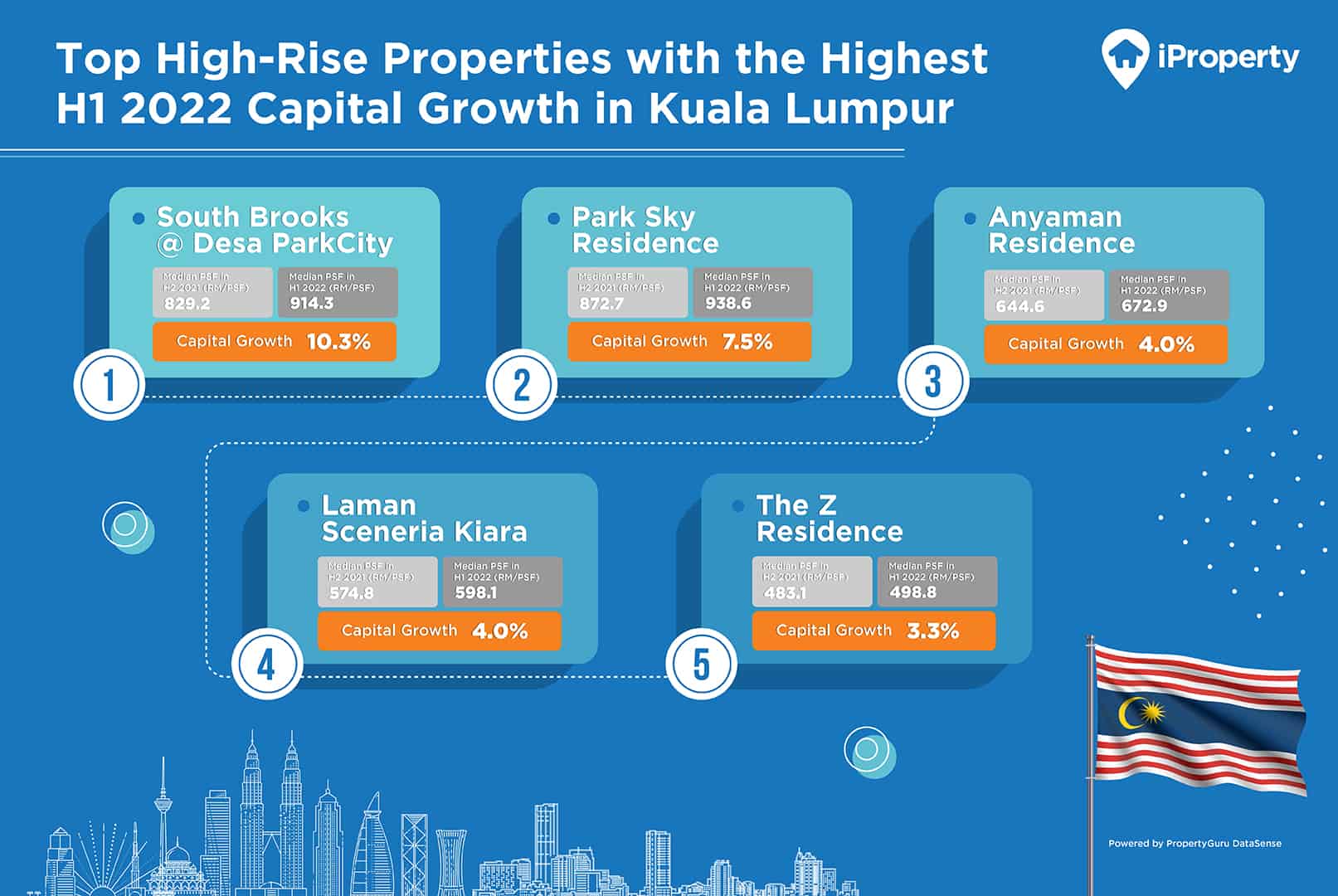
Top High-Rise Properties with the Highest H1 2022 Capital Growth in Kuala Lumpur 

Kuala Lumpur Infographic Iproperty

In Kuala Lumpur, South Brooks in Desa ParkCity tops the list with the highest capital growth at 10.3%. In addition to providing club-level gymnasium facilities, the condominium boasts a landscape with tropical pocket gardens. As South Brooks is within the affluent Desa ParkCity enclave, it has the advantage of being connected by various highways. A renowned international school and private hospital are also a short distance away from South Brooks.

Select high-rise properties in Bukit Jalil also emerged as winners, registering between 3.3% (The Z Residence) and 7.5% (Park Sky Residence) in capital growth. The price growth is spurred by each property’s emphasis on green living and proximity to Bukit Jalil Recreational Park. Meanwhile, Anyaman Residence in Sungai Besi and Laman Sceneria Kiara in Segambut achieved capital growth of 4.0%. Both housing developments provide luxurious living spaces and calm surroundings for residents. 

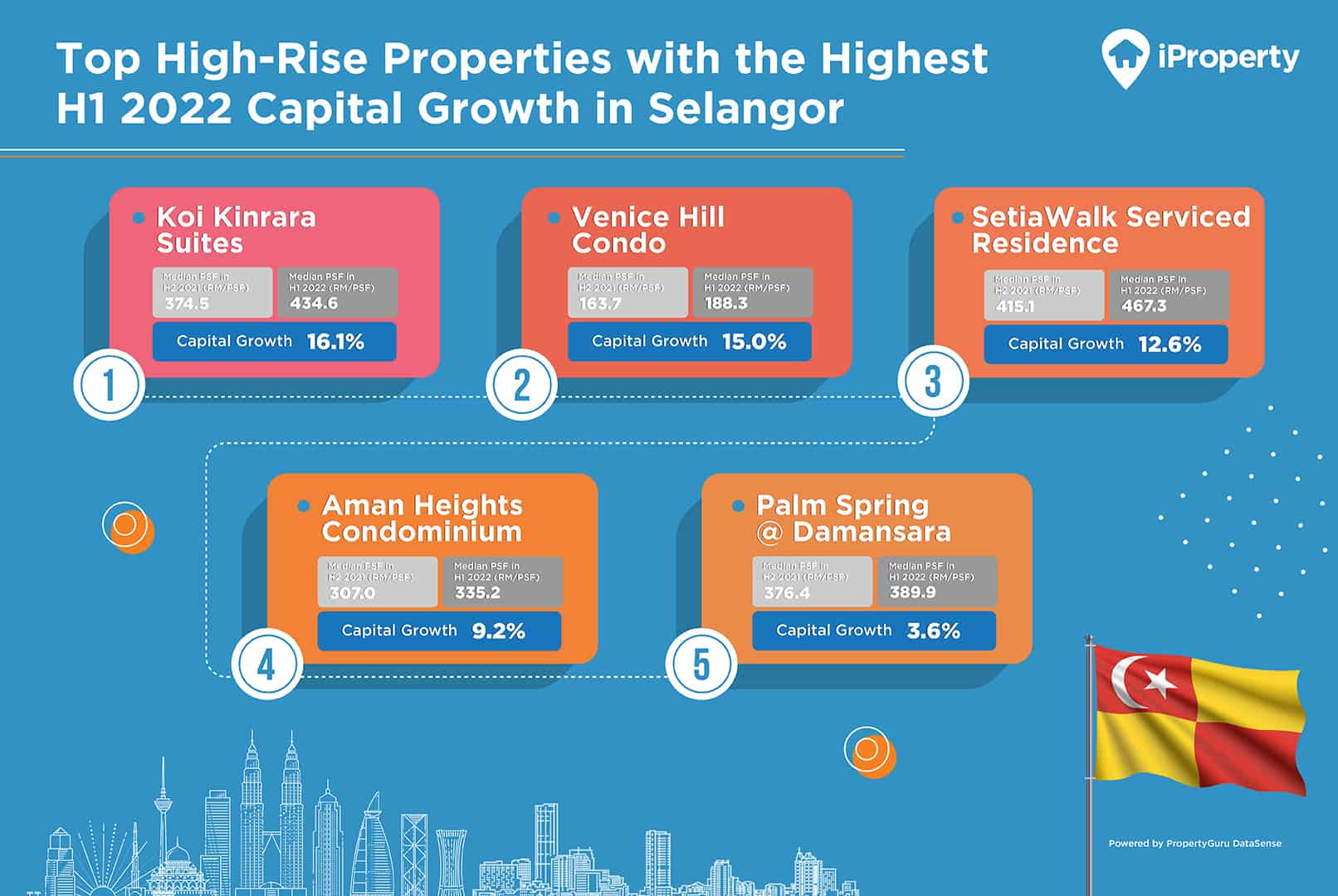
Top High-Rise Properties with the Highest H1 2022 Capital Growth in Selangor 

Selangor Infographic Iproperty

Two hillside properties, Koi Kinrara Suites in Puchong (16.1%) and Venice Hill Condominium in Cheras (15.0%), gained the highest capital growth in Selangor. These high-rise developments appeal to urbanites who prefer green living environments and modern condominium amenities. Regarding accessibility, Koi Kinrara Suites is well connected to major highways and is located nearby reputable tertiary educational institutes. Meanwhile, Venice Hill Condominium which is located on a hill, enjoys huge demand from expatriates for its scenic view of Kuala Lumpur City Center.

Setiawalk Residence is another property in Puchong with a double-digit capital growth figure of 12.6%. The service residence is popular among small families and young professionals as it is in a mixed development consisting of retail lots, offices, restaurants, and entertainment outlets. Apart from offering facilities along green landscapes, the property is strategically situated in the heart of Puchong. In Seri Kembangan, Aman Heights Condominium reaped a capital growth of 9.2% due to its peaceful surroundings, verdancy and tropical resort architecture. The condominium has attracted residents who prefer to live in a less hectic suburban area without sacrificing connectivity and access to commercial sites, educational institutions and medical centres. 

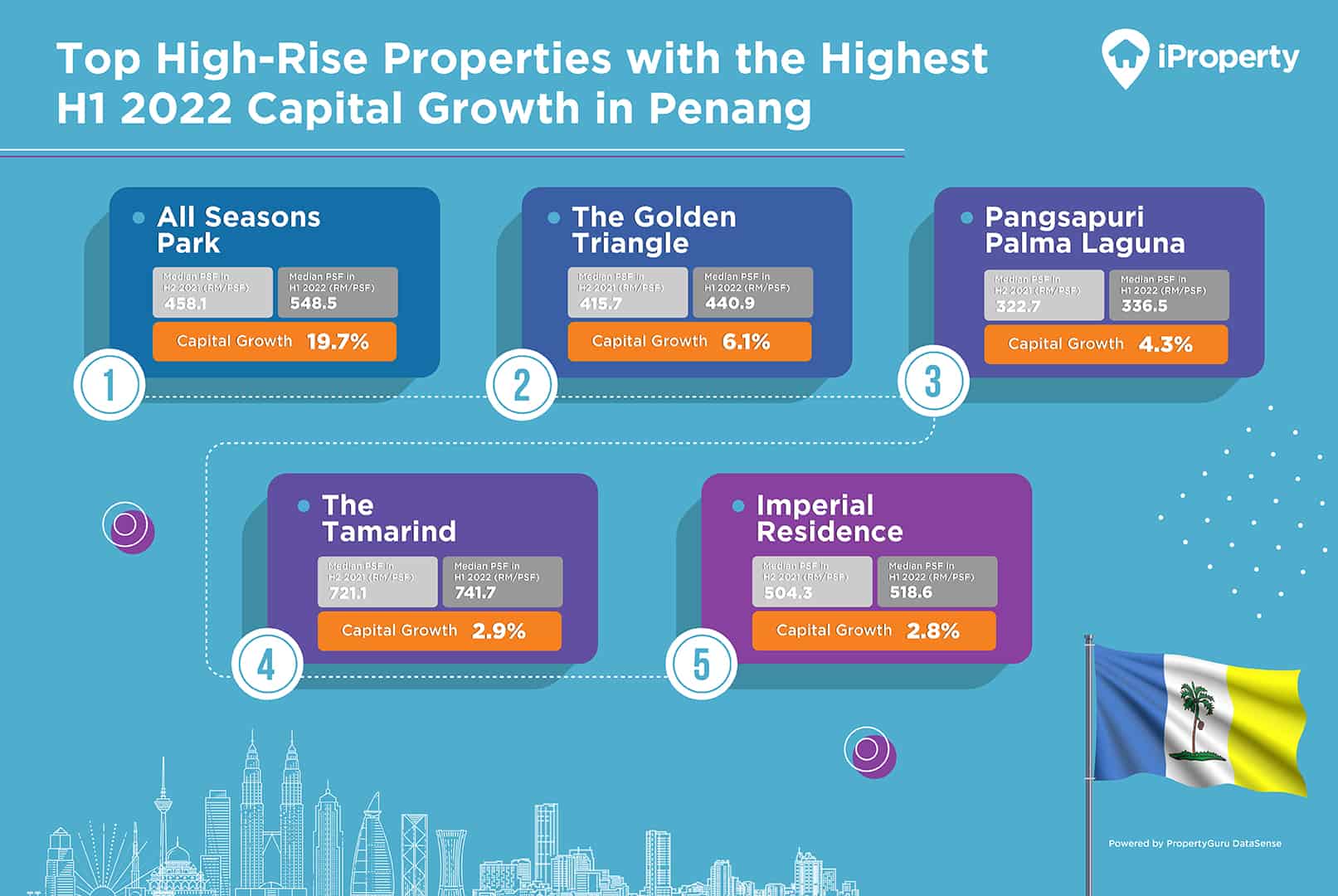
Top High-Rise Properties with the Highest H1 2022 Capital Growth in Penang 

Penang Infographic Iproperty

All Seasons Park in Ayer Itam achieved the highest growth with 19.7% because of its clubhouse facilities and an exclusive park with different landscaping themes, water features and hues of greens in keeping with the four seasons theme. Situated along Lebuhraya Thean Teik, residents can easily travel to other parts of the city. Another development, Golden Triangle, gained 6.1% in capital growth and is located in the middle of three prime locations — Relau, Sungai Ara and Bayan Lepas. A highlight of this condominium is that residents can enjoy the view of 1.9 acres of green open space. The development is also accessible via the Tun Dr Lim Chong Eu Expressway and is close to the Penang Bridge and Penang Bayan Lepas International Airport.   

Other projects on the island round up the list — The Tamarind in Tanjung Tokong (2.9%) and Imperial Residence in Sungai Ara (2.8%). The resort-like design of The Tamarind is ideal for young professionals and families looking to live a seaside lifestyle while being close to The Gurney Drive area. Meanwhile, the main attraction of the Imperial Residence is its spacious layouts, inspired by bungalow and semi-detached homes. Similar to the Golden Triangle, it is near the airport and the Penang Bridge.

* * *

Footnotes

*The Malaysian House Price Index (MHPI) measures the price changes of residential housing in Malaysia as a percentage change from a specific start date

Capital growth is calculated as = Median PSF in H1 2022 – Median PSF in H2 2021 / Median PSF in H2 2021. Median Per Square Foot (PSF) is used to calculate capital growth due to various built-up sizes being transacted.

Only properties that have more than 5 transactions in H2 2021 and H1 2022 were selected to negate the effect of any spikes.

The data system from JPPH officially records a property transaction in Malaysia once the stamp duty for the Sales and Purchase Agreement is paid. Analytics is based on the data available at the date of publication and may be subject to revision as and when more data becomes available.

The opinions stated in the press release are not in any form an endorsement or recommendation by iProperty.com.my. Individuals are encouraged to perform their due diligence and seek independent advice prior to making any investment.

About iProperty.com.my  iProperty.com.my is the market-leading property marketplace in Malaysia and offering a complete property picture for seekers in their property buying, renting, selling or investing journey. The company offers a search experience in both English and Bahasa Malaysia and provides in-depth consumer solutions such as Transaction Section – which offers the latest and most accurate sub-sale transaction data and LoanCare – a home loan eligibility indicator. The company has also been committed to developing innovative Proptech tools and data-driven insights such as iProperty PRO, Customer Hub and Marketing Services to support our partners, property developers and agents, in growing their business.  The company is part of PropertyGuru Group (NYSE: PGRU), Southeast Asia’s leading property technology company. 

A Chief Investment Officer’s View On Where To Invest In 2023

With so many uncertainties coming our way, recession, and general election just to name a few, there’s a lot of jittery investors out there. Throw in volatility, rise of inflation, hike in interest rates, and we have ourselves a storm coming up next year.

Not sure where to invest? Smart Investor recently spoke with Lee Sook Yee, Chief Investment Officer, Kenanga Investors Berhad to find out more about this hot topic.

Lee Sook Yee
Lee Sook Yee, Chief Investment Officer, Kenanga Investors Berhad

Smart Investor: Analysts are saying that recession is coming next year, does Kenanga Investors agree? If yes, what contributed to it and will it be even worse than previous recessions?

Lee Sook Yee: A typical recession is characterized by declining GDP growth together with a rise in the rate of unemployment. In that respect, there is increasing likelihood that the USA and Europe will fall into a recession sometime next year.

Looking at consensus estimates, US GDP growth will slow from 1.7% in 2022 to 0.4% in 2023. Meanwhile, growth in the European Union is forecasted to decline from 3.3% in 2022 to 0.3% in 2023.

With regards to the causes of the recession, a cyclical slowdown in the business cycle is made worse by high inflation, tight monetary policy and geopolitical conflicts. The magnitude of recession is still uncertain, and will depend on many factors.

Recessions in the past such as the 2008 financial crisis were driven by subprime mortgages and a subsequent liquidity crisis when Lehman failed. The issues this time around centers on high inflation and the resulting tight monetary policy by central banks to combat it.

Hence the magnitude of the recession would be the persistence of inflation and the willingness of policy makers to ease policy when inflation starts to cool. For Malaysia, growth will slow in-line with global growth but should still remain relatively resilient supported by domestic consumption despite the drag from exports.

Analyst expect a lower growth rate but still above 4% for 2023 with stable employment.

Pablo Heimplatz EAvS 4KnGrk Unsplash
Photo by Pablo Heimplatz on Unsplash

SI: What is Kenanga Investors’ market outlook for 2023? What are the things to look out for?

LSY: We think 2023 could see a market rebound depending on how long inflation takes to cool and the corresponding policy response from central banks. Global markets should be able to embark on a sustainable rebound once central banks signal a pause or a turn in policy stance.

For now, trends in the datapoints point to lower inflation by end of 2Q’ 2023 due to easing supply side constraints, tighter policy working with a lag and base effects.

Markets have declined significantly in 2022, pricing in higher rates and also a slowdown in growth. Looking a past history, markets tend to bottom about 1-2 quarters before the worst period in growth and earnings and sometimes even ahead of the final rate hike.

Business Finance Employment Female Successful Entrepreneurs 1
Image by benzoix on Freepik

SI: As a retail investor, where should we invest our hard-earned money in 2023?  

LSY: Overall, we expect a recovery in global markets for 2023 after the sell-down in 2022. Valuations have become cheaper across the board and investors are highly cashed-up.

Earlier in the year, we think bonds could perform better as inflation peaks. Meanwhile equities should recover thereafter, once the growth concerns get priced in and the central banks move to a more supportive stance.

When equities rebound, we should see strong performances across the board regardless of geography. Malaysia also stands to see better days, as uncertainties abate post-election and global macro concerns cools. 

The Answer To Where To Invest In 2023

Hope you now have the answer on where to invest for next year. As we approach the end of the year, take the time to unwind and spend quality time with your loved ones.

Read: Where To Invest In 2023: Amidst The Recession And General Election

Takaful: More Than Just Islamic Insurance

Malaysians are generally at a loss when it comes to being able to tell the difference between takaful and insurance. Some come to the conclusion that takaful is the Islamic version of insurance, while some perceive that takaful and insurance are just the same, hence the term Islamic insurance.

What Is Insurance?

Blur Hospital

Insurance is where a company undertakes the risk to provide a guarantee of compensation for specified loss, damage, illness, or death, in return for payment of a specified premium. There are two types of insurance namely, life insurance and general insurance. The coverage includes the insurance of life, personal, property, marine, fire, professional liability and guarantee.

The purpose of insurance is to manage one’s risk. When the insurance is purchased, the participant buys protection against unexpected financial losses. In case an unexpected loss occurs, the insurance company will compensate the loss to the participant.

Should the participant have no insurance coverage and an accident happens, they themselves shall be responsible for all related costs. In other words, the risk in insurance terms means the probability of something harmful or unexpected happening. This might involve the loss, theft, or damage of valuable property and belongings, or it may involve injury or harm.

Read: Should I Give Up Paying Insurance Premiums In Difficult Times?

What Is Takaful / Islamic Insurance?

Young Muslim Businesswoman Check Product Purchase Order Stock Save Tablet Computer Work Home Office
Image by tirachardz on Freepik

Takaful is often referred to as ‘Islamic insurance’. It is strictly a business transaction to mitigate the financial risk of unforeseen events to the participants. Takaful is formed on the social solidarity and cooperation amongst a group of participants who mutually agree to jointly indemnify
loss or damage from a fund they donate to collectively.

In other words, takaful is a type of Islamic insurance where member participants contribute money into a pool system (tabarru’) to guarantee each other against loss or damage.

There are two types of takaful, namely family takaful (mirror of life insurance) and general takaful (mirror of general insurance). A takaful contract which is called ta’awun must be based on principles of cooperation, protection and mutual responsibility. It must avoid acts of interest, gambling and uncertainty.

The term Islamic insurance is popular, because it takes the insurance concept and turn it into shariah-compliant.

Read: Takaful vs Conventional Insurance: What’s the Difference?

The Shariah Aspect Of Islamic Insurance

Beautiful Young Smiling Asian Muslim Woman Working Phone Sitting Living Room Home

Islamic scholars differ in their opinion about conventional insurance. Some say insurance is permissible, some say only several types of insurance are prohibited but most of the Islamic scholars conclude that conventional insurance is unacceptable in Islam.

The Shariah Advisory Council of Bank Negara Malaysia in its resolution states that the prohibition of conventional insurance is because it does not conform with Shariah law, particularly on the contractual agreement between the policyholder and insurance company.

Conventional insurance uses a sale contract in their agreement but there is an element of gharar fahish (major uncertainty) in the contract since the essential element of the sale contract is not fulfilled. Furthermore, conventional insurance is also based on the concept and practice of charging interest.

Islamic Fiqh Academy gave several reasons for the prohibition of conventional insurance:

  • The policyholder does not know about the time of the contract and the amount of what the policyholder gives or gets.
  • It is a contract based on probability.
  • It includes excess and delayed riba.
  • It can be considered a form of betting because of the existence of ignorance, uncertainty and probability.
  • The premium is taken for no consideration in exchange.
  • There is a compulsion that is not compelled by Shariah law such as the insurer does no specific work for the insured.

Read: How to Protect Yourself at Different Stages in Life With Insurance

The Importance Of Insurance And Takaful

Both insurance and takaful are financial safety nets set to helping participants and their loved ones recover after something bad happens to them. Bad things may strike a participant at any time such as a fire, theft, lawsuit or car accident.

When the participant joins in takaful or purchases insurance, they will receive a certificate or an insurance policy, which is a legal contract between them and the takaful operator or insurance company.

Read: Insurance Affordability vs Need, 6 Factors You Should Consider

The Differences Between Insurance And Takaful

Muslim Small Business Entrepreneur With Their Food Cart

‘Insurance’ and ‘takaful’ by name, are known as products. One is offered in the conventional financial system while the other is offered in the Islamic financial system. In Malaysia, insurance companies are under the jurisdiction of the Financial Services Act 2013 and takaful operators are
under the jurisdiction of the Islamic Financial Services Act 2013.

Payment to the insurance company are called ‘premiums’ and it is owned by the company. The payment to takaful is known as a ‘contribution’ and it is owned by the fund. The takaful operator just ‘manages’ the fund. The policyholder ‘buys’ insurance, and the participant ‘joins’ takaful.

Takaful and conventional insurance companies share a common objective in providing protection to the participant, their loved ones and their valuable belongings. For Muslims, takaful is not the alternative to insurance.

It is because takaful is based on the concept of social solidarity, cooperation and mutual indemnification of losses of members among the participants. It is a pact among a group of persons who agree to jointly indemnify the loss or damage that may be inflicted upon any of them, out of the fund they donate collectively.

Business-wise, the main difference between conventional insurance and takaful is that the former is a risk-transfer model whereas the latter is a risk-sharing model. Mutual risk sharing is a transaction where instead of passing the risk on to an operator like conventional insurance, the risk in
takaful is shared by every participant.

The main concept of insurance is compensation of loss. Any insurance policyholder will be compensated once they lose something.

In takaful, the concept is mutually helping each other (ta’awun). Members will get together to help other members should they incur any losses.

Hope you now have a better understanding of takaful and insurance, and why the term Islamic insurance is often used.

Read: Should I Nominate My Wife As Sole Beneficiary Of My Life Insurance Policy?

About the Author

Doc Haji Razli1

Dr Haji Razli is a Senior Lecturer with Azman Hashim International Business School (AHIBS) at University of Technology Malaysia (UTM) and an Adjunct Fellow with IIUM Institute of Islamic Banking & Finance (IIiBF) at International Islamic University Malaysia. He is also the Honorary Secretary of the Association of Senior in Islamic Finance (ARIF).

Affin Hwang AM Rebrands as AHAM Capital Eyes Regional Expansion & AUA Growth of RM100 Billion

Affin Hwang Asset Management Berhad (“Affin Hwang AM” or “the company”) announced today the successful completion of its rebranding which would strategically position the company for its next growth phase after over 20 years in operations. The rebranding exercise would engender a new corporate name and logo that is reflective of the company’s new growth ambitions, while also affirming its commitment to clients in building trust.

Starting today, the company will now operate as AHAM Asset Management Berhad (“AHAM Capital”). As a name that is already widely used and familiar amongst clients and business partners, the simplified brand name builds upon the positive brand equity of the company’s asset management capabilities as well as its people that has distinguished it over the years.

The rebranding is also infused with bold visual elements and a newly-designed logo that pays homage to the company’s brand heritage, while signifying its evolution into a modern and future-focused asset manager.

AHAM Capital Dato Teng 1
Dato’ Teng Chee Wai, Managing Director, AHAM Capital

Dato’ Teng Chee Wai, Managing Director of AHAM Capital said, “Our new brand identity AHAM Capital marks the start of a new and exciting journey for us and our clients. Anchored by the same core values and entrepreneurial spirit since our founding in 2001, we have continuously grown from strength to strength over the years alongside our clients who have placed their hard-earned trust with us. Today, we are taking our business to greater heights by embarking on three strategic growth pillars – i.e. wealth management, innovation and regionalisation that will transform AHAM Capital into a leading independent wealth and asset management company in Southeast Asia.”

“Looking ahead, we are confident of achieving our assets under administration (AUA) target of RM100 billion in the next 3 years as we strengthen our wealth management capabilities including alternatives and private market offerings. We will also harness innovation to support the development of digital-focused solutions that will democratise access to investment products for all client segments.

“Led by the same team, we remain committed to helping our clients achieve their financial goals and forging a stronger, more resilient financial future. Alongside our new shareholder CVC Capital Partners who came on board in July 2022 as well as Nikko Asset Management who have stood by us, we will continue to chart new frontiers in wealth to empower investors in a changing financial landscape,” Dato’ Teng said.

AHAM Capital’s Journey So Far…

Since the company began operations in 2001, AHAM Capital has delivered exponential growth by growing its total assets under administration (“AUA”) from just RM20 million to over RM75 billion (as at 31 July 2022).

At the same time, the company has also grown from a small investment firm into an established asset management house generating RM105 million in Profit After Tax (“PAT”) for the financial year ended 31 December 2021. Last year, the company also declared a total income distribution of RM1.13 billion across its retail and wholesale funds.

On 28 January 2022, Affin Bank announced that funds advised by CVC Capital Partners (CVC), a leading global private equity and investment advisory firm with approximately US$125 billion of assets under management, has agreed to acquire approximately 68% of the equity interest in AHAM Capital.

The acquisition was approved by the Securities Commissions Malaysia (“SC) on 1 July 2022, and upon successful completion of the acquisition on the 29 July 2022, AHAM Capital has ceased to be a subsidiary of Affin Hwang Investment Bank.

The acquisition by CVC which is a leading global private equity and investment advisory firm will provide AHAM Capital a strong platform to grow and scale its business to the next level. AHAM Capital will work closely with CVC to continue driving the growth of its wealth management business and spearhead digitalisation, as well as to devise a plan for expansion into key markets across Southeast Asia.

The company’s Shariah investment solutions will continue to be managed and made available through its wholly owned subsidiary and Islamic investment arm, AIIMAN Asset Management Sdn. Bhd. (“AIIMAN”).

About AHAM Asset Management Berhad

AHAM CAPITAL HIRES 1

AHAM Asset Management Berhad (“AHAM Capital”) (formerly known as Affin Hwang Asset Management Berhad) is an institutionally-owned, independently managed asset and wealth management firm. Our purpose is clear. We are here to help our clients build wealth and achieve their financial goals through their trust.

Over the years, we have served the needs of corporates, institutions, pension funds, high net worth individuals and the mass affluent in building a stronger, more resilient financial future by delivering better investment outcomes and creating a positive impact.

Drawing upon years of expertise and experience, we invest into an array of asset classes including equities, fixed income, money market instruments, structured products, and other alternative assets to generate long-term sustainable returns. By adopting a holistic and client-centric approach, our wealth platform allows investors to gain access to regional and global solutions across multiple strategies in various asset classes.

Through a stable of unit trust funds, exchange-traded funds, Shariah-compliant and cash management solutions, we provide comprehensive solutions that help investors realise their financial goals. For private wealth & family offices, we also offer bespoke wealth management solutions including portfolio management and advisory which are tailored to achieve specific outcomes.

Embracing the same entrepreneurial ethos of the company since its founding, we are charting new frontiers in wealth through innovative and progressive solutions that empower investors in a changing world. These include spearheading digitalisation initiatives that would enhance client experience as well as make investing simpler and more accessible to everyone.

As a corporate citizen, we are committed to growing together sustainably with the communities we operate in by fostering greater financial inclusion as well as championing financial literacy.

Incorporated in Malaysia on 2 May 1997, AHAM Capital first began operations under the name Hwang–DBS Capital Berhad in 2001. On 29 July 2022, CVC Capital Partners (“CVC”) a global private equity and investment advisory firm acquired an approximate 68.35% controlling interest in AHAM Capital via a private equity fund, i.e. CVC Capital Partners Asia V managed by CVC. AHAM Capital is also 27.0% owned by Nikko Asset Management International Limited, a wholly-owned subsidiary of Tokyo-based Nikko Asset Management Co. Ltd., an Asian investment management franchise. The remaining 4.65% are held by the key management personnel of AHAM Capital.

AHAM Capital’s Shariah investment solutions are made available through its wholly owned subsidiary and Islamic investment arm, AIIMAN Asset Management Sdn. Bhd. (“AIIMAN”).

Since its inception in 2001, AHAM Capital has achieved an exponential growth in its total assets under administration (“AUA”). As at dd/mm/yyyy, the total AUA, comprising in-house unit trust funds as well as corporate and discretionary portfolios stood at approximately RMxx billion (combined AUA of AHAM Capital and AIIMAN).

Investing And ESG

Environmental, Social, and Governance (ESG) is becoming a very hot topic recently, and today we will be taking a look at how ESG and investing go hand-in-hand. Smart Investor spoke with Datuk Wira Ismitz Matthew De Alwis, Executive Director & Chief Executive Officer, Kenanga Investors Berhad to find out more about investing and ESG.

He is also one of the speakers at the prestigious ESG Evolve 2022 conference that Kexxel Group is organizing in KL on 6-8 December. We will talk more about the conference at the end. For now, let’s find out more about how Kenanga Investors is pioneering ESG in Malaysia.

Ismitz Matthew 0011 Final
Datuk Wira Ismitz Matthew De Alwis, Executive Director & Chief Executive Officer, Kenanga Investors Berhad

Smart Investor: What does ESG mean to Kenanga Investors? Why is it important to your business and how does it impact your industry?

Datuk Wira Ismitz Matthew De Alwis: The impact of ESG on the financial markets has been significant. Investors and businesses alike are beginning to acknowledge that an ESG-driven perspective promises stronger and more resilient economies and businesses. As a result, this awareness has changed the way individuals and institutions invest. Many are now are focusing on mitigating their portfolio exposures to carbon risk for example.

As a partner to the sustainability agenda, we are dedicated to the goal of developing Malaysia’s impact investing landscape. Currently, we believe that the local environment faces issues in capacity building to address sustainability issues such as lack of competencies, skills and technical awareness on ways to adopt a sustainability-driven top-down model at each level of the organisation. Recognising this, Kenanga Investors, as an established financial institution, must actively seek out and collaborate with regulators and corporates finding its footing within the local green economy.

To ensure sustainable performance for our stakeholders, we are confident that the integration of carbon exposures, ESG ratings, financial quality metrics and active engagements, amongst other factors, in a diversified and risk-controlled portfolio has historically resulted in better risk adjusted returns for investors than just plainly investing in a broad market index.

esg environmental social and governance
Image from internationalinvestment.net

SI: What are the key factors for successful ESG deployment?

DWIMDA: We believe that there a few critical factors required for a successful ESG implementation. To begin, a supportive and knowledgeable board is critical in steering the company’s ESG agenda as well as building the appropriate corporate culture, which leads to effective ESG implementation. Furthermore, the ESG goals must not only be specified, but also time-bound and practical during the implementation process. Policies, plans, and oversight mechanisms must address these issues both qualitatively and quantitatively.

At Kenanga Investors, we believe that the continuous delivery of consistent top performance stems from the premise of an effective stewardship and active ownership approach throughout the investment value chain. In search of long-term value accretive investments, we aim to influence investee companies as shareholders through the promotion of responsible and sustainable practices.

SI: What are the challenges that you faced in deployment?

DWIMDA: The lack of knowledge and comprehension of ESG among our retail investors in Malaysia was one of the hurdles we faced in implementing our ESG objectives. Businesses also lacked transparency and reliability when it came to ESG data and disclosure. Furthermore, when it comes to ESG practises, there is a lack of consistent standards, measurements, and focus as some may focus on climate change, whilst others may focus and emphasise human rights issues.

Environmental Social Governance Esg Investment Organizational Growth Wooden Cube With Symbol Esg Concept
Environmental, social, and governance (ESG) investment Organizational growth. Wooden cube with symbol of esg concept

SI: What are the key trends you see gaining traction for ESG?  What are the areas of growth amongst the pillars to look at in 2023?

DWIMDA: During the Covid-19 pandemic, there was a significant increase in ESG awareness. During this period, many firms suffered financially, whilst others with ESG policies were more protected from the pandemic’s consequences and were able to outperform their peers and competitors.

As ESG awareness continue to grow, trends within the ESG economy increase in tandem as well, most notably is impact investing. This was apparent in the deployment of financial firepower to investments and causes that could provide quantifiable benefits and allowed investors to see and measure the beneficial effects of their investment.

There is currently a significant trend in assuring the interconnectedness of human and developmental needs. Assuring that these needs are fulfilled in a way that benefits society while being environmentally and ecologically sustainable is a delicate balance. The blue economy and nature-based infrastructure are two examples of this.

“It is becoming increasingly critical that sustainable development continues strengthening its foothold in a way that is consistent with future focused values. Regulators and key players must work towards actionable policies that will produce value for stakeholders, investors and our communities. Let us invest in a tomorrow that is prosperous and principled.”

Datuk Wira Ismitz Matthew De Alwis, Executive Director & Chief Executive Officer, Kenanga Investors Berhad

ESG EVOLVE 2022: Driving Catalytic Change For Business Sustainability

ESG Evolve 2022 Poster

Kenanga Investors will share more insights at the ESG Evolve 2022 Driving Catalytic Change for Business Sustainability organized by Kexxel Group  which will be held on 6-8 December in EQ Kuala Lumpur. Come and join us, see you there!

Be Wary Of Crypto Scams In Malaysia

The COVID-19 pandemic outbreak shows an increasing trend of hackers and scammers stealing information and financial data since many business operations have shifted to global scale, and consumers have an increased dependence on online payment systems.

This is true for cryptocurrency or crypto investments. But why is crypto scams in Malaysia still on the rise despite countless news regarding it that have made headlines both worldwide and nationwide?

The possible reason behind this is the attractive and fast return of investment. Success stories of those who are lucky enough to succeed in this investment became the fascination for others to do the same.

After all, crypto investments do exist and are real. In Malaysia, the potential is massive as our financial industry is accelerating into Fintech and digitalisation as portrayed in the Bank Negara Malaysia (BNM) Financial Sector Blueprint 2022-2026 and Malaysia Fintech Report 2022.

Shariah wise, the legitimacy and the nature of trade plays a big role in determining whether an investment is permissible or otherwise. It is reminded that Muslims are prohibited to invest in something which contains element of gambling or an investment which involved speculation in its nature of trading.

The importance of the legitimacy and nature of investment, in relation to the works of Imam Al-Ghazali, was described in his Magnum Opus, Kitab Ihya Ulumuddin. Al-Ghazali mentioned that the understanding of Fiqh is crucial as the action taken in making investments are properly managed and done according to the Shariah.

Checklist On Crypto Scams In Malaysia

investment scams

It is best to refer to the two checklists below before getting involved in any crypto investments, or you may expose yourself to crypto scams in Malaysia.

1. Checklists regarding investment and investing in crypto:

  • Study the investment model, risk, and return to see whether it is reasonable.
  • Muslims can check regarding the Fatwa given on cryptocurrency investments and if it is permissible, check further if there are any circumstances where a crypto investment is considered impermissible? There are many other pointers given by the Shariah Advisory Council (SAC) regarding Islamic investments.
  • When in doubt, you can check with the Compliance Officer from Bank Negara Malaysia, Securities Commission Malaysia (SC), Ministry of Domestic Trade and Consumer Affairs, Cybersecurity Malaysia or other relevant authorities regarding the licensing status of the local or foreign investment company or find out if there are any latest warning issued regarding cryptocurrency investments.

2. Checklists in identifying and avoiding crypto scams in Malaysia:

  • You could contact the National Scam Response Centre (NSRC) if you realised you had been scammed and provide the authorities with the relevant details.
  • To check whether the investment account has any police report record linked to its bank account number. This can be done through the website of the Royal Malaysia Police Commercial Crime Investigation Department, which is supported by Bank Negara Malaysia (BNM), Ministry of Domestic Trade and Consumer Affairs (MDTCA) alongside with the Ministry of Communication and Multimedia Commission (MCMC).
  • When the transaction amount is suspicious, the Bank officers might stop it for the purpose of due diligence. Be cautious if the Bank officer advice you not to proceed with the transaction without providing any specific reason. They usually have the basic background detail regarding the account you were transferring money to. If you had transferred the money and regretted it, you may call the Bank immediately to cancel it.

Although praise should be given to ‘financial advocates’ who hunt after scammers personally in real life, prevention is better than cure. In this case, it is better to be an informed investor. Hopefully the checklists above can prevent you from becoming a victim of crypto scams in Malaysia.

About the Author

Azah Atikah

Azah Atikah Anwar Batcha has an Accounting, Finance, Auditing, and Islamic Finance background. She has worked with two of the Big four firms prior to pursuing her postgraduate studies at University of Technology Malaysia (UTM), Kuala Lumpur. She can be contacted at aaabwrite@gmail.com

Getting To Know Private Retirement Schemes (PRS)

For most people, the goal is to be able to retire comfortably. However, the effects of the Covid-19 pandemic have made achieving this goal a lot more challenging. But have you heard about Private Retirement Schemes?

Various economists have warned that a retirement crisis is on the horizon. To insulate ourselves from this retirement crisis, the best time to act is now. The earlier you start saving for your retirement, or even growing your wealth again after it has taken a hit, the better.

This time, we would like to explore a wealth-building option known as a “Private Retirement Scheme”, or more commonly known as “PRS”. This investment solution is offered and managed by PRS Providers and is governed by the Securities Commission Malaysia.

As the name indicates, a PRS is a voluntary long-term investment scheme that is designed to help you save more for your retirement. First introduced in 2012, it is meant to help encourage people to contribute to their retirement savings.

Investments in PRS are structured in the following manner: contributions are divided into two sub-accounts, and you can only make withdrawals once you reach retirement age. You are permitted to make partial withdrawals before then, but you will incur a penalty fee (there are exceptions, such as emigration).

Contributions to PRS are entirely voluntary. It seeks to enhance choices available for all Malaysians, whether employed or self-employed, to supplement their retirement savings under a well-structured and regulated environment. Each PRS offers a wide range of retirement funds from which you may choose to invest in based on your retirement needs, goals and risk appetite.

Why Invest In Private Retirement Schemes?

Investing in PRS may be one of the best things you can do for your retirement. Here’s why:

Getting To Know Private Retirement Schemes1

Designed for retirement

As a scheme originally established to help investors accumulate more savings for their retirement, you can be assured that there is a selection of investment options to suit your specific goals and needs.

Easy investments

Anyone can invest in a PRS. There is a wide choice of PRS Providers and self-selected funds, as well as default option funds that have been pre-selected based on investors’ age.

Affordable savings

The minimum contribution varies depending on your chosen PRS Provider. While the flexible nature of the investment scheme means that there is less pressure on you to commit to a certain amount, just remember that the more you ‘save’, the better your potential returns can be.

Tax incentive

At the moment, the benefits of investing in PRS are not only for the future. In the short term, you can also enjoy a yearly personal tax relief of up to RM3,000 from your taxable income, for as long as you contribute to a PRS (the tax relief is available up to 2025). The earnings generated from a PRS will also be tax exempted, so that is even more reason to contribute!

Factors To Consider Before Investing In Private Retirement Schemes

When making your PRS contribution, you need to consider various factors such as your age, personal and household income, risk tolerance, retirement objectives as well as the suitability of the different funds offered under the various schemes to meet your retirement needs.

The following chart offers suggestions on what you should take into consideration prior to investing in PRS. While the rule of thumb is that your investment strategy should be based upon the time you have until retirement (i.e. long-term investment strategies should focus more on capital growth, while short-term investment strategies should focus on income generation), remember that everyone’s situation is different, and that you should always consult an expert should you have any questions.

Read: Who Are Unit Trust Consultants?

Getting To Know Private Retirement Schemes2

Among the key items to note:

Objectives: Based on your intended goals, you can choose to invest with the intention of growing your capital, generating income, or a combination of both. The goals of each person are different. As such, it is important to decide which option you wish to take.

Your life stage: Those who are nearing retirement age should focus on investments that can provide them with a sustainable income, while younger people should be looking towards investments that have a higher potential for growth.

Your risk appetite: Investors who can handle greater risks tend to be those with a long-term view as they are more able to weather any market volatility. Those who value stability tend to be those already nearing retirement age and therefore, would benefit more from investments that would allow them to preserve their initial capital.

Additionally, it is important to review your PRS portfolio regularly. As your life progresses, your circumstances change and so do your needs and objectives. Hence, do ensure that your PRS portfolio continues to match your risk appetite and investment objectives.

Investment Risks Associated With Private Retirement Schemes

Businessman Hand Stop Dominoes

Investing in PRS is not risk-free. You will be exposed to some general investment risks as well as specific risks when investing in PRS. Therefore, you must consider the different type of risks that may affect you and the fund.

These risks are disclosed in the PRS’ Disclosure Document and Product Highlights Sheet (PHS).

How Do I Invest In Private Retirement Schemes?

Your journey to save more for your retirement with PRS begins with these four simple steps:

1. Select your PRS Provider.

2. Choose a suitable fund.

3. Open your PRS account.

4. Top up your funds regularly.

The Final Word About Private Retirement Schemes

Remember that with careful planning, a PRS can be a useful tool to help you in your wealth-building journey. By staying focused, disciplined and investing wisely, you can be assured of a comfortable nest egg once you reach your golden years.

Read: Getting To Know Unit Trust Schemes

FIMM Logo 01 Blue Transparent BG

This article is in collaboration with The Federation of Investment Managers Malaysia (FIMM), a self-regulatory organization (SRO) that regulates the marketing and distribution of Unit Trust Schemes (UTS) and Private Retirement Schemes (PRS).

Visit www.fimm.com.my for more information on PRS, Unit Trusts, and UTS & PRS Consultants.