Wednesday, 5 August 2026 Stay informed. No noise.

Takaful Malaysia Launches Nation’s First Flexi Motor Takaful Plan with Pay As You Drive Daily Cover

Syarikat Takaful Malaysia Am Berhad (“STMAB” or “Takaful Malaysia”), the general takaful arm of Syarikat Takaful Malaysia Keluarga Berhad virtually launched Takaful myClick Motor FlexiSaver, the nation’s first flexi motor takaful plan with Pay As You Drive daily cover. Jointly organized by Takaful Malaysia and technology partner, Fusionex, the virtual launch was officiated by Dato’ Mohammed Hussein, Chairman of Syarikat Takaful Malaysia Keluarga Berhad.

“Virtual launch of Takaful myClick Motor FlexiSaver signifies Takaful Malaysia’s unwavering commitment to driving product innovation and delivering superior customer value. Flexible protection plans are the future of the insurance and takaful sector. Offering insurance and takaful products in the new mobility space that are simple, flexible, and usage-based is revolutionising the industry. This means, consumers have the option to decide and pay for just the coverage they need, as and when they need it. With more people driving less these days, while some may face financial challenges due to the impact of the COVID-19 pandemic, Takaful myClick Motor FlexiSaver is the best option that suits the financial and protection needs of those who drive infrequently or own several cars and want to save more on motor takaful or insurance plan. The Pay As You Drive daily cover available under this plan is ideal and rewarding, as we give customers the flexibility to activate it the day before they want to drive and will only be charged for the days they drive. Suffice to say, Takaful myClick Motor FlexiSaver is a quick win for customers to enjoy great savings and peace of mind when they drive,” stated Dato’ Mohammed Hussein, Chairman of Syarikat Takaful Malaysia Keluarga Berhad.

Takaful myClick Motor FlexiSaver is an online motor takaful plan that provides one-year coverage for loss or damage to your vehicle due to fire or theft, as well as third party bodily injury, death, or property damage. Offered through Takaful Malaysia’s online sales portal and Click for Cover mobile application, this plan provides a 24-hour roadside assistance program for unlimited breakdown towing service and minor roadside repairs, including tyre change, fuel delivery, battery change, and jump start. Featuring Pay As You Drive daily cover for accidental damage to your own vehicle and complimentary personal accident coverage of RM15,000 for the driver and all passengers as well as accident towing, Takaful myClick Motor FlexiSaver also offers add-on protection options for windscreen, personal accident, and key replacement. Customers can also enjoy an instant 10% discount when applying the base plan of Takaful myClick Motor FlexiSaver, and when activating Pay As You Drive daily cover.

Chief Executive Officer of Syarikat Takaful Malaysia Am Berhad, Mohamed Sabri Ramli said, “In our continued efforts to meet ever-changing consumer expectations, and in line with the rapid pace of digital expansion in consumer purchases, it is timely that we introduce Takaful myClick Motor FlexiSaver with Pay As You Drive (“PAYD”) daily cover to better serve our customers with innovative takaful solutions while preserving consumer choice. The PAYD is the key differentiator, a unique feature that sets us apart from other motor insurance and takaful plans available in the market. Customers only need to sign up for the base plan of Takaful myClick Motor FlexiSaver via our online sales portal or Click for Cover mobile app, before activating PAYD through the mobile app. Eventually, we want to make it easy and hassle-free for customers to enrol in this motor takaful plan online, corresponding to our digital strategy to enhance product and service accessibility.”

“Takaful myClick Motor FlexiSaver with PAYD not only provides a simple online application process along with an array of benefits and services offered to customers but also diversifies Takaful Malaysia’s product offerings and creates a value proposition for consumers at large. Takaful Malaysia’s strategic move to introduce this motor takaful plan will provide new revenue and value-producing opportunities for the company to stay ahead of the curve and remain competitive in the motor insurance and takaful market,” added Mohamed Sabri Ramli.

Dato’ Seri Ivan Teh, Group Chief Executive Officer of Fusionex said, “Insurance, at its core, is a business that underwrites risks and helps people in times of need. As such, I applaud Takaful Malaysia for revolutionizing their offerings and empowering their customers to take more control over how they purchase insurance. As a long-term and fully-supportive technology partner, Fusionex pledges to lend our experience, expertise and cutting-edge technology to drive excellent user experience for Takaful Malaysia’s customers, and this partnership continues to innovate with the launch of Malaysia’s first pay-as-you-drive motor insurance.”

“Together with Fusionex, which specializes in analytics, big data, and artificial intelligence, we leverage digital and social media platforms to actively promote this product. Ultimately, we want to ensure that our business is competitive and relevant to the growing consumer demands, particularly the tech-savvy generation. By embracing technology and digital tools to offer differentiated product offerings and services, we will be able to reach new customer segments through superior protection products and customer experience,” said Mohamed Sabri Ramli in conclusion.

Takaful Malaysia was recently voted once again by Malaysians as the Best Motor Takaful Company in Malaysia for 2021/2022. The annual award clinched by Takaful Malaysia is based on the results of the online survey conducted by iBanding, an independent, knowledge-based company that provides transparent insights about the local insurance and takaful industry that ranks insurance and takaful companies in Malaysia according to the actual feedback from survey responses among motor vehicle drivers.


Learning More about Kidney Cancer

Dr J.R Sathiyananthan, a Consultant Urologist at ParkCity Medical Centre, explains about kidney cancer and the measures that can be taken to minimise the risks of getting it.

Kidney cancer is a disease in which malignant tumour is found in one  or both kidneys.

Kidney cancers account for a small proportion of all cancers, and the insidious nature of it makes early detection difficult.

In 2010, kidney cancer was reported to affect 1.9 in every 100,000 Malaysians, while 2020 data from World Health Organisation showing 2.1 per cent of all cancers in Malaysia to be kidney cancer.

Types of kidney cancer

“Kidney cancer is generally divided into two—primary and secondary kidney cancer.

“Primary kidney cancer comprises renal cell carcinoma, which accounts for 90 per cent of all kidney cancers, and other rare cancers such as lymphoma or medullary and collecting duct cancers.

Dr J.R. Sathiyananthan ParkCity Medical Centre kidney cancer
Dr J.R. Sathiyananthan

“Secondary kidney cancer originates from cancers in other organs such as breast and colon. This in turn spreads to distant organs such as liver, lungs, and the kidney. This is not considered kidney cancer per se.,” says Dr Sathiya.

Although there are instances when kidney cancers are caught early, most are diagnosed at a more advanced stage. This is due to a variety of reasons, including the cancer being localised and growing without causing any pain or symptoms. Besides that, the nature of the kidneys lying deep within the body, small kidney tumours cannot be felt during a physical exam.

“At times when we examine patients for kidney cancer, it may have progressed to be locally advanced. Patients may have come in with flank pain, blood in urine, and sometimes the cancer is large enough to be palpable. The definite test which can confirm this is a contrasted multiphase CT scan, an imaging tool that provides accurate diagnosis. Besides that, percutaneous biopsies are also used in some circumstances to confirm the diagnosis and exclude metastasis from other cancers, bilateral cancers affecting both kidneys, or possibly benign tumours,” explains Dr Sathiya.

How the disease progresses

Currently there are no recommended screening protocols for kidney cancer in people who are not at increased risk. As of now, no screening test has shown to lower the overall risk of dying from kidney cancer.

Kidney cancer is known in some instances to grow aggressively and invade the surrounding bowel and solid organs, which is called local extension.

Other methods of progression could be blood borne, and spread to the lungs, liver, pancreas, lymph nodes, and bone. This is referred to as metastasis. When metastasis occurs, the outcome is expected to be poor as patient may not benefit from surgery.

The spread could occur anywhere between six months to years depending on the type of kidney cancer. Clinical data suggests that cancers larger than 3cm have higher tendency to spread compared to smaller ones. Nonetheless, the more common renal cell carcinoma has a slow progression rate compared to the rarer varieties, leading to the possibility of better outcome.

Treatment options

“Localised kidney cancer can be treated by surgery. This can be done by removing the entire kidney, also known as radical nephrectomy, or removing only the tumour, with multiple factors taken into consideration prior to this decision. For metastatic kidney cancer, there is evidence that removing the kidney may benefit the long-term systemic treatment, and it is still an evolving area. For those with advanced cancer where surgical options are not available, arterial embolisation to block blood supply to the tumour can treat some symptoms,” describes Dr Sathiya.

Although radical nephrectomy has been the mainstay of treatment for kidney cancer, the last 20 years has seen partial nephrectomy being the treatment of choice for most patients. This can be performed by open surgery, keyhole (laparoscopic) surgery, or robotically with the Da Vinci robot. The newer treatments include cryoablation and radio-frequency ablation, which can be used for tumours smaller than 4cm. Larger tumours may require multiple treatments.

“However, the evidence for the newer treatments is not strong and only supported by inferior clinical trials. Nevertheless, they are a viable option for weak patients who are unfit for surgeries or could be used in combination with surgery in familial kidney cancers where multiple tumours are found within the kidney,” Dr Sathiya elucidates.

Since it’s difficult to catch kidney cancer early, what can people do?

“The known risk factors associated with kidney cancer are smoking, obesity, and hypertension. If you can avoid those or keep them in check, you could reduce the chances of getting kidney cancer.

“Those who are at risk, for instance known family history of kidney cancer, should be aware of the symptoms and perform regular screening by ultrasound, blood, and urine test as prescribed by your Urologist,” highlights Dr Sathiya.

How to Choose the Right Investment Vehicle for Yourself?

“Soo Yee, I saw someone on Instagram saying that stock investment is better than unit trust investment. What is your view?”

This is one of the questions that I get from my client on investment.

Everyday, we are bombarded by a myriad of information on social media. It’s especially important to process the information, rather than consuming it blindly. How can you take up a piece of investment advice from someone who does not understand your financial situation as a whole? Does the mentioned investment vehicle suit your investment plan?

Is stock investment really better than unit trust investment? It depends. Stock investment might be good for that person, but it is not necessarily good for you.

When it comes to investment vehicles that suit you, there are many factors to consider. Here are some of the questions to ask to find your preferred investment vehicle.

1. Risk level of the investment

  • Is the investment low, moderate or high risk?
  • Does it match your risk appetite?

2. Capital needed to start investing

  • Does the investment require low or high capital?

3. Investment lock in period

  • Is there a lock in period for your investment?
  • Is the investment easy to sell?

4. Guaranteed element of the investment & its income tax implication

  • Is there a minimum guaranteed return for this investment?
  • How does this investment affect your income tax?

5. Other considerations on the investment

  • Do you enjoy handling property management?
  • Do you enjoy spending time doing stock research & analysis?
  • Are you skilled in stock picking or do you prefer getting professional fund managers to manage your investment?

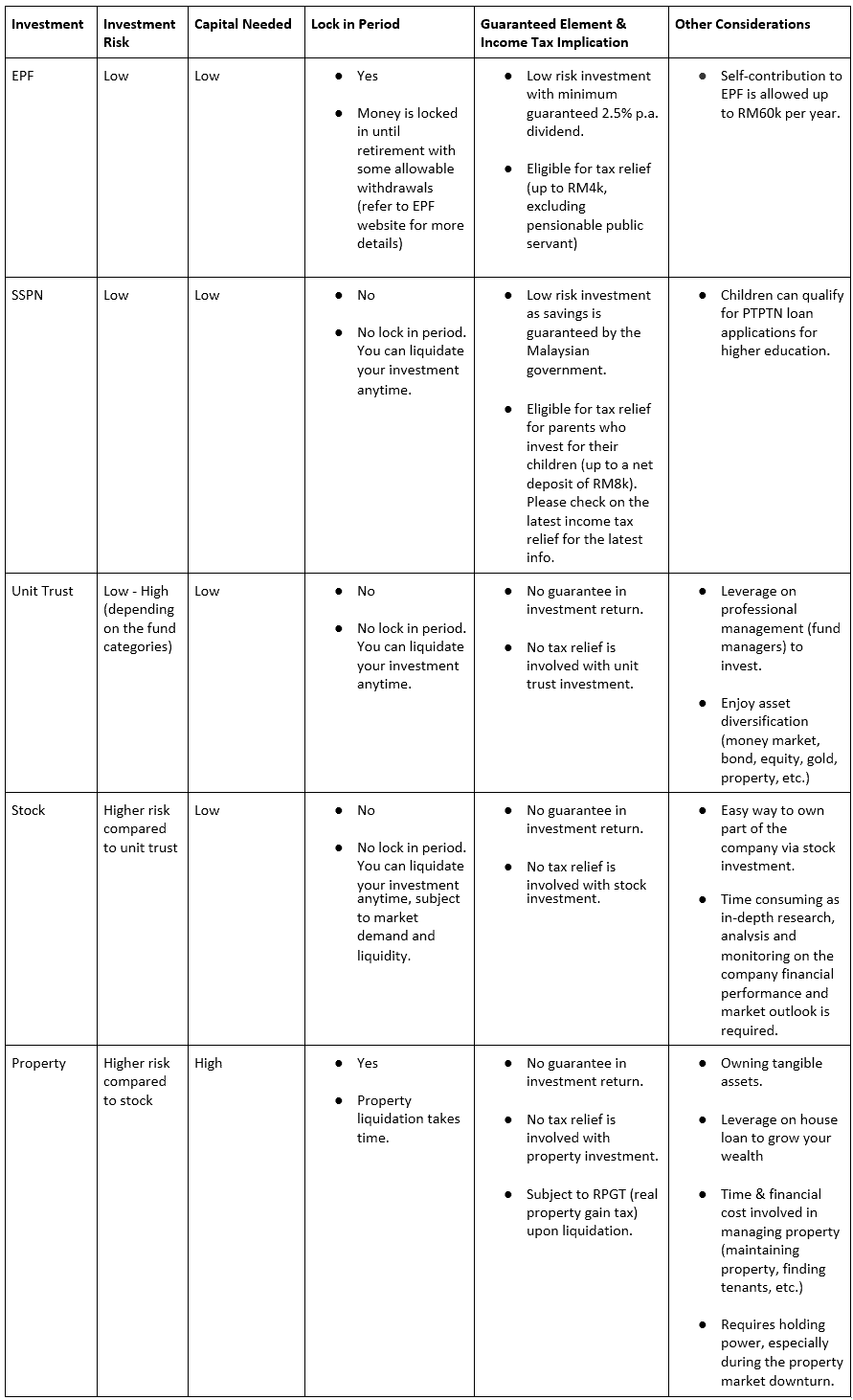
There’s a multitude of investments available, so here are five of the more common investment types for your reference:

How to Choose the Right Investment Vehicle

If you’re a business person (without EPF contributions) and concerned about payable tax, some of the investments that can be considered are EPF and SSPN. Both EPF and SSPN will help to reduce your payable tax.

If you’re a person who doesn’t have time or enjoy doing stock research & analysis, perhaps you can look into unit trust investment that leverages on professional management to invest your hard earned money.

In short, a suitable investment vehicle for you should be tailored to your financial situation as a whole. If you’re clueless about your investment planning, you may consider investing in a licensed financial planner. A licensed financial planner will be able to look at your whole financial landscape and advise on the right investment vehicles to help you to reach your financial goals.

About the author

Kuah Soo Yee is a Licensed Financial Planner (CFP) who is passionate about helping people make sound financial decisions and achieve their financial goals, and recently launched her own app. Her personalised strategies and advice have helped many to gain better clarity and take firm control of their financial future. She can be contacted at soo.yee@ipp.com.my

Website
LinkedIn
Facebook
Instagram