Wednesday, 5 August 2026 Stay informed. No noise.

Review: 5 Things We Learned about Luno Malaysia

Recently, Luno Malaysia held a virtual media conference to reflect on a year of operations since its relaunch in Malaysia, sharing its achievements to date and plans for 2021.

Having originally entered the market back in 2015, it quickly became the platform of choice for Malaysians to purchase and trade bitcoin, before being forced to suspend operations while being audited by the Securities Commission Malaysia (SC). After securing approval, it relaunched in October 2019 and has gone from strength to strength.

Here’s five things we learnt about the digital asset exchange (DAX) during the presentation:

2020 Was a Stellar Year for Luno Malaysia

According to Luno Malaysia Country Manager Aaron Tang, the DAX has processed a cumulative total of RM827 million since its relaunch.

It also claims to hold approximately RM165 million worth of digital assets on behalf of their customers, spread across Bitcoin (BTC), Ethereum (ETH), Ripple (XRP) and Litecoin (LTC).

LUNO relaunch in Malaysia
Luno relaunched in Malaysia back in October 2019.

These figures clearly show that there is a healthy demand for cryptocurrencies in Malaysia. According to Luno, 68% of its users buy cryptocurrencies for investment purposes, while 10% conduct trades on the platform, and a further 8% use it for sending and receiving cryptocurrencies.

Luno is the Runaway Market Leader in Malaysia

Claiming to hold over 90% of the market share among the regulated DAXs in Malaysia, Luno has certainly made the most of its past year!

The platform currently boasts more than 180,000 registered users, and given that Luno was the first Securities Commission-approved DAX in Malaysia, it not surprising that they have leveraged their first-mover advantage to great effect.

With the recent surge in the price of bitcoin and other cryptocurrencies, we think it is a pretty safe bet that this number will continue growing exponentially in the near future.

Bitcoin Isn’t Just for Risk-Taking Youngsters

More seasoned investors may have the idea that the volatile, high-risk nature nature of investing in cryptocurrencies is only suitable for younger people that are looking to make a quick buck off the huge swings.

However, for Luno this is far from the case.

According to Tang, the majority of Luno’s customers are aged between 30-49 years old. These are people in their prime working age, with the demographic mostly made up of accountants, engineers, educators and entrepreneurs.

This trend is also reflected globally, with institutional interest from the likes of Grayscale and PayPal credited with driving up the price of bitcoin in recent times.

Who says cryptocurrency is just for millennial and Gen Z investors?

2021 Promises to be an Exciting Year for Luno

On plans for 2021, Tang shared that Luno aims to launch a Savings Wallet for customers, where they will be able to allocate bitcoin to an interest-bearing account which allows them to earn 3-4% interest per annum on their holdings.

While this feature is already available for Luno users worldwide, it is currently under review by the Securities Commission Malaysia (SC).
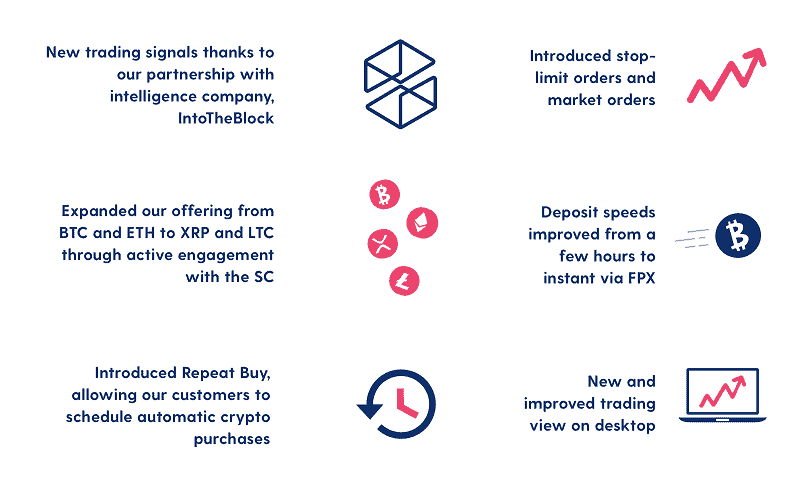
luno malaysia new features - luno relaunch
Some of the features Luno Malaysia introduced in 2020.

The company also plans to introduce new cryptocurrencies to the platform in 2021, subject to regulatory approval. Tang would not divulge which coins were under consideration, but the pending introduction of more assets to invest and trade in should help to bolster Luno’s position as the clear market leader in Malaysia.

Luno is About as Safe as it Gets

The issue of safety is one that retail investors often have when purchasing cryptocurrencies on a particular platform, with more seasoned cryptocurrency owners often championing the practice of storing digital assets on a privately-owned wallet instead of a platform.

However, Tang was quick to elaborate on the extensive security measures that Luno has in place to safeguard customer assets.

luno malaysia country manager aaron tang - luno malaysia relaunch“Any regulated platform in Malaysia must have their security systems audited and vetted by the Securities Commission,” he said.

“This is the first point of confidence that consumers can have, in that you are dealing with a regulated platform that must prove that its systems are safe and secure.”

In terms of asset storage, Luno works with the digital asset custodian BitGo to secure its “hot wallet” which is directly linked to its platform and facilitates all transactions.

The majority of its customer assets are stored in “cold storage” (not connected to the internet), rendering it impossible for hackers to gain access to it.

A portion of assets are also stored in “deep freeze”, which means they are spread out across several vaults in separate locations, spanning multiple continents around the world.


Weathering the Storm with a Solid Financial Plan

So which financial plan predicted COVID-19?

None, unfortunately. In the financial services industry, product pushers will always tell you “failing to plan is planning to fail”.

But is that true? Which product could have predicted Covid-19? No salesman, financial planner or even fund manager could have possibly envisioned this pandemic a year ago.

When unprecedented events like these occur, any plans you made, or were sold, are bound to crumble like a house of cards.

Is There No Point in Having a Financial Plan?

Well, yes and no.

Yes, because a financial plan is just a static document. It is only true today, and its authority will fade with each passing day when the assumptions used in the plan turn out to be different in reality. In fact, I believe that the plan has no tangible value at all.

No, because I believe that a financial plan is not the main focus. Rather, the real value lies in the planning process. It is here that the client reflects on their life, assesses their financial position, identifies challenges and issues, thinks of action plans, and sets KPIs that propels them forward.

Evidently, no one could have predicted Covid-19. However, if you have gone through a proper planning process, you may be able to deal with this better than most. Here are a few reasons why.

Liquidity in Net Worth

For many, their net worth is a good indicator of financial health and could even be in the millions. However, if this value is tied to illiquid assets, this means they are asset rich but cash poor.

In this case, the planning process would show the client that most of their net worth is tied to non-liquid assets that cannot be sold quickly. This may help the client to see things in different light, resulting in them using future cash surplus to build a portfolio of assets that is easily liquidated.

Emergency Fund

A fundamental part of my work is ensuring clients have an adequate emergency fund.

The current pandemic has shone a spotlight on emergency funds, as many without one have been caught out and now face a huge mountain to climb.

It is crucial to have emergency funds as this is our fallback plan when unforeseen events strike.

Cash Flow Management

Most people have a strong tendency to opt for instant instead of delayed gratification. Going through the financial planning process allows us to honestly assess our spending habits and lifestyle choices.

Looking at your cash flow also helps you understand if you are being hindered by excessive debt. If your debt-servicing-ratio is high (over 50%, or 60% in extreme cases), you will suffer greatly during salary cuts or retrenchment. Even if ignoring Covid-19, you are likely to be tied down to your job because you cannot afford to lose this income.

Prior to taking on new loans, look at your cash flow situation and be certain that you will still be able to work towards other life goals.

Are You Saving for the Future?

Covid-19 may have disrupted your plans for 2020 and even 2021, but it surely will not destroy what you want to do in five or ten years.

For example, if you began to prepare for a big event like a wedding at the start of this year, the MCO may have prevented you from building the funds required.

However, if you have been steadily saving for years, you would have your wedding money prepared by now. You might have to postpone your wedding, but not because you were not financially stable. We cannot control external factors, but we can certainly control our preparation for life.

Risk Management and Dependent Care

What if you unexpectedly left your family earlier than you wished, like many who fell victim to Covid-19? What about children or elderly parents who depend on you for their living expenses like food and shelter?

The process of financial planning forces you to think about the what-ifs in life. If you have not planned in advance, your dependents are at your life’s mercy. You could (and should) do better.

Diversification and Asset Allocation

If you make investment decisions on a piecemeal basis and only chase after returns, chances are your investment portfolio is not optimised.

With proper planning, you would have an asset allocation and portfolio strategy that fits your risk tolerance, risk profile, and investment objective. When the stock market fell earlier this year, not every asset class fell with it. That is why you will benefit from not putting your eggs in one basket.

If you are yet to sit down and plan your finances for life and finances yet, this is a good time to do so. It will help you build a stronger base so that during the next crisis, you can say, “it could have been worse”.

About the author

Kevin Neoh is a NextGen Money Coach at NextGen Independent Advisors and a certified member of the Financial Planning Association Malaysia (FPAM). He can be contacted at www.kevinneoh.my.

financial plan kevin neoh