Wednesday, 5 August 2026 Stay informed. No noise.

How to Protect Yourself at Different Stages in Life With Insurance

We speak with financial planners to get their advice on what people at different stages in life need for insurance coverage.

If you think about your circle of family and friends, there is a good chance that you will know someone that works in insurance. But for a product that is seemingly ubiquitous, the numbers paint a different story.

In 2020, Life Insurance Association of Malaysia (LIAM) president Loh Guat Lan revealed that almost half of the country does not have life insurance, while the National Health and Morbidity Study conducted in 2019 by the Ministry of Health (MOH) showed that only 54% of Malaysians have health insurance coverage.

Apart from reasons of affordability, many do not have insurance simply because they do not see a need. However, this can be a dangerous mindset to have as it does not offer a safety net in the event of  unfortunate accidents or peril. After all, it is likely that anyone will go through life and come out completely unscathed.

Here is what three financial planners have to say about the types of insurance you should be looking to get:

What Insurance Should You Get In Your 20s?

This is the time when most people are settling into life as working professionals, often in their first job. Earning income for the first time can be a thrill, and with disposable income to spend on clothing, dining, hobbies and more, it is no wonder that insurance can often be the last thing on their minds.

marshall wong insurance“I often tell younger clients and friends that the first insurance one should get is a health insurance, or commonly known as the medical card,” says Marshall Wong, a licensed financial planner at FA Advisory.

“A health insurance covers the hospitalisation bill that may cost more than one’s annual income.”

He adds that personal accident insurance is the second most important insurance that young working adults should seek out, given that traffic accidents are the fourth-highest cause of death in the country according to the Department of Statistics Malaysia.

Although a life insurance policy will usually cover accidental death, he notes that the premium for such coverage is “a lot higher” than insurance for personal accidents.

“Young adults may not be able to afford an adequate coverage,” he notes, with this being the reason why personal accident insurance is important.

Although having insurance is always important, Wong acknowledges that many of today’s youths may be of the mindset that it is unnecessary given their age. He warns that a lack of insurance could potentially lead to financial ruin if an unfortunate event occurs.

“Young adults need to know that not all insurance is expensive, and not all insurance agents are out there to take their money,” he advises.

“There are plenty of affordable insurance that may be suitable for them. If you cannot afford an investment-linked medical card, you may opt for a stand-alone medical card. The standalone medical card may not have as many features as an investment-linked counterpart, however, it may cover the basic necessities, and it may cost 50% lesser!”

When quizzed about niche forms of insurance, Wong says that it is more important for young adults to “stay nimble” rather than opting for unnecessary protection.

“Hire a fee based financial planner to go through your financial position as the exit cost of some insurance products can be very high,” he suggests.

What Insurance Should You Get In Your 30s?

By this time, most people should be well-established at work and have built up a solid base in terms of finances. This is the period in which many start taking on more financial responsibilities and assets. So where does insurance factor into this?

Pang Wan Khim insurance“In your 30s, your financial status is likely to be more stable,” says Pang Wan Khim, a licensed financial planner with VKA Wealth Planners.

She recommends a life insurance policy for those who do not have one at this age, as most people will have plenty of bills and commitments to pay down, such as cars, houses, and even marriage.

“With many financial responsibilities, and good health likely still on your side, you should get a life insurance policy to protect your loved ones’ future from life’s uncertainties,” she says.

Such policies pay out a lump sum of money to beneficiaries in the event of premature death. The idea is that death benefit should be sufficient to replace future income loss especially if you have a spouse who solely relies on your income. The total amount will cover the expenses and obligations outstanding such as funeral costs, medical expenses, debts, children education or living cost for your loved one.

“This gives your family financial continuity so they do not have to struggle and have more time to structure the financial status or fill the financial gaps,” explains Pang.

With most people in this age bracket acquiring assets like property, vehicles, and businesses, the upfront cost usually takes decades to accumulate. This is where financial assistance from banks come into play, with loans usually taken to acquire these assets.

“But as a borrower, if you pass away, all the debts will still need to be repaid in full by your estate,” she warns.

“Life coverage plays a crucial role in this situation and most people tend to overlook this when planning.”

She also believes critical illness insurance is very important as it helps to cover insufficient limits on hospitalisation plans as well as costs not covered on such plans, as well as non-medical costs like nurse care, transportation expenses, income replacement, medical equipment or even time off while recovering.

Although she is recommending guidelines for those in their 30s, Pang believes that insurance should be bought as soon as you can afford it, regardless of age. It goes without saying that the best time to buy is also while you remain healthy, but ultimately, these are just best-case scenarios as life is not the same for everyone.

“My general recommendations will not work for everyone because our situations are unique and financial statuses are different,” she observes.

Pang also recommends investment-linked insurance because most people tend to be busy with work and family, and it provides flexibility and peace of mind. With the cost of insurance generally increasing, she suggests using some of the investment proceeds to cover this increase in later years.

“The design of this product does offer a structure that helps us to gradually accumulate value which may be used to help us fund for the future when charges are generally higher,” she adds.

“However, as this is still an insurance product, the main focus should still be about protection, not growing your wealth.”

What Insurance Should You Get In Your 40s?

Individuals in this age group should be firmly at their peak in life. Many will have assumed positions of seniority at their jobs or built a family. With all these added dependents, not having insurance by this time can often be concerning, with premiums usually higher due to the advanced age of potential buyers. So, have you missed the boat by the time you hit your 40s?

Nicholas Wong insuranceNicholas Wong, a certified financial planner with IPP Financial Planning Group, believes that it is “never too late to get insurance”, but concedes that it is advisable to start getting insurance at an early age.

“It is always recommended to get coverage as soon as possible if one can afford it as one can only obtain insurance when healthy,” he shares.

The higher risk of developing illnesses or other serious health conditions means that for individuals in their 40s, it is now or never when it comes to buying insurance, especially if they are still healthy. Those with pre-existing conditions may find it harder to purchase insurance coverage says Wong.

“Your plan might come with exclusions or premium loading, which is paying more due to illnesses such as hypertension, for example. If one has diabetes, one generally can no longer purchase medical or critical illness coverage.”

“Thus, it is better to get a plan when you are younger as the premiums are lower and there is less risk of having exclusions or insurance coverage being denied,” he concludes.

For middle-aged people looking to get insurance for the first time, there is still time as alluded to earlier.

“For insurances, we always look at the needs of the individual and have to select the appropriate type of coverage,” says Wong.

“For example, if they have dependents such as young children or old parents, life insurance would be a need unless they have surplus liquid cash around.”

Wong, who formerly worked in insurance, recommends critical illness and disability insurance as a safety net against a loss of income arising from unfortunate events. This is because those in their 40s are likely to be at the peak of their career in terms of earnings and income replacement coverage will help to mitigate against unfortunate life-changing events.

“For critical illness cover, the recommendation is three to five times of the annual income or annual expenses,” he says.

“This means that while one is recovering from a critical illness, they would be able to take three to five years off work and not worry about expenses or dipping into their savings.”

Wong also recommends a 20-year term plan for those in their 40s as it is both affordable and provides large amounts of cover.

“A 20-year term plan with RM500,000 for life and total and permanent disability cover with RM100,000 critical illness cover can start from approximately RM200 a month,” he continues, noting that premiums may differ depending on plan benefits and type.

Wong suggests that one should usually budget 5-10% of total income for insurance payments, with this amount set aside to “protect or guarantee the remaining 90-95%” in the event of death, disability, critical illness or hospitalisation.

“Medical insurance which gives access to private healthcare is also something one can consider as it gives you more options when it comes to medical treatments as not everything is covered by our government hospitals,” he adds.

Insurance As Wealth Management

angie ng insuranceWhile many may look at insurance purely from a protection standpoint, it may also help to picture it as a mechanism to manage or preserve your wealth. Here are four ways which Angie Ng suggests insurance can be used for this purpose:

1. Wealth creation
“Part of the premium paid each month can go into cash value and there are also some products available that will help people who prefer very conservative savings instruments to build their wealth slowly and steadily.”

2. Debt cancellation
“There are insurance policies from which the proceeds can settle outstanding loans on assets like houses, cars, businesses and others in the event that they are unable to repay the balance.”

3. Wealth protection
“When risk is incurred, medical treatment, critical illnesses or total permanent disability occurs, insurance can protect their wealth as the treatment and insurance proceed can ease their financial burdens without
touching their hard-earned money.”

4. Wealth distribution
“In the event of an untimely death, life insurance policies can help to settle a person’s outstanding taxes, estate administration fees, and most importantly, leaving a legacy behind for their loved ones.”

In addition, insurance can also be used to mitigate the risk of natural disasters, no matter how rare or unexpected they may be. According to the Department of Statistics, the 2021 floods caused total losses of RM6.1 billion, with RM1.6 billion of damage to residential properties, RM1 billion to vehicles, RM900 million to the manufacturing sector, RM500 million to business premises, RM90.6 million to agriculture, and RM2 billion to public assets and infrastructure.

“If you are exposed to risk, for example, flooding in low lying areas or landslides in high hill areas, it is wise to include additional peril in your insurance policy to cover for natural disasters or other events,” says Ng.

What Net Zero Means for Inflation

Inflationary pressures are likely to increase amid measures to discourage high-carbon energy sources, although much depends on how policymakers intervene to tackle global warming.

Reducing carbon emissions is essential to curb global warming, one of the biggest long-term risks for the world economy. All countries across the globe will have to introduce ambitious mitigation policies over the next few years if the physical costs associated with a changing climate are to be limited.

Consensus among economists on carbon taxes as an effective policy lever to tackle climate change is rapidly growing.

By internalising the costs of the negative impact on health, the environment, and future generations, carbon taxes provide great incentives to transition to “net zero” emissions. They not only curb demand for fossil fuels, but also encourage business investment in renewable energy and low-carbon technologies, stimulating innovation.

In addition, they represent a source of government revenue. This can be used to finance tax reforms, lowering taxes on workers and businesses while supporting economic growth, or redirected to fund investment in climate technology.

Carbon taxes are fundamental to discourage the use of high-carbon energy sources and key to drive the behavioural change needed for the move towards net zero. They are, however, likely to have a large impact on energy and electricity prices, given the current widespread use of fossil fuels for energy production.

What Our Three Scenarios Tell Us

Business Man Show Increase Market Share Investment
business man show increase market share, growth of profit investment

To analyse and better understand the impact of carbon taxes on inflation, we use the Oxford Economics Global Economic Model (GEM) to consider three different scenarios: Net Zero, Net Zero Transformation (NZT) and Delayed Transition.

Given the high degree of uncertainty around policy intervention to tackle global warming, scenario analysis is a key framework to assess the implications of climate-related risks.

In the Net Zero and NZT scenarios, global warming is limited to around 1.5°C by 2050 as carbon taxes start from 2022.

The Delayed Transition scenario, meanwhile, sees temperatures increase by 1.7°C as it assumes annual emissions do not decrease until 2030.

The key difference in assumptions between the first two scenarios is that only the NZT scenario assumes that there are wider economic benefits associated with innovation. NZT also factors in a greater amount of green investment from the private sector.

Carbon prices are lower than those in the Net Zero scenario as it is assumed that benefits from research and development bring down the marginal cost of reducing emissions.

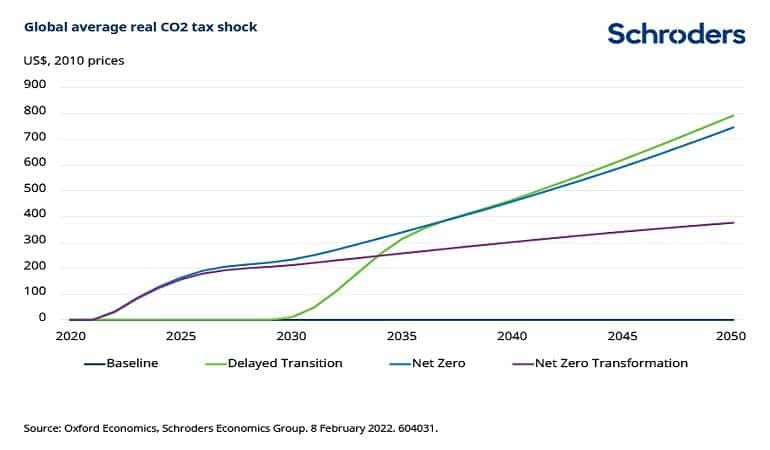
The assumptions on carbon taxes for the different scenarios are shown in chart 1. These trajectories are consistent with the analysis done by the Network for Greening the Financial System (NGFS) that derives the carbon tax for a given degree of mitigation while maximising welfare. The Delayed Transition scenario highlights the risks associated with governments failing to act swiftly. The world ends up with more stringent policies from 2040 as a stronger price signal is needed to limit global warming. The chart also shows the economic benefits associated with greater innovation, reflected in much lower carbon taxes for the NZT scenario.

Chart 1

chart 1 inflation net zero schrodersCarbon prices rise to US$200 per tonne of carbon dioxide (tCO2) by 2030 and steadily increase to more than US$700/tCO2 in 2050 in the Net Zero scenario. Prices do not exceed US$400/tCO2 under NZT. In the Delayed Transition, carbon prices increase rapidly after 2030 to reach US$800/tCO2 in 2050.
Oxford Economics assumes that the government recycles 50% of the carbon tax revenues back to consumers in the Net Zero and in the Delayed Transition scenarios. The other 50% remains on government balance sheets and is partly used to fund investment.

In NZT, they assume that the government fully recycles revenues in the form of lump-sum transfers to households. Therefore, the clean energy transition is financed by increased government borrowing that takes the global economy on a higher equilibrium level of economic growth.

What Will Drive Inflation?

The impact on inflation will come via changes in energy prices. The Oxford Economics model assumes that fossil fuel supply is slow to adjust to the change in prices. In contrast, demand is more elastic, adapting more rapidly to a change in price. These are realistic assumptions.

Therefore, spot prices fall below baseline on the back of weaker demand for fossil fuels. However, the move in the spot price is not large enough to keep the after-tax price at the pre-shock level. Given the large magnitude of the tax increase, after-tax prices are significantly higher than their baseline level.

It is evident that oil prices will rise more rapidly in the Delayed Transition scenario starting from 2030 given the disorderly impact of the late policy implementation. Meanwhile, oil price increases are more modest in NZT thanks to the lower tax profile associated with greater innovation and green investment that boosts productivity.

Higher Inflationary Pressures On The Horizon

The recent developments in the gas and oil markets are already showing us how important energy prices are for headline inflation. Accelerating energy prices have been a key factor behind the recent surge in global inflation. Therefore, it should not come as a surprise that with the adoption of carbon taxes, inflationary pressures will increase globally. In addition, the move to net zero will also dramatically boost demand for key industrial metals used to generate and store renewable energy. Given the supply challenges, this is likely to add further pressure on inflation, via higher prices for aluminium, copper, cobalt and lithium.

Carbon prices are estimated to boost US headline CPI, adding 300 basis points (bps) to our baseline forecast in the years following the implementation of the carbon tax. However, higher inflation will be temporary as pressures on prices will be mostly concentrated in the early stages of the transition.

As countries decarbonise their energy production and move away from taxed products, inflation will start declining in the second half of 2020s, returning to its baseline level by 2050. Inflation under the NZT will return more quickly to its baseline due to higher productivity and less severe carbon pricing. Meanwhile, in Delayed Transition, inflation will start rising from 2030 and remain above the baseline in the longer term due to continued increases in taxation policy.

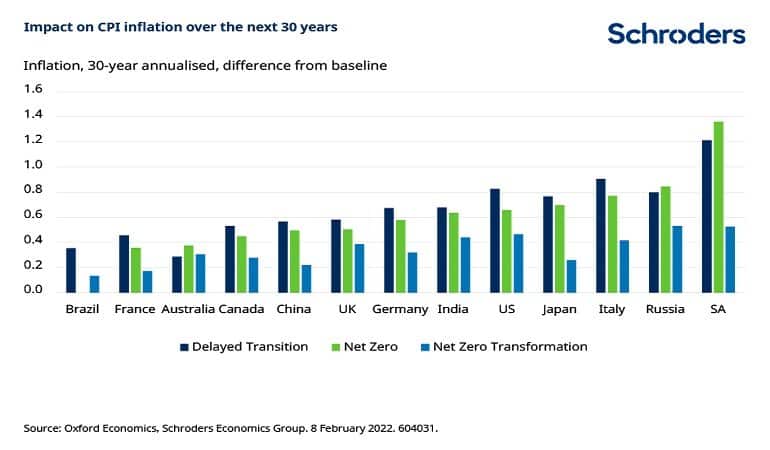
It is important to note that the impact on price growth will not be homogeneous across countries, as shown in chart 2. Over the next 30 years Brazil and France will see the smallest inflation increases, while Russia and South Africa are likely to experience the largest rises. The UK and Germany will also be affected, with the Net Zero transition expected to add more than 50bps to headline inflation over the next 30 years. The analysis also highlights the greater risks to price pressures associated with the delayed transition on the back of more severe increases in carbon prices.

Chart 2

chart 2 inflation net zero schroders

The impact of carbon pricing across the globe will depend on various country-specific factors. First of all, the magnitude of carbon taxes is a key determinant in the change in energy prices. Most developed markets will see carbon prices well above the global average. Europe will experience the highest price, almost US$900/tCO2 in 2050 in the Net Zero scenario, closely followed by the US and Japan. European prices are higher than other developed countries due to the region’s relatively smaller endowment for CO2 removal, via carbon capture storage technology, for example. Carbon prices for emerging markets will be much lower than their developed counterparts, increasing to US$600/tCO2 by 2050.

Another key factor behind the cross-country differences of the inflationary impact is the energy mix. Countries that are currently more reliant on fossil fuels for their energy generation will be more exposed to carbon taxes, as a higher share of fossil fuels strengthens the pass-through to prices.

The degree to which energy prices rise also strictly depends on the carbon content of the fossil fuels used. This is because coal is much more carbon intensive than oil and especially gas, implying that for the same amount of tax, coal prices will rise more than the other fossil fuels.

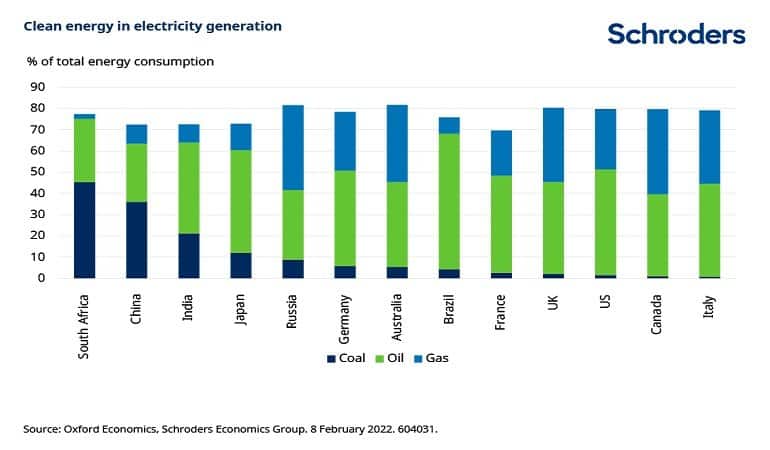
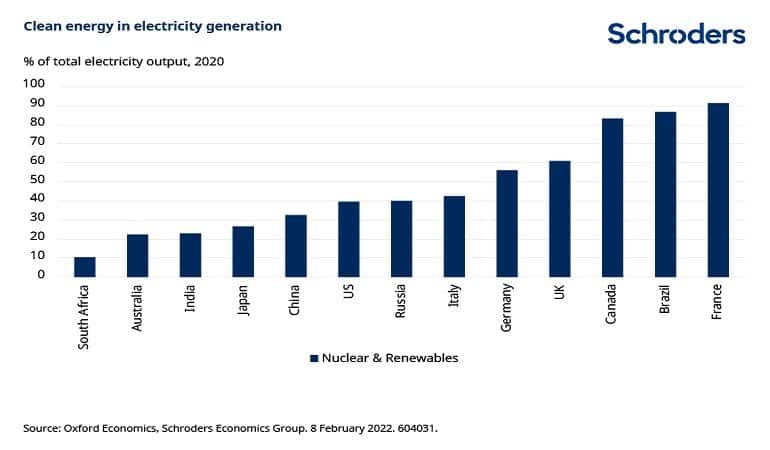
It is therefore important not only to look at the amount of fossil fuels used in the energy production, but also at the carbon content of each source. Chart 3 highlights that emerging markets heavily rely on dirtier sources of energy. South Africa leads the way, as coal accounts for more than 60% of its energy demand, followed by China and India. Countries highly dependent on oil like Brazil, Japan, Russia and the US will also see significant increases in fuel prices.

Chart 3

chart 3 inflation net zero schroders

Electricity prices will also be impacted by carbon taxes. The higher the share of renewables and nuclear used for electricity generation, the weaker the pass-through to electricity prices. Countries like France, Brazil, and Canada, whose electricity is already being produced with more than 80% of clean energy, will see a more modest rise in inflation.

Achieving net zero emissions requires a radical decarbonisation of the energy mix. By 2050, all coal mining will need to end, stranding these assets. Moreover, the majority of oil reserves will also be unburned. This means that developed countries will need to be less dependent on these dirty sources of energy, and consume low-carbon sources, like natural gas, and rely more on nuclear and renewables. By 2050, oil is assumed to account for less than 10% of total energy consumed for most developed economies (chart 4).

Chart 4

chart 4 inflation net zero schroders

What Are The Implications For Central Banks?

Carbon taxes represent an efficient policy tool to tackle environmental problems, but it is clear that they will lead to inflationary pressures. These will be felt across the globe, but will be more pronounced for economies that still largely rely on energy from fossil fuels. It is interesting that the impact on inflation in European countries will be more limited despite them likely to see the most severe carbon taxes and highest carbon prices. This is thanks to their greater use of clean energy, especially in France.

Our analysis also shows that inflationary pressures are mostly concentrated in the near term. The transitory nature of inflationary impact could imply that central banks look through the carbon pricing shock. The current prevailing consensus is that monetary policy should look through energy shocks as these tend to be short-lived and only result in a temporary deviation from the inflation target, provided that expectations remain anchored. And this is in line with what the Oxford Economics model assumes. But the energy transition will require a radical transformation in the energy sector, with the potential to generate large demand and supply imbalances, posing profound challenges to policymakers.

Finally, carbon prices are likely to act as a trigger for large investment stimulus, boosting employment and aggregate demand. Higher energy prices, if associated with a smaller output gap and stronger underlying price pressure, could force central banks to abandon any “look-through policy” and act to preserve price stability.

About the author

Irene Lauro is an economist at Schroders.

Changing Habits in a Cashless Society

Are you psychosocially fit to harness fintech solutions for your financial well-being?

The outbreak of the Covid-19 pandemic has accelerated the use of cashless payments in Malaysia. There is a surge in the usage of cashless payment as consumers start to adopt e-wallets like Touch ‘n Go, GrabPay, and MAE, besides the use of electronic payment through cards, mobile banking and internet banking during the Movement Control Order (MCO).

A cashless society does not necessitate that cash transactions do not exist in the economy but rather, financial transactions are facilitated by electronic means in an attempt to minimise the volume of cash transactions.

As the buzzword “fintech” is rapidly becoming a household name, early adopters may have already benefited from their early adoption of fintech solutions. There were many lengthy articles written on the benefits and risks of moving towards a cashless society as well as highlighting the risks associated with the adoption of fintech platforms such the potential compromise of client privacy, security and operational risks. In their quest for higher customer acquisition, fintech platforms provider may have overstated their claims with regards to their services.

Not surprisingly, certain segments of the society, which are either unconvinced of the benefits or lack the ability to reconcile with the technology, are still rejecting the use of tech-based solutions despite rapid adoption by the tech-savvy generation.

Mobile Payments Mobile Scanning Payments Face Face Payments
 

So, are we getting or feeling smarter as technology users? Is our digital financial literacy moving in parallel with the availability of fintech solutions to manage our finances?

As reported by EPF, our savings are not sufficient and some EPF members are opting for early special withdrawal under i-Lestari, i-Citra and i-Sinar due to the pandemic.

So, are cashless and fintech solutions the panacea to help us save, spend or invest better?

The main issue does not lie with using technologies per se for financial planning but rather, a lack of awareness in understanding savings and spending behaviour. This is because, if we cannot or do not have the self-disciple to save, knowledge and skills alone will not enable us to fully capitalise on investment opportunities provided by fintech solutions.

Let us try to understand ourselves. In this age of consumerism, by nature, it is our inherent behaviour to prefer current consumption over future consumption. The additional satisfaction known as marginal utility in Utility theory expounded that the marginal utility of current consumption is always higher compared to the marginal utility of future consumption.

In other words, it may be difficult for some of us to save for tomorrow unless we are incentivised to do so. As most people are not self-motivated creatures, we need external push and interventions from time to time to help shape our savings behaviour. In addition to this, psychologically, we dislike waiting.

But unfortunately, the incentive to compensate us for waiting and delaying our current consumption in the form of interest rate is negative. In this low or negative interest environment coupled with the availability of easy credit, plastic cards such as debit cards or credit cards, e-wallets or other alternative payment systems, the motivation to save becomes even lower, and spurs us to spend recklessly.

Young Lady Use Cellphone Order Online Shopping Product Paying Bills With Banking App With Transaction Successful Stay House Quarantine Activity Fun Activity Coronavirus Prevention
 

While we love the constant innovations or fintech solutions by companies in their attempt to provide a seamless experience for customers, we are becoming somewhat less patient. Spoilt for choices with a button or click-away conveniences provided by companies, our impulse to spend for instant gratification is magnified.

In addition, the theory also explicates that we tend to value current consumption even more over future  consumption during period of scarcity. Thus, it is no surprise that due to the Covid-19 pandemic, we may have the urge to spend and consume even more like there is no tomorrow.

Some of us are being lured into adopting exuberant lifestyles that are beyond our means as we are besieged daily by spam, scam calls, marketing gimmicks or repetitive unwanted advertisements.

While some of us are plunging deeper into the abyss of maintaining exuberant lifestyles that we find hard to extricate ourselves from, companies are getting unrelentingly creative in helping us to reduce our pain of losing money via innovations in electronic payment means. Accordingly, we do not just experience as much pain as our predecessor because we are just literally transferring the numbers or data via the electronic systems when we make our purchases. In consequence, we are inclined to spend lavishly on unnecessary items.

Things were markedly different back then when cash was used extensively. Our grandparents or parents may have better spending habits because they get to feel, touch, smell and count the hard cash of their money in their hands before parting with their money. The painful experience associated with seeing with their own eyes that the money is actually leaving their hands or pockets may have deterred them from spending on unnecessary items. This explains why they spend more on necessities that benefit themselves to equalise the pain inflicted upon parting with their money.

To put it in another way, if we could not be cognizant of our own innate behaviour by getting psychosocially ready, in harnessing the so called “smart” fintech solutions, we are not going to get smarter. On the contrary, we may become more mentally depressed.

Cultivating good spending habits and resisting temptations to splurge often require self-discipline, practice and planning. To be more unsusceptible to act impulsively when our brains process words frequently used by marketers such as easy, convenient, fast, instant, and limited, we should stop being hyperconnected all the time.

By not subscribing to this new religion of “irrational exuberance” (a popular term used by Professor Robert Shiller) in our daily spending habits, hopefully, then, perhaps, our life would be psychosocially and financially happier.

About the author

Dr Audrey Lim Li Chin is a lecturer and a researcher at Multimedia University (MMU) Melaka. She teaches International Finance and Derivatives. She is particularly interested in retirement planning, mental health, fintech especially in blockchain and data analytics. She is also a Certified Financial Planner, (CFP) and is currently pursuing Chartered Financial Analyst (CFA) certification. She is also the external educational advisor to Max Wealth Education Sdn Bhd.

Upgrade Yourself To Become A Certified Financial Planner And Islamic Financial Planner

The Certified Financial Planner (CFP) qualification is for those wishing to practice the profession of financial planning and who wish to master a certain level of theoretical knowledge and practical application of financial planning in such areas as:

  • General principles of financial planning
  • Insurance planning
  • Taxation planning
  • Investment planning
  • Retirement planning
  • Estate planning
  • Financial plan construction and professional responsibilities

Islamic Financial Planner (IFP) is designed especially for professionals and personnel serving the retail segment of the Islamic financial products and growing demands of discerning Muslim retail clientele call for higher standards of competency and ethical practice of financial planning professionals. Equip yourself with enhanced knowledge in the personal financial advisory space.

SI A4 Ads Poster 1024

Exclusively for Smart Investor followers, click https://www.smartinvestor.com.my/SIxMaxWealth to find out more about the Special Promotion Package and get up to 20% special discount.

*This promotion is valid until 31st December 2022 only

The Cause And Effect Of Anger

Everyone experiences this emotion, but knowing how to control it is crucial.

Overblown anger usually indicates a larger underlying problem in life. Depression, anxiety, and other mental health issues are associated with many magnified negative feelings, some common culprits being worthlessness, shame, and disappointment, all of which can translate into anger.

Addiction is also a common source of anger, showing up when we get frustrated with ourselves for not being able to stop our compulsions, or to get the fix that would soothe us temporarily.

What Causes Anger?

There are two sets of structures in the brain that govern us: the cortex thinks, while the limbic system takes care of the more ancient aspects such as emotions and memories. External triggers, particularly fears, are sent to a deep, central part of the brain called the amygdala.

The amygdala decides whether to send the incoming data to the cortex for rational processing, or straight to the limbic system that generates quick knee-jerk reactions.

Childhood maltreatment, poor social adaptation, and unchecked habits sometimes lead to an overactive amygdala, causing us to react too strongly and out of proportion to the actual gravity of the triggering event. Anger becomes an undesirable response when we keep getting uncontrollably irritated against a perceived threat, no matter how small or unfounded it is.

What Makes Us Angry?

Anger makes everything seem worse or more important than it actually is. It also makes us feel sure that the things that offend us are true even though we cannot know absolutely whether they are. We feel the urge to exert our will, and we feel justified to let our ego overcome others’ rights.

Having said that, anger is nevertheless a normal response experienced by everyone in the face of unfairness. Some events in life make us feel deliberately harmed, even when on a deeper level we know that that is not true.

Such events can cause unforgiving feelings that manifest themselves in anger:

  • Frustration — Feeling victimised when things are not going the way we want them to.
  • Injury — Feeling the need to revenge after being attacked.
  • Exploitation — Feeling the need to set things straight after being taken advantage of.
  • Lack of attention — Feeling small as a result of being ignored or dismissed.
  • Envy / jealousy — Feeling obsessed when someone else has something that we desire.
  • Lack of conformity — Feeling irritated when other people do not obey the rules that we obey or believe to be important.
  • Sympathy — Feeling troubled when seeing someone else suffer a harm that should not be allowed to happen.

Everyone Expresses Anger Differently

Even though anger is completely normal, it becomes a problem when we feel it too frequently, too overwhelmingly, or when we express it in ways that can hurt other people or ourselves.

Noticing our own physical signs of anger is the best way to catch the beast before it overcomes us. Because physical signs tend to show up even when we are trying to suppress our feelings, they are highly useful for those who are used to restraining themselves, but nevertheless suffer from deep-seated and unresolved rages.

Some of anger signs include:

  • Clenched fists
  • Fast and shallow breathing
  • Stomach in knots
  • Shaking or trembling
  • Sweating
  • Hotness
  • Pounding heart
  • Reddened face

Apart from classical displays of anger such as verbal abuse and physical violence, many people have learned to express their anger in subtler forms due to social conditioning and habitual inhibition. These are not better or worse than other kinds of aggression, whether self-directed or interpersonal, and should also be monitored mindfully with consistent practice:

  • Passive aggression — “I want to control your emotions or behaviour but I don’t want you to notice it.”
  • Sarcasm — “I want to hurt you verbally and I will force you to take it as a joke.”
  • Contempt and disdain — “I am better than you and you are lesser than me.”
  • Disgust — “You contaminate me or the things I care about.”
  • Coldness — “I refuse to acknowledge you, and I take pleasure in your misfortune.”
  • Hostility — “I am ready to fight you if I have to.”

How To Cope With Anger?

Unbridled anger can form a vicious cycle that becomes more aggressive at every outburst and harder to break. The understanding that anger is usually fuelled by an overblown emotional threat is essential to rebuilding a response mechanism that is not based on defensiveness and flight-or-fight reaction, but compassion and rationality.

Anger can be caused by real problems in our lives that need to be solved, but our ability for problem solving is weakened if we continuously fail to provide ourselves a suitable framework in which to assess life that is based on reality instead of drama.

Many established anger management techniques are not only meant for emotional de-escalation, but also for helping us to restructure our attitudes and rebuild our empathy, so as to restrain our ego from taking centre stage on every occasion:

  • Maintain a diary to record the thinking patterns and common triggers that have led to your angry outbursts.
  • Recognise the moment anger starts appearing in your body.
  • Observe whether the angry feeling is taking over your logical mind.
  • Do not feel guilty about your anger, but accept that you need ample personal space to avoid lashing out (even though you really want to), and to let the urge flow through you.
  • Practise switching attention to your breathing until the anger feels less urgent.
  • When things have calmed, retrace and revisit the train of thought that you have experienced during the provoking situation.
  • Do not blame yourself.
  • Visualise giving yourself a pat on the shoulder or hugging yourself like a parent would to a child.

Exploring Our Inner Thoughts

Therapy and counselling help us understand our anger and learn how to manage it, so that we can limit its negative impact on our lives in scientifically proven ways.

To gain more insight into our anger, it is useful to ask, “in what ways had this situation hurt me?” and, “am I overestimating the damage that can be done to me?” The answers to these might put things into perspective as we realise that our anger has more to do with our flawed beliefs about ourselves, other people, and the world, than the actual severity of the situation itself.

After an angry episode has subsided, ask yourself the following questions, and remember your answers when the next tantrum begins to simmer:

  • Do I talk to myself in an overtly emotional language that tends to describe situations as catastrophes, exaggerated dramas, or black-and-white scenarios?
  • Was the situation worth getting angry over?
  • Did I really need to be angry at that moment? Did it solve my problems?
  • Did the pleasure of lashing out justify the harm done (or could potentially do)?
  • How did the effects of my anger impact people on the receiving end?

We often either use anger as a tool to avoid feeling hurt, or hurt ourselves by directing the rage inwards. Neither pattern is necessarily our fault, but both can lead to bigger mental health problems and social issues. Learning how to control anger does not mean denying ourselves the freedom of expression, but that it happens to be a vital step towards gaining more inner peace and overall contentment in life. 

Seek the help of a psychiatrist or a clinical psychologist if you often feel unsure, overwhelmed, or out of your depth when confronting difficult feelings.

This article is adapted from an article by Sunway Medical Centre, Sunway City.

Sunway Medical Centre Qr Code

Property Investing In A Post-Pandemic World, 4 Things To Consider

Planning to do some property investing after the pandemic? Here are some factors to help you find rewarding deals.

Real estate investment is one of the most preferred forms of medium to long-term investment, especially for Asians. It increases in value and generates ongoing passive income over time.

Despite the Covid-19 pandemic that took a toll on Malaysia’s property industry, experts say the property market will likely recover in 2022 with renewed consumer confidence and the expected recovery in Malaysia’s overall economy. They anticipate that property investing will get better in the first half of this year before it begins to pick up in the second half.

“All signs are pointing towards 2022 being a recovery year for the property market in Malaysia. It is predicted to be stable in the first half with gradual improvement in the second half. While many are adopting a wait and see approach, landed properties in the Klang Valley are hitting new highs each month,” says Chan Ai Cheng, President of the Malaysian Institute of Estate Agents.

Chan Ai Cheng

4 Factors To Consider In Property Investing

With the attractive low interest rates and property prices on an upward cycle, it seems like a good time to snap up some good properties. However, you do need to have a sound knowledge before venturing into the world of investment properties.

According to Chan, some of the factors to consider when investing in a property in Malaysia include:

1. Purpose Of Property Investing

Are you looking to make money through rental income or property appreciation? What you plan to do with the property makes a difference in deciding the type of property you need to buy. It also helps you narrow down the available options to find one that is better suited for your needs.

2. Location And Neighbourhood

Location is one of the most crucial factors to consider when investing in property. Other factors include accessibility and connectivity, amenities, plans for future development, proximity to transportation network, and how safe is the location from natural calamities like floods or landslides.

“For me, I look for properties within easy reach of areas I am familiar with. There may well be opportunities in other localities, but it is always best to invest in locations you know best. You would have better knowledge of the neighbourhood, past prices, and potential for the area compared with buying on one’s hunch,” she explains.

3. Type Of Property

The main three types of property investing include residential, commercial, and industrial.

“In Malaysia, most investors buy residential properties with a minority investing into commercial and industrial properties,” Chan says.

Popular residential property options include landed properties like terraced houses, semi-detached houses, or bungalows. For non-landed properties, they include highrise or strata residential properties such as condominiums, serviced residences, and apartments.

Each property type has its own set of terms and guidelines or considerations; thus, you need to determine what you are looking for in advance.

4. Budget

Your choice of property to invest in should not only be a good investment, but it should also fit within your budget.

When calculating your budget, remember to factor in all initial costs such as downpayment, legal fee, stamp duty, bank processing fee, valuation fee (for subsale), as well as renovation expenses to get the property ready for use.

Besides the monthly loan instalment, you also need to budget for recurring payments that come with owning a property such as monthly maintenance charges, annual quit rent and assessment tax.

While most people buy directly from the developer and the secondary market, Chan says that there are some investors who focus only on picking up investment properties via public auctions. So, how do you find a profitable investment property in Malaysia post-pandemic?

“Data is key,” says Chan.

“Do your research on the type of property and the location you have your eye on. Although most hold the view that investing in property should not be an emotional affair, it is quite hard to separate the two.”

According to Chan, if prices of properties within the area you are targeting have had a downward adjustment in asking prices – then it might be worth your while to put in an offer.

With the rising cost of building materials and disruptions in the supply chain, Chan indicates that this might lead to higher property prices. This is favourable to property owners as real estate has historically been viewed as a good hedge against inflation—when housing prices rise with inflation, owners will see appreciation.

Besides being a hedge against inflation, if done right, property investing can get you a substantial return through passive income and equity gains.

Techrevo For Homebuyer

Do you know how much is your Home Loan eligibility? Not sure how much you can borrow from the bank? 

Get your TechRevo credit report + Home Loan Eligibility which includes:
  • Credit history up to the past 12 months [CCRIS] 
  • Bankruptcy, Legal Suits, Legal action from banks, SAA, and Trade Bureau (Section E)  
  • Max home loan eligibility calculation up to 12 mortgage favorable banks in Malaysia 
  • CCRIS + Credit report + Calculator 

It only takes 5 minutes. Click here now to get 50% off -> https://www.smartinvestor.com.my/techrevo


What Types of Insurance do Malaysian Finance Content Creators Have?

These content creators are known for their financial savviness but what about their own safety nets?

Personal finance is a topic that many Malaysians have begun taking an active interest in recent years, with more and more people looking up ways to maximise their net worth, especially in the wake of the pandemic. This surge of interest is also reflected by the number of personal finance content creators that have emerged and built up sizeable followings of their own.

But while investing in the wide array of products available may be more up their alley, how have they built their own contingency plans in the event of life-changing events? Here’s what some of Malaysia’s most well-known finance content creators have to say about insurance:

Leigh (32 years old) – Dividend Magic

Leigh Dividend Magic personal insuranceSI: What types of non-compulsory insurance do you currently have?
L:
Medical, life, and house insurance.

SI: Which of these is most important to you and why?
L: Medical insurance. My life insurance is the bare minimum as a base policy for medical insurance. I see medical as being the most important in the future and because I have no dependents now, no life  insurance for me. As we all know, the medical inflation rate is crazy and way above the average inflation rate of the economy. I foresee myself having to increase my medical coverage in 10 to 20 years.

SI: What prompted you to purchase your first insurance policy?
L: Financial literacy and with the realisation that medical costs can reach hundreds of thousands of dollars!

SI: What type of insurance do you think every Malaysian should have and why?
L: Medical definitely, please please please get your medical coverage sorted out. As for life insurance, you should consider it if you have dependents. If your investments and savings are sufficient, you might not even need life insurance etc.

SI: Is there a niche form of insurance that you have considered purchasing?
L: No.

Read more from Leigh at dividendmagic.com

Helmi Hasan (35 years old) – Balkoni Hijau

Helmi Balkoni Hijau personal insuranceSI: What types of non-compulsory insurance do you currently have?
HH: I currently have a personal life and medical policy, an additional life and medical policy from my employer, and house insurance. I also used to have annual travel insurance pre-Covid as I travel frequently.

SI: Which of these is most important to you and why?
HH: Medical and travel insurance is super important as I studied in the US. A friend of mine was hospitalised for a broken collar bone in a skiing accident had to fork out at least US$4,000 for his medical bill. Also, as a family man, a home is super important, so you might want to get house insurance and flood coverage since the last flooding event.

SI: What prompted you to purchase your first insurance policy?
HH: My mother asked me to buy insurance to follow in her footsteps. I started with investment-linked life insurance. But after I had kids, I needed to readjust my insurance plans. For me, I only want to get insurance coverage (without the investment part).

SI: What type of insurance do you think every Malaysian should have and why?
HH: Medical, life, and house should be mandatory for all. Also, all Malaysians MUST have extreme weather insurance coverage (floods etc).

SI: Is there a niche form of insurance that you have considered purchasing?
HH: When I was working in Singapore, there was something called “lifestyle insurance” where if you are laid off from your job, it can help to pay your salary for a few months. I have yet to see such insurance in Malaysia (besides PERKESO) and would like to consider one.

Also, as a YouTube content creator, I invest in expensive camera gear. I want to purchase camera/tech insurance as it’s normal to have this in the US.

Read more from Helmi at balkonihijau.com or subscribe to his YouTube channel.

Suraya Zainuddin (33 years old) – Ringgit Oh Ringgit

Suraya Zainuddin Ringgit Oh Ringgit personal insuranceSI: What types of non-compulsory insurance do you currently have?
SZ: I have medical, critical illness and personal accident insurance.

SI: Which of these is most important to you and why?
SZ: In my early 20s, I thought medical card was the most useful, since I didn’t want to burden my family with hospital bills in case anything happens to me. Now in my 30s, I appreciate critical illness insurance more, especially after knowing the best time to get it is before having serious illnesses. Otherwise, you’ll be considered to have pre-existing conditions and the insurance won’t cover it.

SI: What prompted you to purchase your first insurance policy?
SZ: I heard ‘I wish I got insurance’-type advice one too many times, especially on the personal finance-related forums I used to frequent. Something about hearing complete strangers’ regret over not doing certain actions in their youth that would have greatly benefit them in old age made me determined to get my insurance situation sorted out.

SI: What type of insurance do you think every Malaysian should have and why?
SZ: Different types of insurance cover different types of risks, therefore there is no one type that is a blanket ‘must have’ for all.

I have two opinions when it comes to Malaysians and insurance. One is we should not pretend that comprehensive insurance coverage is not expensive, and out of reach for many Malaysians in the M40 and B40 category (and even for some in the T20 category as well). According to the Department of Statistics Malaysia, the median salary for Malaysians in 2020 is RM2,062. Paying for life, medical, critical illness, personal accident, house and car insurance with suitable sum assured can easily reach RM1,000 per month. The maths simply does not add up. Malaysians should be compensated better to be able to afford insurance.

Secondly, the irony of insurance is it is the most important for the people who cannot afford it. While there are now government programmes like Perlindungan Tenang specifically for the B40 community, take up rate is low. Rather than spending so much time and money and effort in educating about the usefulness of the tool, I wish it was implemented on an opt-out rather than opt-in basis, so the coverage is automatic for the people who need it. Alternatively, take-up rate may also be improved if insurance is added as a requirement for getting specific government services, such as cash handout.

SI: Is there a niche form of insurance that you have considered purchasing?
SZ: I have considered pet insurance before.

Read more from Suraya at ringgitohringgit.com

Chin Yi Xuan (28 years old) – No Money Lah

Chin Yi Xuan No Money Lah personal insuranceSI: What types of non-compulsory insurance do you currently have?
YX: I have life, medical, and critical illness insurance.

SI: Which of these is most important to you and why?
YX: All of them are equally important as they act as financial protection for me and my family under different circumstances in life. Life insurance pays when I pass away. Medical insurance pays if I am hospitalised. Critical illness comes in as income replacement if I get illnesses like cancer.

SI: What prompted you to purchase your first insurance policy?
YX: I upgraded my policy as there was a transition in my life from being a student to a working adult. I needed more comprehensive coverage in line with new commitments and rising medical costs.

SI: What type of insurance do you think every Malaysian should have and why?
YX: Everyone should get a medical card and critical illness protection in event where one is hospitalised and/or down with illness like cancer. Especially for people that have commitments and family, best to get life protection to help ease the burden of their loved ones when they pass away.

SI: Is there a niche form of insurance that you have considered purchasing?
YX: No.

Read more from Yi Xuan at nomoneylah.com

Ryan Lee Chun Hoe (31 years old) – Bujang and Broke

Ryan Lee Bujang and Broke personal insuranceSI: What types of non-compulsory insurance do you currently have?
RL: I got myself life, medical and house insurance at various stages of life.

SI: Which of these is most important to you and why?
RL: Personal insurance is the most important to me because of unpredictable situations that may occur which I have no control of, such as accidents or health threatening diseases. Insurance may help to reduce the financial burden if I face hefty bills during the recovery phase.

SI: What prompted you to purchase your first insurance policy?
RL: I was late to buy my own personal insurance as you can actually pay a cheaper premium before you turn 25 if I am not mistaken. Around the age of 27 years old, I started to take adulthood and self-reliance seriously whereby if I happened to be on the hospital bed, will I be able to pay my bills? Would I want to seek help from my family members who are saving money for their retirement or medical bills? Hence, after giving it some thought, I personally did not want to trouble them which made me buy my first personal insurance.

SI: What type of insurance do you think every Malaysian should have and why?
RL: Medical insurance because operations and hospital accommodation are expensive, which could easily burn your hard-earned savings. The last thing you want is the hospital chasing you to pay your bills before they decide to treat you; we can’t blame them for this because that is what keeps their operation running.

SI: Is there a niche form of insurance that you have considered purchasing?
RL: Not at the moment; buying insurance is subjective as it is supposed to solve the problems that you are facing in life without much worries.

Watch more from Ryan on his YouTube channel.

Gracie (30 years old) – Ringgit Freedom

gracie ringgit freedom personal insuranceSI: What types of non-compulsory insurance do you currently have?

G: Mainly life and medical insurance.

I didn’t opt for mortgage insurance but instead, I purchased life insurance with sufficient cover to offset my mortgages as it provides greater flexibility at lower cost. I also added an additional buffer for families to have additional pocket money when I pass on.

As for the medical insurance, I also added some accelerated critical illness payout for myself in case of severe illness or major surgery, avoiding potential dents to my cash flow and emergency fund.

SI: Which of these is most important to you and why?
G: Quite frankly, both are equally important to me but if I really have to choose, I’ll pick the medical insurance with accelerated critical illness payout. If I were to be unfortunately affected by critical illness which affects my employability and disrupts my income (both from hefty medical bills and the lack of paychecks) – the insurance will definitely be a blessing for myself and my family since the large sum of payout via life insurance is only meaningful for my family members upon my death, not myself.

SI: What prompted you to purchase your first insurance policy?
G: When I signed up for a mortgage for our first family home, I had to purchase the life insurance on the same year to offset my mortgage loan, since my mom wouldn’t be able to service the mortgage loan upon my passing, hence I needed to ensure that she has a place to stay even if I moved on.

I relied only on my company’s medical insurance for the first few years until my salary grew enough for me to afford a proper medical card (whilst not overstretching my monthly budgets).

SI: What type of insurance do you think every Malaysian should have and why?
G: Personally, I think it differs on a case-by-case basis as everyone is exposed to different risks. But as a bare minimum, I would recommend getting a basic medical card whilst we’re still healthy with sufficient coverage proportionate to our risk appetite/level.

Leverage insurance can also be considered as a form of mitigation for risks we cannot afford to have – but be very careful not to fall onto the trap of over-insuring ourselves especially for risks that we can easily afford to take, since over-insuring will just do more harm than good on our cash flows.

SI: Is there a niche form of insurance that you have considered purchasing?
G: No.

Read more from Gracie at ringgitfreedom.com

Covid-19 The Catalyst in Estate Planning

Passing your hard earned wealth to the next generation is not as easy as writing a will.

The Covid-19 pandemic which started two years ago still lingers on today, which has affected the planning of individuals and businesses in many ways.

As far as estate planning for one’s estate is concerned, the awareness on the need to do personal estate planning has been heightened. This can be demonstrated by the fact that many will-writing and trustee companies have reported a jump in their will-writing business in the past two years. The unexpected spike in deadly casualties due to the attack by the Covid-19 virus has rattled many who began to worry about their health and safety.

What is estate planning?

Estate planning is actually more than having your will written, though it is a basic instrument in estate planning. To put it in layman’s terms, you can say that it is a well-thought through planning process to ensure that your loved ones are protected, your hard-earned assets are preserved, and your accumulated wealth is perpetuated to more than three generations.

You have probably heard of this Chinese saying that goes “Wealth does not pass through three generations”. Interestingly the Americans have a similar saying, “Shirt sleeves to shirt sleeves in three generations”. These sayings show that estate planning is both necessary and crucial, especially for those who are on their way to, or have accumulated a fair amount of wealth.

Is writing a will estate planning?

Most people have the impression that having a will written is having done their estate planning. Water is essential for soup, but soup is more than just water. In actual fact, there are more legal instruments than just a will, such as a testamentary or living trust, a shareholders agreement, a Labuan foundation, life insurance and its use of nomination. Even an EPF nomination or a joint-account, planned intelligently is an instrument in estate planning.

Integrated approach to estate planning

Thus, there is a need to integrate all your estate planning instruments into a coherent estate plan. This is because the various instruments you choose must work together to address all your concerns in the event you depart from this physical world.

On top of that, your estate planning must also be able to handle the situation, though less likely, in the most tragic event that you and your beloved spouse were to perish at the same time, or die within a short span of each other. We have seen such tragedies occur during this pandemic.

Estate planning must be objective-driven

As the estate planning industry in Malaysia is still very product-driven, financial consumers end up with, and having being sold, a will or a bunch of fragmented products. The danger in such a scenario is that when the time comes, there will still be gaps that will not be covered by the products, and left the beneficiaries dangerously exposed.

To eliminate such a risk, your estate plan must be objective-driven. What this means is that your estate plan must achieve all your intended objectives when the time comes.

To help you think through and to write down your estate planning objectives, you can refer to the 3Ps model in estate planning – protect, preserve and perpetuate your estate.

3Ps model in estate planning    

Your first estate planning objective must always start with protecting your intended beneficiaries. Their welfare and financial well-beings must always be highest on your list. This is especially true when you have beneficiaries who are under-aged, be they your minor children or grandchildren. Parents with special needs children must also pencil in this objective when they start thinking about what will happen to their special need child if and when they, as parents, predecease the children.

Secondly, you must set in your mind to preserving your hard-earned wealth if you were to suffer an untimely demise. The tragedies we know of during this pandemic among our friends, and actual incidents we read in the newspapers remind us that life is uncertain and no one is immortal.

Preserving your wealth means you take deliberate strategies to prevent your wealth from being poached by potential creditors. It also includes preserving your wealth from being destroyed or diminished in its financial value from potential business risks as well as unexpected professional liability exposure. You can imagine it as a financial tsunami that hits you when you least expect it. The business and work environments faced by business owners and professionals can be quite unpredictable, especially in the post-pandemic world.

Thirdly, you should plan in such a way that your beloved family members and descendants will be blessed by your hard-earned accumulated wealth beyond three generations. In this modern and IT-centric world, there are many potential risks of losing your wealth when you pass your wealth to the next generation.

We have seen some people’s wealth dissipated due to low financial intelligence of their descendants; and some lost through scams; business failures or in some cases through indulgence of their descendants. It is always wise to be extra careful when you do your planning. When it comes to planning your own hard-earn estate, it is expected of you to exercise the same standard of care.

About the author

Lee Khee Chuan estate planning

Lee Khee Chuan is a chartered financial consultant (ChFC), chartered life underwriter (CLU), CFP professional, and Fellow, Life Management Institute (FLMI) USA. He is also a licensed financial adviser representative with more than 25 years’ experience in estate planning. To learn more, visit: www.estateplanningmalaysia.com

Personal Tax Relief for 2022

Remember to take full advantage of the tax reliefs available in filing your personal tax returns in 2022.

It is that time of the year where you need to fulfil your duty as a Malaysian individual if you are earning income.

E-filing with the Inland Revenue Board of Malaysia (IRBM) will only be available from March 1, 2021 and you must ensure that you submit your filing by April 30, 2022.

For individuals filing their tax returns, you have some personal reliefs that you can claim, such as personal tax relief, medical and insurance premiums paid during 2021.

Additional relief is available to further reduce your tax burden for caring for your parents, spouse and children.

Some changes were made to reduce some of the taxpayer’s financial burden and adjusting to life during the pandemic.

 LHDN-Tax-Relief-For-Resident-Individual
Image from https://twitter.com/LHDNMofficial/status/1473529533391196160


Tax reliefs for taking care of your parents

Tax-Reliefs-for-Taking-Care-of-your-Parents.


With a growing ageing population, many of us are required to care for our ageing parents.

It can be a privilege to spend time with an older parent. However, it is also a huge responsibility and takes a lot of time, energy and money.

If you are caring for an elderly or sick parent, you can get a tax break to help relieve some of your financial challenges.

Effective from the Year of Assessment (YA) 2021, the deduction on the expenses incurred by an individual for the medical treatment, special needs and carer for his parents is increased to RM8,000, an increase of RM3,000 from the previous YA.

The amount includes parents’ medical treatment, limited dental treatment such as tooth extraction, filling and scaling services as well as care services.

Expenses for caregiving include nursing home or home caregivers, including cost of foreign hired caregivers with valid visas or special work permits.

However, it shall not include tax payers and taxpayer’s spouse or children. Note that parents who are physically and mentally healthy who may receive such care do not qualify for this deduction.

Note-on-claims


Tax reliefs if you have children

Tax-Reliefs-If-You-Have-Children.


Having children is costly, and to reduce the financial burden will encourage better childcare.

For each child below 18 years old, taxpayers can claim relief of RM2,000.

For children above 18, the taxpayer can claim up to RM8,000, with the condition that the child is studying or serving under tutelage in a professional trade.

In addition, if you have children up to age six who attend registered child care centres or kindergartens, you can claim relief of up to RM3,000 for the expenses incurred.

Since YA 2017, to support mothers in breastfeeding their young children, breastfeeding mothers can claim relief for the purchase of breastfeeding equipment (such as breast pump kit, milk collection and storage and cooler bag) with proof of receipt.

The relief is up to RM1,000 allowed in total and only claimable once every two years.

One special tax relief that parents should consider is savings for their children in the Skim Simpanan Pendidikan 1Malaysia (SSPN) account.

While the child reliefs mentioned earlier can only be claimed by one parent, the relief of up to RM8,000 for savings in SSPN can be claimed by both parents for their respective contributions.

This is provided that each parent has contributed a net deposit of the claimed amount, even for the same child. This relief has been extended a few times, and the latest extension is to YA 2022.

Fun-fact-SSPN


Reliefs available for self

Regardless if you have any such dependents or expenses, you are entitled to RM9,000 relief where evidence of expenses incurred is not required.

However, for the rest of the reliefs, you are required to provide supporting records.

Tax-Reliefs-Available-For-Self


Disabilities

To provide further support for those with disabilities, the government has granted added reliefs for the taxpayers.

Tax-reliefs-disabilities


Except for the purchase of equipment for disabled use, the rest of the reliefs given do not require proof of expenses incurred.

******************

That summarises the reliefs you can claim in filing for your individual tax return this year based on the latest personal tax filing information updated by the IRBM on January 20, 2022.

Remember to keep all receipts and supporting records where applicable for seven years, which you will need to produce in the event that the IRBM wants to do a tax audit on you.