Legacy planning. Estate planning. Succession planning.
What do all these phrases mean? Am I too young or is it too early to consider such plans?
Life as we know it, does not always go according to plan. For example, an unexpected pandemic may have forced a career change on you. Suddenly, you need to dip into your retirement fund for some emergency funds – which would leave you with a depleted income when you reach the age of retirement.
What is more worrying is that when your business encounters financial trouble, it leads to more money being pumped from your retirement fund into the business. Would your retirement plan that was created a decade ago still be sufficient? Would you still be able to leave a legacy for your family and protect them from uncertainties in life? Unlikely.
It is common for us to think of investment and insurance after settling down, but what about legacy creation and why is it important?
Legacy planning
Legacy planning takes on many meanings for different people. However, the focus remains – will I have a lasting and positive impact on the lives of my loved ones? While some have given some consideration to their legacy, most have never put it in writing, and even fewer have established a plan of action.
As a doting provider, you would want your family to inherit the fruits of your labour and ensure that they will always be well looked after especially in later years. With legacy planning, it allows you to pass on what is most important to your loved ones without compromising your current and future lifestyle.
With adequate legacy planning, you will be able to increase your estate, enjoy greater liquidity and ensure fair distribution should any unforeseen circumstances occur while benefiting from financial freedom in your golden years.
Estate equalisation and succession planning
For those who own a family business, one of the challenges is figuring out how to pass on the business to the next generation, especially when one child participates in the business and the other does not.
While you want to leave a good legacy for your family, you would also like to ensure that the inheritance is fairly distributed to maintain the peace and harmony of the family. With fair distribution it can help to mitigate family problems which may arise when the distribution of an estate appears unevenly allocated.
If your wealth changes your life for the better, you are successful. If your wealth changes others’ lives for the better, you have created a legacy. What legacy will you leave behind? When is the right time for such commitment? The answer is now or the sooner the better. However, there are a few things to be considered such as:
1. How much do you want to invest?
Are you looking to invest a lump sum, or set aside a regular monthly amount? And how much money do you – make available for investment? Is this your emergency fund? You are advised not to use your emergency funds for investment.
2. How long do you want to invest?
Certain investment products run for a fixed period, so if you have a specific date in mind as to when you need access to your funds, then some product types might not be necessarily right for you.
3. What is your risk profile?
How do you feel about investment risk? As the saying goes: the higher the risk, the higher the potential returns. Imagine if you incur losses on your investment; what is your risk appetite and how much loss can you stomach?
4. How much flexibility do you need?
It is important to note that when you invest your money, it can get tied up and is no longer easily accessible. But, if you have a sudden need for cash, how quickly and easily can you liquidate your asset? And what is the penalty for doing this?
It is always a good idea to consult an appropriate professional or financial adviser on the particular investment in relation to your own circumstances.
Alternatively, you could consider Affin Maximiser, an investment-linked plan with flexible investment options to help you gain more. You can choose to invest into different investment funds across both local and regional markets to diversify and balance the risks of your investment portfolio. Top-up your investment for more potential returns and get rewarded with loyalty bonus and extra allocation as you invest.
AFFIN Maximiser
Your investment objectives may change over time, and Affin Maximiser gives you greater flexibility to reallocate your investment funds or change your selection of funds without any switching fee. As you may have different financial needs at different life stages, this plan allows you to withdraw your investment funds in part to accommodate your financial needs at any time.
Being more than just an investment tool, this plan also provides insurance protection of up to four times in the event of death or total permanent disability.
From now till 31 July 2021, all Affin Bank customers can enjoy a fuss-free enrolment via the Maxi Easi Campaign with no medical check-up required. If you have a moderate risk appetite, are able to commit to a long-term investment and looking for protection at the same time, then this might be a suitable plan for you. Or, if you are unsure of your risk appetite, feel free to speak to our Affin Personal Banker/Relationship Manager at your nearest Affin Bank branch.
Click here to learn more about this product.
“Soo Yee, I can’t make any investments. I don’t have money left every month, how do I even invest?”
This is a common reply when I bring out the topic of investment. And no, you don’t really need a large amount of cash savings to start investing!
Did you know that you have the option to invest your EPF monies into EPF approved investments via the Member Investment Scheme (MIS)? Let me explain more below.
1. EPF Member Investment Scheme (MIS)
MIS was introduced back in November 1996 for EPF members to diversify, boost and strengthen their retirement savings.
In short, if you have enough funds in your EPF account 1, you can invest part of the funds into EPF approved investments via appointed fund management institutions (FMIs) including Unit Trust Management Companies and Asset Management Companies.
2. Advantages of MIS
a. Allows you to enhance investment returns
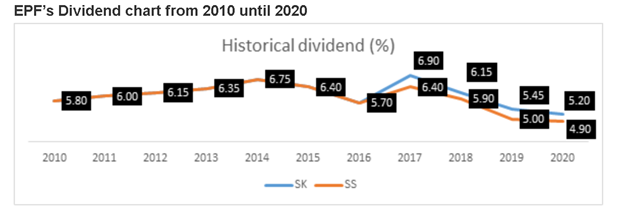
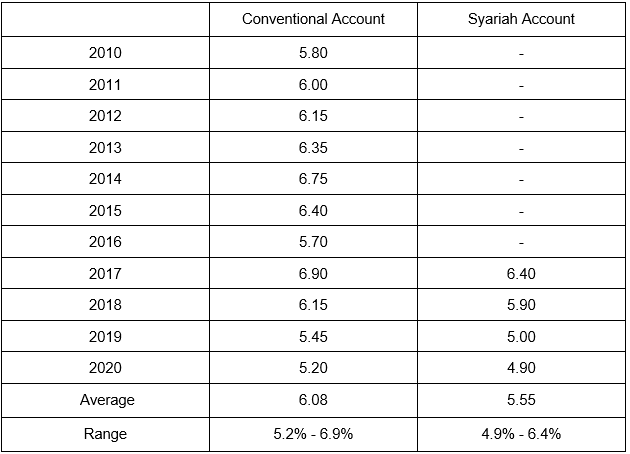
At the end of February 2021, EPF announced the 2020 dividend rate for Conventional accounts and Syariah accounts, paying out 5.2% and 4.9% respectively.
But what has the historical rate of EPF dividends looked like?
SK = Conventional AccountSS = Syariah AccountThe graph above is taken from the EPF website (as of 26 May 2021)
So while EPF has been paying a solid return each year, MIS provides the opportunity and potential for you to increase your investment returns and boost your retirement savings overall.
b. Enables you to increase exposure to foreign markets
Have you thought about where EPF decides to invest your money?
As at December 2020, EPF invested 67% of its investment assets in Malaysia and the remaining 33% outside Malaysia.
The numbers show that the majority of your EPF money is invested in Malaysia.
So if you’d like to have greater exposure to foreign markets, you can diversify your investments overseas via MIS.
c. Empowers you to have some control over your EPF investment
You can now choose to invest according to your risk profile.
There are EPF approved investment options for you to match your objectives and risk appetite.
3. Disadvantages of MIS
a. No guarantee of investment returns
For all its benefits, please note that any investment done via MIS doesn’t come with any guaranteed return, while EPF has a minimum guarantee of 2.5% dividend. You might get a higher or lower return compared to the EPF dividend rate, depending on your actual investment return.
You are solely responsible for the investment via MIS that you made.
b. Not entitled to EPF dividends
One of the big downsides is that the EPF money that you channel into MIS is no longer eligible for EPF dividends. Basically, you’re on your own. However, if you’re confident about your investment, this shouldn’t concern you.
c. MIS investments come with fees
Investment fees (such as sales charges, management fee and trustee fee) might eat up your investment returns. You must ensure that your investment returns (after deducting fees) will still be on par with EPF dividends at the very least.
4. How much can you invest under MIS?
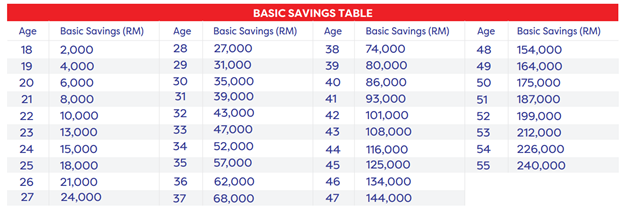
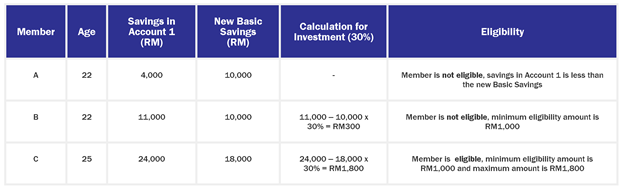
You may invest up to 30% of savings in excess of basic savings in account 1 with EPF. You may continue investing via MIS every three months as long as your balance in account 1 exceeds your required basic savings and fulfills all EPF requirements.
To confirm your eligible investment amount for MIS, you may check it under the i-akaun website.
Go to i-akaun website → withdrawal tab → withdrawal eligibility → member investment scheme.
The number that appears next to the member investment scheme is the amount eligible to invest via MIS.
Alternatively, you can also do a self-calculation of how much you can invest under MIS.
The formula is as below:
(EPF account 1 value – required basic saving in account 1 based on your age) x 30%Basic Saving Table from EPF website (as of 26 May 2021)
The minimum savings benchmark set by the EPF will be updated from time to time. You may check out the latest minimum savings required on the EPF website.
Sample calculation from EPF website (as of 26 May 2021)
5. Your investment options under MIS
You may invest via EPF in approved Unit Trust Management Companies and Asset Management Companies under MIS.
epf member investment scheme mis
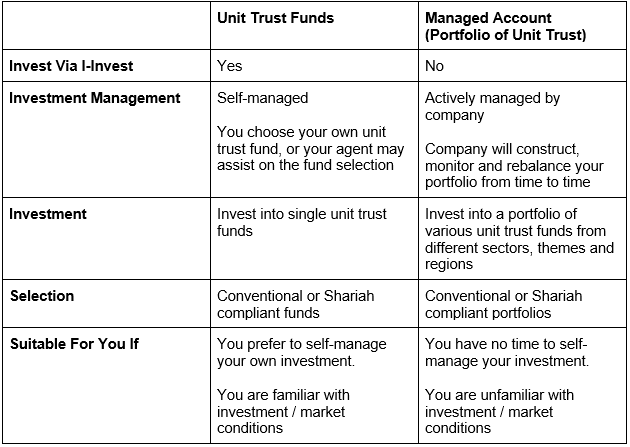
Difference between investing into unit trust funds compared to managed account (portfolio of unit trust)
In summary, any investment that you may choose to do via MIS comes with pros and cons. Do research and understand all the risks that you’re taking before proceeding with investing. If you have further enquiries on EPF investment via MIS, I suggest that you seek out a financial professional to discuss and design an investment plan that matches both your risk profile and investment objectives.
About the author
Kuah Soo Yee is a Licensed Financial Planner (CFP) who is passionate about helping people make sound financial decisions and achieve their financial goals, and recently launched her own app. Her personalised strategies and advice have helped many to gain better clarity and take firm control of their financial future. She can be contacted at soo.yee@ipp.com.myWebsiteLinkedInFacebookInstagram
Taking personal finance to another level by looking at it from a more holistic view.
How has the past year been for you? I’ve done a lot of reflection on myself and how I want to further evolve when things get a little more normal for the coming year (fingers crossed)!
One thing I personally learned is about life and recognising that money is just a tool. We must make sure we use it correctly in order to work towards financial wellness.
“People first, then money, then things.” – Suze Orman
Reflection on the path to financial wellness
The stoic path to wealth mentions that the fear of losing all our wealth is creating a monster inside us and therefore turning the chase for wealth into fear of losing it.
This eventually turns money into our master and we’re enslaved by fear until we almost lose touch with ourselves.
There is a saying “Money is the root of all evil”. But in actual fact, the full quote is “the love of money is the root of all evil.”
It’s the greed for wealth that is bad as it can corrupt minds, and the need to keep accumulating more and more is the real issue.
Money is not the end goal
Personal finance is not about the money we have or about creating more wealth. Its main purpose should be more holistic, ie. leading the life you were born to lead, no matter what your financial status is.
You’ll see money in a different light if you began your career with a student loan. Even before starting your career, you’ve already created a load of fear by accumulating a large amount of debt.
This results in your mind becoming clouded with thoughts of the repayment of loans first and pushing aside all other goals or dreams. I personally experienced it as a child; teachers kept telling me to finish school, get good grades, go to university, get a degree and get a good paying job.
As a child I thought that was the dream, but it didn’t turn out the way I imagined it would as a child.
We were repeatedly told this fairytale, and subconsciously I believed it. But now that’s not the case. How can we take a holistic approach around our personal finances and take back control of our life?
Believe me, we’re not meant to suffer through life constantly worrying about paying bills.
Reflecting on your childhood dreams
Have a goal in mind. You already knew what you wanted when you were a child. In fact, there’s a good chance you were so good at it.
Try asking your parents or other close family members what you were like when you were around the age of 9 to 12. It’ll give you some insights about your strengths and your childhood dreams.
I grew up observing how passionate my parents were and how they were willing to give their all to their career. At the end of the day, my parents still had time to spend with us and go on a little vacation once in a while. It was a nice balance.
That’s currently what I want to strive for – a balanced life between my career and family.
I’m not saying I don’t want to be rich (who doesn’t), but it’s not my main focus right now.
Between juggling two young kids, my husband works long hours because he enjoys the work he does. Even though in my opinion, he deserves to be paid better, it matters less.
There’s been a string of financial decisions we made that may be a sin in the personal finance community focused on accumulating wealth. But we needed to make those decisions to get to where we need to be in life.
Our goals were bigger than wealth accumulation.
Using my finances to find peace
We can never be free. I believe there’s no such thing as financial freedom. This is because I realised just when I thought we were “free”, something would suddenly hit us like a bomb and I would think “Here we go scrambling again”.
Getting married is expensive. Staying married is expensive. Having kids is expensive. I remind myself of my battles daily.
If my needs are covered, I am willing to forgo some of my wants. How precious and priceless is the laughter of a child?
Just do you
It‘s terribly hard to maintain a balance and I personally struggle with this on a regular basis. Turning off the work switch and being present was a difficult process.
Being frugal and being disciplined in managing our budgets has a big impact on our long term finances.
But this just makes me exhausted. There’s no point stressing about maximising my savings or the future so much that I forget to be present. The goal is not the money – it’s my life.
I’m not going to kill myself just to keep striving towards this illusion that my future will be far brighter if I continue maximising my savings and investments.
I choose to enjoy every step of the journey instead, without mentally burdening myself.
Use your wealth-building experience to create happiness for yourself and inspire others to do the same. Remember it’s not about the numbers and figures in your portfolios, but what you do with the money.
“Wealth consists not in having great possessions but in having few wants.” – Epictetus
Move from survival mode to thriving mode. Choose not to be trapped in the illusion of not having enough. You’re enough! If you’re in survival mode, you’ll trap yourself in the rat race.
Therefore, there’s no room for helping others and all you’ll think about is how to make yourself better instead of the community around you.
About the author
Nurul Yahi has a background in Business Administration majoring in Islamic Financial Planning. She’s a financial enthusiast and you can find her at dearduit.com. You can also find Nurul on Twitter, Instagram and Facebook.
Back in December 2019, the Covid-19 outbreak was triggered in Wuhan, a city located in the Hubei province of China.
The virus continued to spread and eventually escalated into a global pandemic which devastated every single corner of the world, causing radical changes in the way we live as well as social, economic, technological, and political policies.
Amidst the economic doldrum in China, there have been interruptions in exports and imports, while global supply chains have been disrupted significantly.
With a strongly connected and integrated worldwide trading relationship, the contraction in the global supply chain led to a big drop in global economic activities.
Furthermore, governments around the world have been forced to implement harsh restrictions on human activity to curb the spread of the virus.
These travel restrictions further burdened the financial markets and led to dramatic falls in global economies.
It’s been a similar situation in Malaysia, with the implementation of various Movement Control Orders (MCO) costing millions of people their jobs across varied industries, leaving many Malaysians suffering from salary reduction, furlough, or unemployment and retrenchment.
This impact has become apparent since the outbreak and many of them have turned to alternative jobs like driving Grab cars, venturing into the food and beverage industry, online vocations, or direct selling to make ends meet.
In December 2020, the Employees Provident Fund (EPF) launched a new scheme which allowed members to prematurely withdraw their EPF savings in order to aid their cash flow during the difficult economic times posed by the Covid-19 pandemic.
What are i-Sinar withdrawals?
The EPF i-Sinar initiative enables EPF members to make a partial withdrawal from their savings in EPF Account 1.
This initiative was launched by the EPF for the purpose of easing the financial burden of members who’ve been affected by the Covid-19 pandemic, helping them sustain their livelihood. The withdrawal amount will vary, depending on each member’s needs and of course their available balance.
Unfortunately, Malaysians are taking advantage of this opportunity to maximise their withdrawals and spending it on non-necessities.
In fact, without realising it, they’re withdrawing and spending their retirement savings nested in the provident fund!
According to a survey conducted by UCSI, among 809 people in Malaysia who have withdrawn from or planned to participate in the i-Sinar scheme, 47.2% of the respondents realised that the withdrawal will affect their retirement funds, 22.6% of the respondents were uncertain, while the remaining 30.2% of respondents didn’t realise the huge impact it would have on their retirement funds!
Returning to fundamentals, EPF serves as a social security organisation that primarily provides retirement benefits for the private sector and pensionable employees in Malaysia. Since 1951, it has proven to be a responsible and efficient custodian of its members’ retirement savings.
With the introduction of i-Sinar, this can potentially lead to a significant reduction in our retirement savings. The reason for this is that it leads to fewer dividends earned, missing out on the compounding interest in future.
If our savings are insufficient to sustain our retirement years, we may be compelled to delay our retirement further and continue to work, or may even be forced to downgrade our retirement lifestyle to one that is humbler or minimalist.
For individuals who’ve withdrawn their i-Sinar, what else they can do to manage the money beside spending it?
Well, upon fulfilling current needs, you’re highly encouraged to utilise the balance for better purposes such as investing. This is one of the instruments that’s able to grow our wealth through capital gain and appreciation in the value of an asset over time.
As with any savings fund, the benefit of putting money in EPF is the dividends and the compounding interest that you could accumulate over the years.
However, many EPF members have also opted to withdraw their i-Sinar and invest it into different investment vehicles which could offer potentially higher returns compared to EPF dividends.
Let’s use an example to illustrate this: Ms. Maria, aged 35 has withdrawn RM10,000 via the i-Sinar withdrawal facility and invested this into an investment vehicle that has the potential to generate 15% returns annually.
EPF DIVIDEND
ALTERNATIVE INVESTMENTS
PRINCIPAL
RM10,000
RM10,000
ESTIMATED ANNUAL RETURN
5%
15%
AGE 40
12,763
20,114
AGE 45
16,289
40,456
AGE 50
20,789
81,371
AGE 55
26,533
163,666
AGE 60
33,864
329,190
The table above explains how her i-Sinar withdrawal may grow from RM10,000 in the subsequent 25 years to RM329,190 thanks to higher returns and compound interest. If she doesn’t withdraw her i-Sinar and let it nest in EPF, she will only receive RM33,864 in the 25th year!
According to the aforementioned survey conducted by the UCSI Poll Research Centre, it shows that almost half (47.7%) of T20 income group earners who were polled said they used or would use their i-Sinar withdrawal for investment purposes.
Although the hardship faced during Covid-19 pandemic didn’t affect the T20 respondents as much as the others, they still saw this as an opportunity to invest and plan better for their retirement funds!
In a nutshell, the i-Sinar withdrawal is a good initiative to ease the financial burden of Malaysians who have been affected by the Covid-19 pandemic, helping them sustain their livelihood.
Despite part of the population not being affected much by the pandemic, they still continue to think about withdrawing their i-Sinar for investment purposes so that it can potentially generate better returns for their retirement funds. So instead of spending it on unnecessary items, invest it if possible!
Edmond Tang Zhen Han is a certified financial planner that is passionate about helping people achieve financial literacy in order for them to reach financial freedom. He can be contacted at edmondtangzh@genexus.com.my

 As a doting provider, you would want your family to inherit the fruits of your labour and ensure that they will always be well looked after especially in later years. With legacy planning, it allows you to pass on what is most important to your loved ones without compromising your current and future lifestyle.
With adequate legacy planning, you will be able to increase your estate, enjoy greater liquidity and ensure fair distribution should any unforeseen circumstances occur while benefiting from financial freedom in your golden years.
As a doting provider, you would want your family to inherit the fruits of your labour and ensure that they will always be well looked after especially in later years. With legacy planning, it allows you to pass on what is most important to your loved ones without compromising your current and future lifestyle.
With adequate legacy planning, you will be able to increase your estate, enjoy greater liquidity and ensure fair distribution should any unforeseen circumstances occur while benefiting from financial freedom in your golden years.
 If your wealth changes your life for the better, you are successful. If your wealth changes others’ lives for the better, you have created a legacy. What legacy will you leave behind? When is the right time for such commitment? The answer is now or the sooner the better. However, there are a few things to be considered such as:


 So while EPF has been paying a solid return each year, MIS provides the opportunity and potential for you to increase your investment returns and boost your retirement savings overall.
 In summary, any investment that you may choose to do via MIS comes with pros and cons. Do research and understand all the risks that you’re taking before proceeding with investing. If you have further enquiries on EPF investment via MIS, I suggest that you seek out a financial professional to discuss and design an investment plan that matches both your risk profile and investment objectives.