Wednesday, 5 August 2026 Stay informed. No noise.

Lazada partners with POP MART for faster access to collectibles

Lazada has partnered with POP MART once again to expedite collector’s journey, delivering a more seamless and enjoyable experience with faster access to sought-after IP collectibles. With Lazada’s new logistics enhancements, fans will enjoy faster deliveries, lower shipping costs and smoother return process.

Starting today, shoppers across Malaysia will enjoy enhanced collector experience with orders dispatched within 48 hours and arriving in as fast as 2 days. Fans can now shop their favourite POP MART collectibles on LazMall with full confidence, knowing they’re buying through a trusted and authentic channel for total peace of mind. The same enhanced experience will also be extended to POP MART fans in Singapore and Indonesia, bringing even more joy to collectors across the region.

Reinforcing the eCommerce Foundation for a More Effortless Collector Journey

The new logistics upgrades are part of Lazada’s broader mission to make shopping not just fast, but also frictionless and reliable. Fans can expect:

  • Faster dispatch and deliveries: Orders will be shipped within 48 hours, and will arrive in as fast as two days
  • Lower shipping fees: Optimised logistics help reduce costs borne by shoppers and make premium art toys more accessible than ever.
  • Hassle-free returns: Shoppers will enjoy LazMall 30-day free return policy, with more localised processes to ensure that refunds are easy and fuss-free.

“As the toy collector community in Southeast Asia continues to grow, we want to make every moment of the shopping journey on Lazada, from discovery to delivery, to feel effortless, seamless and exciting,” said Kaya Qin, Chief Executive Officer, Lazada Malaysia. “These enhancements are about more than speed; they’re about elevating the experience of collecting something you truly love.”

Improving Accessibility for Collectors across Southeast Asia

Lazada’s ongoing partnership with POP MART showcases the blending of commerce and culture, transforming the art of collecting into a multi-faceted experience. The collaboration has enabled Lazada to bring the brand to life through vibrant community experiences and exclusive drops – from the Lazada x POP MART 5 KM Run in Southeast Asia – including Malaysia’s energetic edition on Sunday, 12 October 2025 – to the POP TOY SHOW event in Singapore this August, where Lazada also hosted the brand’s first Regional Super Brand Day (RSBD) concurrently to share the excitement with all its regional fans online.

These touchpoints reflect Lazada’s growing commitment to nurturing Southeast Asia’s art toy movement by improving access and convenience online as well as creating opportunities to connect offline for all fans.

Malaysia tops emerging ASEAN banking benchmark on climate action

Malaysia’s banks have emerged as the strongest climate performers amongst the 14 ASEAN Banks assessed, according to Bridging the Gap: Have ASEAN Banks Caught Up on Climate Action?, a new report launched by Asia Research & Engagement (ARE).

The study finds that ASEAN banks in Malaysia, Indonesia, Thailand, and the Philippines are making measurable progress, with 11 of 14 setting long-term net-zero goals for financed emissions—up from three in 2022—but they still trail banks in Japan, Singapore, and South Korea, where decarbonisation targets are broader, deeper, and aligned with national net-zero goals for 2050.

Within emerging ASEAN, Malaysia stands out. The assessment of CIMB, Maybank, and Hong Leong Bank (HLB) underscores the country’s leadership:

  • CIMB has one of the region’s most advanced decarbonisation frameworks, with sectoral targets across coal, cement, palm oil, oil & gas, and real estate.
  • Maybank has embedded climate KPIs into executive pay, phased out coal financing across lending and underwriting, and disclosed detailed financed emissions.
  • HLB has pioneered client transition risk categorisation, engaging directly with high-emitting sectors.

Based on public disclosure, sustainable finance now represents a growing proportion of lending of the Malaysian banks, although the definitions vary so the numbers are not fully comparable.

  • Maybank: USD 39.3bn (24.4% of loans)
  • IMB: USD 33.8bn (33.4%)
  • HLB: USD 5.3bn (11.6%)

Yet challenges remain. Heavy financing exposure to palm oil and limited policies on upstream oil & gas leave gaps.

“Malaysia’s banks have raised the bar for emerging ASEAN, but credibility will rest on closing loopholes in palm oil and for gas finance,” said Ben McCarron, Founder and Managing Director of ARE.

Across the region, banks in Thailand, Indonesia, and the Philippines are rapidly improving governance and disclosure, while counterparts in Japan, Singapore, and South Korea continue to set the global benchmark with broader sectoral policies and 2050-aligned net-zero goals.

Opportunities Ahead for Malaysia
Malaysia’s leadership in ASEAN positions its banks to capture new opportunities:

  • Shape regional policy standards by extending strong frameworks beyond coal into gas-fired power and high-carbon sectors.
  • Set a governance benchmark by formalising climate-linked KPIs in remuneration and nomination processes.
  • Pioneer advanced risk practices by expanding financed-emissions disclosures and scaling client-level transition planning.

Accelerate sustainable finance growth by channelling capital into industrial decarbonisation and grid-enabling investments, turning current ambition into system-level impact.

Commenting further on the findings, McCarron, said, “Malaysia’s banks are setting the pace in emerging ASEAN with stronger policies, governance, and disclosures. The challenge now is to expand this leadership into broader sector coverage and 2050-aligned targets so the region can meet the demands of a low-carbon economy.”

MBSB Bank commits RM1 billion to solar financing

MBSB Bank Berhad (“MBSB Bank”) announces a dedicated RM1 billion allocation for solar financing, with RM104 million already in the process of disbursement, reinforcing its role as a catalyst in Malaysia’s renewable energy transformation and in advancing the objectives outlined under the National Energy Transition Roadmap (NETR).

“Our RM1 billion allocation for solar financing is designed to empower SMEs and industry players to invest in renewable energy projects that can accelerate Malaysia’s transition to a low-carbon future,” said Jesleigh Johari, Chief Operating Officer of MBSB Bank.

Under its Sustainable and Transition Finance Framework, MBSB Bank has already mobilised over RM4.7 billion in sustainable and transition financing — nearly halfway to its RM10 billion target by 2026.
Through a dual-financing model with MIDF, MBSB Bank offers SMEs a structured pathway to growth via facilities such as the High Tech and Green Facility (HTG), All Economic Sectors (AES), and Low Carbon Transition Facility (LCTF).

Recently, MBSB Bank reached a major milestone by formalising RM1.3 billion in Islamic Financing Facilities for Cypark Resources Berhad, Malaysia’s leading renewable energy and environmental solutions provider
Jesleigh added, “Beyond financing, transformation happens when industries collaborate and share ideas. Our partnership with MPSEA reflects our shared vision of a resilient, low-carbon Malaysia powered by innovation, purpose, and responsible finance.”

MBSB Bank remains steadfast in its commitment to support the nation’s energy transition, empowering businesses and communities to embrace a future powered by innovation, collaboration, and responsible growth.

SC and TERAJU to boost capital market access for Bumiputera MSME and MTC

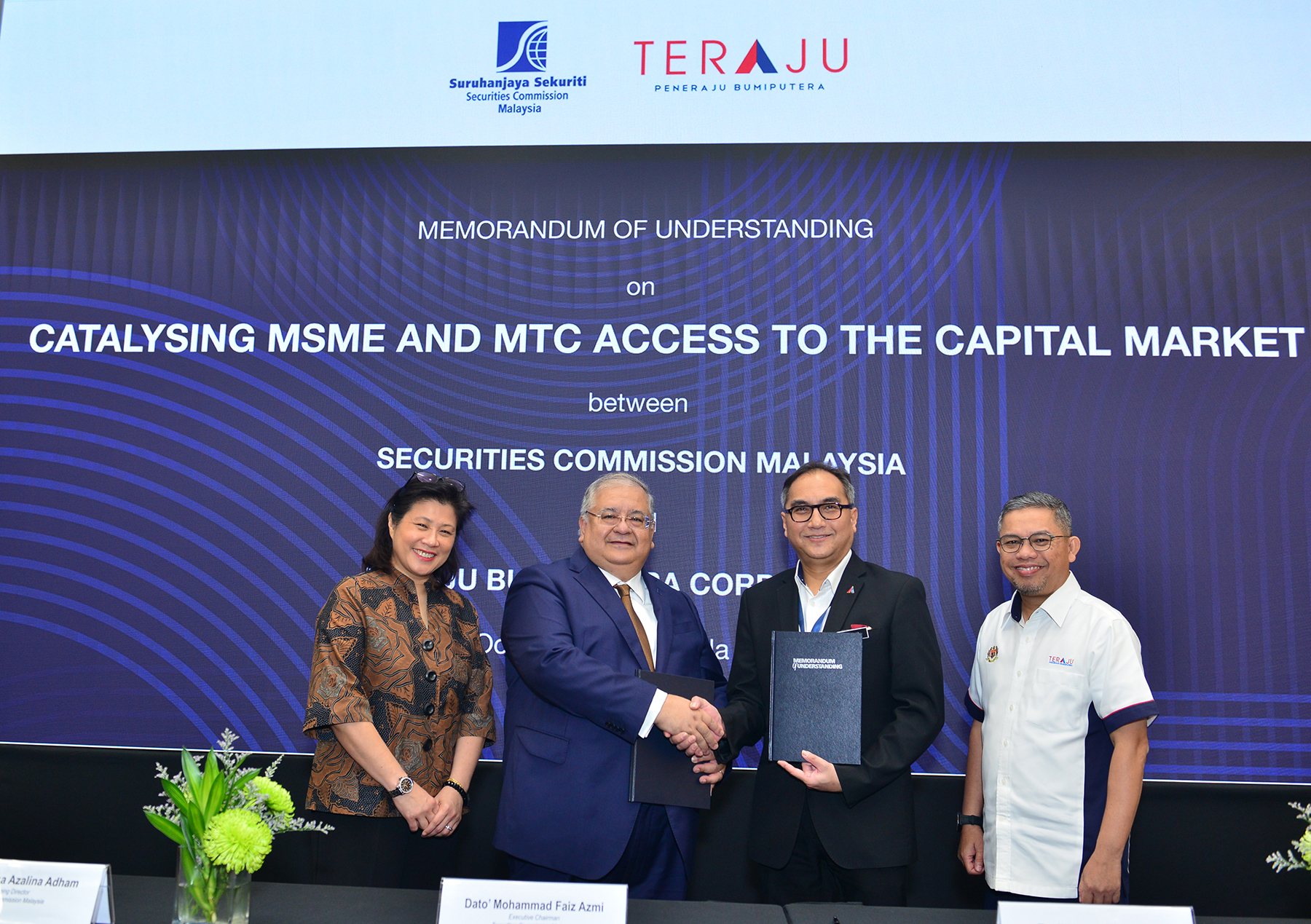
The Securities Commission Malaysia (SC) and TERAJU Bumiputera Corporation (TERAJU) have jointly agreed to facilitate better access to capital market financing for Bumiputera micro, small and medium enterprises (MSME) and mid-tier companies (MTC) through a Memorandum of Understanding (MoU).

The two-year MoU supports the SC’s ‘Catalysing MSME and MTC Access to the Capital Market: 5-Year Roadmap (2024-2028)’ (Roadmap), which is aimed at increasing MSME and MTC market-based fundraising to RM40 billion in 2028. In addition, this partnership supports SC’s capacity building initiatives as outlined under the Roadmap aimed at enhancing the readiness of MSMEs and MTCs for capital raising.
The tie-up also aligns with the 13th Malaysia Plan aspirations to scale up SMEs and enable Bumiputera entrepreneurs to compete regionally and globally.

Dato’ Mohammad Faiz said that Bumiputera companies have significant potential to scale, and capital market financing can be an important catalyst for their next phase of growth. “Through this collaboration with TERAJU, we aim to build a stronger pipeline of investment-ready companies that can raise funds, expand their businesses and compete regionally,” he said.

TERAJU’s CEO Encik Junady Nawawi said, “This collaboration opens up new pathways for Bumiputera companies to expand beyond traditional financing. By working together with the SC, we are preparing more Bumiputera enterprises to access capital market opportunities with stronger governance, sharper financial discipline, and the confidence to compete regionally and globally.”

A key outcome from this collaboration is to strengthen the fundraising readiness and leadership capacity of Bumiputera companies.

This will be achieved through targeted capacity building initiatives, including the creation of the Elevate–TERAJU cohort under the SC’s Elevate programme, led by Capital Markets Malaysia (CMM), an SC affiliate.
The Elevate programme is an executive leadership and fundraising readiness programme that help MTCs and SMEs strengthen their business strategy, governance, and financial management to meet the standards expected by investors.

Since its launch, five cohorts, comprising 78 companies have now successfully completed the Elevate programme. Under this initiative, 20 Bumiputera companies from the manufacturing, healthcare, engineering and technology sectors has been selected for the inaugural Elevate–TERAJU cohort, marking the first step toward broader participation in Malaysia’s capital market.
The MoU will cover the following areas:

  • Build a strong pipeline of Bumiputera companies with the potential to access capital market financing.
  • Explore financing avenues through potential co-investment opportunities with private investors, to support the growth and expansion of Bumiputera companies.
  • Support sustainability disclosures for companies through the adoption of the SC’s Simplified ESG Disclosure Guide and targeted capacity-building programmes.

TikTok strengthens Malaysia’s scam prevention efforts with multilingual #ThinkTwice knowledge hub

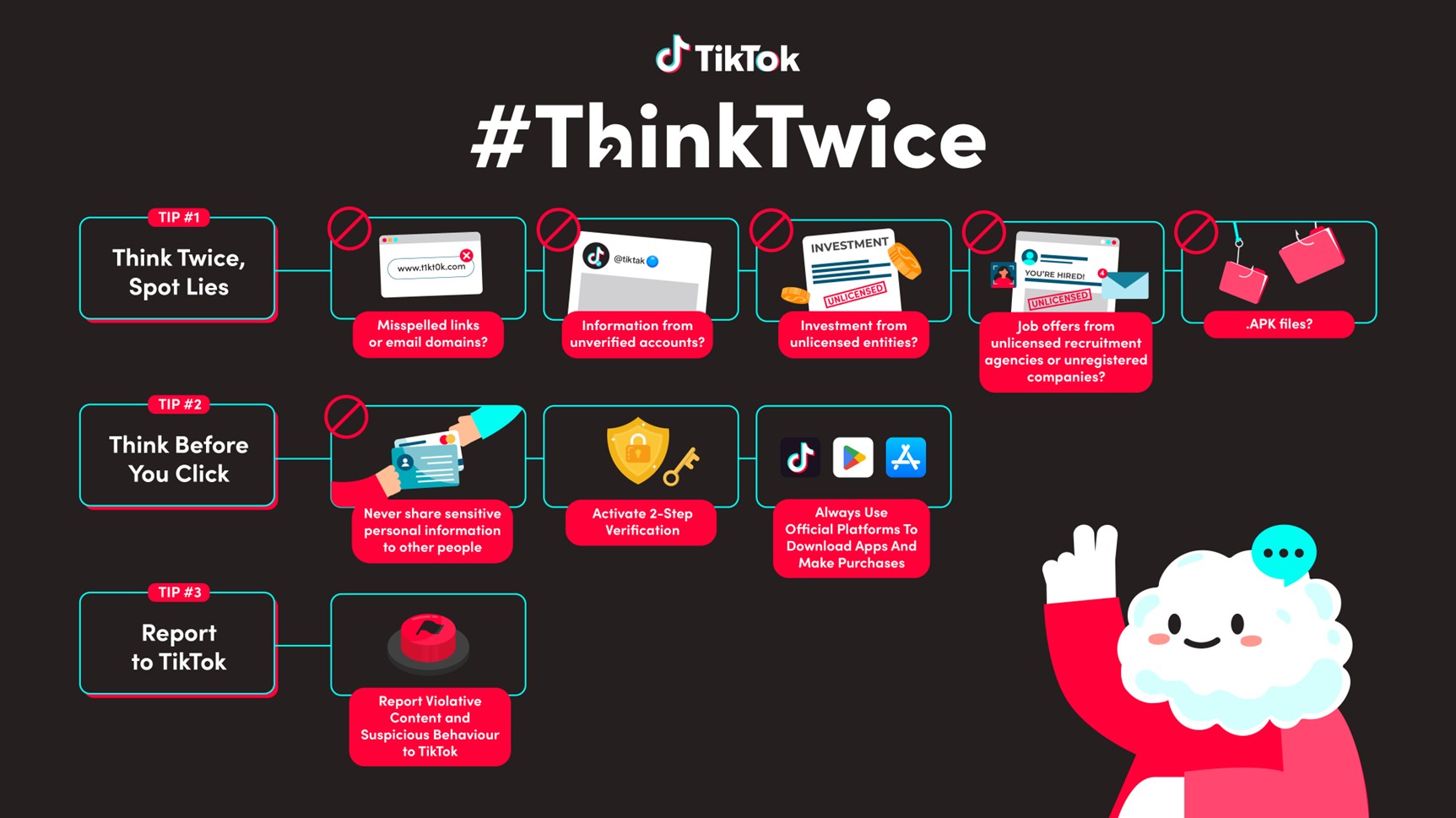
TikTok Malaysia has expanded its #ThinkTwice digital literacy initiative this year with simplified access to additional resources on scam prevention through its multilingual in-app knowledge hub, search banners, short videos, creator content, and upcoming series of industry dialogues.

The in-app knowledge hub is now available in more languages, including English, Bahasa Melayu, Mandarin, and Tamil. This initiative aims to spread awareness across millions of users nationwide through a multi-pronged approach in collaboration with the Royal Malaysian Police (PDRM), Malaysian Communications and Multimedia Commission (MCMC), Securities Commission Malaysia (SC), and other key government agencies.

Firdaus Fadzil, Head of Public Policy, TikTok Malaysia, said: “Online safety is a shared responsibility. It requires collaborative and continuous efforts across all segments of society. This is especially true in the case of scams as the modus operandi of cybercriminals are constantly changing. Education is key and we are delighted to empower Malaysians with the knowledge and tools to combat scams together through #ThinkTwice.”

TikTok’s digital literacy initiative encourages Malaysians to Pause, Prevent, and Protect. Pausing represents taking a moment to reflect and refrain from activities that violate TikTok’s Community Guidelines and local laws. Prevention means proactively deploying TikTok’s safety features and tools from local authorities to identify red flags. Protection rallies the community to keep each other safe by reporting potentially violative activities.

Dato’ Rusdi Mohd Isa, Director of the Commercial Crime Investigation Department (CCID) of the Royal Malaysian Police (PDRM), remarked: “Most of the scams can, in fact, be prevented. Among the most prevalent in Malaysia are investment scams, phishing, phone scams, job scams, love scams, and loan scams. There are readily accessible tools to assist the public in detecting such threats, including PDRM’s Semak Mule portal. Strengthening the nation’s scam prevention ecosystem requires the concerted involvement of both the public and private sectors. In this regard, TikTok’s support in enhancing public awareness is most timely and greatly appreciated.”

Malaysian Communications and Multimedia Commission (MCMC), underscored that: “Awareness and education remain our strongest defence against scams. While advanced tools and strong policies play a critical role, it is the public’s ability to detect and reject fraudulent tactics that ultimately determine our collective resilience. We are pleased to collaborate with TikTok to build a more informed and vigilant community. Through this partnership, we aim to amplify the reach of Sebenarnya.my, MCMC’s official verification portal, and AIFA, our AI-powered fact-checking assistant that helps users verify information instantly and confidently.”

Malaysians can easily access the knowledge hub by searching #ThinkTwice or relevant keywords on the TikTok app. It features four main pillars of information, mainly scam prevention tips using publicly available tools from key government agencies, TikTok’s Community Guidelines, TikTok’s safety features, and helplines to local authorities.

NCT Group expands industrial development with NGX

NCT Group of Companies (NCT Group), in collaboration with Northern Gateway (NGX) has launched the NCT InnoSphere, the first certified project of its kind to be built in the Delapan Special Border Economic Zone (SBEZ) in Bukit Kayu Hitam, Kedah. The project leverages NCT Group’s expertise in bridging technology advancement with environmental sustainability to create an industrial park set to attract global investors and next-generation industries.

NCT InnoSphere, spanning across 137 acres of free zone land, is being developed in partnership with NGX, a wholly owned subsidiary of Minister of Finance Inc. (MOF Inc.) and master developer of SBEZ. The development comes on the heels of the NCT Smart Industrial Park (NSIP) in Selangor, launched by NCT Group in 2023, Malaysia’s first certified MIP, which achieved 80% sales in Phase 1 and is set for vacant possession in Q4 2025. NSIP has been recognised for its green-oriented design and innovation, including a Five‑Diamond rating under the Low Carbon Cities 2030 Challenge for its exemplary low-carbon design, the StarProperty Excellence in Business Estate Award for best industrial park development, and the Asia Pacific CEO Sustainability Awards 2025 for sustainability leadership in industrial development.

Dato’ Sri Yap Ngan Choy, Founder and Group Managing Director of NCT Group, said, “We are honoured to work alongside the Kedah State Government and NGX on this transformative, world-class initiative. NCT InnoSphere will not only unlock long-term economic value creation for the northern region, it will support national efforts to diversify logistics channels and facilitate seamless trade access among regional markets.”

Under the Joint Development Agreement, NCT Group is responsible for the full delivery of the project, including planning, construction, and ecosystem development. NGX, as landowner and facilitator, will oversee the primary infrastructure works, utility provisions, and regulatory coordination to ensure smooth project execution.

Its strategic location adjacent to the Malaysia-Thailand border and in close proximity to Penang Port, positions NCT InnoSphere as a vital land access trade gateway for the Northern Corridor, while also serving as a hub for key industries including logistics, automotive supply chains, food manufacturing, digital and smart technologies, advanced manufacturing, and agriculture and bio-industries.

Dato’ Sri Yap added, “Our second MIP is a strategic leap forward in our commitment to help shape Malaysia’s industrial future with a high-impact ecosystem. NCT InnoSphere is designed to harness the strengths of cross-border trade, logistics efficiency, and smart infrastructure, creating a significant platform for advanced industries such as semiconductors, electrical and electronics, and smart logistics to flourish. As with NSIP, our goal is to foster a resilient environment on a foundation of digital readiness and innovation.”

Razwin Sulairee Hasnan Termizi, Group Chief Executive Officer of NGX further added: “NCT InnoSphere is built at the Zero Mile Zone, the very first point of Malaysia’s supply chain. Each year, nearly 1.3 million trucks cross at Bukit Kayu Hitam–Sadao, carrying close to RM70 billion in annual border trade, making InnoSphere the first touchpoint for consolidation, light assembly, or full-scale manufacturing. This creates what we call the First Load Advantage, where investors capture value in the first mile, as every truck and shipment that flows south begins its journey here. As part of Delapan, InnoSphere also sits at the convergence of more than 60 Free Trade Agreements (FTAs), giving investors seamless access to regional and global markets. Penang becomes a natural stop along a one-flow corridor that ultimately leads to Singapore. Backed by the Bukit Kayu Hitam Inland Port (BKH ICD) and strengthened by Thailand’s role as Malaysia’s natural value chain partner, InnoSphere is an industrial park that will define the cost of supply chains to be competitive, directly tied to the cross-border flows that already drive this region’s economy.”

NCT InnoSphere is planned as an eight-phase development, with each phase equipped with a mix of industrial, commercial, and support components to efficiently facilitate operational, trade and manufacturing activities. The development will feature over 230 units, including semi-detached, detached, cluster, terrace, and built-to-suit configurations, designed to accommodate diverse business needs across sectors, with an estimated Gross Development Value (GDV) of RM1.10 billion.

With a Silver Provisional GreenRE Certification in hand, NCT InnoSphere is the first MIP in Northern Malaysia with this distinction. Aligned with NCT Group’s longstanding sustainability drive, the project will incorporate features that promote environmental responsibility and greener operational efficiency in forward-thinking industrial layouts.

NCT InnoSphere will be a catalyst for industrial advancement in the Northern Corridor. Through its Free Zone designation and collaboration with agencies like MIDA and NCER Malaysia, NCT InnoSphere will provide investors duty exemptions, streamlined customs processes and access to cross-border incentives. Additionally, a dedicated one-stop centre within the park will offer integrated investor services, including licensing support and coordination with relevant government agencies.

New report warns boards of top risks in Southeast Asia in 2026

As companies budgets and business plans for 2026, the latest global Risk in Focus 2026 Report by the Institute of Internal Auditors Inc. warns that boards must urgently strengthen governance to keep pace with fast-evolving risks.

The report has outlined changes in top risks over the years in many regions, showing how cybersecurity, business resilience, disruptive technologies such as AI, and geopolitical volatility are converging into complex increasingly interconnected, challenging and intensifying.

In the Risk in Focus 2026 Report’s regional deep-dives, Asia Pacific is highlighted as a fast-growing but risk-intensive region requiring urgent governance responses. Specially to Southeast Asia, the Report highlights that Cybersecurity (67%) tops the list as the number one threat, with AI, digital disruption, and data privacy expanding the attack surface. Business resilience (62%) comes second, reflecting the impact of tariff wars, supply chain shocks, and climate-related disruptions. The top two audit priorities for Southeast Asia (above 60%) mirror these threats.

For Southeast Asia, these trends not only heighten exposure but also present an opportunity: organisations that invest in the right resources, skills, and internal audit capabilities today will be better positioned to build resilience, sustain growth, and protect stakeholder trust in the years ahead.
However, while 52% of Southeast Asia survey respondents included digital disruption as a Top 5 risk – with AI reshaping competition and productivity, just 32% included it as a Top 5 audit priority. Many companies admit they lack the skills and frameworks to respond.

This year, the annual global report surveyed over 4,000 senior internal audit leaders worldwide, including 159 respondents from Southeast Asia who represent organisations with significant operations in the region. The 2026 edition introduces a forward-looking outlook — not just a snapshot of current risks but a projection of what boards cannot afford to ignore in the next three years. It also integrates AI, green finance, and geopolitical fragmentation as cross-cutting themes, which were less pronounced in earlier reports.

Malaysian Companies Under Pressure In 2026
Some of these risks are already manifesting and weighing on organisations in Malaysia. In 2024, police reports point to cybercrime losses exceeding RM1 billion, and yet, only 2% say they are prepared. That’s a governance gap with real financial consequences. Meanwhile ESG compliance pressures are also mounting with IFRS S1/S2 alignment this year and Scope 3 reporting by 2027.

Boards, therefore, cannot afford to deprioritise these threats, and gaps between identified risks and internal audit coverage, particularly in areas such as cybersecurity, digital disruption and human capital which must be addressed with the appropriate control measures.
In these, internal auditors can support leadership in anticipating risks, testing resilience and building confidence with stakeholders. What were once operational — have now become
business survival issues, and internal auditors are empowered to guide boards through this era of polycrises.

With organisations improving their resilience against “cascading failures”, The Institute of Internal Auditors Malaysia offers more than 90 training programs each year to elevate governance practices and foster a culture of transparency and accountability for businesses. IIAM recently launched the Statement of Risk Management and Internal Control (SORMIC) Guide 2025 with Bursa Malaysia which provides public-listed companies with a clear framework to strengthen disclosures, bolster investor confidence, and embed risk governance into their operations.

Demand for internal audit upskilling is also rising sharply: with growing enrolment in IIAM’s 80 programmes.” Continuous professional development and staying abreast of emerging trends are key to enabling internal auditors to excel in their roles. The Institute is central to equipping professionals with the knowledge, skills, and ethical standards necessary to comply with Global Internal Audit Standards effectively.

Advancing cyber resilience through data-driven intelligence

Zurich Insurance Group (Zurich), together with the Cyber Threat Alliance and CyberGreen Institute, has published a new report “Enhancing cyber security: Key metrics for policymakers” urging the adoption of standardised national cyber security metrics. The report notes the global cyber risk protection gap of USD0.9 trillion, with insured losses covering only 1% of economic losses from cyber incidents.

The measures proposed in Zurich’s 2024 whitepaper, “Closing the Cyber Risk Protection Gap”, rely on robust quantitative data to enhance standards and best practices. While organisations like ENISA and CISA provide corporate-level frameworks, national metrics for policy decision-making are largely absent. Zurich’s new report introduces six key metrics and an institutional framework for governments to help clarify national cyber risk, strengthen resilience, and enable informed policy decisions:

  1. Percentage of organisations with cyber insurance or audit certification: Measures preparedness and understanding of cyber security.
  2. Proportion of exploited vulnerabilities older than one year: Indicates ecosystem defense and remediation speed.
  3. Number of significant cyber incidents: Reflects national detection and analysis capabilities.=
  4. Average time to containment of cyber incidents: Demonstrates ability to halt the spread of threats.
  5. Mean time to restore operations: Assesses speed of recovery after incidents.
  6. Percentage of unfilled cyber security positions: Gauges workforce capacity to manage risks.

Establishing National Cyber Statistics Bureaus – dedicated institutions for collecting these metrics – would ensure consistent incident reporting, track threats and resilience, publish key analyses, and assess security regulation effectiveness. These bureaus could also support a supra-national body to aggregate findings, enabling deeper global comparisons and insights into evolving threats.

To move from currently fragmented, reactive approaches to a unified, data-driven strategy, Zurich calls on policymakers to:

  • Collaborate on data collection: Move from reactive incident reporting to proactive, cross-sector data sharing
  • Establish dedicated entities: Create or empower national and global institutions to collect, analyse, and report cyber statistics across industries and borders
  • Harmonise standards and frameworks: Align definitions, benchmarks, and reporting protocols.

LexisNexis launches Lexis+ AI with Protégé Malaysia

LexisNexis® Legal & Professional launches Lexis+ AI with Protégé Malaysia, a state-of-the-art, personalised AI assistant designed to transform legal work in Malaysia. The platform is built to streamline routine tasks while empowering legal professionals in unlocking new economic opportunities.

Developed with insights from pioneering customers, this groundbreaking solution harnesses the power of both AI agents and generative AI, all grounded in proprietary LexisNexis Malaysia content, including the prestigious Malayan Law Journal, to deliver next-level productivity and outcomes. Additionally, it is developed to the highest standards of security, compliance and privacy, ensuring that with dedicated human oversight, Protégé autonomously reviews, refines, and continually improves its deliverables based on user-defined goals.

“With the launch of Lexis+ AI with Protégé Malaysia, we are excited to offer a solution that is perfectly aligned with the unique legal landscape of Malaysia, ensuring every practitioner has access to a personalised and intelligent assistant that drives better outcomes,” said Gaythri Raman, Managing Director, LexisNexis Southeast Asia and India.

Leveraging proprietary agentic and generative AI technology, Lexis+ AI with Protégé offers a suite of
cutting-edge features, including:

  • Document Analysis and Summarisation: Upload and analyse documents with speed and
    accuracy. Lexis+ AI can summarise large, complex documents and generate concise overviews.
  • Intelligent Drafting: Draft personalised legal documents – ranging from transactional contracts
    to litigation motions, briefs, and court filings – with the ability to self-review and flag areas for
    improvement.
  • Graphical Timeline: Generate visual timelines from uploaded documents, highlighting key
    events and milestones.
  • Dynamic Workflow Suggestion: Receive actionable prompts and automated suggestions based
    on the type of document and workflow requirements. The assistant can dynamically generate
    follow-up queries to further tailor outputs.
  • Secure Document Management: Protégé Vault allows users to securely store, upload, and
    manage thousands of legal documents while performing a variety of AI-driven tasks such as
    identifying key information, extracting clauses, summarising and drafting.

The Malaysia launch builds on the successes in the United States, United Kingdom, Hong Kong, and
Australia, where LexisNexis has deployed similar innovations in legal AI. Integrating extractive AI (for
deep insights and data retrieval), generative AI (for content creation), and now, agentic AI (for
autonomous task completion), Lexis+ AI with Protégé is set to transform legal workflows by:

  • Reducing Repetitive Work: Allowing legal professionals to spend less time on mundane tasks
    and more on high-value services.
  • Improving Outcomes: Enhancing the accuracy and precision of legal documents through
    advanced self-review features.
  • Personalising User Experience: Grounding AI outputs in locally relevant legal content and
    tailoring the experience based on the specific needs of the Malaysian market.