Saturday, 22 August 2026 Stay informed. No noise.

Analysis: Property Market Expected to Bounce Back

As the nation endures its third week under the extended Movement Control Order (MCO), Malaysians from every walk of life face increasing uncertainty in the face of unprecedented sociopolitical and economic change.

The impact of the MCO amid the ongoing Covid-19 outbreak on the Malaysian economy has yet to be fully realised. Conservative estimates forecast Gross Domestic Product (GDP) growth of 2.0% to 2.5% for 2020, while other analysts foresee domestic and global recession.

However, PropertyGuru Malaysia, in line with its commitment to being the nation’s property advisor, anticipates corresponding effects on home seeker sentiment to be short-lived,with prospects for recovery in the near term.

Bread-and-butter Issues Take Centre Stage 

“Income and employment have been adversely affected by the closure of non-essential businesses during the MCO, and many Malaysians are prioritising bread-and-butter issues,” says Sheldon Fernandez, Country Manager, PropertyGuru Malaysia.

Sheldon Fernandez Country Manager PropertyGuru Malaysia
Sheldon Fernandez

“This dampened sentiment is likely to persist through to H2 2020, though measures such as the government’s Economic Stimulus Package (ESP) announcements and Bank Negara Malaysia’s (BNM’S) six-month moratorium on financing payments are laying the foundation for the market to bounce back.”

Sentiment among home seekers was already in decline at the start of the year, with the PropertyGuru Malaysia Consumer Sentiment Study H1 2020 reporting a drop in the Property Sentiment Index to 42 points, down from 44 points in the corresponding period last year.

This will likely see a fall in home loan applications, despite catalysts such as BNM’s recent revision of its Overnight Policy Rate (OPR) to 2.50%. Other markets experiencing Covid-19 outbreaks have seen mortgage applications drop by as much as 30%.

Beyond these short-term impacts, research by property data analytics and solutions provider MyProperty Data Sdn Bhd underscores the property market’s resilience in the face of prior economic downturns and viral outbreaks, notably the severe acute respiratory syndrome (SARS) epidemic of 2002.

The Resilience of Property

While recent events have brought industries such as tourism and hospitality to a standstill, property transaction volumes and values have remained strong throughout periods of uncertainty (see Chart A).


Chart A Transaction Volumes And Values 1988 2018
Chart A: Property Transaction Volume vs Value Growth (Source: MyProperty Data, NAPIC data)

“The 1998 recession, in conjunction with the outbreak of the Nipah virus, saw volumes and values declining by 32.3% and 47.6% respectively, the largest downturn in recent decades,” says Fernandez.

“However, the industry still moved forward, with 186,000 transactions worth RM27.9 bil. In addition, house prices as a whole have only continued to grow over the past few decades, highlighting the merits of property as an asset class.”

According to the National Property Information Centre (NAPIC), the national house price index has not exhibited an overall decline since 1999, though its growth moderated to a low of 1.1% in 2001.

In terms of property types, high rises exhibited the most volatility in prices from 1999-2009, from a high of 15.1% growth in 2003 to a low of –5.9% the previous year (see Chart B).

Chart B Malaysian House Price Index Growth 2000 2009
Chart B: Malaysian House Price Index Growth (2000-2009) (Source: PropertyGuru Analytics, NAPIC data)

From 2009 to 2018, this volatility spread to other property classes such as detached and semi-detached homes. Since 1999, terrace homes have shown the most stability and consistent price growth among property types, with prices in the segment growing by 6.5% in 2018 (see Chart C).

Chart C Malaysian House Price Index Growth 2010 2018
Chart C: Malaysian House Price Index Growth (2010-2018) (Source: PropertyGuru Analytics, NAPIC data)

As such, terrace homes will likely be a key focus for property seekers moving forward. This is supported by the PropertyGuru Malaysia Consumer Sentiment Study H1 2020 report, which found that terrace homes are the residence of choice (39%) among Malaysians.

Locational Variations in Demand

The aforementioned price trends were seen in the market as a whole, with variations in demand by area. For instance, MyProperty Data research shows that terrace homes emerged as the clear favourite in Greater Klang Valley from 1999 to 2004, in terms of transaction volumes.

However, Kuala Lumpur saw high demand in luxury condominiums and service apartments throughout these crisis years. High-rise properties were also popular in Penang, particularly lower-end apartments and flats.

“For Selangor, it was the city fringe, with terrace houses in Subang Jaya, USJ and Putra Heights as the hottest market. Median prices went from about RM220,000 in 1999 to up to RM400,000 by 2004. Around which time, demand similarly progressed to Setia Alam, Klang and other outlying areas towards 2012,” says Joe Hock Thor, CEO, MyProperty Data.

Joe Hock Thor CEO MyProperty Data
Joe Hock Thor

“Developers such as Sime Darby, SP Setia, Gamuda Land and IOI caught the wave perfectly, building larger homes within master planned townships at prices found closer to the city. High-rise popularity in Kuala Lumpur over this period picked up post-2003; this may have been due to cashed-up investors taking the opportunity to pick up glossy headline properties at discount prices.”

This resulted in substantial price appreciation, with median high-rise prices rising from RM350,000 in 4Q 2003 to RM765,000 in 4Q 2009.

Inflection Point and Recovery

Whether in terms of price, transaction volume or value, the property market has repeatedly showcased a tendency to bounce back immediately following a downturn.

This is seen in surging transaction volumes and values in the years following 1998 (the Asian financial crisis and Nipah virus outbreak), 2002 (the SARS outbreak) and 2008 (the global financial crisis and H1N1 outbreak).

Similar recoveries are seen in national house price growth in the years following 2001, 2006 and 2009. “Price growth, as well as transaction volumes and values, have slowed down in recent years, with measures in place to address the residential overhang. This may cushion potential impacts on the market as it rolls with the blow,” says Fernandez.

“Moving forward, investors tend to restructure their portfolios in uncertain times to manage risk, with property as a potentially lucrative venture. This, along with natural corrective forces as the market regains equilibrium, may account for the sharp recoveries seen in domestic property following crisis years.”

These patterns are set to repeat themselves following the MCO and Covid-19 outbreak, with various initiatives contributing towards significant domestic liquidity moving forward.

These include BNM’s reduction of the Statutory Reserve Requirement Ratio to 3.00%, moratorium on financing payments, OPR revision as well as revised voluntary EPF contribution guidelines in the government’s earlier ESP announcement.

“For those struggling to make ends meet, these measures help address costs of living while presenting an opportunity to rebuild savings. For those with leverage, it may be a good time to invest,” says Fernandez.

“There have already been calls from some quarters for revised loan-to-value ratio caps for third home purchases. This would accommodate demand from property seekers with leverage, driven by developer initiatives to add value for purchasers amid the changing property landscape.”

GuruCares Reaches Out to Property Agents

The Covid-19 outbreak and MCO have highlighted existing structural weaknesses in domestic businesses when it comes to technology-driven remote operations. However, while property players are tapping further into online platforms to drive sales, the underlying business model is likely to remain.

“Developers have already invested in virtual show units and the online paradigm, and these can be useful for informational purposes. Due to the large emotional and financial investment required for property purchases, though, there will always be a need for the human touch, as well as physical showrooms and site visits,” says Fernandez.

However, PropertyGuru acknowledges the potential impact of the MCO and other recent events on industry stakeholders, particularly property agents, who are often overlooked amid the larger national housing agenda.

In its role as Asia’s largest property technology company, PropertyGuru has announced the launch of a (), aimed at easing the burden on agent partners. These include:

  • 100 free advertising credits, valid for a 12-month period to support listing activities
  • Complimentary account upgrades for renewing agents
  • 40% price reductions for any agent package, for first-time applicants, and
  • Four months’ unlimited access to Property Transaction Reports.

P2P Investing Ideal for Millennials

Every year, thousands of young Malaysians launch their businesses, and as these young entrepreneurs set out to change the business world, raising the funds necessary to start their businesses is invariably a huge obstacle. So, what about P2P investing?

This is where microLEAP comes in – catering to the Malaysian microfinance sector, the B40 to lower M40 income group as well as businesses that require small funding amounts, the peer-to-peer (P2P) financing platform is exploring an untapped space in the P2P world. In the process, it has found its niche and calling.

Smart Investor speaks with microLEAP CEO Tunku Danny Nasaifuddin Mudzaffar about P2P financing as an ideal investment option for millennial and Gen Z investors.

Smart Investor: Can you share what inspired your founders to establish microLEAP, and to focus on micro-enterprises?

Tunku Danny Nasaifuddin Mudzaffar: After 15 years in banking and financial services, I wanted to do something that would have an impact in people’s lives, yet give me the opportunity to use the knowledge and skills that I’ve learnt in my many years in KL and London.

So, after leaving my very comfortable banking job, I decided that microfinance was the answer, where small amounts of money can have a great impact on the livelihoods of many people we assist. But in what format? I looked at raising funds from investors and banks to lend from my own balance sheet, but it wasn’t innovative enough.

There must be another model out there, I thought, and that’s when I stumbled upon P2P financing. P2P financing is perfect to plug the RM80 bil funding gap in Malaysia estimated by the Securities Commission (SC) in 2018. It connects P2P investors, looking for alternative assets that provide a return higher than fixed deposits, to issuers, or borrowers, who require much-needed working capital. It’s a win-win in my book.

Having learnt that Malaysia was the first country in Asia to regulate P2P financing, I started doing my research and hatched a business plan for my P2P microfinancing platform. I found that microenterprises, which have business owners in the B40 to lower M40 income group, were not really serviced. There was a gap in the market, a gap that could eventually leave the underserved behind as our economy grows.

So, having found my target market, I then found my co-founder who was the ex-CEO of the largest government-funded microfinance institution in Malaysia. I then set about establishing the founding team and from this microLEAP was born. 

Can you share how much microLEAP has benefited Malaysian micro-enterprises so far?

microLEAP is still very new and we only went ‘Go-Live’ in October. With our tagline ‘small steps, BIG IMPACT’, we assist microenterprises raise funds from as little as RM1,000 to RM50,000.

Nonetheless, we have fully funded six microenterprises with financing amounts ranging from RM1,000 to RM25,000, giving our P2P investors returns from 10%-12%p.a.

At the moment we have a 0% default rate and our issuers are strictly credit scored before they are hosted on our platform. We also have our first Shariah-compliant Investment Note ready for funding in March and we are targeting a 60-40 split in terms of Islamic vs Conventional Notes.

The microenterprises we have helped are far reaching and diverse, from a small shop selling handbags in Ipoh, to an e-commerce company selling halal confectionary in Kuantan, all the way to a small events company in Kota Kinabalu.

Of the microenterprises which received funding from microLEAP, what proportion of its business owners are millennials?

Millennials account for about 2/3 of all business owners that have requested for funds on microLEAP. This data gives us a couple of things:

  1. As we are in the business of fintech (financial technology), where we cut costs by pushing everything to digital, our issuers (borrowers) need to be able to use a smartphone, laptop or PC to complete their online application. We do not use any physical documents. This sits very well with millennials rather than older issuers who may not be used to filling forms online; and
  2. It tells us who our target market is and where we should concentrate our efforts on. That is not to say we will only concentrate on millennials, as businesses with many years of experience in managing debt and managing P&L is an important consideration when it comes to credit risk. However, it tells us that P2P financing is much more geared towards the tech-savvy millennials than say, Generation X or Baby Boomers.

What makes P2P financing an ideal investment option for Gen Y and Gen Z investors?

P2P financing is absolutely made for Gen Y and Gen Z investors. While sipping their soy-milk, decaf chai-latte, they can easily log in, choose the Investment Note that suits their credit risk profile and returns target, top-up their available balance online and invest in the time it takes most Baby Boomers to work out how to log on to Netflix!

Gen Y and Gen Z investors are extremely tech savvy and their knowledge in this space should not be underestimated.

How easy is it for millennials to start investing via the microLEAP platform?

We believe simplicity is key. With everything that we do being online and digital – from your investor application, to our KYC, AML and CFT checks, to your top-up into your available balance and your investments – it is extremely straightforward to carry out any transactions on our platform on your smartphone.

We also give a RM10 free credit for first time investors to use on the platform, and they can get a RM10 referral fee for every other investor they get to sign-up.

However, what really sets us apart from the rest, and is a main draw for many of our millennial investors, is the impact that their investments can make.

Microfinance, and to this extent micro-enterprises, are often the underserved of the economic population. It is not always profitable for banks to cater to microfinance due to the cost per loan (it is much more profitable to write a RM1,000,000 loan than a RM1,000 loan) and so many micro-enterprises lack access to basic loan products.

By becoming a P2P investor and with a minimum investment of RM50, millennials have the chance to have a real impact in people’s lives by providing much needed working capital to our microenterprises. As our tagline goes, small steps, BIG IMPACT!

By Bernie Yeo

6 Simple Ways To Reduce Investment Risk

How do you evaluate your risk before you invest? Experts share how to go through Risk Profile Evaluation to ensure that your take calculated risks towards achieving your personal financial goal, and ways to reduce your investment risk.

Here are the six factors you should consider that will be affecting your risk profile. Let’s dive in!

12

Factor #1: Age

Risk tolerance reduces as you grow older because you have less time to recover your loss if you make any financial mistakes.

In other words, do your due diligence before investing in a company, a stock, a property or any investment vehicle.

The more you understand the ins and outs of an investment vehicle, the better you can make informed decisions and hence, reduce your overall risk.

Factor #2: Your Current Family Situation

If you are Single, young and capable, you can tolerate more risks in your decision-making. You have more time to learn, study and grow compared to someone who is already retiring.

If you’re a young and newly married couple, you should also be able to tolerate more risks towards achieving your financial goals.

However, couples contemplating divorce and couples with kids should be more risks adverse and opt for more careful planning.

Factor #3: Your Current Income Source

Double-income families with both husband and wife working can assume more risks.

For example, the one with the more stable income, with good employment medical and retirement benefits can enable the other spouse flexibility to take a little bit more risk for higher financial gains, or even starting a business.

Consider your level of commitment and what would be the worst that can happen, if the investment does not go as planned.

On the other hand, families with just one spouse as the sole breadwinner should not be making high-risk investments.

Factor #4: Availability Of Surplus Cash

If you have a comfortable surplus of cash buffer that could take you through for a minimum or more than 6 months, then you can take more risks with your investments.

If not, take very calculated risks. Always think about an exit plan and the worst-case scenario as no one can guarantee how the market will perform.

If you are burdened with debts, it is advisable not to take on any high-risk investment vehicle.

Factor #5: Your Coverage

Risks resulting from unforeseen life events such as accidents, sickness, disability or premature death should always be taken into account first before you utilise extra funds to pursue a higher return corresponding with a higher-risk investment.

If you have adequate insurance coverage to indemnify yourself or your family, then you might be spared the financial burden of having to utilise your liquid assets.

Factor #6: Sleepless Nights

Lots of investment schemes in the market paint remarkably beautiful prospects with the promise of high returns.

Do invest with care!

It is not worthwhile holding on to one investment if you will be concerned about parting with too much of your hard-earned money.

Would you be always thinking about how this investment could potentially compromise your existing lifestyle if it doesn’t go well?

Ask yourself, “If this investment goes bust, will I still be able to sleep at night?”

Just reject the “opportunity” if you don’t feel at peace with it.

345

Start Investing Now, No Matter How Small

The early years of working life (between ages 20-30) are surely the best time to begin investing. Ironically, this is also the time of your life when you have the least amount of money to set aside after deducting all your expenses.

However, no matter how little you are able to set aside, the time factor can make up for that. The concept of compounding interest will kick in to multiply your minute savings into a large retirement nest egg 20-30 years down the road.

It is also at this early stage of your working life that you can afford to take on higher investment risk vehicles. Should you incur losses due to a wrong investment decision, there is still ample time to start all over again.

Thus, even if you start with a small amount of money at this stage of life, you can invest in riskier investment vehicles to generate higher returns to make the most out of your small savings.

In fact, you have two choices to opt for:

(i) Go for a high-risk/return investment vehicle or

(ii) Settle with lower risk and safer investment (lower returns).

Your decision now should depend on your personal risk tolerance level.

Remember, always strive to set aside some funds, no matter how little, into a vehicle of your choice and set a target or milestone on the investment to help you monitor the progress and appreciate the fruits of your investment.

Most people did not understand the importance of starting early, and therefore have to compromise their lifestyle when they reached the stage of life when they intend to start a family.

7

Manage Your Risk: Cut Losses, Cash Out

The best-developed investment plan is useless unless appropriate action is taken to implement it.

Many people assume that they are capable of undertaking the implementation process of their investment plans all by themselves.

However, investing is not just about buying investment products alone. Knowing when to cash out is equally important. Similarly, knowing when to cut losses is also key.

Plus, not everything will turn out to be as planned. Circumstances change as well as the investment environment. Constant monitoring of the investment environment and the business environment is required if the investment objective(s) are to be met.

If the assumptions made in developing your plan have to change, due to the changes in the investment environment, then a reality check of whether the investment plan is still on track is required on a periodical basis.

Under such circumstances, having a professional consultant may prove useful as they can help review your plans from time to time.

However,  the cost of engaging a professional investment adviser has to be considered carefully as the cost of their services is certainly an investment in itself!

8

In Summary

Evaluate your current financial position to assess where you currently stand.

Once you understand your current financial position and stage of life, determine your financial goals and objectives. Whether it is investing in a new house, retirement or children’s education fund, begin with an end in mind.

Before you determine what type of investment vehicle to choose, you will also need to assess your personal risk tolerance.

Combining all these factors will assist you in formulating your investment portfolio.

A wise man once said, “If you know where you want to go, no matter how far or how difficult the journey is, you will reach the destination one day”.

If you know your investment objective (whether it is for your retirement, children’s education, etc), you will make plans to achieve it.

How do you manage risk when it comes to investing? Leave us a comment below and share your experience with us.

What is Millennial Wealth Management?

While millennials may sometimes be seen as flippant in their attitude towards wealth, this is far from the reality as many young adults are financially aware and understand the importance of saving and investing for the future. When it comes to millennial wealth management, this tech-savvy generation also expects convenience and automation in their investments while demanding top value for their dollar and solid returns from their investments, says Affin Hwang Asset Management chief marketing & distribution officer Chan Ai Mei.

In an interview with Smart Investor, Chan gives her take on Malaysia’s millennial investors.

Smart Investor: Technology and innovation have altered the investment landscape, especially for millennials. How has the investment landscape evolved?

Chan Ai Mei: Millennials are certainly more discerning when it comes to investing. A product of their environment, this digital-savvy generation desires much more convenience and automation in their investments without necessarily going through a financial adviser. 

Most millennial investors instead prefer a DIY-approach and doing away with face-to-face meetings or phone calls. Also known as a generation of instant gratification and speed, you would be hard-pressed to find millennials which aren’t glued to their smartphones.

As a result, asset managers today have to evolve together and cater to the needs of this new generation through a rich front-end digital platform (whether through an app or an online portal). The objective here is to create a seamless investing experience from the process of on-boarding, selection of funds, making a deposit, fund transfers, portfolio monitoring and financial advisory.

How do you think millennials differ in their investment approach and what do they desire from their investments?

Millennial investors are very savvy consumers and they do pay a lot of attention to cost. These includes not just consumer goods and services, but also extends to financial products. However just because an item is cheaper, it does not mean that they are willing to forgo quality. They still demand top value for their dollar and want solid returns from their investments. 

Another area that millennial investors might differ are their value systems and openness towards championing a cause that they believe in. Most millennials would only invest if it is aligned to their own personal values and they can see sustainable outcomes. This has also led to the rise of impact investing as well as the growing importance of environmental, social and governance (ESG) considerations. 

Millennials sometimes get a bad rap about their attitude towards wealth and can be rash in making financial decisions. What’s your take on this? 

We think more credit should be given to millennial investors. There are a lot of assumptions about millennials being reckless about their finances and only knowing how to live in the moment. However, most are financially aware and understand the importance of saving and investing for the future. 

A key factor that may be hindering millennial investors from achieving their goals is perhaps in striking a balance between immediate and delayed gratification. Learning to control one’s impulses and practicing self-control would ultimately help investors achieve their long-term goals. However, striking a perfect balance may be difficult to achieve with competing priorities.

That’s why it’s crucial that investors first sit down and properly plan their investment goals (both short-term and long-term) and then draw up a financial roadmap towards achieving them. Don’t be afraid of setting ambitious goals, but the plan should also be realistic by incorporating measures to meet your short-term needs and lifestyle.

For instance, if you do enjoy forms of entertainment like movies, concerts or social events, you should also ‘treat’ yourself and consider allocating a portion of your budget towards these forms of discretionary expenditure. 

What are some healthy investing habits millennial investors should adopt?

It’s first important to have this realisation that investing is a marathon and not a sprint. Millennial investors living in the digital age may find this paradoxical, when they are used to getting everything quickly at the tip of their fingertips. 

But investing is a different ball-game altogether and rewards the patient.  As legendary investor Charlie Munger puts it, “It is waiting that helps you as an investor, and a lot of people just can’t stand to wait”.

For millennial investors just starting out in their investment journey, our advice is for them is to stay disciplined and stick to their investment plan regardless of how markets behave. Dollar-cost averaging is a simple yet effective technique to ease one’s way into the market over periodic intervals and helps reduce the impact of volatility in one’s investment. 

Newer investors’ nerves can be easily rattled when faced with choppy market conditions and this may drive them to making impulsive decisions in their portfolio and selling too early. However, our advice is for them to stay invested and avoid timing the market. 

Let the professional fund managers make adjustments to the portfolios when market conditions warrant them. For individual investors, you should stay focused on your goals and rebalance annually to correct any portfolio drifts that will ensure you are on track towards achieving your goals with a level of risk you are comfortable with. 

What should a millennial’s ideal investment portfolio look like? 

Time is on the side of millennial investors and they should make the most of this finite resource. Whilst some millennials may be wary of taking too much risk and getting jittery quickly, they should also realise they have a much longer investment horizon to recoup back losses and compound returns further.  

Thus, if circumstances allow, a millennial investor’s portfolio should be tilted more aggressively towards capital growth via equities and growth funds. The remainder of the portfolio can be diversified through allocations in fixed income that can provide stability and consistent income with lower drawdowns when market conditions turn more volatile. 

For tactical exposure which constitutes a smaller portion of the total portfolio, millennials can also seek exposure in more thematic and structural growth funds like China consumption or disruptive technology for example. 

By Bernie Yeo

Please click here to read the full article in the digital edition of Smart Investor (April 2020 issue).

Morningstar Awards Highlight Quality of Investments

This year, Morningstar Asia Limited announced the winning funds and fund houses for its Morningstar Fund Awards Malaysia in a rather unconventional way. The awards ceremony, which is typically held annually in Kuala Lumpur, was instead hosted via a special webcast on March 19 in light of the Covid-19 outbreak globally. 

Nevertheless, the change in the awards ceremony format did not prevent Morningstar Asia Limited, a subsidiary of Morningstar, Inc., a leading provider of independent investment research, from recognising retail funds and fund houses that have added the most value for investors within the context of their relevant peer group in 2019 and over longer time periods. 

Morningstar selects the winners using a quantitative methodology, along with a qualitative overlay. Weightings to one-, three-, and five-year risk-adjusted performance are factored into the methodology.

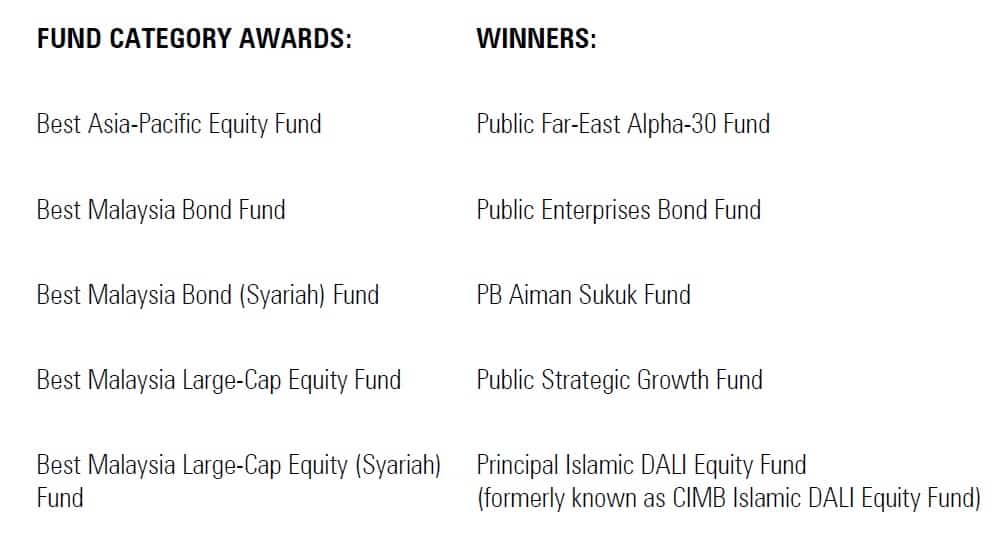
Public Mutual Bhd was the biggest winner, sweeping four out of the five awards on offer. Malaysia’s leading unit trust company took home the awards for Best Asia-Pacific Equity Fund, Best Malaysia Large-Cap Equity Fund, Best Malaysia Bond Fund and Best Malaysia Bond (Syariah) Fund. 

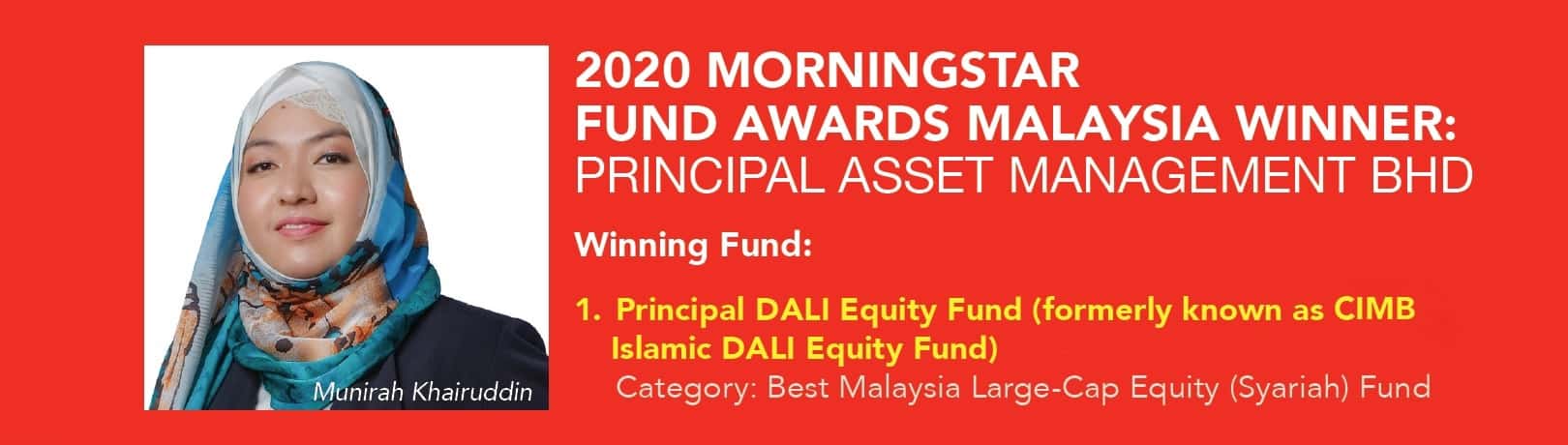
Principal Asset Management Bhd’s Principal Islamic DALI Equity Fund (formerly known as CIMB Islamic DALI Equity Fund) won the Best Malaysia Large-Cap Equity (Syariah) Fund. 

In his speech delivered via the webcast, Morningstar Asia chief executive officer Nick Cheung said Morningstar’s Annual Awards highlight the quality and breadth of investments available for investors in each region. “Our 2020 winners have been great drivers of investor success. It is our honour to recognise their outstanding achievements and commitments to investors.” 

Cheung pointed out that every year, Morningstar presents awards to more than 30 countries globally to recognise exceptional fund managers and investment teams who deliver value to investors, and put investors’ interest at the first place.

“This is in perfect alignment to Morningstar’s vision, which is to empower investors to make more informed investment decisions, and make better investment outcomes. Morningstar has a long history of helping investors.

“Despite the current diff cult environment, we continue to invest to allow investors to have more and expanded research coverage on equity, fund, ETF, ESG and private investments,” Cheung said. 

For example, he said Morningstar will soon roll out a new web-based analytic platform of Morningstar Direct which has new features and data sets to allow investors to make better informed investment decisions. 

Delivering market-beating returns

Wing Chan, Morningstar’s director of Manager Research Practice, EMEA & Asia, said the 2019 rally in both equities and bonds has rewarded investors handsomely. “However, it was also one of the more unpredictable periods in history, with low interest rates, heightened geopolitical uncertainty, and stretching asset valuations continuing to worry investors. 

“The awards winners, across our equity and fixed income categories, have proved their ability to deliver market-beating returns over the long term without undue risk,” he added. 

On what Morningstar looks for when picking the winning funds for the annual awards, Andrew Daniels, senior analyst, Equity Strategies, Manager Research for Morningstar Asia, said the goal is to recognise those funds that have added the most value within the context of a relative peer group for investors over the past year and the longer term. 

On how Morningstar plays a key role in helping bring about better outcomes for investors, Daniels said Morningstar offers a global reach and has earned investors’ trust through its unbiased and independent research, investor-centric mission, and thought leadership.

“Since its founding more than 35 years ago, Morningstar’s mission has been to empower investor success. We believe that by taking something nebulous, such as the financial services industry, and making it transparent, investors gain the knowledge to make better decisions. 

“As a result, Morningstar builds unique products and services that connect people to the investing information and tools they need, because when investors are successful, so are we.”

Sidebar

By Lee Min Keong

Please click here to read the full article in the digital edition of Smart Investor (April 2020 issue).

Principal Asset Management Bhd Wins Morningstar Fund Awards Malaysia

WInnig Fund

Principal Asset Management Bhd took home the Best Malaysia Large-Cap Equity (Syariah) Fund award at the 2020 Morningstar Fund Awards Malaysia for its Principal DALI Equity Fund (formerly known as CIMB Islamic DALI Equity Fund).

Smart Investor speaks with chief executive officer Munirah Khairuddin on the fund’s performance and how Syariah-compliant funds are gaining traction with investors.

Despite the strong headwinds buffeting the equity markets, Munirah sees opportunity in adversity, adding that Malaysian equity evaluation is already cheap. While taking a defensive stance, she says Principal Asset Management will take the opportunity to accumulate selective stocks within the plantation, construction, and oil and gas, and healthcare sectors.

Smart Investor: Congratulations on your win! What were the major changes made to the portfolio in 2019? What key factors drove your winning fund’s performance?

Munirah Khairuddin: Thank you! I believe the right asset allocation strategy has helped the fund’s performance in 2019. As you may know, the fund consists of 70% Malaysia and 30% Asia Pacific markets, and we manage the fund based on our proprietary top-down FTV and bottom-up FMV Research Process.

We adopted the Barbell Portfolio structure approach that emphasises on capital preservation and/or growth and have a rigorous portfolio optimisation process that focuses on the Beta, Active Share, and Sharpe Ratio. On top of that, we also run continuous data analytics to ensure that the portfolio is been managed within the optimum risk parameters.

Fund Info 1

Are Shariah-compliant funds like Principal DALI Equity Fund gaining traction with investors?

Yes, we are seeing Islamic Asia Pacific funds gaining traction with investors. This is part of the asset allocation/risk diversification strategies that we are advising investors to consider.

Historically, Islamic investments are less volatile than their conventional counterparts, especially during periods of uncertainty. During the subprime crisis in 2008, Islamic investments were not as greatly impacted compared to the conventional investments. The Islamic financial markets do not rely on the subprime assets or excessive leverage which caused difficulties for many conventional institutions in the past.

What are the major risks or challenges facing the financial markets in 2020? How do these risks affect your investment decisions?

We are in a unique situation in Malaysia. Our markets have been impacted by the Coronavirus outbreak and the US-China trade war. However, for the right investor, we believe there is an opportunity to invest in Malaysian equities and fixed income products because of the value.

In terms of equity, Malaysian equity valuation is already cheap. We are taking a defensive stance and focusing on stocks which are resilient to the expected slowdown in the domestic economy and/or not exposed to domestic political and regulatory uncertainty. We prefer sectors that benefit from interest rate cuts and are USD earners. This would include stocks in the consumer staples, healthcare, energy, plantation and the REITs sectors.

On the fixed income side of things, the impact of the Coronavirus outbreak may result in growth in 1Q2020 softening to below 4%. As a conservative move, our fixed income funds are taking a neutral view on benchmark duration. If government bond yields start to rise, we may take advantage of it to extend duration at an opportunistic level.

Info

Given the current headwinds, which sectors do you see as resilient and can thrive, and how would you position your funds to take advantage of opportunities and/or mitigate risks?

As I mentioned earlier, we prefer sectors that benefit from interest rate cuts and are USD earners. This would include stocks in the consumer staples, healthcare, energy, plantation and the REITS sectors.

As always, we advise investors to consider their long-term financial goals and risk tolerance when it comes to investing. Our investment team has recommended the following based on our asset allocation mix (as of Feb 2020):

Malaysia

Malaysian equity valuation is undervalued, making it attractive. It’s a great time to take advantage of the opportunity to buy low. We will continue to buy Malaysia on weakness and keep our barbell approach on high yield stocks. We’ll take the opportunity to accumulate selective stocks within the plantation, construction and oil and gas sectors.

When it comes to the Covid-19 outbreak, we will look at sectors impacted by this event. We’ll tactically underweight the aviation sector, while taking opportunities to trade the glove and healthcare sectors.

Asia Pacific Region

A market sell-off during an event like the Coronavirus outbreak usually offers great buying opportunities. Much like Malaysia – it’s a great opportunity to buy low.

We are taking advantage by buying into structural names with good management and strong business models. We also like companies that are emerging as the key players in the fourth industrial revolution.

Even though e-commerce may be a relatively more resilient sector with Chinese consumers choosing to spend more time at home and online shopping demand may increase, stocks of these companies are likely to also be sold off indiscriminately in a knee-jerk reaction. We will also be taking the opportunity by adding companies that are capable to lead in the growing consumption space in China.

By Bernie Yeo

Please click here to read the full article in the digital edition of Smart Investor (April 2020 issue).

2020 Morningstar Fund Awards Malaysia: Public Mutual Bhd

Winning Funds

Public Mutual Bhd took home four awards at the Morningstar Malaysia Fund Awards 2020, namely Best Asia-Pacific Equity Fund, Best Malaysia Large-Cap Equity Fund, Best Malaysia Bond Fund and Best Malaysia Bond (Syariah) Fund.

Smart Investor met up with Public Mutual chief executive officer Yeoh Kim Hong to discuss the out-performance of its winning mutual funds, risks in the market risk, and the technologies the fund house has adopted to make its business more appealing and
efficient to investors.

Smart Investor: Congratulations on your win! Public Mutual won four awards this year. What are the key factors behind the winning funds’ successful performance?

Alpha 30

Yeoh Kim Hong: Despite volatile market conditions in 2019, our winning funds continued to adopt a fundamental approach to investing by selecting stocks and bond/sukuk which have sustained earnings, strong financial positions and proven management track records.

Public Far-East Alpha-30 Fund (PFA30F), which is a regional equity fund that invests in a concentrated portfolio of a maximum of 30 stocks, won in the Best Asia-Pacific Equity Fund category. In 2019, the fund generated a return of +19.9% to outperform the regional equity markets, as proxied by the MSCI All Country Far East ex-Japan Index, which rose by 15.2% (in ringgit terms).

The fund’s performance was driven mainly by the out-performance of regional technology stocks which are leveraged to the increasing adoption of digital products and services globally, as well as the secular growth trends in online financial and e-commerce services.

The second equity award achieved is for the Best Malaysia Large-Cap Equity Fund category. Public Strategic Growth Fund (PSTGF), which focuses its investments on growth stocks in the Malaysian market, achieved a return of +4.3% in 2019. In comparison, the FBM KLCI, which tracks the performance of the domestic equity market, declined by 6%.

Despite challenging market conditions, the fund was able to achieve a commendable performance, as it focused on fundamentally-strong companies within the consumer, healthcare and technology sectors. These stocks benefitted from sustained consumer spending as well as the trade diversion arising from the US-China trade tensions.

Public Enterprises

Public Enterprises Bond Fund (PENTBF), which invests mainly in ringgit-denominated bonds, won the Best Malaysia Bond Fund category. In 2019, the fund achieved a return of +8.2% due to its focus on long-duration bonds with sound credit fundamentals, primarily in the infrastructure and banking sectors. Bonds in these two sectors saw strong buying interest on the back of easing monetary policies globally, which contributed to the fund’s strong performance.

The second bond award achieved is for the Best Malaysia Bond (Syariah) Fund category. PB Aiman Sukuk Fund (PBASF), which mainly invests in ringgit-denominated sukuk, registered a return of +9% in 2019.

The fund’s strong performance was due to its focus on long-duration sukuk with sound credit fundamentals, especially in the infrastructure and banking sectors. The fund also benefitted from its sukuk holdings issued by the Malaysian government, which performed strongly in 2019 as sukuk yields compressed.

Moving forward, how can your bond funds outperform in a volatile yet increasingly low-yield environment?

The low global interest rate environment as well as the accommodative domestic monetary policy is anticipated to underpin the domestic bond/sukuk market in 2020. Our bond/sukuk funds will continue to seek investment opportunities in bonds/sukuk with strong credit fundamentals while adopting an active portfolio rebalancing approach and maintaining reasonable portfolio yields to ride through periods of volatility in the domestic bond/sukuk market.

How will market risks like the US-China trade war, geopolitical tensions, and Covid-19 outbreak impact your investment decisions moving forward? What are some of the under-reported risks that could surface this year?

In light of the uncertainties pertaining to the US-China trade relations, our investments in sectors deemed to be susceptible to increased trade tariffs or restrictions have been reduced. In addition, our funds have largely avoided tourism-related sectors which are directly impacted by the slowdown in travel activities amid the Covid-19 outbreak.

Public Strategic

Other uncertainties include the upcoming US presidential election in November 2020, the Brexit negotiations as well as the sharp fall in oil prices following the Organisation of the Petroleum Exporting Countries’ (OPEC) move to hike oil production despite weak global demand.

However, accommodative monetary policies by major central banks and various fiscal stimulus measures by global and regional governments should help lend support to global economic activities. The volatility in financial markets will provide opportunities for our equity funds to add to their positions in fundamentally-backed stocks with positive long-term growth prospects.

Meanwhile, there could be volatility within the domestic bond/sukuk market in the run-up to September 2020 when FTSE Russell is anticipated to announce its decision on the retention of Malaysian bonds in the FTSE World Government Bond Index (WGBI).

To navigate such market uncertainty, our bond/sukuk funds will continue to focus on high-quality bond/sukuk issuances and rebalance the funds’ portfolio duration accordingly. Our focus on fundamental research and long-term investment strategies should help both our equity and bond/sukuk funds to ride through market cycles as well as through periods of elevated market volatility.

What measures or strategies has Public Mutual put in place to deal with these market risks?

In addition to the aforementioned measures, we will continue to be vigilant to developments within the economic and financial markets so as to proactively manage the exposure of our investments to these risks.

In this respect, we believe our adherence to fundamental research and long-term investment strategies will serve us well in delivering consistent returns to our unitholders over the long term.

Aiman Sukuk

With Malaysia gravitating towards a digital economy, what are some advanced technology that Public Mutual has adopted to make its business more appealing and efficient?

Among our technological offerings for investors is a dedicated online investment platform, Public Mutual Online (PMO), which provides them with easy access to our products and services on a 24/7 basis. Its key features include a Fund Analytics feature that allows investors to easily review the different features and performance of our available funds.

Meanwhile, our PMO landing page allows investors convenient access to stock market performance data and fund reviews, as well as a quick overview of their portfolio holdings.

We also recently revamped our website with improved functionality as well as enhanced user navigation. Investors can now use the website to explore funds, view fund performance and discover the right funds for their investment needs. It also allows investors to conveniently access articles on the financial markets and financial planning.

New investors can use the Digital Onboarding facility to sign up without need for physical documents, while existing investors can leverage on other facilities to top up their investments and register for the Direct Debit Authorisation (DDA) facility within a few clicks.

We have also designed several digital tools as part of our efforts to facilitate our unit trust consultants (UTCs) in servicing investors. For instance, the CAMS software allows UTCs to present to investors their investment account details including returns.

Meanwhile, the U@Bis$ app allows UTCs to guide investors in answering a risk-profiling questionnaire, before subsequently building a unit trust portfolio based on the recommended allocation.

By Bernie Yeo

Please click here to read the full article in the digital edition of Smart Investor (April 2020 issue).

The Smart Investor’s Guide to Islamic Social Finance

What are the main tenets of Islamic social finance?

Sustainable Development Goals 2030

Sustainable Development Goals 2030

In 2015, countries around the world adopted a set of goals to end poverty, protect the planet, and ensure prosperity for all as part of a new sustainable development agenda. Formulated on the principle that no one gets left behind, the Sustainable Development Goals (SDGs) have defined the world’s priorities and aspirations for 2030.

In 2016, a high-level panel commissioned by then-UN Secretary-General Ban Ki-Moon estimated a humanitarian financing deficit of $15 billion – and the gap is widening each year.

Last year, only 58.5% of requested humanitarian funding needs were met.

There’s an overwhelming need for capital to help fragile nations battle everything from widespread food and water insecurity to the fallout from natural disasters.

Uplifting Poverty Levels

To mobilise these efforts, we need to effectively uplift groups living below the line of poverty.

Although poverty levels have fallen dramatically since 2000, there are still 783 million people living below the international poverty line of $1.90 a day. Obviously, it calls for more creative and effective solutions to end poverty.

With technology playing a key role in implementation, this makes it more targeted and effective – an important move that we must take to lift people at the bottom of society from poverty and end world hunger to ensure that no one gets left behind.

An Important Role in Achieving SDGs

Islamic social finance was developed in adherence to the Sharia principles of socioeconomic justice, equality and collective prosperity.

Islamic social finance tools have been instrumental in the alleviation of poverty and socio-economic development for over 1,400 years. Among the instruments available in Islamic social finance to achieve this are zakat, waqf and sadaqah (charity) which have been adopted and applied even outside the Islamic world.

Zakat – wealth tax and a means of wealth distribution – is thought of as harmonising the relationship between the individual and public interest (maslaha). Each year, Muslims are required to donate 2.5% of one year’s total cumulative wealth to the poor in the form of zakat.

Waqf is an endowment to a religious, educational or charitable cause, most frequently used to build schools, hospitals or religious institutions. Given its communitarian nature, waqf is often used to fund social projects and services.

Sadaqah is a voluntary charity given on an ad-hoc basis; a concept similar to putting coins into a charity donation box.

These instruments are used to provide education and healthcare, to develop infrastructure and maintain social welfare provisions for the poor and destitute.

waqf-sadaqah-zakat-social-islamic-financewaqf-sadaqah-zakat-social-islamic-financewaqf-sadaqah-zakat-social-islamic-finance

Charity through Islamic Crowdfunding

With the huge gap in humanitarian funding, coupled with the immense need, innovative financing models are starting to play a critical role as it becomes clear that no single factor can plug the deficit.

In the humanitarian sector, international aid organizations are looking to new sources of capital and utilizing Islamic social finance for humanitarian projects. Innovation in the financial industry happened at a very fast pace, and Islamic Social Finance is one of the industries undergoing rapid disruption by digital platforms.

GlobalSadaqah was a recipient of the Best Social Impact Islamic Fintech Firm Award at the World Islamic Fintech Awards 2018, during the Global Islamic Fintech Huddle in Bahrain. The Islamic crowdfunding platform helps channel donated funds to some of the neediest individuals in society. It connects individual donors to a diverse range of social causes that require financing around the globe.

For donors, digital technology makes it easier to identify, evaluate, and fund causes. For organizations collecting social finance, technology provides greater access to donors, lowers costs, and allows for greater reporting and communication. For institutions implementing projects, technology enhances project management, workflows, and monitoring. Perhaps most importantly, digital technology can help recipients of social finance and their communities by making resources more accessible and distribution more efficient.

waqf-sadaqah-zakat-social-islamic-financewaqf-sadaqah-zakat-social-islamic-financewaqf-sadaqah-zakat-social-islamic-finance

Public Mutual Bags 4 Morningstar Fund Awards

Public Mutual Bhd was the biggest winner at the Morningstar Malaysia Fund Awards 2020, bagging four out of the five awards on offer.

The unit trust company took home four awards, namely Best Asia-Pacific Equity Fund, Best Malaysia Large-Cap Equity Fund, Best Malaysia Bond Fund and Best Malaysia Bond (Syariah) Fund.

Principal Asset Management Bhd’s Principal Islamic DALI Equity Fund (formerly known as CIMB Islamic DALI Equity Fund) won the Best Malaysia Large-Cap Equity (Syariah) Fund.

The winners were unveiled during an awards webcast today by Morningstar Asia Ltd, a subsidiary of Morningstar, Inc., a leading provider of independent investment research.

The annual Morningstar Malaysia Fund Awards recognise retail funds and fund houses that have added the most value for investors within the context of their relevant peer group in 2019 and over longer time periods.

Morningstar selects the winners using a quantitative methodology, along with a qualitative overlay. Weightings to one-, three-, and five-year risk-adjusted performance are factored into the methodology.

“Morningstar’s Annual Awards highlight the quality and breadth of investments available for investors in each region,” said Nick Cheung, chief executive officer for Morningstar in Asia. “Our 2020 winners have been great drivers of investor success. It is our honour to recognise their outstanding achievements and commitments to investors.”

He pointed out that every year, Morningstar presents awards to more than 30 countries globally to recognise exceptional fund managers and investment teams who deliver value to investors, and put investors’ interest at the first place.

“This is in perfect alignment to Morningstar’s vision, which is to empower investors to make more informed investment decisions, and make better investment outcomes.

“Morningstar has a long history of helping investors. Despite the current difficult environment, we continue to invest to allow investors to have more and expanded research coverage on equity, fund, ETF, ESG and private investments,” Cheung said.

For example, he said Morningstar will soon roll out a new web-based analytic platform of Morningstar Direct which has new features and data sets to allow investors to make better informed investment decisions.

Wing Chan, Morningstar’s director of Manager Research Practice, EMEA & Asia, said the 2019 rally in both equities and bonds has rewarded investors handsomely.

“However, it was also one of the more unpredictable periods in history, with low interest rates, heightened geopolitical uncertainty, and stretching asset valuations continuing to worry investors.

“The Awards winners, across our equity and fixed income categories, have proved their ability to deliver market-beating returns over the long term without undue risk,” he added.

Public Mutual, the No 1 private unit trust company and Private Retirement Scheme (PRS) provider in Malaysia, commands a market share of 34.6% for the retail funds sector and 42.7% for the PRS sector. A wholly-owned subsidiary of Public Bank, its total net asset value stands at RM85.3 bil as at end-January 2020.

Principal Asset Management is a joint venture between Principal Financial Group, a Nasdaq-listed global financial services company, and CIMB Group Holdings Bhd. Headquartered in Malaysia, Principal Asset Management has footprint across Indonesia, Thailand and Singapore, with nearly RM88 bil in assets under management as of February 2020.

2020 Morningstar Fund Awards Malaysia

00

Nick Cheung CEO For Morningstar Asia
Nick Cheung, CEO for Morningstar Asia

Global Diversification in the Year of the Metal Rat

The Year of the Metal Rat has started. The rat is the first of all zodiac animals. According to one myth, the Jade Emperor said the order would be decided by the order in which they arrived to his party. The rat tricked the ox into giving him a ride. Then, just as they arrived at the finish line, the rat jumped down and landed ahead of the ox, becoming first.

Feeling good about the Year of the Rat? Will the Metal Rat be seen as a deliverer of good fortune? If you look at the world objectively and understand what is happening regardless of what the famous Chinese fortune tellers or feng shui masters are going to sell to you, there are lots of good opportunities to be found around the world.

The view here is that the Year of the Rat will likely be bullish for risk assets although timing is always a tricky factor plus the expected volatility. The global investment backdrop contains many positives that remain in favour of maintaining a bullish outlook for stock market investors.

Don’t fight the Fed

“Don’t fight the tape, don’t fight the Fed.” It is never a good idea to fight the US Federal Reserve and other central banks, and that is one of the key reasons I subscribe to the overall positive outlook. It is a great policy if you are dancing until the music stops. I am flexible and can always adjust my thoughts and strategies along the way.

I sold a few positions and rebalanced one of my client portfolios which have made extensive moves and have gone parabolic during the latest rally. Let me make myself clear. The bullish position here does not mean complacency.

Can one actually make good money without lifting a finger these days? It is scary to find young professionals putting a majority if not all of their hard-earned savings into the stock market for quick money. I hope they really know what they are doing.

At the time of writing this missive, stocks are going higher around the world. With every tick up, the stock markets gain some more credibility with the public. Why not invest a little more? It is important for investors to avoid the temptation to buy blindly because of the tempting hot markets.

There is no need to get emotional in dealing with any asset classes or markets. Like most investors and traders, I like to make money in bull markets but one should always be disciplined and not get carried away.

Risk management vital

Please remind your spouse that anyone can make big money initially when everything goes up in prices but keeping it and staying in the game long-term requires risk management, which is one of the most important recipes in investing.

The global economy and markets continue to face old worries in the year of the Rat. The recent geopolitical situation in the Middle East shows there are always potential for negative surprises. I expect a more bumpy road ahead in the second half of this year.

We have always been told not to put all our eggs in one basket, right? Real diversification is important for medium to long-term investors who wish to load up stocks. On this note, are you someone who is still stuck with homegrown meat and potatoes ignoring other opportunities or are you an investor who has a diverse mix of asset classes around the world using different investment styles or strategies?

Investing globally

In my work over the years, I have always viewed investment choices as a global beauty contest. Chart 1 illustrates my model portfolio which is invested globally and can be customised for investors with different risk profiles.

Chart 1 Edit3

Chart 1: Model Portfolio

Observations from Chart 1:

  1. Globally diversified asset class exposure with different investment styles.
  2. Maintain a minimum exposure to local assets.
  3. Exposure to a range of alternative investment solutions that promotes low volatility.

Chart 2 and 3 show the performance in the US Dollar of a balanced strategy for more risk-averse investors with different time frames. Of course, past performance is not a guarantee of future results.

Chart 2

Chart 2: Balanced Portfolio (2019)

Chart 3

Chart 3: Balanced Portfolio (Since Inception)

I have observed that there is now a new appreciation among some investors that not all opportunities for profit are homemade. For others, there are still concerns and questions in their minds. Even good old-fashioned patriotism.

There are many benefits of a globally diversified portfolio which I will discuss more in another article. Spare your venom please. I am not suggesting anyone dump the local economy or markets.

Before I hit the send button, no matter what the Year of the Rat brings, I wish my readers a healthy, happy and prosperous Chinese New Year. In that order because without the first two, prosperity would have definitely less appeal.

The start of a new year usually comes with new resolutions of goals that we hope to achieve. These include setting for ourselves financial goals.

For those who are “home-biased” when it comes to investing, one of the financial goals they should aim for in this Year of the Rat is to learn how to invest globally.

———————————

YH Wong has over two decades of experience in the financial services industry. He is currently principle of Noble Hills Partners Ltd and is also a senior partner of a licensed offshore investment platform. His clients include high net worth investors and boutique institutions such as family offices and investment partnerships. He can be reached at yhwong@noblehillspartners.com.