Saturday, 22 August 2026 Stay informed. No noise.

Charting the Path to a Synchronised Global Recovery

If all goes according to plan, the new year is expected to usher in the distribution of a Covid-19 vaccine, along with the great promise of a return to normalcy and a global economy that is on the mend. Cautious optimism seems to be the way forward, and things are finally looking up for investors.

This follows a grim year rife with tragedy and heartbreak over the Covid-19 pandemic, which spread with alarming speed, infecting millions and bringing economic activities around the world to a near stand-still.

“There is a synchronised global recovery in the horizon, with all regions bouncing back from the pandemic-induced recession in 2020 and heading onto a path of recovery. What’s more, global GDP is expected to rebound from -3.9% in 2020 to +5.2% in 2021 based on a survey of forecasters on Bloomberg,” says Kenanga Investors Berhad Chief Investment Officer Lee Sook Yee.

The deployment of a vaccine is expected to help global recovery of economic activity, while extensive support from both fiscal and monetary policy provides a further boost.

“Interest rates remain at decade lows worldwide, while the Federal Reserve (FED) and European Central Bank (ECB) continue to expand their balance sheet with various asset purchase programmes. Hence, we should see a positive environment for risk assets in the first half of 2021 at least,” she tells Smart Investor.

Opportunities Ahead for Global Recovery

On investments bright spots going forward, Lee says that 2021 is expected to be the year where risk assets will outperform defensive assets, with “equities likely to outperform fixed income and gold”. She adds that “Within equities, higher beta sectors and countries such as commodities and emerging markets are expected to outperform defensive and developed markets.”

Lee highlights that monetary and fiscal policies are expected to remain supportive in 2021 as global recovery remains slow and uneven, and is highly dependent on the successful roll-out of the Covid-19 vaccine.

As such, interest rates are expected to remain low and accommodative, although a bottom is likely to have been reached, reckons Lee, adding that “against this backdrop, risky assets can largely be expected to outperform.”

On the sectors that will do well, Lee remains overweight in sectors that offer secular growth such as technology. “The tech sector will see various drivers such as the rising adoption of 5G technology, electric vehicles and artificial intelligence in 2021. This will boost the demand for semiconductors and related components and services across the value chain.”

“On the other hand, we are also overweight on the cyclical/value sectors that might have suffered in the past, but will benefit from the global recovery. This includes sectors such as commodities, industrials, financials and consumer discretionary,” adds Lee.

Indeed, we will come out of 2020 stronger and the market is looking forward to a better year with earnings anticipated to bull-doze ahead.

“In line with the synchronised rebound in global economies, corporate earnings are expected to recover strongly in 2021. Sectors that are hit the hardest by Covid-19 such as consumer discretionary, industrials, retailing, gaming and construction are expected to enjoy the base effect of above-average rebounds in earnings.

“Consensus expects 2020 KLCI earnings to contract 18.8% on the back of Covid-19 virus outbreak in 2020, before rebounding 32% in 2021,” Lee informs.

Where to Put Your Money

On the strategy that investors can adopt to stay on top of their investment performance, Lee offers this advice: “In our assessment, the ‘mobile barbell strategy’ is the most suited investment option under the current economic climate.

“The barbell strategy is an investment concept that suggests that the best way to strike a balance between reward and risk is to invest in the two extremes of high risk and no risk assets while avoiding middle-of-the-road choices.

“Although the growth sector is expected to continue performing well, investors should also consider shifting their weight to value and cyclical stocks as a balancing act.

“Above all, stay diversified and focused on your personal financial goals. It would also be beneficial to have a side of supplementary savings such as Private Retirement Schemes (PRS) which can help cushion inflation or unexpected emergencies such as today’s situation,” Lee advises.

By Bernie Yeo

Global Economy Set for Recovery Phase

If anything, 2020 has taught us that opportunities for investors can arise in the midst of uncertainty, and that market sentiments can change within a short span of time.

The pessimism during the first quarter, according to FSMOne research analyst Shawn Low Tian How, has been  quickly replaced with a bullish rally up to the point of writing as demonstrated by the benchmark for global equities, which is represented by the MSCI All Country World Index.

Performance-wise, Low reveals that most unit trust funds have come out of 2020 in the green despite the difficulties during the first quarter of the year.

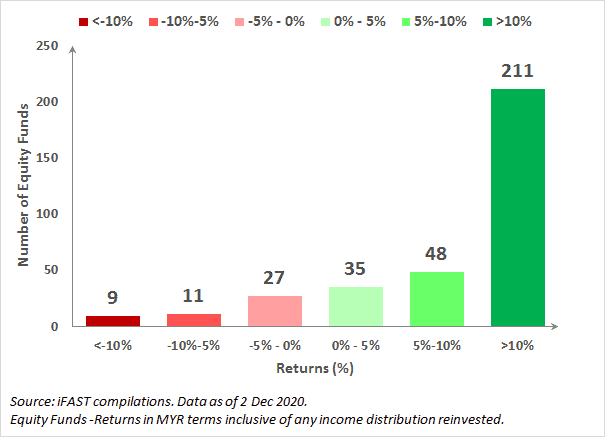
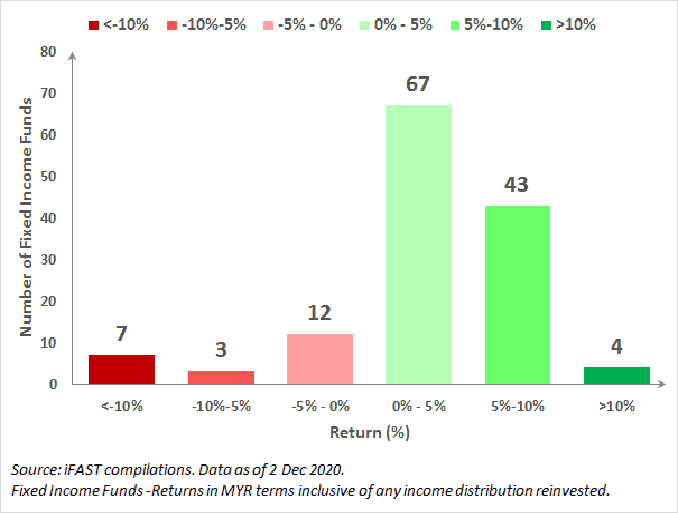
“86% of the 341 equity and 84% of the 136 fixed income funds on the FSMOne platform have clocked in positive gains on a year-to-date basis (see Figures 1 and 2). These two asset classes have had stellar performances largely due to the immense liquidity injected by major policymakers of the world,” he tells Smart Investor.

global economy recovery growth markets equity funds

Figure 1: Equity funds have performed decently over the year.

global economy recovery growth markets fixed income funds

Figure 2: Similar occurrences can be seen in fixed income funds.

“This event has once again reinforced a timeless quote by Warren Buffett — ‘Be fearful when others are greedy, be greedy when others are fearful’.

“Investors who had invested during the Covid-19-induced March sell-off would have benefitted greatly on the following run up in asset prices. On the other hand, investors who exited the market in the midst of the selloff in fear of further drawbacks have lost out on potential returns during the subsequent recovery.

“This also strengthens our belief that investors should not be shrouded by short term noises and should stay invested at all times with a long-term view,” he reveals.

Investment Outlook for 2021

The conditions going ahead is likely to be constructive for equities, according to Low.

“Looking at the business cycle, we may have just witnessed a trough in 2020. Given that most leading indicators such as Purchasing Managers’ Index (PMI) or exports have begun bottoming out, the global economy could be positioned for a recovery/expansionary phase in 2021,” he explains.

“However, a resurgence in Covid-19 cases could force many economies to reimplement lockdown measures, much like how European countries are doing. Should this threat be prolonged, it will overshadow any chances for a global recovery,” warns Low.

That said, positive progress surrounding the vaccine such as the slew of efficacy test of around 90% in recent weeks have shed some light on the pandemic.

“We expect more positive news to follow suit as other vaccine developers catch up to the final phases of testing, providing more options for countries to combat the coronavirus,” he points out.

Meanwhile, the United States presidential election – which was the key risk event in 2020 – has mostly come to an end. The world will see a Biden presidency, alongside a bipartisan Congress in 2021, which is ideal for the market, reckons Low.

Foreign policies firstly are likely to be more predictable, to which actions taken could be more bilateral instead of unilateral.

“In terms of the bipartisan congress, some of the more extreme bills such as raising taxes could face some challenges in being passed, or at least being downsized. Given that extreme changes are unlikely, the probability of increased volatility coming from new legislations are likely to be low.”

While the tensions between US-China may be a recurring theme going ahead, that president-elect Biden’s stance towards China is less aggressive compared to President Trump, he adds.

Bright Spots Aplenty

Given that most markets have experienced depressed earnings in 2020, many markets should register decent earnings growth in 2021 due to the low base effect.

“Amongst the many markets we cover, emerging markets such as China and Asia Ex-Japan will lead their global counterparts. China, being one of the first countries to successfully curb the pandemic, is expected to clock positive GDP growth.

“Coupled with tailwinds such as growing middle income and high population, the country is one of the more fundamentally sound markets and could remain so for many years to come. In extension, given that most Asia Ex-Japan countries export mainly to China, the recovery of China could also serve to boost its neighbours’ growth,” opines Low.

Closer to home, Malaysia’s recent announcement of the 2021 Budget sets the tone for the year ahead. Budget beneficiaries include the property and construction sectors as the government focuses on providing support to low-income housing and the continuation of infrastructure projects.

The local technology sector, mainly the semiconductor players, are also expected to do well, benefitting from secular trends such as Internet of Things (IoT) and 5G technologies.

“In addition to the key risk posed by the Covid-19 pandemic, other risks are likely to be implementation risks as infrastructure projects historically have faced pause orders.

“However, we deem this risk to be relatively low given the high multiplier effect of the sector which is used to support the economic growth of the country. In terms of the technology sector, while high valuations could be a concern for many, the decent growth potential of the sector is likely to bring valuations to more palatable levels,” says Low.

Strategies to Ride through Market Uncertainties

Due to volatility being part and parcel of investing, the strategy of investing through a diversified portfolio (incorporating different asset classes, geographies and sectors, among others) has been proven to help lower overall portfolio volatility and give investors better peace of mind in times of market distress.

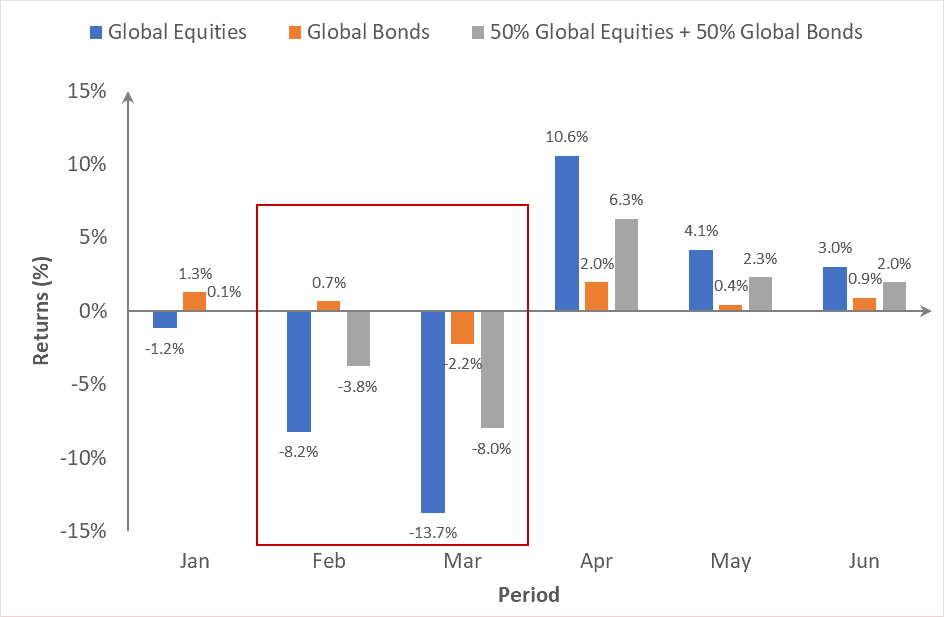
To illustrate his point, Low draws attention to the start of 2020 where global equities (represented by MSCI AC World Index) suffered sell-offs of -8.2% and -13.7% in February and March respectively due to Covid-19 induced fears.

Global bonds (represented by Bloomberg Barclays Global Aggregate Bond Index), on the other hand, were up 0.7% in February and only down -2.2% in March (see Figure 3).

global economy recovery growth markets global equities bonds

Figure 3: Global equities and bonds monthly returns in 2020.

The deviation in price movements is because equities and bonds are different asset classes and have a low correlation with one another, he explains.

“A mixed asset portfolio with 50% allocation in global equities and 50% in global bonds would evidently have much lower volatility than global equities over the same period.

“For example, during the Covid-19 induced sell-off, the portfolio was down -3.8% and -8.0% in February and in March respectively. The annualised volatility of the portfolio is 17.4%, significantly lower than the 30.6% that of global equities.

“As such, investors should adopt the strategy of investing through a diversified portfolio to help them ride through any market uncertainties in the future as just as it would have in 2020,” he explains.

By Bernie Yeo

Asian Market Recovery: Light at the End of the Tunnel

There has not been a more dramatic rollercoaster ride for investors than the year 2020. From the global outbreak of the Covid-19 pandemic to subsequent economic lockdowns and geopolitical tensions, it has been a year that many investors would probably like to forget. With that 2021 is expected to be a year for Asian market recovery.

A highly volatile year for financial markets, the year started off with cautious optimism as the global trade war between the United States and China began to thaw. Come February, global markets were hitting new highs.

And then came the Covid-19 pandemic, which caused markets to sell-off by 34% (as measured by the MSCI World Index) within a short span of just six weeks.

“However, as quickly as the market sold down, the recovery was swift. In early April, we saw benchmark gauges retracing back their losses induced by the pandemic as stimulus optimism buoyed market gains,” Affin Hwang Asset Management deputy managing director and chief investment officer David Ng tells Smart Investor.

Policymakers were seen doing whatever it takes to shelter the economy through a swathe of stimulus measures ranging from relief packages to loan facilities and asset purchases.

“All the losses were finally recovered at the beginning of November, which coincided with the initial release of Phase III clinical trial data for the vaccines. So, there is light at the end of the tunnel in every cycle,” he adds.

Opportunities for Asian Markets

There is an emerging bullish consensus that 2021 will be a recovery year. While current estimates suggest that global gross domestic product (GDP) is expected to fall by around 5% in 2020, this is expected to rebound by 5.4% in 2021 as growth returns and more economies open up.

“So far, economic growth has surprised on the upside and there are positive revisions to corporate earnings. These will be supportive of risk assets. Effective vaccines will be key in providing a boost for markets,” Ng remarks.

However, as the vaccines will take time to produce, the recovery will be prolonged into 2022 and 2023, thus making this a multi-year theme.

Being a recovery year, the expected key investment themes are normalisation/rebound plays that include banks, insurers, materials, consumer discretionary and tourism and hospitality.

“Stocks that were trading at low multiples are now coming back in flavour as we see a rotation to value,” says Ng.

However, he stresses that the shift in value does not signal the end of the upside for technology and growth stocks. After all, while valuations are expensive, it is also one of the sectors that has the ability to grow profits consistently and exhibit secular growth, and not many sectors can claim as much.

According to Ng, Affin Hwang Asset Management is adopting a barbell approach for their portfolio positioning.

“On one end, we are tilted towards a basket of secular growth names with multi-year prospects that would continue to grow beyond the development of the vaccine. On the other end, we are also weighted towards cyclical and value-plays that would benefit from a re-opening of the economy,” he says.

On the flipside, there are also risks that could derail this recovery theme.

“Firstly, we would be closely monitoring president-elect Joe Biden’s approach to dealing with China. Asian markets and Asian foreign exchanges have reacted positively to the recent election results. An antagonistic approach would certainly bring downside risks,” Ng explains.

Another key risk the team is monitoring is whether corporate earnings can recover as strongly as expected given the rising Covid-19 cases globally. Market valuations are high and good earnings are thus required to anchor them.

As it will take time to produce enough vaccines on a global scale, Ng also expects the economic conditions in the near term to stay muted. “Growth may stay tepid until various countries and/or sectors can fully reboot,” he says.

Investing in the New Normal

But while 2020 may be a year that investors would like to forget, it was also one filled with important lessons.

“If anything, the year has emphasised yet again the importance of diversification. Staying diversified across different asset classes is crucial; geographical and sector exposure can help minimise volatility and smoothen returns. In turn, this will induce investors to remain invested and help them stay the course,” Ng opines.

2020 has also underscored the perils of market timing and investing according to one’s emotions. When the markets plunged in March, for instance, many investors may have panicked and resorted to shifting all their allocations to cash.

According to Ng, the market began to recover and recouped back its losses a few weeks after the drop, and not wanting to miss out on the surge, many investors have shifted back their exposure into equities.

“Timing the markets can prove to be more costly than the actual correction itself. That being said, investors should periodically reassess their risk capacity to see if they are comfortable with the level of risk in their portfolio.

“If investors are taking on more risk than they can handle, this might cause jitters and lead to making impulsive decisions that do not benefit them,” concludes Ng.

By Bernie Yeo

Understanding Your Assets And Liabilities

Many of you will know the difference between assets and liabilities, but allow me to explain for those that don’t. An asset is something that potentially goes up in value over time, such as a limited edition timepiece, property, or blue chip shares. Liabilities are what’s owed to other parties such as banks or even friends and family, which can include your house or car loan, or study loans. The difference between your assets and liabilities is what’s known as your net worth.

But why does this matter? Consider this – if you stop working today, how long can you survive financially? Many people have lost their jobs or faced pay cuts during the Covid-19 pandemic, and the hardest hit are usually entry-level employees who have just started their careers. Most, if not all, would have accumulated some assets if they consistently saved and invested from their first paycheck, while others may have car loans or credit card loans to settle. 

Some may have filial responsibilities and need to support their family and loved ones with their entry-level pay. According to a Jobstreet salary report, the minimum income level for fresh graduates before the pandemic was between RM1,949 to RM2,836, which is very low considering the time-cost requirements to get an education. No matter the situation, you must repay your commitments, and if you’re unable to, the worst case scenario is being declared bankrupt and forfeiting your assets to the bank! It’s crucial for fresh graduates to have basic financial knowledge, and take proper action to safeguard their own finances.

Good Assets vs Bad Assets

Although your net worth is your true wealth, this isn’t the be-all and end-all. There are many other financial areas we must look at; assets and liabilities are only one part of the equation. Generally, there are good and bad assets but of course, whether or not it’s a good asset depends on the owner’s perception, so there are no hard and fast rules to judge whether an asset is good or bad. 

For instance, an investment property that has been successfully rented out for the past 10 years might be deemed as a good asset, but when it loses its ability to be rented, then it suddenly becomes a bad asset.  Impatient or desperate owners may try to sell the property before finding out the underlying reason for the failure to secure a new tenant. 

Another common example is a car, which many perceive as a liability. However, this has changed since technology revolutionised the taxi industry, with the emergence and eventual merger of the Uber and Grab ride-sharing platforms. For many gig workers, the traditional perception of a car being a liability changed as it became a tool to generate active income instead of solely required for travelling to work. As you can see, what can be considered a good or bad asset is somewhat subjective, but all it takes is a little assessment to judge for yourself.

Understanding Various Forms of Debts

Apart from assets, you also need to review your debt. In the market, there are numerous forms of debt, such as personal debt, corporate debt, or even government debt, and so on. Let’s focus on some of the debt that fresh graduates are more likely to carry, which may include student loans, credit card debts, hire purchase (car loans), and mortgages (housing loan). 

These four types of loan are common among fresh graduates, and are typically the type of debts that people start acquiring in their 20s. Of course, the ideal scenario is not getting into these but it’s more likely than not! As these loans come at different costs to the consumer, you must fully understand the respective terms and conditions before taking on these debts.

Managing Money by Understanding Assets and Liabilities 

Once you’re mindful of what assets and liabilities are available, you can start learning how to maximise opportunities. For example, if you love shopping, get a credit card with cash-back or rewards points and use them when purchasing daily necessities. Needless to say, you should be conscious of your budget and settle the bill in full before the due date! In the long run, not only does timely credit card repayments build your credit score, but more importantly, it becomes ingrained as part of your money habits!

How to grow your net worth?

Now that you know the difference between assets and liabilities, you should start planning how to grow your net worth? As a fresh graduate, the road is likely to be long but not unattainable so do try some of these tips to speed up the journey:

  • Reduce your debt

    Since debt is the major factor dragging down your net worth, it’s advisable to keep this to a minimum. As a benchmark, your total debt should be around 50% out of your total assets. If you’re at a higher debt level, consider allocating more of your income to reducing it.
  • Expenses

    This may seem obvious but your daily expenses can pile up, especially if you don’t differentiate between needs and wants. Spend on what you truly need rather than what you want. If you buy too much of what you want, you may not have enough to buy what you need.
  • Savings

    Once you have successfully lowered down your expenses, you’ll definitely see your savings increase. If you are working in the Klang Valley, a good benchmark to aim for is a saving rate of 30% from your gross income. Anything more than this is amazing!
  • Investing

    Once you have built up your savings for a rainy day, start looking at investing elsewhere since keeping your money in bank deposits will hardly beat inflation. In the long run, you’ll potentially see your assets grow steadily if you do it right, and increase your net worth as a result.

In short, clear your debts, spend wisely and invest sensibly. Bear in mind though, it’s easier said than done!

About the Author

Wong Chee Yang is a financial advisor representative and is dedicated to promoting financial literacy amongst fellow Malaysians. He can be contacted at cywong@finwealth.com.my.

10 Most Searched Areas by Malaysian Homebuyers in 2020

iProperty.com.my has revealed the 10 most searched areas by Malaysian homebuyers in the year 2020.

The list looks at data for the highest number of searches among homebuyers who visited the property site from January to December 2020. The search data is captured by iProperty.com.my, with the properties being ranked in ascending order and the popularity being displayed in terms of percentages (%).

#10: Kota Damansara

Percentage of views: 6.79%

The improved amenities and infrastructure coupled with improved connectivity make this township in Petaling Jaya a widely searched area for homebuyers to live in. Additionally, the MRT Kota Damansara makes travelling to other parts of Klang Valley much easier.

Kota Damansara offers properties from all ends of the price spectrum. The median price for a condominium is RM600,000 whereas the median rental price for a fully furnished 3-bedroom 1,237 sq. ft. condominium unit is RM2,300. This area is accessible via LDP and NKVE and is only a short drive away from Bandar Utama, Mutiara Damansara and Damansara Perdana, among others.

#9: Rawang

Percentage of views: 6.93%

Rawang has undergone nearly 200 years of change since the British Malaya era. Today, Rawang is flourishing and has never looked more promising. It has progressively developed by transforming an ordinary old town into an urbanised township. The fast-growing property development and demand has opened the residential property market in Rawang. Landed houses are in an affordable range compared to other parts of Klang Valley. According to Brickz, the median price for a terrace house in Rawang is RM289,000.

This had led to buyers becoming less hesitant to the idea of moving to Rawang. It also has the potential to attract local and foreign families who wish to own a landed property in Rawang as there are options for vernacular, national, and international schools. The nearly 60-metres-tall Rawang–Serendah bypass eases the journey to Serendah, Selayang, and KL city centre. It cuts the journey down from two hours to just 30 minutes during peak hours.

#8: Tropicana

Percentage of views: 7.57%

Tropicana Golf & Country Resort is an exclusive and all-inclusive gated community. This 625-acre upscale township is located in the prime suburb of Petaling Jaya and is home to residents who enjoy the convenience and comfort of resort facilities right on their doorstep. This township offers a mixture of link, semiD, and bungalow houses overlooking the charming landscape and surrounded by lush greeneries. The median price for a bungalow at Tropicana Golf & Country Resort is RM2.3 mil.

#7: Ipoh

Percentage of views: 7.71%

Ipoh is the capital city of Perak and it is one of Malaysia’s biggest attractions. This former mining town is located about 200 km from Kuala Lumpur (KL) and 150 km from Butterworth (mainland Penang). It charms its visitors with attractions like Concubine Lane and Birch Clock Tower, and it is also the gateway to Cameron Highlands.

Based on listings on iProperty.com.my, terrace houses in Ipoh are ranging from three to five bedrooms with built-up sizes within 1,200 sq ft to 4,550 sq ft. The median price for a terrace house in Ipoh is RM220,000.  Ipoh is also number one for the top five areas in Malaysia for properties below RM500,000.

#6: Ampang

Percentage of views: 8.22%

Ampang has been long known for its exorbitant real-estate prices and wealthy residents. Besides Mont Kiara, Ampang is also favoured by expatriate communities due to its amenities like international schools, private healthcare facilities, and entertainment.

Ampang is also home to a large Korean community in the Klang Valley. This area is ideally located close to the KL Golden Triangle and major roads and highways such as Jalan Tun Razak, Jalan Ampang, AKLEH and MRR2 are moments away. This affluent township is also listed as the top 10 most searched areas to rent in Malaysia in 2020. The median price for a condominium in Ampang is RM1.15 mil.

#5: Damansara Heights

Percentage of views: 9.67%

The enclave neighbourhood of Damansara Heights or Bukit Damansara is dubbed the Beverly Hills of Malaysia as it is sprawling with bungalows, villas, and other luxury residences. Its immediate affluent neighbours are Bukit Kiara, Sri Hartamas, and Bukit Tunku. The median price for a bungalow in Damansara Heights is RM3.5 mil.

Other than upper-class Malaysians, expatriates are flocking to this area for its trendy nightlife and entertainment, as well as a selection of bars and restaurants. It is also surrounded by a network of highways and main roads such as Jalan Tuanku Abdul Halim, Jalan Damansara, and Kerinchi and Damansara Link. Access to Sultan Abdul Halim Highway is also seamless due to its proximity.

#4: Cheras

Percentage of views: 10.6%

Cheras has remained in the top five for the most searched areas among Malaysian homebuyers. Even though it went down one spot to the number four position in 2020, Cheras is still popular among homebuyers and potential buyers. Cheras isn’t only one of the townships with the easiest access to the main rail lines, it is also one of the most searched areas to rent in Malaysia in 2020.

The readily available public transportation services and amenities, as well as a range of houses and price spectrum, make it favourable among house hunters and investors. The median price for a condominium in Cheras (KL) is RM350,000.

#3: Shah Alam

Percentage of views: 10.66%

This Selangor state capital is Malaysia’s first planned city and known for its family-friendly attractions like i-City. The LRT Bandar Utama-Klang Line or LRT 3 connecting Bandar Utama to Johan Setia in Klang will not only alleviate travelling time to other parts of Klang Valley but will also boost the capital growth of properties in Shah Alam especially those projects nearby the train stations.

The new LRT line will be extending the connectivity of two million people in the Western Corridor to other parts of the Greater Klang Valley. There are at least 4 properties in Shah Alam near LRT 3. The median price for a condominium in Shah Alam is RM390,000.

According to the H1 2020 Portal Demand Analytics by iProperty.com.my, Shah Alam recorded a positive YoY residential property demand, standing at +7.63%. With countless public parks, shopping malls, attractions, and things to do in Shah Alam, it is the natural choice for homebuyers.

#2: Petaling Jaya

Percentage of views: 15.6%

Petaling Jaya, popularly known as PJ has levelled up from the sixth spot last year to the 2nd in 2020. It’s also one of the most search areas among renters in 2020. The reason PJ makes it into the list year after year is because of its proximity to KL and the endless amenities readily available in the area. As far as shopping is concerned, there are a few shopping malls within its vicinity. Besides the ever-popular 1 Utama, there are smaller neighbourhood malls such as Paradigm Mall, Atria Shopping Gallery, and Starling Mall in Damansara Uptown.

The LRT 3 will further alleviate the public transportation service in PJ as it allows seamless commuting to Bandar Utama, Shah Alam, and Klang. There will be five LRT 3 stations within the PJ area. 

#1: Johor Bahru

Percentage of views: 16.24%

Johor Bahru tops the chart for the most searched areas among Malaysian homebuyers in 2020. Johor is an attractive residential option for many foreigners who work in Singapore. Nevertheless, the closing of the Johor-Singapore border due to COVID-19 have dampened their purchasing sentiment.

According to the H1 2020 Portal Demand Analytics by iProperty.com.my, the terrace house category is the only one that remained steady in terms of median prices. For H1 2020, the terrace house segment recorded YoY capital gains of +4.97% and the median price was RM360,000.

The Importance of Financial Planning

Have you ever thought about what would happen if Malaysia’s government re-implements the Movement Control Order (MCO)? With the upward trend of Covid-19 cases in Malaysia, this is a big possibility.

Be honest for a second – are you well-prepared for the next MCO? Many seasoned working adults in Malaysia are struggling to manage their cash flow, let alone fresh graduates or youths.

This highlights the importance of financial planning and being financially literate from an early age.

A survey conducted by AKPK in 2019 shows that only 24% of Malaysians are able to survive on their savings for up to three months, while just 10% are able to sustain for six months or more!

Are you among the 76% of Malaysians who won’t be able to cover expenses for more than three months? If so, what can you do to improve your cash flow?

Differentiate between “needs” and “wants”

Many Malaysians lack financial knowledge in general, especially in the area of financial planning. A study conducted by the Financial Education Network (FEN) showed that Malaysians are not confident about their own financial knowledge.

Although 76% have set a personal budget, two out of five people were unable to stick to it. 

In addition, one in every five Malaysian working adults couldn’t save any income in the last six months, while three in every 10 needed to borrow money to buy essential goods.

In other words, these people had to rely on credit cards, government incentives or even loans just to buy food!

To restructure your personal finances, you must learn how to differentiate between ‘needs’ and ‘wants’. For example, food, rent, petrol and insurance fall under needs.

Conversely coffee, streaming services, the latest smartphones, and other luxury goods are not necessary to survive. If you are spending more on wants than needs, you should consider reviewing your cash flow and potentially cut down on luxury expenses.

You could explore carpooling or taking public transport, or cooking at home to reduce spending on dining outside.

Make saving a habit

The rising cost of living in Malaysia, especially in cities, has forced many young working adults to become more frugal.

Even with extra jobs, many are still unable to allocate any earnings to their savings, with a 2017 Bank Negara Malaysia survey revealing that 75% of the Malaysians are unable to raise RM1,000 in emergencies. 

Due to poor saving habits, many youngsters rely heavily on credit cards to finance their needs and wants. As a result, they may fall deeper and deeper into credit card debt. When they fail to settle their balance, it becomes a debt that carries forward to the next month’s bill with compounded daily interest. In simple terms, they’re spending their future income in order to support their lifestyle.

When planning your personal finances, I strongly encourage you to set a budget and always keep track of your expenses, and avoid using a credit card if possible. Below is a rough allocation budget I would recommend:

30% Savings and investment
50% Necessities
10% Commitments
10% Insurance and protection
100% Total take home income

It is advisable to allocate at least 10% to 30% of your income to savings and investments. These savings serve as emergency funds for you to cover the cost of getting sick, accidents and more.

You should also look into exploring small investments that can help to grow their wealth. I highly recommend that you save or invest before spending so that you won’t spend all your income. 

Do also allocate at least 10% of your income for commitments such as PTPTN loans to reduce the principal and compounded interest. Another 10% should be allocated for protection, as you are human and unable to foresee unfortunate incidents in your future.

By purchasing insurance, this offers peace of mind and a reduction of your financial burden during times of sicknesses or unfortunate events.

If it’s too good to be true, it probably is!

High-return investments always sound good on paper, which is why it continues to attract many people, young and old alike. However, if you aren’t able to self-engage in comprehensive and thorough financial planning, you may lack a clear understanding of financial risks and returns.

This makes you prone to errors of judgment, which leads to high-risk or unwise financial decisions. 

It’s very easy to fall into investment traps and suffer huge losses. Many are also jumping into the deep end of trading in forex and bitcoin, or worse still – pyramid schemes and other scams.

Without proper financial planning or knowledge and understanding, it’s easy to be misled by shiny numbers and figures without considering the risk or feasibility of such schemes.

Don’t be susceptible to financial traps and irrational financial decisions – read and learn everything you can about investing before jumping in to avoid becoming another statistic.

In a nutshell, it’s incredibly important for you to learn how to manage your cash flow and have your own simplified financial plan.

By better understanding your cash flow analysis, you can re-allocate your income wisely.

Always remember to save before you spend and understand the financial risks and returns before investing into anything. Be sure to avoid investing in platforms or schemes that aren’t legally recognised by the Securities Commission Malaysia

Finally, remember that it’s never too early to start your financial planning journey!

About the Author

Edmond Tang Zhen Han is a certified financial planner that is passionate about helping people achieve financial literacy in order for them to reach financial freedom. He can be contacted at edmondtangzh@genexus.com.my

Why Cash Flow is More Important than Investing

My personal belief is that the money you earn should be put towards enriching your life sustainably, over the long-term, and not a short-term blast with long-term setbacks.

Ask anyone whether they would like better finances, and the answer is almost always a resounding ‘YES’.

Follow up that question with “How do you feel about your current finances?” and you’ll likely get a mix of a neutral to a negative response.

So why is there this disconnect between what people want and what is currently happening?

You could answer this with a myriad of reasons from various angles and perspectives. Today, however, we’re going to look at the one aspect of personal finance that I feel is the most important to your quality of life.

As someone who has very recently left his 20s, I look back on my youth and experience with my clients so far – and I have to say that if there’s one critical skill to pick up regarding your personal finance, it’s cash flow management.

Yes, cash flow management and not investment, contrary to popular belief!

If life is a car journey, then cash flow management is your fuel management and efficiency, whereas investment is your engine.

A powerful engine that devours fuel may only get you so far, whereas a small engine may chug along and eventually get you to your destination.

I’d recommend ensuring that you can at least get to your destination (comfortable retirement) first, then only worry about how fast to get there.

Why Is Cash Flow Important?

Someone with good cash flow will be more flexible in day-to-day expenditure like eating at a nice restaurant or treating themselves to new gadgets.

With good planning, a lot of them also have more capacity for life events such as weddings, children, holidays, or even big purchases such as cars and property.

They can build up to bigger emergency funds, sustain more setbacks (like Covid-19), make more investments, grow their net worth and so on.

On the emotional side, people with good cash flow have better peace of mind. They’re less worried, happier and sleep better. They get to focus on living life.

You might think I’m describing a rich person, but I’ve met people earning upwards of RM10,000 monthly who are struggling with crippling debt.

The effect of this financial stress really shows. On the flip side, I’ve also met people earning below RM5,000, classified as B40, who are diligently allocating money into their emergency funds, investments, their first property purchase fund, and so on.

The difference in happiness and outlook of life between them is very clear.

Your finances should positively impact your life instead of causing you more trouble, wouldn’t you agree?

I’ll say that there are more factors involved in having your cash flow provide a positive impact on your life – but my point is that you should very much focus on good cash flow first before delving into other aspects of personal finance.

Keep things simple, especially if you’re not someone who enjoys living and breathing the topic of finance.

How to Maintain Good Cash Flow

In essence, cash flow is your income versus your expenditure. At the end of the month, do you have a surplus of income after deducting expenses, and if yes, how much?

The more you have, the ‘healthier’ your cash flow.

Step 1

Recognise how much resource is available to you. How much nett income do you have on a monthly basis? This is usually your net salary, plus any business income. You must know this, and know this very well.

Step 2

Follow the simple method of deducting all necessary living expenses first.

These are things like rent, loan repayments, house bills and groceries.

Be very honest with yourself though, as there are a lot of ‘commitments’ or monthly instalment repayments that are actually not considered ‘necessary’. For example, an instalment plan for a new smartphone is not necessary. 

An argument can be made that repayment plans for the popular water filters are also not necessary. Personal loans for holidays or weddings are not necessary.

Some property purchases are also unnecessary if they’re detrimental to your personal finances (and you aren’t buying them to stay in). At the end of the day, you have to be frank with yourself as to what’s really necessary and what isn’t.

Step 3

Allocate some money towards your future. Some of you may have a bucket list of things to do, and no doubt that will require funds. A common goal for many is to provide quality education for their children.

And finally, at the end of the day, there comes a point where you’ll want to retire and enjoy life. All these need funds, so the more you have prepared, the more you can do. 

Imagine yourself at age 60. Imagine the life that you want to have at that time, and set aside the finances for it.

Start as soon as you can, because every month or every year that goes by without you doing this is wasted time where you made zero progress towards building your life.

If we refer to the car journey analogy from earlier, skipping Step 3 is not moving your car at all!

Step 4

Manage your day-to-day expenses. This is where you can affect the most change, and where a lot of ‘budgeting’ is usually done.

Think about it, you can change how many coffees you buy per week, but you’ll find it much harder to change something like your mortgage repayment. 

I’d suggest keeping track of your expenses in an app or spreadsheet if you prefer.

You don’t need to track every single expense if that’s not your thing, but at least know how much your total spending is.

Knowing where your money goes is very important, and doubly so when your income is smaller. Any surplus or savings from Step 4 can then be channelled into Step 2 or 3.

Admittedly, Step 4 is the most difficult. For some of us, this requires a lot of effort and willpower. But the thing is if it were easy, everyone would be living the life of their dreams and we’d have a very different world.

Please also remember not to do Step 4 before Step 2 or Step 3, because that will cause massive problems down the road.

Try your best, and seek professional assistance if necessary.

To summarise, you can visualise the steps with the following formula, worked from left to right:

Total Income – Essential Living Expenses – Savings for Future = Balance for Discretionary Expenses

Finally, remember that you don’t need to be perfectly managing your finances, but you do have to start somewhere.

What you need to do is start with something that you can handle first, both in terms of time and commitment.

It’s like someone seeking to eat healthier. He/she should change one meal at a time and not force every meal to be a salad (because the chances of giving up are high!).

Your financial journey is a marathon, so make sure you can go the distance. All the best!

About the Author

Ian Wong is a licensed financial planner with eight years of experience in the industry. He specialises in making personal finance simple, practical, and accessible to people from all walks of life. He can be contacted at ian.wong@ipp.com.my.

Improve Your Personal Cash Flow

When financial planning comes to mind, most of us don’t think about personal cash flow management. It’s actually a fundamentally important process where spending is broken down and analysed if used efficiently.

Yet, it’s also often avoided or put off because it’s tedious and could even get depressing when we realise we have to cut down on expenditures!

In most cases, changing spending behaviour is difficult without sufficient motivation, emotional value, and discipline. This is where financial goal setting and prioritising goes hand in hand with cash flow management.

Once you have identified your desired goals, it then comes down to prioritising as you might not have enough resources to reach all of them.

Cash flow management will then help to ensure you allocate your income appropriately, and most importantly, maintain a positive cash flow as without one, there is no way you can begin to achieve any of your financial goals.

To kick off your financial planning journey to improve cash flow management, it would be prudent to start with creating a monthly budget. To take it a step further, start recording your expenses for comparison against your budget.

This shouldn’t be as challenging these days due to the availability of mobile apps.

Ultimately, this effort will give you insights into your spending patterns, and the amount of flexible income at the end of the day. If you find a shortfall in allocating toward your financial goals, perhaps it’s time to scale back on some lifestyle choices and try to find areas where financial fat could be trimmed.

Give yourself a simple financial health check as you review your cash flow every few months. Some basic ratios to follow are:

  • Liquidity Ratio
  • Savings Ratio
  • Debt Service Ratio

Liquidity Ratio = Total Cash Reserves / Total Monthly Expenses 

This monitors your emergency cash reserves to pay for monthly expenses in the event of unforeseen circumstances.

Typically, a liquidity ratio between 3 to 6 is recommended, which means you’ll have a buffer of 3-6 months. However, in a bad economy, it may be sensible to double this ratio to 6 to 12 (buffer of 6-12 months) in the event of retrenchment or unemployment.

Cash Reserves come from your savings accounts and assets that can be very quickly converted to cash such as money market funds.

Savings Ratio = Monthly Savings / Gross Monthly Income

This indicates if you are on track to meet your own financial goal allocations. As a rule of thumb, it’s recommended to aim for a ratio of 0.1-0.2, which means you are saving at least 10-20% of your monthly income on top of your EPF contributions.

If this seems difficult, a common tip is to set aside savings first as a mandatory commitment instead of leaving it for the balances under flexible income. 

Debt Service Ratio = All Debt Repayment / Net Monthly Income 

This tells you how much of your income is taken up by debt service obligations, or if you can afford to handle more financial commitments.

This is particularly useful as nowadays, it is so easy to sign up for instalment plans without considering the longer-term impact it has on your cash flow. To be safe, you should ideally keep this ratio below 0.35 (35%).

Finally, to secure your progress towards achieving your financial goals, you mustn’t forget about managing as much risk as possible. At a minimum, you should have a personal hospitalisation plan in place as a backup and for additional medical treatment options.

Without one, a major trip to the hospital could instantly wipe out your savings and you may even require financial support from other family members, which could completely decimate your cash flow management. Other major considerations are debt cancellation and income protection which will provide an additional safety net while you accumulate your wealth.

All in all, this article highlights the importance of cash flow management and why it’s a cornerstone in the financial planning process. It provides you with a spending structure to stay prepared and keeps you on track on your financial roadmap.

It’s not easy to change spending behaviours and you could even consider engaging a licensed financial planner to help you explore what motivates you and keep you accountable. A planner may help develop financial planning strategies with you but remember, change always starts with yourself!

About the author

Jon Ti is a licensed financial planner who coaches families with their financial management and helps them focus on improving their long-term financial behaviour. He can be contacted at yhti@ascendur.com

Life Lessons Learnt From Investing

Investment has been a big part of my personal finance journey. And with that, there have been a lot of life lessons learnt from investing

There are so many things we can learn about investing in modern society (share market, private equities, debt, commodities, properties, mutual funds, derivatives, robo-advisors, crowdfunding, digital assets, etc) that it seems far-fetched to ever think of mastering them all.

One of the things I was mulling on was the similarities between investing and life itself, while it was interesting to see that how we invest tends to reflect how we live our lives. Here are five life lessons that I’ve observed from my own investing journey.

1. Hard Work Pays Off (Eventually!)

All seasoned investors know that proper analysis is key to successful investments. Although all investment comes with risks, it’s important to make sure that the reward is worth the risk taken.

If you want your long-term investment to pay off in the end, you must put in the work to ensure that:

  • Your investments is aligned with your investing principles
  • You’re comfortable with your asset allocation and not taking on too much risk
  • You know exactly what investments we are entering into (e.g. equities, ETFs, robo-advisors, StashAway Simple, ASNB funds, mutual funds, etc)

Similarly in life, you work for what you want. Successful people don’t get to where they are overnight. It takes years of hard work, building the foundation in knowledge and experience, to eventually master something in life.

An important caveat is that the effort put in must be something that contributes to the goal or the hard work will be worthless.

This is like looking to invest in property but analysing the materials used to build the place. Not exactly useless, but definitely pointless for the purpose of an investment property!

2. Diversification vs Focus

All investment professionals mention the need to diversify your investments. It’s a valid argument for you to distribute and lower your risk across different assets.

If one asset class/industry drops in value, your other investments can help to alleviate the damage.

However, the counterargument to that is that your returns are also muted in conjunction with lower risks.

If you had the power to accurately predict the movements of your investments this year (and no one does!), wouldn’t you have focused on glove stocks in May 2020 which saw 3x – 5x growth in only four months? Of course, the risk is that you may also have lost all your capital if this didn’t work out. Is it worth it?

We are also often faced with the same in other aspects of life such as:

  • Studies (double/triple degree, ACCA, doctor, law, psychology etc.)
  • Career path (work and side hustle, or go all-in and start a business)
  • Employment (stay in one job for a long time or continue job hopping)
  • Skills (master a single skill or learn multiple skills)
  • Holiday (save and go somewhere far and exotic, or go on several cheaper trips nearby)

3. People Will Talk, Regardless

In investing, all market news and announcements are met with either a positive or negative view. Short-term traders will trade based on news, whilst fundamentalists will always look at the news with a long-term view in mind.

As long as an investor believes that negative news will not affect his long-term prospects, then noise in the market from forums, news and analysts will be ignored.

Conversely, even if positive news keeps pushing prices higher, the investor will assess the company based on his / her gauge to ensure that the investment remains sound.

In life, all decisions you make will be met with judgmental eyes and “advice” from family, friends, colleagues, or even people you’ve just met! It takes a lot of mental discipline to shut out the noise and focus on what you want to do in life.

Remember, even if you get “advice” from others, ultimately you are the one that decides what action to take.

4. Be Clear on Your Goal and Know When to Cut Losses

When investing, you should know the reasons behind why you bought into a particular asset, share or business.

Each investment carries their own goals, be it for capital preservation, income generation or capital gains. Keep your eyes fixed on the goal. If the investment turns sour, cut your losses and move on to the next.

The epitome of this is when you discover your purpose in life and focus all your energy into achieving it. Of course, we plan for things we want to achieve in life and go for it a little at a time.

For example, building an emergency fund, accumulating your first RM100k, getting the next promotion at work and so on.

On the other hand, you also need to acknowledge when you’ve given it your all and things just don’t work.

Knowing when to cut losses is a valuable skill in life to save time to work on something more worthy. I’ll be the first to acknowledge that I’m very bad at cutting losses when it matters, meaning I usually suffer more than I should! 

5. Luck is a Factor of Success

The Roman philosopher Seneca famously said “Luck is what happens when preparation meets opportunity”.

Whilst the majority of life and investments hold true to tried and tested principles, I believe that there is a part where luck is purely just that… luck.

In investing, you don’t control market movements. It’s made up of various different gears (business direction, scandal, market makers, insider movements, retail investors, traders, fund managers, etc) that are set into motion every time the market is active. In most cases, you invest without knowing which way the market will go.

By pure luck, if the gears decide to move in your favour, the prices will move in our estimated direction earlier than expected. 

It’s similar to other aspects of my life which I attribute to pure luck:

  • When my speaker broke down and I happened to have enough credit card points to get a new one
  • The time when I wasn’t able to stay in Australia after graduation but managed to land a decent job in Malaysia
  • Surviving a major car crash due to driver fatigue
  • Landing a dream job but having to put up with a terrible boss

Some may call it attraction or guidance by a higher power of sorts.

All in all, I’d say it’s luck and it plays a big part in our lives to get us around. So don’t be too down on yourself if luck isn’t going your way – the tide will eventually turn at some point!

About the author 

This article was originally published at betweenthemoney.com, a personal finance website by Jason Loh that focuses on money matters and investment topics for Malaysians.

Does Money Make You Happier?

Is there something that we’re afraid of talking about?

YES. We’re all afraid to talk about money.

We were taught and trained to be polite when talking about personal finances. Most of us feel awkward when we’re approached by someone to talk about it, and tend to be alert and sensitive when asked about our personal finances.

This taboo in treating money as a touchy subject hinders people from learning about it.

Despite this, many young people nowadays turn to social media to learn about making money, growing money and many other money-related issues.

There is nothing wrong with this, only the potential consequences of your actions thereafter. Most of these money questions on social media lead you to take some form of action.

As a result, you might have SKIPPED and MISSED the opportunity to understand your relationship with money and your purpose of money.

To gain a different perspective, you should ask the following questions:

  1. What does money mean to you?
  2. Does money make you happier?
  3. What have you done to grow your happiness by leveraging on money?

What is Financial Happiness and Why is it Important?

Finnian Kelly, the financial happiness expert, defines Financial Happiness as a philosophy and a practice that guides you into an intentional relationship with money.

With this intentional relationship, you can unlock the financial confidence to enjoy your life NOW while also feeling excited about your big vision and plans for your future. 

Managing money can be simple. Most of the time we merely focus on how we earn it, save it, invest it, and protect it. Nevertheless, the underlying purpose – happiness, is in actual fact the ultimate factor that motivates and drives us to work better in these areas.

In life, we spend money and put in time and effort to pursue happiness. According to psychologists David Myers and Ed Diener, there is a scientific correlation between money and happiness.

From a data-driven perspective, money can buy happiness, but only up to a certain point. In reinforcing this, happiness economics studies in various countries by leading economists also led to similar conclusions.

This perspective is compatible with what was suggested by Tal Ben-Shahar, professor of the most popular course at Harvard, “How to Be Happier” who describes happiness as the ultimate currency. With the progress of the times, Financial Happiness is becoming a trend.

Principles to Achieve Financial Happiness

Good information alone will not drive you towards Financial Happiness; you need to take action. Here are a few general principles to practice towards this goal:

1. Focus on habits that increase your financial happiness

  • Keep your eyes on small expenses – building good spending habits are important but it is more practical to increase your awareness on small expenses incurred, for example the supposedly RM1 unlimited premium music subscription fees. Small leaks will sink a great ship, so stay alert on small purchases that can eventually help you save a big sum of money.
  • Grow your personal capital – resources such as time, energy, talent, network and money represent your personal capital that are vital in your wealth building process. Most of the time, you’ll start by trading time and energy for money. With time and better exposure, you’ll probably have more options. Your wealth creation journey can be easier if you can identify important and meaningful resources to grow and sustain yourself from an early age. So take action now to develop your blueprint to build, expand and manage your personal capital required for long term wealth building.
  • Connect with your inner self – a profound body-mind interconnection is crucial. Maintaining physical and mental health will enhance your abilities and strengths. Once your relationship with your inner self improves, your relationships with nature and people around you will strengthen as well. 

2. A happy present leads to a happy future

Dwelling on the past will affect your achievements in the present and failing to concentrate your efforts on the now might affect your future happiness. To have a balanced orientation in life, you must embrace your past, present and future. 

  • Don’t underestimate what you can do TODAY – big things have small beginnings. You must discipline yourself to focus on practicing the habits mentioned above. Your persistence will determine your future.
  • Don’t be too optimistic about the future – many only start thinking about financial planning at a later age and are optimistic that the future will bring a better job or better income. However, no one has a crystal ball to see what the future holds. As such, you should take action now and do the best you can, and select the best options available to you right now.

3. Establish ‘financial goals’ as a positive strategy  

Never be afraid to speak out about what you want – all of us know what we actually like and dislike; what we want and don’t want.

The reason less people speak about it is because many are scared of knowing what is needed of them to fulfil their wants. It’s always good to establish specific “financial goals” and use them as your yardstick for future success.

4. Stay curious, stay simple

Curiosity and simplicity are the keys to happiness. Curiosity allows us to explore new opportunities while simplicity keeps our thinking process grounded. People prefer simplicity and are always looking for easier ways to achieve what they want.

The simplest way to practice this is to always stay alert to new information, find out more by asking appropriate questions and make simple decisions as we go along the way. Connecting curiosity and simplicity in your financial matters will lead you to more possibilities and an easier route to achieve Financial Happiness.

5. Balancing egoism and altruism

Proper discovery about yourself and your own values will empower you to continue to create value for others while not sacrificing your own position.

Uphold the principle that the more money you create and accumulate, the more you will be able to benefit others. This will streamline your decision-making process and add more value to those around you.  

So, if your peers are searching for ways to grow wealth or are seemingly successful, don’t jump to the conclusion that they’re doing better.

All of us deserve a unique financial journey. So does money make you happier? Ultimately, your small steps today will lead you closer to the Financial Happiness that you dream of. For easier practice, you might want to start practising from top to bottom and you will realise the importance that these principles should rank bottom to top once you successfully adopt it!

About the Author

Jess Hon is a Licensed Financial Planner and can be contacted at jesshon@finwealth.com.my.