Friday, 21 August 2026 Stay informed. No noise.

Gold Investment From An Islamic Point Of View

Gold is one of the most popular precious metal investment and can provide a source of income for investors.

Gold has historically been used as a hedge against currency depreciation and inflation. When there is a rise in inflation, gold usually gains in value.

As a result, in this post, I will discuss gold investing from an Islamic perspective.

Gold Is One Of The Ribawi Item

Initially, it was ruled that buying something with cash or in instalments was permitted in Islam. However, if a transaction involves ribawi items (items included under the ruling of riba), then each party involved will have to give attention so that he or she would not be involved in riba.

أَخْبَرَنَا مُحَمَّدُ بْنُ عَبْدِ اللَّهِ بْنِ بَزِيعٍ، قَالَ حَدَّثَنَا يَزِيدُ، قَالَ حَدَّثَنَا سَلَمَةُ، – وَهُوَ ابْنُ عَلْقَمَةَ – عَنْ مُحَمَّدِ بْنِ سِيرِينَ، عَنْ مُسْلِمِ بْنِ يَسَارٍ، وَعَبْدِ اللَّهِ بْنِ عَتِيكٍ، قَالاَ جَمَعَ الْمَنْزِلُ بَيْنَ عُبَادَةَ بْنِ الصَّامِتِ وَمُعَاوِيَةَ حَدَّثَهُمْ عُبَادَةُ، قَالَ نَهَانَا رَسُولُ اللَّهِ صلى الله عليه وسلم عَنْ بَيْعِ الذَّهَبِ بِالذَّهَبِ وَالْوَرِقِ بِالْوَرِقِ وَالْبُرِّ بِالْبُرِّ وَالشَّعِيرِ بِالشَّعِيرِ وَالتَّمْرِ بِالتَّمْرِ – قَالَ أَحَدُهُمَا وَالْمِلْحِ بِالْمِلْحِ وَلَمْ يَقُلْهُ الآخَرُ – إِلاَّ مِثْلاً بِمِثْلٍ يَدًا بِيَدٍ وَأَمَرَنَا أَنْ نَبِيعَ الذَّهَبَ بِالْوَرِقِ وَالْوَرِقَ بِالذَّهَبِ وَالْبُرَّ بِالشِّعِيرِ وَالشَّعِيرَ بِالْبُرِّ يَدًا بِيَدٍ كَيْفَ شِئْنَا قَالَ أَحَدُهُمَا فَمَنْ زَادَ أَوِ ازْدَادَ فَقَدْ أَرْبَى ‏.‏

It was narrated that Muslim bin Yasar and ‘Abdullah bin ‘Atik said:

“Ubadah bin As-Samit and Muawiyah met at a stopping place on the road. ‘Ubadah told them: ‘The Messenger of Allah forbade selling gold for gold, silver for silver, wheat for wheat, barley for barley, dates for dates”‘- one of them said: ‘salt for salt,”‘ but the other did not say it-“unless it was like for like, hand to hand. And he commanded us to sell gold for silver and silver for gold, and wheat for barley and barley for wheat, and to hand, however we wanted.”‘ And one of them said: “Whoever gives more or ask for more has engaged in Riba.”

According to the preceding hadith, sales and purchases of ribawi products like as gold jewellery must be made immediately and without delay.

If there is a condition of delaying payment or delivery of the item, it falls into the category of riba al-nasiah, which is riba that occurs as a result of the item’s delayed payment or delivery. In fact, it is of greater prohibition when the delay is included with some additional charges.

As an alternative, the buyer may take a financing from a third party before buying the gold in cash. However, using a leverage technique in gold investment is riskier because it will magnify the profit (when gold price appreciates) and loss (when gold price depreciates).

6 Ways To Invest In Gold

There are 6 common ways to invest in gold for an everyday investor:

1. Physical Gold via Bullion or Coin Websites

Close Up Flat Golden Bars Isolated

Bullion refers to high-purity physical gold and silver held in the form of bars, ingots, or coins. Purchasing gold bullion bars is the most conventional method of gold investment.

However, don’t limit yourself to buying actual gold, such as coins or bullion, when considering gold investments.

2. Physical Gold via Jewellery

Woman Hand Hold Gold Bracelet Necklace Jewelry

Gold jewellery is one of the most popular ways for women to invest. This strategy is a popular option for women to invest in gold because it makes them happy by allowing them to use the gold while also making them look attractive when worn around their neck and on their wrist.

However, there are a number of drawbacks to gold investment in the form of jewellery:

  • You’ll probably pay more than the gold price for the piece’s craftsmanship.
  • You’ll most likely be purchasing a piece of 24 carat gold that isn’t totally pure. Because 24 carat gold is delicate and easily scratched, it is rarely used in jewellery. As a result, make sure that you’re not buying 24 carat gold.
  • It is a nightmare to keep the gold safe. Burglars know that Malaysians like to keep gold in their homes, thus they target a lot of Malaysian houses.
  • Because each piece of jewellery is unique, you won’t get a uniform price when you sell it; instead, you’ll have to shop about and bargain, and you won’t likely get as good a price as a pure gold coin or similar item. This is because the buyer will be responsible for the cost of melting down the gold to rebuild it. As a result, they’ll pass that cost on to you.

3. Exchange-Traded Funds (ETFs) That Buys Gold

Besides physical gold, ETFs can be purchased like shares on a stock exchange. ETFs allow investors to gain access to gold without the expenses and hassles of markups, storage charges, and security risks associated with real gold.

The expense ratio of a fund causes an investor to lose a percentage of his or her investment each year. An expense ratio is a recurrent annual fee that funds levy to pay their management and administrative expenditures.

In Malaysia, TradePlus Shariah Gold Tracker by Affin Hwang Asset Management provide investors a Shariah-compliant Avenue to invest in physical gold without the hassle of storing or insuring gold bullion. The Fund closely tracks the returns of gold through an Exchange-traded Fund structure; where units are tradeable on Bursa Malaysia Securities.

4. Buy Gold Through Futures Or Options

Bullion futures or forwards contracts are also available to investors. A futures or forwards contract is an agreement to buy or sell an asset or commodity at a current price and have the contract settle at a future date.

The seller of gold and silver futures contracts agrees to deliver the metal to the buyer on the contract’s expiration date. The buyer will only be an owner of a paper gold contract until the gold is delivered. If the buyer does not wish to own gold bars or coins, the contract can be sold before it expires or rolled over into a new contract.

This form of investment is not permitted in Islam since, as stated in the hadith above, all item ribawi transactions must be made on the same measurement and on the spot. It indicates that the buyer must take possession of the gold immediately rather than waiting for it to be delivered later.

5. Contract For Differences (CFD) On Gold

Stock Market Forex Trading Graph Graphic Concept

Gold trading has progressed to the point that traders no longer require physical possession of the commodity. A contract for differences (CFD) is a financial contract that pays the difference between the open and closing trade settlement prices.

The objective behind gold trading with CFDs is to speculate on the price of gold. The profit or loss is calculated by the change in Gold’s price throughout the course of the contract. You can buy in rising and falling markets while trading Gold as a CFD, just like other assets. You can trade when the price of gold is rising or decreasing, in other words.

In a falling market you can actually SELL Gold and then later BUY it at a greater value. Likewise, you can BUY low and SELL when gold rises in value

Contract for differences (CFD) investing is categorically prohibited. This is due to the fact that there is no genuine gold transaction going on, and the economic effect is equivalent to gambling.

6. Exchange-Traded Funds (ETFs That Trade In Gold Futures Or Forwards)

When the underlying contract is gold futures or forwards, it is also Haram to invest in gold futures or forwards through exchange-traded funds (ETFs).

About the Author

Hanif Yahaya

Hanif Yahaya is a Licensed Financial Planner. He is the best student of Shariah Registered Financial Planner (Shariah RFP) in 2018 and completed Registered Financial Planner (RFP) in 2020. He is Certified HRDF Trainer and currently he is Youth Committee Member of Malaysian Financial Planning Council (MFPC) and Member of Malaysian Association of Muslim Finance Professionals.

5 Things That You Should Know About This Local NFT Artist Who Is Making Waves Worldwide

Non-Fungible Token (NFT) is the buzzword these days, and you can see many brands embracing it. We have McDonald’s, Coca-Cola, Nike, Ray-Ban, Louis Vuitton and BMW among the well-known brands that have started their own NFT initiative.

Over here in Malaysia, we have KFC, AEON and MyeongDong Topokki offering NFT with benefits to its holders; whereas MY EG Services Bhd (MYEG) have launched their own NFT marketplace called Pangolin.

Having said that, there’s a local NFT artist that have been making waves worldwide and raking in millions of dollars from his NFT collection. Let’s meet Katun and get to know him a little bit better.

Here are 5 things that you should know about this local NFT artist.

1. How It All Started

Apes R Us Superfarm

Katun is a Graffiti Artist and Illustrator based in Kuala Lumpur, Malaysia. He first embarked on his NFT journey with his manager/partner David Ku. Although the NFT sector locally is still in its infancy, they both shared a common vision and their ideas clicked.

With Katun’s experience in the art community, David believed that they could take it to the next level by stepping into the NFT space. Several months of back and forth conversations with industry leader Elliot Wainman, co-founder of U.S based Superfarm platform, resulted in their partnership that set the groundwork for 4 Stages, which then sets the Apes R Us project into motion.

2. Have Been Creative Since Young

Katun have always been a creative person and he has been drawing since a very young age. When Katun was in kindergarten, he used to imitate all of his favorite 80’s cartoon character styles, and even told his teacher that he wanted to be a cartoonist when he grow up.

What do you know, dreams do come true!

3. His NFT Have Been Sold For Millions

Apes R Us

His recent collection entitled Apes R Us, consisting of 8,444 NFTs was sold out within 28 hours. The collection, which valued at USD7 million, surpassed his previous NFT releases – ‘Apes Stands Strong’ and ‘Mystical Fruits’ – which reached an approximate total sale of USD401 thousand.

He have also worked with renowned international artists such as Chris Brown, Dua Lipa, & Post Malone, and brands such as DC Shoes, JBL, Vans, Sony and New Era.

4. His Advice To Fellow Malaysians

For fellow Malaysians who wants to get involved with NFT, it is important to know the value of your art and your audience. Take your time to create good artwork and most importantly, don’t rush. Don’t stress yourself out on how much you can earn, just enjoy creating instead of thinking about it.

Focus, concentrate, and trust the process.

5. His Plans For The Future

There is plenty in the works regarding the Apes R Us project. He aims to expand and explore other mechanisms and mediums.

A few brand collaborations are in store as well, and anyone that wants to know more about his projects, feel free to join their Discord community and follow their Instagram profile for the latest updates.

Of course we didn’t stop there, we also asked Katun on NFT as an investment tool. Let’s check out his answers.

With The Recent Crash Of Crypto, Will The NFT Market Crash Too?

Concept Nft Buying Selling Digital Art Auction

Personally, he don’t foresee the NFT market crashing. As a creator, he have always been self-motivated, and don’t quit easily.

“Ups and downs are part of the game, you either keep going or you’ll get chewed out. For as long as there are creators in this world, it will always be survival of the fittest”, said Katun.

And we can see that NFT is still in a very early stage. We haven’t even get started talking about Metaverse, which is said to be booming in the next few years – which prompted Facebook to change its name to Meta.

Is NFT A Good Investment To Venture Into?

“If you have a solid plan of action, a valid strategy, I believe money can be made, but my core focus is on building and growing the project, along with the community, and putting emphasis on executing development work”, said Katun.

For investors, yes NFT would be a good investment. But maintaining a diversified portfolio to mitigate the risks involved is equally important.

8 Categories of Real Estate Investment Trusts (REITs) in Malaysia

Real estate or property is one of the ‘cliche profitable’ investment portfolios. Many people said that you can never go wrong with property or real estate investment. They never ‘betray’ you. It performs very well for the last few years.

Before REITs were introduced, an investor need to buy physical property to get exposure in real estate/property investment. But now, with REITs being introduced, an investor can just buy a fraction of the property prices.

Want to get investing started? You can try the easiest one : 5 Easiest Investments You Can Start With In Malaysia

Simply put, REITs offer you a high-value commercial property at just a low price and without the need for you to buy the properties physically. It’s very interesting and tempting! Isn’t it?

We can also say that it’s an investment that gather funds and access better investment opportunities which in this case, property.

So, what are the categories of REITs in Malaysia? This categories came from PropertyGuru.

8 Categories of REITs

1. Hotels

hotel REITs

This includes any property with hotel business and also accommodation

2. Office

This includes office buildings or office spaces.

3. Retails

Malls REITs

This includes malls, shops or commercial shops.

4. Industrial

This includes factories, industrial buildings, and industrial lands.

5. Healthcare

Hospitals property reits

This includes clinics, hospitals, pharmacies or any healthcare buildings.

6. Warehouse

This includes storage and logistic facilities.

7. Carparks

car park reits

This includes car parks or parking infrastructure.

8. Residential

This includes residential properties, multi-unit properties or rental properties.

You can buy this REITs via your CDS account in Bursa Malaysia. These are 18 REITs that you can purchase from Bursa Malaysia as of 1st June 2022.

Image 1
Source : Bursa Malaysia

Remember! There are syariah and non-syariah compliant REITs (this will be discussed in our next article).

The best REITs in Malaysia? Best Reit In Malaysia. Which One Is Better? Is It Time To Invest Now?

As you can see from the image above, you can invest in property (REITs) with less than RM100. It’s kind of great opportunities for those out there that want to save their money, take lower risk without having to buy hundreds of thousands or million of physical property.

What do you think?

Avoiding Behavioural Biases Of Investing

C: Behavioural biases can lead investors to make decisions that can jeopardize their investments

The traditional economic theory assumes that all individual investors would behave and act rationally by considering all information available to them. This would be reflected in the prices of assets and ultimately, what makes markets efficient.

But we know textbook theories don’t apply in real life and investors do not behave rationally all the time. This is particularly true when markets reach euphoric highs or plunge to scary lows.

Following these mental cues or tendencies can be harmful, especially when logic gets thrown out the window. Decisions that may appear rational are in fact detrimental. Here are four common behavioral biases that can lead investors astray and how one can overcome them.

1. Recency Bias

Happy Businessman Celebrating Company Fast Grow

Symptom: If you find yourself reacting immediately to every breaking headline and being trigger happy with your investments, you may be succumbing to recency bias which is the tendency to overemphasize new information.

In the current 24-hours news cycle with the prevalence of social media, the investment realm has become a global echo chamber constantly reverberating with news alerts.

The coronavirus outbreak and ensuing market correction is a more recent example. But if there is something more contagious than any viral outbreak is the spread of fear. Add a web of disinformation and fake news; you have a toxic concoction oozing with fear and market angst.

If you look at past outbreaks like that of Severe Acute Respiratory Syndrome (SARS) in 2003, the incident didn’t create any long-term impact on asset classes and equity markets promptly recovered after the outbreak was contained.

Having a recency bias will also almost certainly lead you to buy when markets are peaking and selling at the bottom.

Remedy: There is nothing wrong with staying informed with new information, but the problem lies in how we react. According to Lim Chia Wei, a portfolio manager of Affin Hwang Asset Management, it is essential to first recognize the media’s thrives by sensationalizing new news.

“I think it is helpful to clearly write down every investment’s long-term thesis. As new information presents itself, we should ask ourselves how the new information will affect our long-term thesis. It is crucial to think in terms of probability. Anything is possible to break or support one’s thesis. But not everything is probable,” he says.

The prevalence of market noise as well as the legitimisation of social media as a reliable news source has injected more volatility in markets. Think US President Donald Trump and his Twitter diplomacy during the US-China trade talks last year. If you reacted to every one of his tweet, you may find yourself burnt in the end by Trump’s randomness.

2. Herding Bias       

Herding Bias

Symptom: There is safety in numbers, correct?  Well not really if you look through history. From Tulipmania in the 17th century, the dotcom bubble in the early 2000s, and the 2008 subprime mortgage crisis, history has shown that investors are willing to suspend disbelief when the going gets good. But, we all know how the story ends when there is irrational exuberance bubbling amongst asset classes.

Investors are social creatures, and we are comforted that someone else is buying into a particular investment too. But the wisdom of the crowd can be wrong and the repercussions severe. More recent examples like the bitcoin mania underscore the dangers of herding behavior. 

The truth is much of today’s market volatility is also fuelled by machines or algo-traders that profit from short-term fluctuation in prices and ignore any fundamental analysis. Behind each market plunge is a digital herd of trading bots programmed to buy and sell based on pre-determined formulas and models.

This ignited a ‘flash crash’ like that seen in 2010 when the Dow Jones Index lost close to 1,000 points in mere minutes. The S&P 500, Dow Jones Industrial Average and Nasdaq collectively lost US$1 trillion. But in 36 minutes, the rout was over and markets rapidly recouped its losses.

Remedy: Stop focusing on what the crowd is doing. Instead, work on developing a plan that is right for you. Understanding the self is the first step in modeling a portfolio that is meant to serve your life goals and financial aspirations.

Next, concentrate efforts on building a diversified portfolio that fits your own financial goals and risk-appetite. Intraday fluctuations in markets are unlikely to bother you if you are well diversified across asset classes. 

A diversified multi-asset portfolio with low correlations helps smoothen the investment journey when faced with adverse market conditions. In turn, this would induce investors to stay invested and reap the benefits when markets bounce back.

3. Loss aversion bias 

Loss aversion investment bias

Symptom: We all hate to lose money. But if you find that fear of loss crippling and clouding your decision-making, you may be suffering from loss aversion bias. Investors often feel more acutely the pain of loss than the pleasure they reap from gains.

Why are we so afraid of loss? It’s an emotive response that is typically hard-wired into someone’s psyche. In markets, this is manifested through behaviors of extreme risk-avoidance, such as investing in only low-risk, low-return investments and selling immediately at the first sign of a headwind.

This behaviour is counterproductive to investors’ financial goals by not fully utilising their capacity for risk and financial resources.

Remedy: Investors’ memories are by nature short-term and most of the time we only remember the bad parts. If you are feeling jittery about markets, consider rebalancing your portfolio to its target asset allocation or locking-in gains to raise some cash.

Importantly, work on developing a financial plan that suits your goals and risk-appetite. If you cannot stomach the volatility, chances are that you may be taking too much risk and there is a portfolio mismatch.

Chia Wei believes it is important to have the right perspective of performance to overcome one’s loss aversion bias. “History has shown that taking a long-term investment approach and sitting through short-term declines has been very rewarding. Investors should push themselves to focus on the long-term prospects and de-emphasise short-term events.”

4. Confirmation bias 

Symptom: One of the more common behavioral biases amongst investors stems mainly from overconfidence, particularly in bullish market conditions. When investors are misled to think they are invisible in the marketplace when they are raking it in, this can lead to tunnel vision when they only seek out information that supports or confirm their view.

For example, say you just added a new stock into your portfolio. When you continue your research on the stock, you only click on positive headlines which support your decision but avoid negative ones. Restricting yourself to such information only confirms your own assumptions that may lead you to miss important red flags or warning signs.

Remedy:  Be open to new sources of information that may not sit well with you. Ask yourself if the issues raised have their merits and if they would impact the fundamentals of a particular investment you just made. It’s not easy to challenge your own assumptions. Still, it is important to do so, especially when there is a lot of hype built-in and technical indicators are pointing to overbought territory.

Investing With Clarity

The first step in overcoming behavioural biases is to understand why we have such tendencies in the first place. But proper planning with clear financial goals can help anchor investors and guide them in their financial journey no matter how markets behave.

Stick to a disciplined approach by investing consistently and be conscious about the decisions you make to navigate markets confidently. 

About the Author

Lee Sheung Un

Lee Sheung Un is a communications officer at Affin Hwang Asset Management. A millennial, he is still finding that balance between wealth, freedom and purpose. Views expressed are his own.

Don’t Worry, It’s Okay To Spend!

In order to become financially independent, the need to track your net worth is a crucial step. And for our net worth to grow, we need to have good cash flow management where part of our income is retained and converted into financial assets. Can we spend or can we not?

However, when I say good cash flow management, this does not mean you have to track what you spend every day. Usually, people associate this with not spending money or cutting back on their lifestyle, which is inaccurate.

Rather than doing that, I believe that we should not suppress our urge to live our life the way we want it. We work so hard every day, so why shouldn’t we live the lifestyle that we would like to have?

Why it’s OK to spend?

Credit Card Payment Buy Sell Products Service

I’m not here to tell you not spend money, and I’m not here to tell you that you should save x% of your income either. With our lives surrounded by advertisements that promote consumerism, it’s not easy to resist the temptation to spend. Instead, I’m here to tell you that it’s okay to spend money.

Generally, there are three types of spenders – which category do you belong to?

Type 1: Spend More Than You Earn

spend your money

Despite enjoying and living on our own terms to the max as a Type 1 spender, it comes with consequences. Since the additional spending is funded by money that is not ours, there will be time when you will need to pay it back, and it will not be fun when that time comes.

Immediate gratification is common for Type 1 spenders, as their wants and needs get fulfilled. Over time, however, this may become a habit and if you are trying to adjust or change this habit later, it may already be too difficult, and the process may not be easy.

Type 2: Spend What You Earn

Those in this category are usually smart enough to avoid the painful journey of paying back what they owe the bank, and so they spend within their means. If they bring home RM1, they spend RM1. This seems slightly more attractive than the first type, as this is living in the present without having to worry about payback.

However, this has its downsides too.

The downside comes from you having to continuously earn an income to pay for the food and services you need. It means that you cannot stop working. The day you stop working is the day you stop earning an income, and you’ll then no longer be able to pay for what you need.

That said, this category isn’t entirely ideal either. On the flipside, if you are a salaried employee, you are automatically made to save at least 11% of your gross salary in anticipation of your golden age.

Interested to invest for your old days. Worth a read, Selecting The Right Investment Funds For Your Retirement Portfolio.

However, this can only be enjoyed after your retirement. What about the other life priorities and goals that you would like to pursue between now and when you retire? If we spend all that we take home now, we will never have the ability to pursue these life goals.

Type 3: Spend Not More Than 90% Of What You Earn

spend not more than 90%

This type of spender acknowledges the irony of the need to spend and to save, and makes it a point to set aside part of their take-home income to prepare for their future.

While living in the present, they also prepare for the future. This group of spenders understand that it is better to prepare than to repair. With the goal of spending not more than 90% of the take-home income, they practice what is referred to as ‘pay-yourself-first’.

You can decide how to spend as you like, so long you keep the maximum available for spending at 90%. If you can lower that spending amount, you will have more control over your quest towards financial independence.

By doing so, you have choices for your future. You are not just saving money; you are giving yourself more flexibility and options.

Honest Self Review

So, which type of spender are you now? If it’s up to you, which type of spender would you want to be? If you are not there yet, what is stopping you from getting there?

Usually, people who have insufficient monies to spend every month would say that they have to spend all their monies because they are not making enough. For these people, their mantra is ‘I will start saving when my income increases”.

Do you have these same thoughts too? My advice to you is to not wait – we can start making an effort to not spend all your take-home income today.

Don’t forget your emergency funds!

Read here : 3 Tips to Building Your Emergency Fund in Malaysia

However, despite its benefits and advantages, just being a Type 3 spender is not going to promise you financial independence. Without managing the monies that you save in an efficient manner that supports your personal values, chances are you are not making full use of your financial muscles.

If you are unsure about your current spending behaviors and how to manage your personal finance, let’s chat.

kevin neohKevin Neoh is a NextGen Money Coach who works with people to help them transform their relationship with money to improve their lives with the money they have. Kevin can be contacted at kevin@nextgenadvisors.my and www.kevinneoh.my

Wisdom Of Investing In Passive Environmental Design

Our KL Petronas Towers do not even feature in the top 10 tallest buildings in the world today (Well, maybe Merdeka 118 is on the list now). The Burj Khalifa, at 828m, which sits in the 2 sq km Downtown Dubai Development holds the current highest record.

Most of these ultra modern glistening towers comes with a massive urban township development. The Jeddah Tower, which is on hold currently, is threatening to be the next tallest surpassing 1km in height. 

These large developments hundreds of acres in size involves high finances, entrepreneurship and high technology. All of it carries a heavy physical demand on the land it sits on to cater to the desired lifestyle. High technology is then sold as the solution to meet these modern lifestyles boasting of innovation where there is a control for everything from climate to commode.

This is a sign of the times we live in – where there is a headlong rush into this technological frenzy which is then touted as being green and environmentally friendly. There are even brownie points given for technology promoted in green buildings.

However, there has not been enough consideration of the impact of producing these man-made products. Some of these materials are potentially hazardous and unwittingly, we are increasing the consumption of these resources. So the costs of making green buildings may not be so green after all. 

We are unfamiliar with substances like tetrachloride, cadmium telluride, or flourinated hydrocarbon. Some of these toxic materials used in building technology products are yet to be fully ascertained on its long term environmental impact.

Also, all technology products have a lifespan and it is getting shorter as the technology itself changes. In many instances, the reliance on technology demands active energy to maintain a comfortable living environment.

These are the running costs involved, not to mention replacement costs which is all great for the tech business but not so for a sustainable lifestyle. We need to revisit our senses and sensibility on the possible over reliance on technology. 

Harnesting The Earth’s Energy

Investing passive enviromental design

Alternatively, consider this, we can draw from nature by responding to reproduce the natural passive environment by harnessing the earth’s energy for an urban solution. For instance, mimic nature and create a green canopy cover to provide shade.

Shading under a tree provides protection to shield against the harsh tropical sun and how remarkably comfortable and safe it feels like a sensation.  These shading over the exposed hard road and structural surface areas will minimize and reduce heat gain, which reduces further warming in the tropical heat.      

The ancient Chinese practice of practical Feng Shui, not the mystical one, has a lot of environmental wisdom in carefully positioning the built form on the land as a response to nature. Orientate the built form to be sensitive to the microclimate to draw the prevailing wind into the created spaces. The system relies on the wind to force exterior air already cool under the green canopies into the building.

It uses the differential air pressures to be directed as cross ventilation. This wind cooled form harnesses the dynamics of natural air flow to mimic a condition similar to resting below a tree canopy. The practical significance is to replace air conditioned spaces with natural ventilation and less energy is required to cool the ones that has less heat gain.

Natural lighting is another fundamental consideration in passive environmental design. The shading must not be misunderstood as the omission of sunlight but the direct light and glare redirection.  Natural light has an emotional and therapeutic feel-good effect on human beings. Designs that allow natural light to permeate the spaces create a desirable habitable environment.  It will eliminate the need for artificial lighting.

The default mode of reliance on technology has allowed too many deep sterile and practical spaces to exist—many of these spaces house working people who psychologically do not know if it’s night or day.  

Do Not Idolise Technology

investing technology

The natural environment is a greater ally if you harness its natural potential.  Do not idolize technology to dominate your mindset. There is a place where technology does matter when it does more good than bad.  Technology is there to supplement and facilitate. No greenhouse gas emissions are released into the atmosphere when solar power is used to create electricity. 

Converting waste into power generation is another worthy technological advancement which will reduce the by product of the urban lifestyles. Electric transport systems supplanting fuel cars within urban developments also reduce fuel consumption and carbon emission.

The passive environmental design prioritizes the optimization of nature’s forces over our human determination to compel the physical environment to bend to our will.  When we learn to work with nature, we run faster because the background can look after itself better.

Empty your mind, be formless, shapeless – be like water.

The legendary Bruce Lee had quoted with the wisdom of the oriental martial arts.

It is a philosophy to borrow someone else’s energy to work in your favor. It would help if you took your mind to understand how to yield to the forces of the natural environment to work for you. If you invest wisely, you create a living environment that draws from nature to cost you less.

About the author

Ng Wai Keong Potrait 1

Ng Wai Keong is the principal director of NWKA Architects Sdn Bhd, a boutique architectural design house which focuses on his passion to conceptualise the idea that success is a process of design excellence.

Can You Be Athletic And A Vegetarian?

A vegetarian diet excludes meat, poultry, and fish; some people also omit eggs and dairy products, while vegans exclude animal products altogether.

You can take it a step further by going on a raw or gluten-free diet. Besides the obvious, which is that any diet built on exclusions is emotionally hard, a vegetarian diet can be a challenge when it comes to your nutrient intake and energy levels.

On the plus side, however, a vegetarian diet usually involves a higher intake of antioxidants and phytonutrients which reduce free radical damage during intense exercise.

Nutrient Concerns

nutrients athletic and a vegetarian

Protein also acts as a complement to carbs. They help regulate the rate at which carbs enter your bloodstream and prevent sugar spikes and crashes. In addition, strength athletes need protein to build muscle mass. A plant-based diet is also usually high in fibre which further inhibits protein absorption.

Vegetarian diets are also generally low in B12, iron, and calcium. These are particularly important for endurance athletes as B12 helps produce red blood cells and prevents you from becoming anaemic. It’s also important for nerve and mental health – long-term deficiency can lead to cognitive impairment, while lack of iron and calcium can affect your immunity and bone health respectively.

Salt and fats seem like bad things to want to put into your body as an athlete, but they are essential to your overall wellbeing. Poorly planned vegetarian diets lack both. Fats help your body absorb fat-soluble vitamins like A, D, E, and K and regulate carb absorption so that your sugar levels stay consistent.

KFit Asia head of operations Shakira Shanaz, who is currently on a vegetarian diet as part of her yoga teacher training course, agrees. “My body craved more sugar, so I’d make myself Milo when I would usually just have water.” Low sodium levels, on the other hand, can lead to muscle cramps, especially if you are sweating a lot.

So, can you still be athletic and a vegetarian?

Read : What Happens To Your Body When You Stop Exercising?

Supplementing A Vegetarian Diet

athletic and a vegetarian

Adequate protein intake on a plant-based diet is difficult but possible with proper planning. Opt for protein rich foods like beans, lentils, legumes, nuts, and seeds. Quinoa and soy are great protein solutions too, as they are complete sources of protein―tempeh is a firm favourite.

It is important to remember that you will need to eat larger portions for the same amount of protein you would get from meat, and a handful of nuts in your salad is not going to cut it.

Read: How To Manage Your Quarter Life Crisis?

Increase iron absorption with the aid of vitamin C rich fruits and vegetables. B12 is not readily available in non-meat items but you can opt for fortified cereals or supplements. Give your body the good fats it needs with avocado, olive oil, or flaxseed oil.

Avoid fibre-heavy meals right before a workout so that you have plenty of time to digest. You should also include a post-workout protein meal to help with muscle synthesis. Protein shakes are useful here too.

Meals don’t need to be boring! You can also substitute your usual flour with soy protein powder or bean flour. Peanut butter is a great source of nutrients for vegetarians as well.

Don’t forget to salt your food (within reason)!

Yes or No?

Two Road Signs Yes No Choice

There are marginal benefits to being an athlete on a vegetarian diet. Over time you tend to feel less bloated and have a quicker recovery time, plus you will probably have a lower intake of bad fats and cholesterol.

However, D. Enette Larson-Meyer, associate professor of human nutrition at the University of Wyoming, has a different opinion.

Many people tell me after they start a vegetarian diet that they feel better, but then again many of them… were eating a pretty poor diet, so of course they feel better. They could have switched to a healthier meat-based diet and they would have probably felt better.

Shakira concurs. “I mostly self-prepare my food as eating out while vegetarian is expensive. I also avoid greasy food since I’m already making an effort to be healthy. I feel like this, more than the vegetarian diet, contributed to my feeling lighter and less lethargic.

“Would I continue to be a vegetarian once my course is over? Probably not. I will eat cleaner and healthier, but I don’t think being a vegetarian is necessary for health.”

Still, there is no harm being an athlete on a vegetarian diet if you choose to do so. It requires greater care and planning than a meat-based diet to ensure you are getting all the nutrients you need, but it’s not impossible.

Uplifting Women’s Role In Family Finances

C: Women have inherent qualities that enable them to plan their own and their family’s finances

In my financial planning practice, I have observed that female clients, whether they be single career women or married with children, tend to face similar dilemmas and challenges when it comes to planning their personal finances.

But why is that happening to them? They should and they must have their roles in family finances.

Lack Of Time Due To Multiple Roles

family finances

There is no denying that the modern-day woman is highly adept at multi-tasking – from her job, her family, her children’s education to other social obligations and so forth. The downside of assuming so many roles and responsibilities is that it leaves hardly any time for herself at all.

Any precious moments of “me-time” that ladies can manage to squeeze out of their packed schedule goes towards rest and de-stressing to rejuvenate themselves. Financial planning issues will hardly be on their minds after a long day.

Tendency To Priorities Family Rather Than Themselves

Being selfless and filial are undoubtedly noble characteristics that every parent, husband or sibling would want their daughter, spouse or sister to have. However, when putting the interests of family members ahead of your own, more often than not, your own needs may be neglected.

A Senses Of Apprehension When It Comes To Managing Money

This can be real, imagined or selective. Numbers and calculations can be intimidating to certain individuals regardless of gender or age. Others tend to shy away from money matters because they find it too complicated and confusing, preferring to let their spouse handle it so that they can focus on other responsibilities.

My wife is happy to help our son with his algebra and trigonometry, but she claims to make no sense out of a financial spreadsheet.

Worth A Read : Financial Literacy & Financial Accountability Are Life Changing

Decision Making Guided By Sentiments And Emotion

family finances sentiments and emotions

Female clients sometimes base their decisions on how they “feel” about something. While having a keen financial gut instinct has made many billionaires, it is another thing when the heart overrides the mind in making investment decisions.

Examples would be putting money in investment plans because a friend “strongly recommended” it, or out of sympathy for your banker whom you known for ages and needs to meet his/her sales target.

Choosing To Save Rather Than Invest

Some individuals consciously decide to continue saving in cash, preferring to keep the bulk of their money in fixed deposits despite the dismal returns. They are in fact aware and reasonably well informed of their options but due to their position in the family (for example, being the only daughter or the only unmarried sibling), they feel a sense of duty or responsibility to have funds on hand to assist other family members should they require it urgently.

Read : How to Choose the Right Investment Vehicle for Yourself?

Taking on the status of the family’s “standby banker” no matter how well-meaning, denies some women the opportunity to plan for their own financial future. Instead of viewing these challenges as barriers, turn them into catalysts for your personal financial growth instead. There are many ways to empower oneself to take control and own your financial destiny.

Reprogramming The Mindset And Be Prepared

While you may currently have the luxury of someone else handling the household’s financial matters for you, i.e. your spouse, there may come a time when you need to take over or assist in those duties. If you are already prepared, well and good. If not, take time to increase your own financial literacy so that assuming the role of the home’s financial manager will be a comfortable transition.

Be Heard And Be More Involved

Suppose money matters are not exactly your cup of tea. It may be tempting to leave all the family finances to someone else, especially if things are running smoothly and the party handling it has the necessary expertise and experience and doesn’t seem to mind doing it. However, you may have insights and suggestions for improvements, so share your thoughts rather than keep them to yourself.

Make It A Learning Process

Business Process Concept Shapes Paper

If your financial matters are currently delegated or outsourced to other parties, there is the danger that you may one day find yourself in a situation where this party is unable or unwilling to continue the responsibility. Thus, it is important to get yourself educated on how to handle your own personal finances rather than leaving such a crucial task entirely to someone else.

Leverage On Other People’s Time

If you find yourself already overwhelmed with work and other obligations, learning to put your personal financial matters in order from ground zero may seem like a mammoth task. Under these circumstances, a licensed financial planner would be able to work together with you and assist you through the entire process while ensuring your involvement every step of the way.

Individuals are not born with good personal financial skills, but everyone can learn how to be competent at it. Due to personal and family circumstances, women are often unable to take advantage of the opportunities present to improve their financial knowledge and be as hands-on in their personal financial matters as possible.

Nevertheless, women already have a natural advantage in taking on the role, thanks to two critical attributes that play a huge part in successful financial planning.

Firstly, regardless of age group, education level or social strata, almost all women are inclined toward a long-term mindset in whatever course of action is decided upon. This is usually more evident when it comes to buying a vehicle for example, or renovating a home or planning for the children’s education. Rarely are decisions made by women in the household without thinking two or more steps ahead about the effects and implications, contrasted with men like many of us who are more prone to “act first, think later”.

Secondly, women tend to err on the conservative side of men by questioning downside risks before taking action, which is actually a good thing. While profit and returns are typically top on the list of male investors, having a woman jointly involved in the investment decision would help to temper any hasty actions and mitigate potential financial risks.

As such, these inherent qualities in women make them suitable candidates to plan their own and their family’s finances. With guidance and financial education, they have the potential to surprise even themselves.

A household may have mixed styles of financial management as both men and women are good in personal finances in their own ways, therefore by complementing one another and learning from one another, amazing results can be achieved.

About the Author:

Felix Neoh Profile Pic

Felix Neoh CFP CERT TM is the Director of Financial Planning at Finwealth Management Sdn Bhd and is a certified member of FPAM. He can be contacted at enquiry@finwealth.com.my

We at Smart Investor and Finwealth is committed to help you better manage your financials. Get a free consultation from an expert by filling in your details here: https://www.smartinvestor.com.my/SIxFinwealth

Financial Literacy & Financial Accountability Are Life Changing

For us to pursue our multiple life goals, we will need to have financial resources, which is like our ‘financial muscle’. We will need to have muscles to do the weight-lifting, which is to turn our life goals into reality. Therefore, we need to have the know how.

This, essentially, is financial literacy.

The Organization of Economic Co-operation and Development has defined financial literacy as a combination of awareness, knowledge, skill, attitude and behaviour necessary to make sound financial decisions and ultimately achieve individual financial wellbeing.

Why Is Financial Literacy Important?

financial literacy

Obviously, the decision we make today has a long-term impact on our financial wellness in the future. Hence, a poorly made decision may have a very detrimental impact on our future.

If a person is not financially literate, then this person may face multiple challenges in respect to managing his or her own wealth. Potential consequences can be:

  • Not protecting savings and assets adequately;
  • Not prudent in borrowings and ending up with too much debt;
  • Not investing to inflation-proof your purchasing power;
  • Not having a will; and
  • Not having financial safety net like an emergency fund and health insurance.

The list can go on and on.

When a person is in a situation as above, it’ll be rather difficult person to attain financial independence as well as pursue his or her life goals.

How Financially Literate Are We?

The following statistics from the National Strategy for Financial Literacy 2019-2023 Report gives us a picture of where we stand as a nation in terms of financial literacy.

  • 43% of Malaysians understand that growth of money is compounded over time, while 22% believe money grows on linear basis;
  • 75% of Malaysians understand that inflation means cost of living is rising, only 38% can relate the effect of inflation on their own purchasing power;
  • 84% of Malaysians who claim to save regularly typically withdraw it at month-end to cover daily subsistence expenses;
  • Three in 10 of working adults need to borrow money to buy essential goods;
  • 52% have difficulty raising RM1,000 as an emergency fund;
  • Only 24% are able to sustain their living expenses for at least three months if they lose their main source of income, and only 10% can sustain for more than six months;
  • Six in 10 adults are self-employed and hence not covered by a social security system or any formal retirement fund; and
  • About 60% of investors were found to have unrealistic expectations on potential annual return from investment in capital market products.

A Financially Responsible Person

financial literacy & financial accountability

When a person is financially literate, he or she will be more capable in understanding how his or her decision can impact their financial future, hence becoming a responsible person financially.

When we are financially responsible, we will be careful about adding financial responsibility to our finances. We will ensure that we do not spend all we make but make provision for our future, and for emergencies.

In fact, most people are aware of this but somehow, fail to take action.

What Is Missing?

Since most of us who are working adults have not been taught about financial literacy in school, we need to learn it from somewhere.

Learning is a passive thing – you can continue to read, learn, listen to podcasts or attend workshops for years. However, it is not the learning that matters but the doing that makes a difference.

To ensure that we do what is in our best interests, not only do we need financial education, we also need financial accountability. I truly think this is the key missing piece of the puzzle.

Perhaps you can read Unit Trusts, The ‘Safest’ Investments For Beginners In Malaysia?

That is why we are unable to behave rationally and stick to our plans, fail to save what we plan to save every month, all because of a lack of accountability.

I will define accountability as having a sense of ownership over your work and accepting consequences for your actions and behaviours.

Many times, we are aware that if we don’t save, it will leave us in a worse shape compared to when we save. But we spend anyway.

So to increase your financial accountability, it’s best if you work with someone interested to help you stay true to your own words, and be accountable for your own actions.

Financial Accountability Partner

An accountability partner is someone who coaches another person to keep a commitment. Getting a right accountability partner is known to be a highly effective strategy for goal-setting and achievement.

The good news is that If we want to stick with our action plan, we just need an accountability partner. The bad news is that we cannot be our own accountability partner.

And if you have selected a candidate who is not so suitable, your accountability partner may well turn into your partner in crime.

What To Look For In Your Accountability Partner?

Ideally, this person should be able to complement you in terms of knowledge, skills, expertise. Since this is a financial accountability need, your candidate should possess extensive knowledge on this subject matter. Otherwise, coaching you to do the wrong thing will eventually send you down a path that is cursed as well.

However, you should look beyond things that are measurable such as knowledge. Will this person be willing to challenge you to out-grow your limit?

Your main objective of getting an accountability partner is to outperform your own set objectives. Therefore, you need someone who has the courage and discipline to tell you what you need to hear, not what you want to hear.

Your accountability partner should also be able to make sure you follow through on your commitments, monitor and review your action plans with you so that you can find ways to improve on it.

When you are in doubt, he should also be able to provide you with independent feedback and show you the next step so that you will not be stuck at status quo.

Who Can Be Your Ideal Financial Accountability Partner?

financial literacy

Most of us have friends, and family members who we care a lot for. Are we their financial accountability partner?

Did any of our friends or family members volunteer to talk to us about our financial successes and planning? Has anyone have taken the time or initiative to tell us the importance of save-first, spend later, or the importance of having an emergency fund?

I guess the common answer to these questions will be a string of “no’s”.

That is also why I volunteer myself to be your financial accountability partner by devoting my lifework to be a licensed financial planner. I have a strong sense of fulfilment whenever people feedback to me that they are seeing progress and happy because they are sticking to their own plans and are seeing results.

That sense of fulfilment is even stronger when I get credit for the success my client is having.

Personally, I believe that it is important for us to work at something we love to do and are passionate about. I’m just glad I’m under this category.

I think someone who is doing what they are doing when not motivated by monetary reward alone, will be the right person to do the best work.

So, get an accountability partner to make sure you are accountable for your financial independence.

About the author 

kevin neohKevin Neoh is a NextGen Money Coach who works with people to help them transform their relationship with money to improve their lives with the money they have. Kevin can be contacted at kevin@nextgenadvisors.my and www.kevinneoh.my

Thinking Of Using An Initial Exchange Offering (IEO) To Raise Funds?

Fintech has made it easier for ordinary retail investors to discover new opportunities through innovation in crowdsourcing. Investors can participate directly as shareholders of private enterprises via equity crowd funding (ECF) or become lenders via peer-to-peer financing (P2P).

Conversely, these enterprises gain access to new capital pools beyond their immediate network of families and friends. Or they get to tap into alternative funding sources after exhausting the credit lines in their banking relationships.

Initial Exchange Offering (IEO) opens another avenue for them. Theoretically, digital assets are borderless and enable free movement of capital. This means that IEO can potentially attract global capital inflows for local enterprises, which is an advantage vis-à-vis ECF and P2P.

A Boon for Local Tech Entrepreneurs?

Corporate Businessmen Working Tablet Office

We know that the financing gap for micro-, small- and medium enterprises (MSME) has always been a perennial problem. This is a key growth engine for the economy but lack funding options. Based on estimates by the Securities Commission (SC), the MSME segment contributes around 60% of our country’s gross domestic product (GDP) but face a financing gap of RM90 billion.

[1] Funding from conventional equity and bond markets mainly cater to listed companies, even though they contribute to only an estimated 15% of GDP. 

In the technology sector, which is typically loss-making in the early stages, the problem is more acute. It has to rely on a limited base of angel investors, government grants, and onshore venture capital (VC) funds, many of which are also government-linked.

It doesn’t help either that the local VC landscape is less robust compared to our neighbours like Singapore and Indonesia – with fewer active firms, smaller fund sizes, and lower risk appetite.

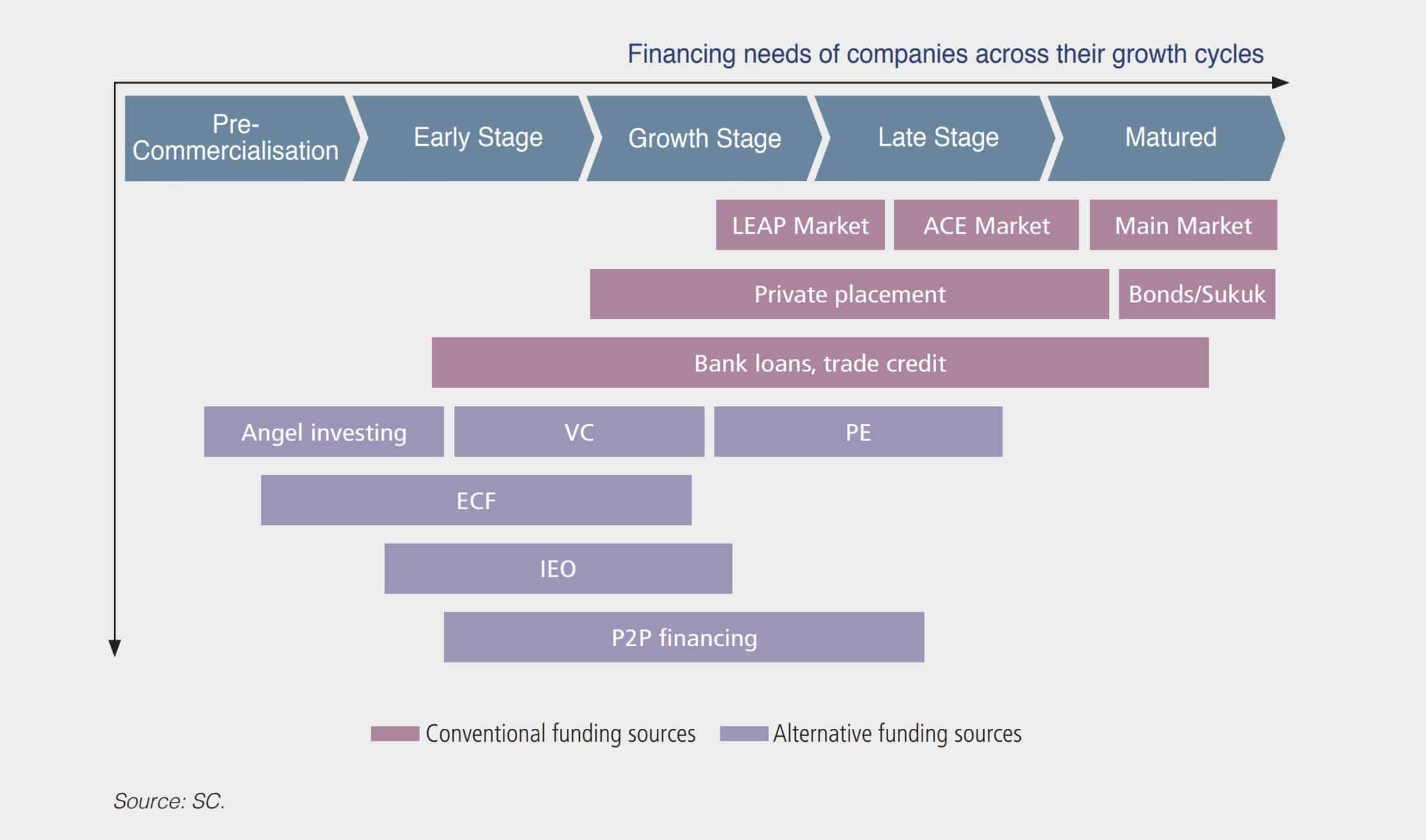
This is where IEOs come in to fill this gap, as an alternative tool for enterprises to form capital across their spectrum of growth (see diagram).

IEOs specifically cater to enterprises with projects that “provide an innovative solution or a meaningful digital value proposition for Malaysia”.[2] This is wide enough to include anything that “addresses an existing market need or problem; or improves the efficiency of an existing process or service”.

By allowing IEOs to raise up to a maximum of RM100 million, this could carry start-ups and early-stagers through to the Series rounds. In fact, this amount is even higher than what late-stagers averagely raise at public listings on the junior boards of Bursa Malaysia like ACE and LEAP!

Funding Sources

Source: Securities Commission Malaysia

Is it Difficult to Become an Issuer?

Business Man Unhappy Businesspeople Sitting Office

While there are regulatory requirements to ensure the integrity of the offering, the funds are kept in trusted hands, and the people running the show are fit and proper – overall, the entry barrier is kept low. If you are planning to issue tokens for your business, you can approach the IEO operator who will qualify your investment thesis and make the decision to approve or reject it. It does not have to go through SC for approval. 

What you do need is to prepare a whitepaper for submission to the IEO operator and SC. Although this is not subject to stringent Prospectus Guidelines, the requisite coverage of contents is extensive. Put bluntly, this is not going to be any run-of-the-mill whitepaper of an Initial Coin Offering (ICO) project that you just pull from the web.

It has to include, among other things, the audited financial statements of the issuer, distribution policy of the digital tokens, their accounting and valuation treatments including “all reasonable presumptions adopted in such calculation”, and the scheduled timeline for drawdown and utilisation of proceeds.[3] And should there be any material changes or omission to the whitepaper, a supplement is required for submission anew.

The issuer should also note that an IEO is an ‘all-or-nothing’ raise. Essentially what this means is that the issuance must be fully subscribed. If it is under-subscribed, the issuer is not allowed to keep the monies raised unless the target amount is achieved, and the IEO operator must refund back to investors. If it is over-subscribed, the issuer is not allowed to keep any amount exceeding the target amount raised.

Does This Replace Venture Capital?

Silhouette Confident Businesspeople

No, it doesn’t. The intent is to diversify funding sources as shown in the diagram above. But there are other factors at play.

To the cash-hungry entrepreneur, the IEO option generally provides lower cost of funds with lower cost of issuance (though this is debatable). Their investors are less demanding than banks when it comes to assessing the credit risk profile of the enterprise.

More importantly, digital tokens are not considered shares (as mentioned in Part 1) and are thus non-dilutive to capital structure. The shareholding control and cap table will remain the same post-IEO.

On the other hand, VCs may prefer the conventional funding route for their investees because digital token issuance can complicate valuation during investment rounds and cause problems for eventual public listing. Why would VCs want to accept digital tokens, which might seem legally untested, instead of the usual tried-and-true convertible notes?

Furthermore, the VC contract includes detailed covenants and provisions which cannot be summarily replaced by the ‘smart contract’ used in digital tokens in an IEO relationship.  

And while there are global ‘crypto VCs’ that do accept digital tokens, they face a hurdle in Malaysian IEOs because cryptocurrency is not allowed as a form of payment for investment. More on this in Part 3.

One thing to note is that IEOs cannot provide the kind of support that VCs do: To incubate, mentor, and accelerate the business. This is a major lesson from the ICO Boom-Bust during the 2016-19 period: While most people think of ICOs as scams or money grabs, the truth is, many projects were genuine without malicious intent, but their entrepreneurs didn’t know how to handle too much investors’ money and ended up failing. Cheap and easy capital can be both a blessing and a curse!

Simply said: IEOs can give what entrepreneurs want but not necessarily what they need. The IEO regulations ensure that there is accountability for the funds raised – but not the advisory to prevent these funds from being misused by management.

Why Are Other Sectors Also Eyeing This?


Construction Workers Sunset

The ability to tokenise assets and businesses into units of investment, and distribute them through IEOs, has captured the imagination of other industries such as property, agriculture, and hospitality.

For lumpy or indivisible assets like real estate or property, tokenisation can carve them up conceptually into smaller affordable portions (commonly known as ‘fractionalisation’) with lower minimum investment for retail investors. For commoditised sectors like agriculture, the issuer can sell digital tokens that represent metric units of their production yield e.g., one token equals to one tonne of wheat.

It boils down to how you play with the economics: Hotels are intuitively tokenisable as they are made up of individual rooms which generate income. Investors can estimate how much a hotel room unit is worth based on its future earnings potential.

Certain suites can be tokenised at a higher price. Shopping malls and integrated projects can choose to unbundle different property rights by issuing different class of tokens, or strip the property into different income streams which are hardcoded into the ‘smart contract’.

There is no doubt that a tokenised structure can provide much flexibility for property owners or developers sitting on illiquid stocks. It can be similar or even go beyond what securitisation models or REITs (real estate investment trusts) can achieve.

However, it is important to realise that what is technically possible may not always be legally feasible. Given the dearth of regulatory guidance on IEOs at this point, there are a lot more questions than answers.

Finally, the RM100 Million Question…

In the end, literally the hundred-million-ringgit question on everyone’s minds is this: Could an IEO operator raise this kind of money, consistently? Even a mere 10% of this is a huge raise on its own, and extremely rare, by ECF standards. Where will the investors come from?

Let’s find out in Part 3.

About the Author

Edmund Yong

Edmund Yong is the managing partner of Celebrus Advisory and appointed by MDEC as part of its Talent Expert Network (formerly known as Digital Expert Panel) for blockchain technology. He is also the resident consultant for GLT Law, a multi-award-winning legal practice with specialisation in digital assets. All opinions expressed are the author’s own.

[1] Securities Commission of Malaysia, Capital Market Masterplan 3: 2021-2025 (2021).

[2] Securities Commission of Malaysia, Guideline on Digital Assets (28 October 2020).

[3] Ibid.