
Thursday, 20 August 2026 Stay informed. No noise.

Will Writing: Can I Do it Myself?

In my article published in August 2017 entitled “Have You Prepared Your Will?” I dealt with the general process of making a will, the advantages of having a will made, and some questions that I have answered from my clients over the years with regards to the will-writing process.

I have since then received further queries on whether it is necessary or mandatory for one to use the services of a law firm, or a professional will-writer for the purposes of writing a will. This article will deal with that question from a legal and practical perspective.

Firstly, the law does not compel you to appoint a law firm or a professional will-writer to have your will written.

Unlike applying for Letters of Administration or a Grant of Probate where the services of a lawyer are required for the purposes of filing the requisite applications in Court, will-writing can be done by the individual.

However, when you undertake the will-writing process without the services of a professional, it is prudent that you are fully aware of the requirements and intricacies of the laws relating to inheritance, in particular, the Distribution Act 1958, The Wills Act 1959 and the Probate and Administration Act 1960. 

Will Writing: Dos and Don’ts

will writing

The worst thing you can do is to use a standard template obtained from the internet, which could eventually lead to various problems, including your will being challenged.

Neither should you use templates given to you by friends as their wills may have been drafted under different circumstances from yours.

It is important to remember that a lack of clarity and vital omissions in your will can lead to disputes between your family members and unnecessary protracted and costly litigation.

If you wish to intentionally leave out a particular family member from your will, it is advisable that you set out expressly that you wish for this person to be excluded and give reasons for that exclusion. This will reduce the chances of a successful challenge in Court.

There have even been circumstances where the Courts have gone against the contents of the Will, and pursuant to the Inheritance (Family Provision) Act 1971, made provisions for other members of the family, where the Court was of the opinion that the deceased had not made reasonable provisions for the maintenance of a particular dependent.    

When the Court makes such a decision to contradict or go against the contents of a will, the Court will consider all circumstances, including the assets and income of the dependent, the conduct and relationship of the dependent with the deceased, the size of the estate, and the interest of the named beneficiaries.

If you are unwell or are under heavy medication for a prolonged sickness, it is advisable that you get your doctor to confirm your state of mind when your will is being signed, as there have been instances where a will has been challenged on the grounds that the deceased was of unsound mind or under heavy medication, and therefore, making it impossible for the deceased to have known what document he or she was signing, let alone the contents of the said document.  

The Courts have in the past dealt with disputes where family members have challenged a will on the basis that the contents of the will had been altered, the signature of the deceased had been forged and that the execution of the will was not properly witnessed.

It is prudent to note here that wills do not need to be stamped, but there is a requirement in law for the will to be properly witnessed.

I have read lots of articles about this matter and have heard many people say that will-writing is a simple matter that any lay person should be able to handle on their own.

However, I am cautious about taking such a position as it may not be as simple as it seems, as I have described above.

Knowledge is Key

will writing

Firstly, you must be very clear in expressing your intentions in writing. It is advisable to appoint a professional, who will be able to craft your thoughts and intention on paper, rather than to be left with a document that is ambiguous, and thus open to challenge in the future.

It is also necessary for you to constantly review and update the contents of your will. This is important as you may have sold some of your properties and may want to omit those properties from your will.

In other circumstances, the status of your relationships may have changed and you may want your will to reflect that. It is important to make those changes and have it properly documents.

There have been circumstances where family members have produced two different wills by the deceased in Court and have challenged the authenticity of later will.

It is my opinion that one should not look too lightly at the will writing process. From a litigation lawyer’s perspective, a badly drafted will can mean years of protracted, costly litigation and years of turmoil and dispute between warring family members.

It is important that one does not leave a legacy of strife and for that, I would advise that the services of a professional be sought for the purposes of writing your will.    

About the author

Sharmila Ravindran

SHARMILA RAVENDRAN is the founder of the law firm, Messrs Ravindran located in Mont Kiara, Kuala Lumpur. She has more than 14 years of experience in the legal industry servicing clients that include local and foreign companies. She is now actively involved in corporate advisory work and commercial litigation and is a Panel Adjudicator with the Kuala Lumpur Regional Centre for Arbitration. She also sits on the Bar Council Child Rights Committee and is the Legal Director for Lean in Malaysia. She can be contacted at sharm@ravindran.com.my.                    

Do You Have a Plan B?

Lee-Wang’s story is not unusual these days. He and his family have been living in Asia for more than 25 years. But as his business expands globally, he spends more and more time shuttling between countries.

The globetrotting businessman is in the process of getting his citizenship through a Portuguese golden visa programme that offers a real estate investment route to gaining residency and potential citizenship in the country and hence European citizenship.

A big driver is for his two children to have the ease of travel a European passport offers in the future. The golden visa programme in Portugal is the most popular in Europe.

Portugal Golden Visa Programme

financial plan b passport

It was launched by the Portuguese government in 2012 to stimulate investment into Portugal and has since encouraged several billion Euros in real estate investment and over 2,000 family applications each year.

An investment of €500,000 is required in real estate in Portugal. The property, either residential or commercial, can be rented for income. Any number of properties can combine to make up the €500,000 minimum investment.

Joint buyers can pool investments into one property. The property can be mortgaged for any investment exceeding the minimum.

Portugal has a very favourable tax regime for anyone considering living in the country. No taxes are charged on overseas income for the first 10 years.

For those non-resident individuals, tax is charged at 28% on income derived in the country. This can be reduced with expenses for rental income.

Capital gains tax is 28% and there are allowances for costs and depreciation. There is no inheritance tax in Portugal. Applicants can apply for permanent residency after five years and Portuguese citizenship after six years.

Global residency and citizenship programmes have been in existence since the 1980s. The demand for the benefits of such programmes expanded rapidly in recent years. The new golden visa programmes in Europe and the Caribbean have wide appeal across many countries.

However, not every country and programme are the same. There are significant differences relating to investment level, family qualification, permanent residency, minimum stay, citizenship and passports, and not to mention, the differing economic states and real estate investment prospects in each country.

The EU Context

plan b european map
Colorful Isolated Europe in Watercolor

A number of European countries offer golden visas through investment in real estate, government bonds and donations. A citizen of any EU country is a citizen of the EU. Citizenship and a passport from any EU country allow the holder to live, work, study or travel visa free to any EU country because they are a European citizen.

A resident of any Schengen countries can travel freely throughout the Schengen zone without border controls even though they may not have a European passport.

The Schengen Area is the area comprising 26 European countries that have abolished passport and any other type of border control at their common borders, also referred to as internal borders. It mostly functions as a single country for international travel purposes, with a common visa policy.

Based on experiences, some of the motivations behind global residency and citizenship planning are:

Investment Return

Most programmes offer real estate investment as the route to gaining a golden visa from that country. Long, medium and often short-term investment horizons lead to significant capital gains for real estate.

Safe Haven Investment

The USA and Europe remain safe havens for investment with clear property ownership laws, democratically elected governments and established taxation rules.

The laws of the Caribbean countries offering citizenship programmes are based on UK law with democratically elected governments.

Legacy for Family

plan b family legacy

Once the investment is made and the visas, residency cards and citizenship are granted then the ties and contacts with that country begin to increase.

Children can be included, they eventually move on perhaps for an education, eventual jobs, eventual citizenship and the next generations have firm roots which they have either put down or have the option to do so.

Education for Children

Once permanent residency is established by living full time in the country, children can be educated under either the state or private education system.

Looking to the future, as European citizens, children can gain access to universities in English speaking countries such as the UK at European and not international rates (a substantial saving).

Some Caribbean countries offer higher education offering ease of access to universities in the USA.

Ease of Travel

plan b ease of travel

A golden visa will lead to a residency card or eventually citizenship and a second passport. In all cases this can significantly improve an applicant’s ease of travelling throughout the world.

A European passport allows the holder to live, work and travel anywhere in the EU including countries outside the Schengen Zone, such as Switzerland, the UK and Ireland.

Second Passport

The second passport and citizenship option arise from all the Caribbean programmes and several golden visa programs in Europe.

Taxation

plan b tax

Taxation is a big concern for most wealthy investors. This is an area where more detailed planning will be needed. The Caribbean countries offer low or no taxation on overseas income.

In Europe, some countries such as Portugal impose no further taxation on overseas income for the first 10 years of residency.

No doubt, there are changing times ahead, with residency and citizenship planning or getting a Plan B already becoming an essential part of an offshore wealth management strategy for high net-worth individuals.

On a final note, beware of fraud. The demand for second citizenships has created opportunities for fraud and misrepresentation.

Be sure to perform the necessary due diligence or hire a qualified advisor or consultant specialising in such programmes. Get the right advice that is balanced and independent.

About the author

YH Wong has over two decades of experience in the financial services industry. His clients include high net worth investors and boutique institutions such as family offices and investment partnerships in the region. He is currently a senior partner with Satori Consultancy Ltd, a financial services company regulated by the Mauritian Financial Services Commission. He can be reached at yhwong@satoriconsultancy.com.

Review Your Business Legal Health Yearly

Whether we are business owners or in employment oftentimes we neglect our legal well-being. The general notion is ‘what isn’t broken need not be fixed’.

What we fail to recognise is that most of the time, a lot of our legal problems, which may at the material time appear small or insignificant, can with time and neglect, multiply and become costly to rectify.

Most times these legal crises and complications can be averted or reduced if the right steps are taken at the appropriate time.

Why is a Legal Health Check Important?

It is important to remember that if your financial and legal matters are badly managed, you are directly exposing yourself personally as well as your company and clients to various legal implications.

These risks can cause unnecessary cost, loss of business relationships, knowledge and possible statutory or regulatory breaches. The effect of a badly managed business is far- reaching and can in some situations take years to rectify/remedy.

The advice here is to be constantly aware and apply your mind to a couple of key areas when you are performing your own legal health check. Here are some of them:

1. Have You Complied with the Relevant Statutory Regulations & Laws?

legal compliance

Often, as business owners, you may not be aware of the changes in law that may have taken place, and as such need to be advised by your legal advisers on the latest legislation or amendments to any current legislation that concerns the industry you are in and the services you render.

There are currently more than 20 new Acts that have been made and countless new regulations and amendments to the current laws.

If you are not keeping abreast with the changes, you will be exposing yourself and your business to risk. What you do not can hurt you!

2. Partnerships and Shareholding

legal partnership and shareholding

Make it a yearly affair where you have a formal discussion with your partners/directors on their roles, scope of work, performance and entitlements.

Have these discussions minuted and served on them officially. This makes it easier to address partnership or business issues and enables you to make any necessary changes to your business structure, revising targets, scope of work etc.

It is also of utmost importance to have written partnership and/or shareholders agreement to cover all terms of your partnerships and shareholding.

Ensure that your agreements adequately deal with matters such as buyouts, raising capitals, succession, put & call options and exit clauses. Your partners/directors must also be fully aware of their duties and obligations under the new Companies Act 2016.

3. Trade Creditors and Debtors

By this time of the year, you must know who owes your company money and how you intend to recover those unpaid debts. Have a list of creditors prepared and send out the necessary reminders and letters of demand.

Start the process of recovering monies before the New Year. The longer you wait, the harder it will be to collect these debts.

For those creditors who, for whatever reason cannot pay you in full, it would be advisable to speak to them about an instalment plan and get a settlement agreement drafted to confirm the instalment terms. If possible collect post-dated cheques.

4. Employment Contracts

legal contract

It is pivotal for you to know what your exposure as a company or business in an employment dispute. It is also important for you to know the processes and procedures that you need to carry out before you terminate a belligerent employee.

It is prudent that you have an Employment Handbook prepared and served on all your employees.

This year alone there have been a lot of discussion on the need for change to our employment laws in particular, to laws covering sexual harassment at work, maternity and paternity leave, data protection and personal information.

5. Intellectual Property

Whatever industry you’re in, it is prudent to consider registering your trademark and tradename. As your business gains popularity and people start recognising your brand and name, it is inevitable that a competitor may want to benefit from your goodwill to gain some traction.

You do not want a competitor to proceed to use your name and logo in a similar industry and reap the benefits and goodwill off your hard work.

Please do consider securing your intellectual property rights. It makes it easier for you to enforce your rights when you have the requisite trademarks being registered.

6. Written Contracts and Agreements

Always have your written contracts and agreements revised and up to date. Review the terms of your Purchase Orders, Invoices, Supplier Contracts, Equipment/ Machinery Leases, Rental Agreements.

It is important that at all material times, you are aware of your key suppliers and key customers. Review these contracts and agreement as there may be renewal clauses in those contracts that may have slipped your mind, which could cause you undue losses.

7. Train Your Staff

legal staff training

Always train your staff to be aware of what type of legal documents to look out for. For example, a Winding up Notice that is served on your registered address needs to be brought to the immediate attention of the Board of Directors, as there are dire repercussions of not responding to the said Notice within the statutory imposed period of time.

Conclusion

There is no such thing as a ‘one size fits all’ when it comes to legal matters. You will need to design your own Legal Health Check which is suitable for your own business or company.

Like a well-tended garden, you will need to constantly prune, remove and regrow your legal structures to ensure that it is in perfect order.

Always remember that a detailed examination of these key areas will help you identify any danger or grey areas which will then enable you to circumvent or reduce any potential risks and liabilities to your business.

About the author

Sharmila Ravindran

SHARMILA RAVENDRAN is the founder of the law firm, Messrs Ravindran located in Mont Kiara, Kuala Lumpur. She has more than 14 years of experience in the legal industry servicing clients that include local and foreign companies. She is now actively involved in corporate advisory work and commercial litigation and is a Panel Adjudicator with the Kuala Lumpur Regional Centre for Arbitration. She also sits on the Bar Council Child Rights Committee and is the Legal Director for Lean in Malaysia. She can be contacted at sharm@ravindran.com.my.                                                                                                                                            

Rich Debt, Poor Debt

Debt seems to give a negative impression. Sometimes it even gives people the chills just by hearing the word. But what is debt? Both layman and business dictionaries define debt as something that someone has given permission to borrow but with conditions to repay.

Now when it comes to organisations around the world, debt is used as an engine that creates financial leverage and multiplies yield on investment; provided returns generated by debt exceed its cost because the interest paid on debt can be written off as expenses.

Looking at this, is debt a good thing? Does debt put you in a better position or worse? Does debt make you RICHER or POORER? The answer is: “It depends!”

Poor Debt

We have seen tremendous growth in lifestyle expenditure. The unfortunate part of this culture is the increase of debts which makes people poorer. Let’s take the credit card as an example; 40% of credit card holders’ debt revolve around their credit, which means they only pay the minimum or part of the due amount after spending in full every month.

This trend has been rising for some time now. When you spend beyond your means and revolve unnecessarily, especially on lifestyle lavishness, you are paying a high price for your indulgences as the payback for your expenditure is compounded by a whopping 18% per annum.  

To make matters worse, most of these lifestyle extravagances depreciate in value.

Responding to this trend, the personal loan product emerged as another form of new age credit. It gives easy cash access as it requires no asset pledged or charged as security. Many people are attracted to this sudden access to large volumes of cash that can be used for anything desired.

What’s more, its fixed low monthly payback instalment makes borrowers believe they have more control of their finances this way. The personal loan is another lending facility that gives the after effect of one week of pure enjoyment and five to seven years of dreadful commitment.

Running a debt on a credit card and personal loan is EXPENSIVE. It will cost you three to four times MORE than a home loan / mortgage.

In a nutshell, a poor debt is basically spending your future money for current or past expenditure and it does not generate anything for your future.

Rich Debt

Please see the situation below on how a debt that can make you richer.

Image 14

John buys the same asset worth RM1M, and after three years, he also sold it at RM1.2M and made a handsome profit of 20%. He paid the entire asset of RM1M in cash. This was his capital outlay.

Amanda buys an asset worth RM1M, and after three years, she sells it for RM1.2M, making a handsome profit of 20%. She had the cash to buy the asset but she took a loan to finance 90% of the asset. Her capital outlay was only RM100,000.   

Who is a smarter investor? Who made more money? Who is financially more resilient?

  1. Amanda only used RM100,000 to make RM200,000 in three years.
  2. While on the other hand John used RM1,000,000 to make RM200,000 over three years.

Amanda applied the power of SMART Leveraging. Amanda leveraged using debt, which she intentionally created, and a debt that is clearly controllable both in paying down and its desired outcome to increase her ROI (return of investment) percentage from 20% to 200%.

On top of that, she had funds for emergencies and additional money to invest on other opportunities that give better ROI than a savings plan. Doesn’t that make more financial sense? Amanda successfully leveraged her way for higher gains.

So, What is the Power of SMART Leveraging?

To simplify it, let’s say you have an objective to achieve, you know how to achieve it but all you need is something to leverage on to make it happen. A mortgage is a cost-effective way of borrowing. Interest rates on mortgage is no doubt the cheapest form of borrowing available in the market because it is secured with property.

What this is creating is that you are now boosting your wealth with effective returns. Just like the example of Amanda and John − Amanda has successfully increased her wealth by using only 10% of the asset value to give her a return of 200% after three years.

Worth a read : 3 Important Steps For Your Mortgage Application

Borrowing is Not New

We borrow to buy our homes. We borrow to buy cars, which is a depreciating asset but at times, a necessity. We also borrow to buy lifestyle indulgence goods.

Most of the time we borrow to do things that are not financially productive.  SMART Leveraging can be incredibly productive when it is understood and used properly.

Therefore, equip yourself with the right financial knowledge and start using mortgages as a wealth creation tool. It can be used as arbitrage to leverage what you don’t have and yet benefit based on the total current value of the property when it appreciates over time.

The key here is;

A mortgage allows us to leverage and leverage allows us to do more with less.

About the Author

Gary Chua

Gary Chua is the Chief Executive Officer of Smart Financing Co.

Is Malaysia Going To Go Bankrupt?

Lately, after Sri Lanka became bankrupt, numerous messages have been circulating on social media claiming that Malaysia will go bankrupt next.

You might have seen them on FB, Insta, and Tik Tok or forwarded WhatsApp messages that we are doomed next.

But do these claims hold? Let’s examine the numbers.

How Does A Country Go Bankrupt?

A country’s economy collapses when it has no or zero cash reserve, exports and economic activities.

In Sri Lanka’s case, rampant corruption, economic mismanagement and meddling with the constitution by the ruling elite have led Sri Lanka to bankruptcy, affecting millions of citizens in the island nation.

They are now facing fuel and food shortages, high inflation and endless political turmoil. Sri Lanka is now drowning in its worst-ever economic crisis and pleading for other nations’ help to keep its economy afloat.

Following a 70% drop in foreign exchange reserves since January 2020, Sri Lanka has struggled to pay for essential imports such as food and fuel. Its foreign currency reserves fell to US$2.31 billion in February, a fall of US$779 million from December 2021 through January 2022.

What led to these dire situations was a series of unfortunate events.

Here Are Some YouTube Videos Which Explain The Crisis In Detail:

Why Sri Lanka is Collapsing: the Coming Global Food Crisis

Gravitas Plus | Explained: Sri Lankan economic crisis

How One Powerful Family Destroyed A Country

To summarise the videos, some key factors diagnose the health of a nation’s economy. Let’s have a look.

Foreign Exchange Reserve

Is Malaysia Going To Go Bankrupt1

Sri Lanka’s Foreign Exchange Reserve

Is Malaysia Going To Go Bankrupt2

Malaysia’s Foreign Exchange Reserve

Foreign reserves are the foreign currencies a country’s central bank holds as backup funds in an emergency, such as a rapid devaluation of its currency.

It is good practice to hold foreign exchange reserves in a currency that is not directly connected to the country’s currency. Therefore, most reserves are held in U.S. dollars, the most traded currency in the world.

Countries use foreign currency reserves to keep a fixed rate value of their currency, maintain competitively priced exports, remain liquid in case of crisis, pay external debts and provide confidence for investors. Therefore, an increasing foreign exchange reserve is ideal. Malaysia, in comparison to Sri Lanka, has a strong foreign reserve which has been increasing while Sri Lanka’s foreign reserve has been declining.

Is Malaysia Going To Go Bankrupt3

Balance Of Trade

Is Malaysia Going To Go Bankrupt4

Sri Lanka’s Balance of Trade

Is Malaysia Going To Go Bankrupt5

Malaysia’s Balance of Trade

Balance of trade (BOT) is measured as the difference between the value of a country’s exports and the value of a country’s imports for a given period.

A positive trade balance (surplus) is when exports exceed imports, while a negative trade balance (deficit) is when exports are less than imports. A trade surplus does not necessarily indicate a healthy economy, nor does a trade deficit necessarily indicate a weak economy.

While a trade surplus helps in creating employment and economic growth, it may also lead to higher prices and interest rates within an economy. When based solely on trade effects, a trade surplus means high demand for a country’s goods in the global market, which pushes the price of those goods higher and leads to a direct strengthening of the domestic currency. On the other hand, a trade deficit can be beneficial to countries that import heavily and simultaneously invest in economic development.

Malaysia, an export nation, has a consistent trade surplus, while Sri Lanka has had a trade deficit for the past years. Unfortunately, Sri Lanka did not invest heavily in economic development activities.

Is Malaysia Going To Go Bankrupt6
Is Malaysia Going To Go Bankrupt7

Malaysia’s Export Category

Is Malaysia Going To Go Bankrupt8

Sri Lanka’s Export Category

Moreover, Malaysia’s exports are varied, well diversified and highly valued, mainly contributed by the Electric and Electronics industry, Oil and Gas and palm oil. Sri Lanka’s exports, on the other hand, are highly dependent on the low-value clothing and agriculture industry, and their GDP heavily relies on tourism.

Government Debt To GDP

Is Malaysia Going To Go Bankrupt9

Sri Lanka’s Government Debt to GDP in Percentage

Is Malaysia Going To Go Bankrupt10

Malaysia’s Government Debt to GDP in Percentage

Is Malaysia Going To Go Bankrupt11

The debt-to-GDP ratio compares a country’s debt to its gross domestic product (GDP). The ratio indicates a country’s ability to pay back its debts by comparing what it owes with its production.

The higher the debt-to-GDP ratio, the higher its risk of default and the less likely the country will pay back its debt.

Even though Malaysia has gone through a series of economic and financial recession crises before, it has never failed to pay interest and mature debts, proving Malaysia’s reputation and capability as a debtor with a good repayment record.

Article 98 (1) (b) of the Federal Constitution stipulates that the Government must prioritise debt charges over other operating expenses. The External Borrowing Act 1963 provides that offshore borrowings cannot exceed RM35 billion. As of the end -of June 2022, this debt amounted to RM29.4 billion.

The Provisional Measures for Government Financing (Coronavirus Disease 2019 (COVID-19)) (Amendment) Act 2021 stipulates that the statutory limit of Government debt cannot exceed 65% of GDP. At the end of June 2022, statutory debt accounted for 60.4% of GDP.

In addition, 97% of the Federal Government’s total debt is in the Ringgit denomination. This reflects prudent debt management as exposure to foreign exchange risk is minimal.

Is Malaysia Going To Go Bankrupt?

Based on Malaysia’s economy, the big answer is NO.

However, as I explored more about the circumstance which led to the Sri Lanka crisis, I couldn’t help noticing parallels between the political and economic situation in Sri Lanka and Malaysia. The situation in Sri Lanka warns us about where we could be headed if we don’t address similar structural problems in Malaysia.

We can avert the crisis Sri Lanka faces if we are willing to learn the lessons the island nation offers.

The problem in Malaysia is social economics, which is stagnant. To elaborate more on social economics problems, here is the list:

  • Lack of proper economic policy and implementation of the policy
  • Lack of policies to control fake demand induced inflation, especially in the property market
  • Lack of technological innovation and skills appreciation in STEM
  • Lack of policies to ensure proper business ethics and transparencies in the business industry
  • Lack of law enforcement leading to rampant corruption
  • Lack of political stability

Therefore, we, the Rakyat should exercise our rights by electing competent leaders at the next general elections to ensure Malaysia does not go down the path taken by Sri Lanka.

Source: J Advisory

Protecting Your Overseas Assets

We now live in a more connected world, thanks to technology and easy travel access to other countries, which is why it has become increasingly normal for us to have our wealth scattered around the world.

However, I would like to urge you not to overlook and forget to protect your assets that are outside of Malaysia when you invest overseas.

Different Jurisdiction, Different Law

We often tend to take things for granted with regards to presuming that the laws and taxes where our foreign assets are domiciled are similar to the set of laws and taxes in Malaysia. As such, many Malaysians will kick-start their foreign adventure without even knowing what will affect them.

One such drastic difference that we must know from day one is perhaps the presence of estate tax or inheritance tax. If you have assets in countries like the US, your estate (US-situated asset) may be subjected to two levels of estate taxes, namely at the Federal and State levels.

Estate tax is a form of tax levied on the taxable estate, meaning after making certain adjustments to the gross estate value such as deducting funeral expenses and donating to charities, among others. It can rack up to as high as 40% of excess of US$5mil for resident and $60,000 for non-resident (on the Federal level).

My Client’s Experience

One of my clients, Mr. Y had experienced a great loss when his brother passed away. His brother is a Malaysian who is domiciled in Singapore a decade ago.

Mr. Y’s brother had accumulated his wealth both in Singapore and Malaysia prior to his death and had left behind a self-drafted will – one that was drafted about 6 years ago, with its contents neither reviewed nor changed since. Mr. Y’s brother had also appointed his younger sister, who resides in Johor Bahru, to be the executor of his Will.

However, when Mr. Y’s brother passed away suddenly, his sister refused to be the executor of the will since she couldn’t make time to go to Singapore on such a short notice.

What’s worse, Mr. Y’s brother did not leave behind a list of his assets and liabilities, which meant that they had to first find out what these assets were, and where they were located.

This responsibility was passed to Mr. Y, who had to write in to every financial institution to inquire if his brother had maintained any accounts with them. This process took Mr. Y several months, and brought him down to Singapore numerous times.

To avoid leaving a mess for our beneficiaries, consider these options to ensure that our foreign assets are protected from the two things that are inevitable in life: Death and Taxes.

1. Making a Will

asset

While a will can lead to a smoother and simpler process of distribution, we also need to understand that not every will is executable.

The most important thing about writing a will is not about the instructions, but who the executor of the Will should be. Taking into consideration distance and proximity to decide who the executor should be might not help the situation a bit; instead the executor of the will has to be, first and foremost, someone who is capable and, at the same time, trustworthy.

As the executor might pass away before the testator, or may not have the time to handle the tedious task of executing the will, the will also needs to be monitored from time to time.

Another point to note would be that we should have multiple wills to separate Malaysian assets from foreign assets in different jurisdictions, especially when immovable assets such as properties are involved.

This will save precious time and money for both beneficiaries and executors as they can execute concurrently, rather than having to wait or decide where to apply for Grant of Probate (original will is needed to apply for probate).

2. Setting up a Trust or Foundation

A Trust or a Foundation is the recommended solution if you have a sizeable asset to leave to beneficiaries. The requirement for applying Grant of Probate is not applicable in this case as the transfer of assets into the Trust will have to occur prior to death of the settlor or founder.

Indeed, a Trust or a Foundation is the solution for investors who need a higher level of planning as compared to the use of will. A will’s role is to mainly dictate the intention on distribution of assets, while a Trust goes beyond and preserves it upon death.

A Trust or Foundation can be maintained for few generations, and some can be perpetual, provided that the funds and asset size are big enough. This can ensure succession for future kin and also allow the settlor to still have control over how beneficiaries can receive from the Trust or Foundation as there will be a Trust deed or Foundation Charter that contains the wishes of the settlor.

3. Insurance Wrap Account

assets

An easier way to protect our paper assets overseas would be through the use of a life insurance wrapper. This is an open-architecture account whereby an investor can put in any form of liquid assets such as equities, bonds, mutual funds, bank deposits, ETFs, and even currencies into the account.

This life insurance wrapper allows investors to trade and buy stocks directly from major exchange such as the New York Stock Exchange and Tokyo Stock Exchange, and buy funds from renowned company such as JP Morgan, BlackRock and Fidelity.

Life insurance wrapper accounts can only be done via a Licensed Financial Planner and the account will be registered in tax havens such as Isle of Man, Cayman Island, the Bahamas and Panama, thus allowing protection from tax leakage as all investment returns are tax-free.

When we open a life insurance wrapper account, we will be able to nominate beneficiaries, thus allowing for smoother transfer of assets when death occurs, and at the same time maintaining protection from tax.

About the author

kevin neohKevin Neoh is a NextGen Money Coach who works with people to help them transform their relationship with money to improve their lives with the money they have. Kevin can be contacted at kevin@nextgenadvisors.my and www.kevinneoh.my.

Spend Only on the Things that are Important to You

In today`s challenging economic environment, people from all walks of life are suffering from financial predicaments that also affect their spending.

Rising Inflation, decrease in value of the Ringgit, increase in prices of goods & services, petrol and cost of living in general, is drastically reducing purchasing power and adding on to the woes.

According to the statistics from the National Health and Morbidity Survey 2015, one in three adults in Malaysia, either consciously or unconsciously, suffer from mental health problems.

Financial constraints and stress, as well as family and career problems, are among the key factors which contribute to the rise in mental health problems.

So, what is the solution for this predicament? It’s none other than financial wellness

Financial wellness focusses on knowing how to plan, save and invest your money so that you can successfully work toward achieving your financial goals. It’s not about how big is the pay check; rather, it`s very much dependent on one`s right financial habits or behaviour.

Achieving true financial wellness is more than outward prosperity and has less to do with dollar signs than it does with how money affects your life and your relationships.

Therefore, to achieve financial wellness, individuals must equip themselves with the right financial habits and knowledge.

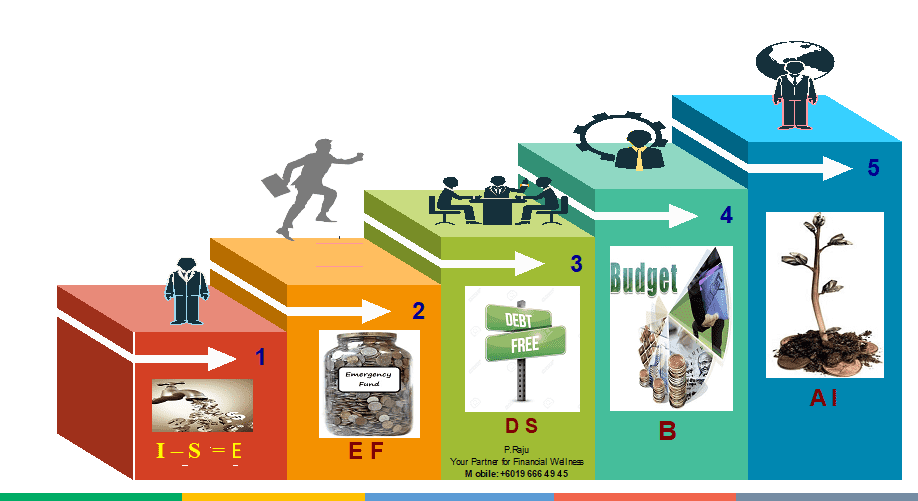
Image 20
5 steps to achieve financial wellness

So, the 5 important steps to achieve financial wellness as described in Figure 1 are as follows:

Step 1: Be a Conscious Spender to Save Money

Step 2: Be prepared for Rainy Days

Step 3: Minimise your leakages by Managing Debts

Step 4: Be Control of Your Money via a Budget

Step 5: Consistent Accumulation & Investing of Money

In the first instalment of this financial wellness article, we will focus on the first step, which is Be a Conscious Spender.

Conscious Spending

spend

Step 1 pretty much implies that you decide exactly where you’re going to spend your money, after you have paid yourself of course. At this stage, you’re also actively choosing to spend on some things and not on others.

According to American personal finance advisor and entrepreneur, Ramit Sethi, who is also the author of the 2009 New York Times Bestseller on personal finance, I Will Teach You To Be Rich, “The heart of frugality is choosing to spend on the things that are important to you while cutting back ruthlessly on the things that aren’t.”

So, conscious spending is very important since it fosters every virtue, teaches self-denial, cultivates the sense of order, trains to forethought, and so broadens the mind.

In a nutshell, it depends on the ability to control one`s money by becoming a conscious spender and focus on needs, then wants, and subsequently cultivate consistent saving habits.

As you start to practice conscious spending, your financial behaviours or habits improves, which is really the key to achieve financial wellness.

To put conscious spending in action, you have to learn to ask yourself the questions below before you make a purchase:

  • Will I use this?
  • Can I get this cheaper?
  • Can I wait to buy this?
  • Why am I buying this?
  • Is there something else I’d rather spend the money on?

Conclusion

Financial behaviours or habits are formed in individuals over time; it cannot happen overnight. However, once you get it going, it would become very difficult to shrug it off.

About the author

Raju Periasamy is a Certified Member of the Financial Planning Association of Malaysia (FPAM) and a Licensed Financial Planner with Phillip Wealth Planners Sdn. Bhd.  He can be contacted at rajuperi@gmail.com

Financial Planning for the Middle-Class Rakyat

Financial planning has often times been associated with the rich. Most people have the perception that only rich people can afford to plan their finances. Is this a fair observation?

So does this mean that if you are not rich, you should drop the idea of financial planning? What if you are in between these two extremes – the middle class or middle-income people?

I have constantly observed how the middle-income group struggle more compared to the low-income group. When you’re in the latter, you live a lifestyle more driven by need.

However, if you belong to the middle-income group, the decision-making process is based more on the want factor, not need anymore.

How then can the middle-income group reduce their disadvantage and propel themselves toward their aspirations and dreams? Below are some ideas that one can explore:

Be Aware

When it comes to investing, you cannot wait until you have enough money, and then only start to think about investing.

The popular belief is that we can only manage our financial affairs once we have surplus. However, in actual, those who have surplus are those who have done planning, and make it a point to ensure they do the needful.

Cash-flow management is crucial

If you manage your cash-flow and debt obligations, you would end up having surplus because without surplus, it’s impossible for one to have savings.

Protect your savings

It’s not easy to accumulate savings nowadays; thus, you need to learn to protect it efficiently. We cannot afford to overlook or ignore risk management as this can help protect our savings when financial losses occur.

Watch your credit behaviour

Those who are in credit card or debt crisis have once told themselves that they would just use the credit card for rebates and free-gifts, and that they would make sure they pay the billed amount every month.

The only trouble with this plan is that before you realise it, you are barely making minimum payments, and the amount balloons into a huge outstanding in no time.

Moreover, interest payment is one of the tiny leakages that will have long-term impact on our ability to save.

Start early but small

According to Figure 1 below, a person who starts investing RM12,000 today with no additional new contributions thereafter, will need an investment that generates 10% per annum to have RM130,016 twenty-five years from now.

financial planning
Future value of investment

However, another individual who started with RM6,000 (50% lesser) would require an investment that is 50% less risky (5% per annum) throughout the same time period, to generate RM134,863. The trick is to cultivate the discipline of adding RM200 a month to the savings pot.

It’s much easier to save a smaller amount than wait for your capital to become significant, as smaller amounts can also grow to become substantial.

Stay ahead of inflation

A person who invests his savings in a way that is right and in-line with his risk capacity, will see his wealth grow and become inflation-proof in the long run.

If you do nothing about inflation, you will find it tougher to maintain your lifestyle. This is due to your shrinking purchasing power, and since it is more likely that your income level will stay stagnant or grow slowly, you will then find that your freedom will be limited by your purchasing power.

The only way to give our wealth some chance to at least maintain its purchasing power is to put it to work.

When you invest, you must bear in mind to invest in instruments that are suitable with your risk profile and is regulated at the same time.

Work on your investment literacy

A person in the middle-income group may have some disposable income, which they would want to invest, after taking care of their lifestyle.

However, be aware of scammers who are out to ‘steal’ our money, influence us to make bad investment decisions, resulting in losses or wasted opportunity.

It is therefore important to have a basic knowledge of investment literacy to conduct appropriate due diligence on investment proposal that is presented to us.

Financial planning is not for the cheapskate

One misconception people have is that when we embrace financial planning, we will have to accept a frugal lifestyle.

However, the whole point of financial planning is to put the aspirations and life goals of a person at the core; as such, it’s rather counter intuitive if you will have to live a frugal lifestyle.

If you embrace financial planning, what you’ll essentially do is look at your personal finance in totality, make decisions that are smarter and less attached to your urge and emotions for instant gratification.

It doesn’t mean you have to eat lesser, or not go out with your friends. We all need a life to build our network.

All said and done, we need to go through a process to manage our financial affairs to ensure that at the end of the day, we will have enough ‘financial muscles’ to help us achieve our life goals.

About the author

kevin neohKevin Neoh is a NextGen Money Coach who works with people to help them transform their relationship with money to improve their lives with the money they have. Kevin can be contacted at kevin@nextgenadvisors.my and www.kevinneoh.my.
Should I Give Up Paying Insurance Premiums In Difficult Times?

Insurance is an important element of any sound financial plan, and a proper Risk Management plan should cover personal risk (Premature Death, Total Permanent Disability, Dreaded Diseases, Personal Accident and Hospitalisation), property risk (car, house and its contents) as well as liabilities insurance.

Having these insurance policies in place can protect your income, savings, retirement, and peace of mind if uneventful situations were to take place.

Without an insurance policy, the consequences of a tragedy can be much worse, especially with the rising cost of health care that can create a heavy financial burden on your family.

A proper life insurance can be used to pay off mortgages, car loans, and credit card debts, leaving other remaining assets intact for your family in the event of the breadwinner’s premature death.

Life insurance proceeds can also be used to pay for final rite expenses. Better still, life insurance can create an estate for your heirs.

Although insurance is a very important aspect of our lives, yet most people treat it as least important, or even strike it off from their financial budget list.

Spending hard-earned cash on vacations, shopping, movies, expensive data plans and dining is seen as more important than paying for a life insurance premium.

Before signing up for an insurance plan, you should first look at your Net Worth Statement to see how much debts you have incurred. Your insurance must be able to cover the debts so that it will not be passed down to your family in the event of a premature death, disability or critical illness that can result in a loss of income.

Therefore, you should either adjust your cash flow and expenses, or increase your earnings in order to find extra money to maintain the premium payments and excess money for savings.

Even if you have been retrenched, you must not stop paying your insurance premium, or worst surrender the policy. Make sure that your insurance is intact to cover you in this critical moment.

However, should there arise a situation when you are really tight for money, there are a few options that can be taken to make sure the insurance cover stays intact. Let’s have a closer look at them:

Car and Home Insurance

insurance

Car insurance premium is mandatory as it is required by the law; so, premium payment is a must.

Same goes for your house fire insurance premium as it is required by bank if your house is still under mortgage.

Life Insurance

You can consider a temporary term, investment-linked, or a whole life non-par insurance policy, which has an affordable premium but comes with big protection to address the problem of huge debts.

If you have an existing traditional whole life policy, you have the option of allowing the policy to exercise auto premium loans (APL) to make sure the protection is not affected due to temporary non-payment of premiums. However, this is only a temporary measure.

You cannot allow APL to exhaust all the accumulated cash values as your policy will then become lapse.

You may wish to convert the policy to an extended term assurance, where there is no further future premiums to be paid, and the sum covered will remain the same until the new revised term of coverage expires. You can even convert the policy to be a paid-up policy with the reduced sum assured.

Health Care Insurance

Medicine Doctor Stethoscope Touching Icon Heart

You’ll never know when you may fall sick or get injured. But you do have options when it happens if you continue to pay your health care insurance premium.

You can lower the premium by considering a standalone health care plan, which has a more affordable premium as compared to packaged plans. But this pretty much depends on your age, gender, health conditions and the coverage amount.

Also, if you are paying a high premium for a bigger coverage, you may want to consider reducing the coverage and get a deductible health care plan with a very low premium.

If you’re planning to do some changes to your existing health care plan, make sure you are aware of the exclusions, waiting period, pre-existing illnesses, as well as other terms and conditions of both the new and the old plan; otherwise you might lose your coverage.

Thus, with the above options, there is no excuse for not paying your insurance premiums.

In any case, before making any of the above decisions, it is best to seek professional advice so that you can make a more informed decision.

2022 Bear Market: A Grizzly Affair

Sometimes, we check our portfolio and we gasp in shock at the horrid performance. The percentages are all in the red, and there seems to be no light at the end of the tunnel.

Young investors who invested into stocks and crypto are left holding the bag, seasoned investors are left shaking in their boots. What can we do to prepare for it?

The Anatomy of the Bear

Before we can figure out what our course of action is, it is prudent to analyze and understand the nature of the problem.

Panda-monium

Bank Number Usa Bills Dollar
One hundred dollars background.

Early 2020 we were greeted with the pandemic. The world went into a halt for two years, where supply dwindled and demand skyrocketed. To alleviate the pain, the US Federal reserve printed trillions of dollars.

Although the initial market reaction was of great fear, the money soon made it into the stock market, and we proceeded to have one of the greatest bull runs in the decade. The ride lasted for about a year, which brings us to the beginning of 2022.

The Ursa Awakens

March 2022 marks one of the darkest days of this year as equities dropped. War broke out in Ukraine following the invasion of the Russian army. The market was concerned with the effect the war will have on supply chain and the availability of commodities.

When the supply of the commodities dwindles, and the demand remains the same, prices skyrockets. Classic economics.

Inflation

Desperate Scared Businessman Keeping Silence

Inflation is the kryptonite of investing (or the economy in general). The CPI numbers is the highest since the 1980s, and it is no wonder it has got everyone running around like headless chickens.

Companies will not be able to keep up with the input costs. Workers will not be able to get a livable wage since prices for basic necessities are soaring. Unchecked, this will create a cycle of hyper inflation that will instantly nuke an economy.

The Feds have been printing money and pumping it into the markets for the past two years. Although the Feds have been parroting that inflation is only transitory, now they have finally changed their tune as the bone chilling inflation numbers become available to the public. Kicking the can down the road has become a non-viable option, and the markets will suffer the consequences.

Although some of the inflation that is present today can be attributed to both the war and the Fed’s actions, one thing is for sure, everything is un-bear-ably expensive now.

Hawkish Feds

Since inflation is sky high currently, and the supply chain is impossible to fix, the Feds have only one option left. To destroy demand by increasing interest rates and reducing the money supply. That or risk runaway inflation.

As interest rates rise and money supply is actively being reduced, cash becomes more expensive, and investors demand more return for their investment, which drives down the value of investments. Complex models are used to determine asset prices, but for us simple investors, understanding this relationship is more than sufficient. In simpler terms, interest rates go up, investment go down.

Recession

Depressed Woman Sitting Chair Dark Room Home

With the threat of two consecutive quarters of negative GDP growth in the US, it is no wonder the markets are growing restless. The GDPNow real GDP growth, as of writing, is standing at 0.3%, it is probable that it will dip into the negative region once more information is available, which will signal to us that a true recession is here.

But can we time the recession and buy in at the bottom? Unlikely.

Recession comes and goes at its own pace, and the markets might reflect that information a lot earlier than expected. Trying to time the market might have the opposite effect of lowering long term returns, since missing just 10 best days of returns in a year will already cripple your portfolio.

Surviving the Rampage

Knowing all of the above, what can we do about it? Navigating the bear market requires understanding of the risk return profile of our portfolio and our specific goals.

Investing in a portfolio of investments that is fully diversified across all economies and geographical regions and taking on the market risk is still the simplest way one can invest without losing too much sleep, as recommended by John C. Bogle, the founder of Vanguard.

Beating the markets is nice, but trying to time derivative hedging strategies and complex long-short plays in a highly volatile market might not be suitable for the less sophisticated investor, and is a recipe for financial ruin. Beating the market is a tough racket, and almost all professionals will not be able to beat it consistently for a long period of time.

The markets have not failed (yet!), and if one believes in the markets, a monthly dollar cost averaging strategy into a diversified index fund is still the most prudent strategy for investors that can tolerate the volatility. Investors nearing retirement age might want to consult a licensed financial advisor to properly plan for retirement, as the market volatility might not be suitable for a retirement fund.

Crypto

Closeup Shot Two Coins Placed Top Mobile Phone

Some experts have touted that crypto moves with the broader market, and offers no diversification benefit, which is hard to dispute, given the current state of crypto. Both institutional and retail investors have lost boatloads of money from being over leveraged and over invested in crypto as the overall crypto market tanked.

Wave after wave of projects that fail to prepare for the market downturn has left investors holding bags. Terra, Celsius and Voyager, are the 3 biggest names that have imploded into oblivion. Many projects, although not dead yet, have lost 90% or more of their peak values. Even Bitcoin and Ethereum have lost more than 60% of their peak values.

What can crypto investors do to survive the impending winter?

First, this is a lesson for young investors that they should only invest in crypto what they are willing to lose. It may sound harsh, but it needs to be said.

For some, it might be 5% of their portfolio, or maybe even less. One might not get rich quick, but at least they won’t be thrown into a roller coaster ride every time the market sneezes.

Second, investors should stay away from any projects promising unrealistic returns. Celsius, Terra, Voyager and many other projects promising extreme returns have gone belly up. If you’re a fish dead in the water, the bear will not hesitate to feast on you.

Stick to the “blue chips” and call it a day.

Summary

There is no sense in panicking in the face of the bear. The myth is that the best investors are dead! (Or forgot they have money invested).

Maybe that is the trick, to play dead, stay invested and wait for the bear to move on.

About the Author

Kevin Wong Photo

Kevin Wong is the partner of Celebrus Advisory, a bespoke and industry-acclaimed consulting firm for digital assets with focus on regulatory compliance, technical delivery, and project outcomes.