The 2022 Budget was short on outlining any initiatives to enable Malaysia to build a more sustainable tax revenue base. The review of the tax incentives regime has yet to be finalised and hopefully, some progress will be announced in the coming Budget.
We expect the 2023 Budget to outline a more structured mid to long term reform of the tax system, so that we can have a more sustainable tax system. Malaysia needs to, in the medium term, broaden the scope of the existing Sales and Service Tax (SST), and ultimately make it a broad-based consumption tax with added features such as tax invoicing similar to a Value-Added Tax.
We should also have a more inclusive capital gains tax and move quickly on an efficient integrated national tax agency, in order to have a more sustainable tax.
Tax Treatments To Review
Currently, fees paid to tax advisers and company secretaries for the various services rendered on tax and corporate compliance matters are subject to restriction. Furthermore, the Inland Revenue Board of Malaysia (IRBM) recently issued the Corporate Tax Governance Framework (Framework) to enhance companies’ processes and governance on income tax matters.
The Framework expects the involvement from the board of directors, audit committee and senior management to set up appropriate checks and balances on tax reporting.
However, the IRBM states that costs incurred for advice and assistance to develop the Framework are considered to be capital in nature and therefore not tax deductible. This further irks businesses as such expenses are incurred to encourage corporate governance.
For a more sustainable tax, another area to review is the exclusion of Intangible Assets from the definition of the term “Plant” in the 2021 Budget. This has resulted in cost incurred such as computer software, licences, trademarks, patents, films, copyrights etc are no longer eligible for capital allowances or tax depreciation, despite these being assets utilised in the production of taxable income.
This is truly surprising, given the Government is leading the push from brick-and-mortar businesses to a digitalised and knowledge-intensive economy. Engagements have been held among various parties and it is hoped that in the upcoming Budget, the IRBM would review those tax treatments.
A More Sustainable Tax Structure
As a country, we cannot keep on borrowing and servicing debt. We should remove unnecessary exemptions and deductions, and simplify things to enable all to be part of the tax net. There is a need to push on towards a reliance on consumption taxes, in order to achieve a more sustainable tax.
The Ministry of Finance (MOF) has stated in the Pre-Budget Statement in June that tax reform initiatives with the objective of broadening the tax base, as proposed by Tax Reform Committee, will continue to be implemented.
The initiatives include:
a) Undertaking a review of broad-based incentives, reliefs and deductions
b) Improving tax administration through comprehensive registration of taxpayers
c) Better training of tax personnel
d) Improved registration of cross-border trade
e) Strengthening the tax audit and investigation
f) Enhancing legal certainty for taxpayers
Necessary details on the aforementioned will need to be spelt out in the 2023 Budget.
On the international front, Malaysia has committed to implement several agreed upon tax standards to create a competitive business environment for investors and to counteract cross-border tax evasion activities. To date, we have implemented four minimum standards of the Base Erosion and Profit Shifting (BEPS) Action Plans, while continuing to review the rest of the Action Plans under our domestic tax law.
Domestically, the tax net can be widened by tracking down those who should be within the tax net. That means curtailing tax evasion, curtailing smuggling, registering those who should be registered as taxpayers, and devising strategies using the tonnes of data that various agencies accumulate to ensure that all who should be taxable are indeed taxed.
In the Budget 2022, several initiatives were introduced to manage revenue leakages, including:
a) Removal of tax exemption on foreign-sourced income received in Malaysia by a Malaysian tax resident
b) Introduction of the Tax Compliance Certificate as a precondition for tenderers to participate in Government procurement
c) Implementation of a Tax Identification Number (TIN)
It was a surprise when a five-year exemption of the tax on foreign income was announced subsequently. Even Singapore and Hong Kong, which have similar tax systems to Malaysia do not have such a time-based exemption period.
However, the implementation of Tax Compliance Certificate and the TIN are very good compliance initiatives to reduce leakages, but more details are needed.
In line with the 12th Malaysia Plan to strengthen digital services infrastructure, the digitalisation of the tax function will be implemented with e-Invoicing to be done in stages. This will enhance the efficiency of the country’s tax administration, reduce compliance costs to taxpayers, and increase the efficiency of business operations. E-Invoicing will also support the use of TIN as a measure to expand the income tax net.
The Auditor General’s report has stated time and time again about losses and waste in the public sector. Greater accountability on where our tax ringgit goes and how it is utilised is essential to further narrow the trust deficit that exists, which is a factor why some are reluctant to pay their taxes.
A more sustainable tax structure for the future is probably in the pipeline. But such matters can be excruciatingly slow in coming into fruition, due to the lack of political will and vested interests.
All said, the 2023 Budget may turn out to be an election budget, with a slew of populist measures to score brownie points that may damage the country’s rather fragile fiscal momentum. Against this backdrop, debt and inevitably debt service charges, will rise.
Given that Malaysia’s narrow tax base means high concentration revenue risk to the overall economy, its fiscal vulnerability could increasingly become a trigger factor for sovereign rating downgrades by international credit rating agencies. Here’s to a more sustainable tax structure for a better Malaysia.
About the Author
Dr Veerinderjeet Singh is a tax observer who is the Non-Executive Chairman of Tricor Malaysia. He is the Immediate Past President of the MIA and MICPA, and a Past President of CTIM. He is a strong advocate of tax reforms and sits on the boards of a few public entities. He is also an Adjunct Professor at Monash University Malaysia, as well as a Vice Chair of the Global Tax Commission at the International Chamber of Commerce based in Paris.
In the midst of recovery, many sectors that were battered by the COVID-19 lockdowns, are looking to the government for further aid to strengthen and iron out obstacles in their path – more specifically for some help to be included in the pre-budget 2023 wishlists.
Small and medium-sized enterprises (SMEs), which had been the backbone of the economy but suffered greatly in the last two years, are looking for a stronger future in the new, digitalised economy.
The high incidence of death and loss of jobs during the earlier phase of the pandemic had also highlighted the importance of financial protection and planning. The current economic recovery had been boosted by, among other things, pent-up demand and a severely impacted base in the last two years of COVID-19 lockdowns.
Industries are now finding ways to sustain that recovery, with a much-needed assistance from the government.
Pre-Budget 2023 Wishlist: The SME Sector
In gauging the sentiment of SMEs, a survey was carried out by the Small & Medium Enterprises Association Malaysia (SAMENTA) with Affin Bank. Of the 613 SMEs responses received from the SAMENTA-AFFIN Survey on Business Conditions and Economic Outlook for SMEs 2022-2023, it showed that about 63% have cash reserves of less than four months, and 26% reported a revenue decline of 11%-30%.
The survey which was published in July 2022 noted that about 50% had expected a turnaround to pre-COVID 19 performance from 2023 onwards, around 4% have recovered and achieved pre-COVID 19 results and 2% do not expect to recover.
Almost 50% have moved part of their processes online, while 21% are performing better, while around 10% are fully digitalised.
The re-introduction of the Goods and Services Tax (GST) was favoured by 47% of respondents, while 25% are uncertain. Of those favouring the GST, 85% supported the initial rate of 4% and below, to be implemented beyond the second half of 2023.
In their digital transformation, SMEs subscribing to Software as a Service, which is a service infrastructure platform, are unhappy that they have to bear the costs instead of the foreign providers.
In this regard, they also want the digital tax to be suspended until a solution is found, said SME Association of Malaysia president, H.S. Ding.
SME Association of Malaysia president, H.S. Ding
To expedite the process of digitalisation, the Industry4WRD Intervention Fund should be extended to 2023. The current allocation of RM45 million is insufficient, as there are more than 500,000 SME manufacturing companies and related services sectors looking for a simpler and shorter approval process, informed Ding.
To promote and nurture the 5,000 start-ups and five Malaysian unicorns under the Malaysian Digital Blueprint, a RM10 million funding should be allocated for 2023, said Ding.
A ten-year tax exemption is sought for local manufacturers with a majority share of 70% and planning business expansion. A waiver or discount of 50% is also sought for business permits, licenses and assessments in 2023, as the COVID-19 lockdowns had caused Malaysian businesses to face losses and disruptions.
To assist SMEs and companies with reduced profits, corporate tax should be lowered. Higher tariffs for electricity lead to higher costs of doing business, SMEs are seeking to maintain the status quo in electricity surcharge or reduction in electricity and fuel tariffs in 2023.
The tenor for the SME Recapitalisation Fund of five years, or a repayment of 20% per year, should be lengthened to 10-15 years, as most SMEs do not have the cash flow to support that repayment period.
SAMENTA also proposes double capital allowance for companies that invest in research & development of orchards, as well as food or fruit related downstream activities.
For SMEs involved in domestic tourism, the tourism tax exemption should be extended to 2023. Under sustainable development, the Low Carbon Transition Facility for capital expenditure or working capital is proposed to be increased to a maximum of RM20 million from RM10 million.
The Business Recapitalisation Facility should also be increased to RM2 billion from RM1 billion, to cater for the 1.3 million SMEs in Malaysia. There should be more automation loans, and 120% loans are sought for SMEs to update the standard of factories to Industry 4.0.
For SMEs with profits of up to RM1 million, corporate tax should be lowered to 15%, suggested SAMENTA honorary secretary general, Yeoh Seng Hooi.
SAMENTA honorary secretary general, Yeoh Seng Hooi
Other budget recommendations by SAMENTA to help the SMEs to thrive include grants and workshops on ESG compliance, and double deduction on remuneration for the hiring of skilled workers and professionals (to enable SMEs to pay higher salary to attract talents), reintroduction of pre-shipment funding as per the Export Credit Refinancing and reduction in statutory fees by 50% for the first half of 2023, as post-recovery incentive to alleviate SME cost of doing business.
Pre-Budget 2023 Wishlist: Property Sector
Various measures have been taken to increase home ownership among Malaysians, but more needs to be done to address the problems of the housing and construction industries.
“We must ensure a smooth recovery from the pandemic lockdowns, and that all cylinders of the economy are firing. “It is tempting for stakeholders such as state and local authorities, as well as utility companies, to impose additional requirements on these industries. “But these temptations must be resisted,’’ said Real Estate and Housing Developers Association (REHDA) president Datuk N.K. Tong.
From right to left: Real Estate and Housing Developers Association (REHDA) president Datuk N.K. Tong, REHDA deputy president Datuk Ho Hon Sang
To mitigate the rising prices of building materials, REHDA proposes a waiver or reduction of duties on certain construction materials until prices normalise or become more manageable. Lifting of taxes and levies imposed on import materials as well as review and/or reduction of unnecessary charges will also help the industries.
To assist first-time homebuyers on properties priced up to RM500,000, REHDA proposes among others, a tax deduction on interest incurred during construction, personal tax relief (of RM20,000) and a one-off grant (of RM30,000) as well as a rent-to-own scheme to be considered.
The cooling measure since 2010, under Loan-to-Value, which compares the amount of the mortgage to the appraised value of the property, should be removed. REHDA also urged the government to review or relax the new and stricter conditions for participants of Malaysia My Second Home.
“A strong secondary market is crucial, as there will be more interest to invest in the primary market when buyers see property prices or rentals going up,” said Malaysian Institute of Real Estate Agents (MIEA) president, Chan Ai Cheng.
Malaysian Institute of Real Estate Agents (MIEA) president, Chan Ai Cheng
Stamp duty exemption for buyers in the secondary market and Real Property Gains Tax (RPGT) relief for sellers are proposed. Under a Home Ownership Campaign for Secondary Properties, MIEA proposes that buyers service the interest portion of the loan instalment for a certain period, instead of principal plus interest.
Pre-Budget 2023 Wishlist: Hotel, Tourism And Retail Sectors
As long as international leisure tourism is still restricted, the hotel industry will suffer a direct loss in revenue. Based on the Tourism Malaysia annual report 2019, receipts for accommodation from international arrivals had hit RM20 billion but currently, many are still on the road to recovery.
With the re-opening of interstate travel and domestic tourism, the Malaysian Association of Hotels (MAH) is asking for a lower wage subsidy, than previously requested, of 30% for employees with wages up to RM4,000, and 15% for those with wages up to RM8,000.
A minimum wage mechanism across the board does not encourage productivity or efficiency, instead, MAH proposes for an industry-based wage mechanism that is based on productivity, skills and tasks performed.
For reliable supply and demand of tourism-related data, a live on-demand, centralised tourism platform should be set up, to plan for the sustainable growth of the hotel and tourism industry.
In terms of tourism industry support as well as integrity and delivery of tourism data, the data should be released in a timely manner, in consultation with the industry.
In view of the massive upgrading and reinvestment required, the investment and reinvestment tax incentives for tourism and hotels should be extended for all categories up to 2025.
After suffering losses for two years, MAH is also seeking tourism recovery funding via soft loans that are interest-free or with low interest for reinvestment, upgrading, repair and maintenance of hotel properties as well as for operating expenses.
To drive domestic tourism, individual tax relief for travel and hotel expenditure within the country is proposed at RM5,000 per year. Exemption of the sales and service tax for hotels are to be extended till December 2022. The counter-productive tourism tax should be abolished to encourage high yield and long stay international arrivals.
To help address Malaysia’s weakness in international business events, a special budget should be allocated to the Malaysia Convention & Exhibition Bureau and Tourism Malaysia to pitch for international events. As the tourism industry invests heavily into international promotions, a special marketing grant for domestic and international marketing activities is proposed for business-to-business and business-to-consumer trade shows.
With the tourism industry just recovering from the lockdowns, there are very few group tours that hire 40-seater buses, many of which have not even had their road tax renewed. A conversion incentive should be given for normal tour buses to be converted into recreation or luxury vehicles, said Malaysian Inbound Tourists Association (MITA) president, Uzaidi Udanis.
A tourism bank can be set up to help expand the industry which does not just involve the provision of hotels and chalets for tourists, as there is also potential in medical, agriculture, youth and education tourism.
Retail Group Malaysia (RGM) hopes there will not be another movement restriction at the end of 2022, or early 2023.
“Malaysian retailers do not have the resources to deal with this crisis again,’’ said RGM managing director, Tan Hai Hsin.
RGM managing director, Tan Hai Hsin
The government has to resolve the problem of rising prices and its impact especially on the B40 and M40, and not allow these price shocks to linger until 2023.
Shortage of staff along the entire retail chain, and especially in Johor which faces competition from Singapore employers, also needs to be addressed soon, as this problem will slow down the economic recovery.
Against the threat of a looming recession, the government needs to take swift action to cushion the negative impact of a possible reduction in take-home pay and consumer spending.
Malaysia needs to attract more foreign tourists for the next one year, as foreign tourist arrivals of more than two million as of June, 2022 (with a target of 4.5 million by year-end, set by the Ministry of Tourism, Arts & Culture), is way below that of 26.1 million in 2019.
Pre-Budget 2023 Wishlist: Insurance And Financial Planning Sectors
The COVID-19 pandemic is a wake-up call, reminding us of how uncertain life can be. To encourage take-up of life insurance, the personal tax relief for life insurance premium should be increased from RM3,000 to RM5,000, said Life Insurance Association of Malaysia (LIAM) president, Loh Guat Lan.
Life Insurance Association of Malaysia (LIAM) president, Loh Guat Lan
Currently, there is a RM3,000 tax relief on insurance premium paid for medical and education insurance policies combined.
The tax relief for education, medical and health insurance (MHI) as well as MHI plans with co-share benefits should be raised from RM3,000 to RM6,000.
In Budget 2021, the tax relief limit on medical expenses for self, spouse and children for serious diseases, was increased from RM6,000 to RM8,000. This tax relief should be extended to include medical insurance premiums for self, spouse and children, said Loh.
LIAM informed that in 2021, RM11.9 billion in benefit payouts were made in the life insurance industry while RM4.6 billion were paid out for medical insurance.
The RM50 Perlindungan Tenang Voucher program for the B40 Bantuan Prihatin Rakyat group, which received encouraging responses but will end in December 2022, should continue for at least another year.
Many in this category do not have any form of insurance or takaful coverage. Having a second premium that is subsidised will be necessary in the midst of an uncertain recovery from COVID-19.
Data shows that less than half of employees, especially B40 workers, are being covered by some form of group insurance which is a cheaper form of insurance. LIAM therefore seeks a waiver of the 6% service tax for group insurance schemes.
The COVID-19 pandemic had caused many people to lose their jobs and also eroded their savings. Thus, to help Malaysians better manage their personal finances, Financial Planning Association of Malaysia (FPAM) proposed that a new tax relief of RM3,000 be given to Malaysians who engage licensed financial planners, said FPAM vice president, Rafiq Hidayat.
FPAM vice president, Rafiq Hidayat
As many Malaysians no longer have enough savings when they reach retirement age, tax relief on the private retirement scheme should be increased from RM3,000 to RM10,000 to attract more people to put aside their money for retirement.
With medical insurance premiums rising regularly due to the high inflation of medical expenses, FPAM also agrees with LIAM that this tax relief should be raised from RM3,000 to RM5,000.
Now that we’ve seen the Pre-Budget 2023 wishlist by the industries, let’s hope that their voices are heard.
While there are substantial views talking about crypto investment, especially views about cryptocurrency and blockchains are the future of financial services, disruptive fintech, potential lucrative returns and many more about the bright side the asset class.
However, what are the cons and risks, and should you invest in it?
Gambling, Speculating, Trading or Investing?
First and foremost, we must ask ourselves what are your objectives in crypto investment. Are you coming from the angle of financial planning? Which means that it serves as a tools to fit into a portfolio along your journey to achieve your financial objective such as retirement or child education.
Or, are you investing merely to earn fast money? Or, are you merely speculating. Speculating Trading is an active income and it merely cannot categorised as investment. Many people actually confused between trading and investing.
Between speculating and gambling, there are also many similar characteristics. Thus, in other words are you ‘investing’ into Cryptos for ‘gambling’?
In this modern world where public are generally getting more educated compared to the post-war era, there are least people going for the conventional gambling, but diverting into so-call speculative financial markets to ‘gamble’, yet seems above the class in eye of the public.
Conventionally, when a person is betting on horse racing, they will tell you all sorts of stories and logic in regards to horse riding. Hence, when a person is speculating on Cryptos, they may tell you all kinds of fintech and futuristic tech stories about blockchain or even the recent hot topic of Metaverse and NFTs.
In conventional gambling, there are licensed casino and the underground operators. Why do some governments grant casino a license then? Of course, there are many reasons, but probably few of the common reasons are due to profit making, demand and the need to safeguard public interest thru monitoring and control.
Would it be some similar reasons where many regulators or some financial institutions started to involve in Crypto business recently? Trading or investing in Crypto may incur significant level of risk, worst still if using unregulated or unlicensed platform.
‘Gambling’ is a bad habit across human civilization. Thus, one had to be aware that is he gambling, trading or investing.
Myth Behind Decentralisation
‘I like freedom!’
These might be the voice from many people especially the young ones. Indeed, everyone wish to have freedom. Some level of freedom is good for overall mankind living. However, would it be disaster behind ‘unregulated’ freedom?
Nobody like to be controlled. However, if you are living in a location which there are no government in place, what would be the scenario? When there are no effective government, there are mafia around. In another word, mafia may be controlling the area. Is it a safe place to stay?
Behind decentralisation, government may have great challenge to control their monetary policies. If we would imagine that our human body live because of blood as blood carries all the oxygen, nutrients etc to every part of our body in order to keep us alive while the brain is the regulator regulating the blood, then money is medium similar to blood that keep a country alive while the regulators act as ‘the brain’ to regulate.
Thus, every Central Banks and Government are working hard to keep their monetary policies in place and in control. Some may argue that blockchain technology in the Crypto can actually play the role of transparency and some kind of ‘self-governed’. Indeed, blockchain is a great technology for financial services. However, many people may be confused. Cryptocurrencies and Blockchain are totally two different matters.
As of March 2022, there are approximately 87 countries are exploring into issuing Central Bank Digital Currency (CBDC), according to the Atlantic Council. While CBDC may adopt blockchain or Distributed Ledger Technology (DLT), CBDC differs from Cryptos as CBDC is legal tender and backed by a claim on the central bank unlike Cryptos that are not legal tender and have no intrinsic value.
Bank Negara Financial Sector Blueprint 2022-202 stated that Bank Negara are exploring into CBDC thru a multi year exploration starting with Phase I via Project Dunbar.
Diagram : Comparison of CBDC, stablecoins and non-backed digital assets
Source : Financial Stability Board (2020), “Enhancing Cross-Border Payment System : Stage 1 Assessment Report to G20”
Crypto As Future Legal Tender?
According to BIS Annual Economic Report 2018, crypto currencies with decentralised trust model, such as Bitcoin, each user needs to download and verify the history of all transactions ever made. This has the effect of slowing down transaction processing time, making it not scalable to facilitate day-to-day retail payments.
Compared to major international cards networks which able to process 2,000 to 3,500 transactions per second, Bitcoin is only able to process 3.3 transactions per second. Most Cryptocurrencies are not likely to be used as payment instruments primarily because they do not exhibit the universal characteristic as money.
Due to price volatility, vulnerability to cyber attacks and lack of scalability, they are not a good store of value, payment method and medium of exchange.
Scarcity, Really?
People used to describe Bitcoin as Digital Gold as there are only a maximum capacity of 21 million coins in Bitcoin. Thus, it is said that Bitcoin has a unique feature of scarcity. Many people seems to illustrate the scarcity of Bitcoin to Gold.
There are limited supply of Gold in our planet. However, gold exist and play its role in mankind civilization since the ancient era as precious metal, jewelries, commodity, mean of storage of value, medium of transfer, barter trade, technology components, currencies etc. It is kept by government and central banks as reserve.
Gold are natural resources and does not created by human being. Thus, there are no other type of gold in existence. Cryptos are created by human being and there are more than 19,000 cryptocurrencies as to date.
Thus, ‘Scarcity’ is it for real then? Thus, it might not be accurate to compare cryptocurrencies to gold in terms of scarcity.
In short, one have to be clear about their objectives in investing into crypto. Is he or she gambling, speculating, trading or investing in crypto? Due to numerous uncertainty in regards to crypto market, one had to be very careful while placing their hard earned money into crypto investment.
About the Author
John Chan Ninyii FAR CMSRL BEng RFP ShRFP MBA PJM CEO of YES Financial Sdn Bhd Bank Negara Approved Financial Adviser Securities Commission Capital Markets Services Licensed Firm Email: john.chan@yesfinancial.co
Financial planning is a very important life skill that most of us had to learn on our own. At times, especially when we were young, we don’t realise how important it is to plan for our financial future until we hit a life-changing moment, such as marriage or having our first child, which require a lot of money.
As such, some of us will have to start making up for lost time, increasing the pressure to reach a certain financial goal. It may not be enough to just save money. We will need to invest too in search of better returns.
One option is to invest in Unit Trust Schemes, or Unit Trusts.
What Are Unit Trusts?
A Unit Trust is an investment scheme that pools money from many investors who have similar investment objectives, strategies and risk appetites. The pooled moneys are then invested into a diversified portfolio of investment assets, such as shares, bonds, and cash equivalents.
Unit Trusts are managed by professional fund/investment managers who have been licensed by the Securities Commission Malaysia. These professionals will be investing your money, using their expertise to help you reach your financial goals. With the professional fund managers making investments on your behalf, you are free from having to study the markets yourselves and making decisions on each individual investment.
Additionally, investing in Unit Trusts is an affordable option, especially for those who are just beginning their financial freedom journey. Only a small amount of capital is needed for you to start investing.
How Long Should I Invest In Unit Trust Schemes?
There are many reasons why investing in Unit Trusts makes good financial sense, particularly if you already have a goal in mind. You can choose to invest in a Unit Trust for varying lengths of time, from one to three years (usually defined as short-term), three to five years (medium-term) or more than five years (long-term).
Here are some examples of how these investment strategies would work with your particular goals:
Short-term: These are good for more immediate goals such as buying a car, looking to take a holiday, or wanting to start a family.
Medium-term: These are suitable if you are looking for slightly higher returns to be used towards the down payment for a house or seeking capital to start a new business in the near future.
Long-term: These are more suitable for big financial goals that you have lined up for the future, such as paying for your young child’s tertiary education or if you want a comfortable nest egg for retirement.
What Are The Risks Involved?
As with most forms of investments, there are risks involved in investing in Unit Trusts. But the beauty of investing in Unit Trusts is that you can choose an investment strategy that best fits your risk appetite.
In general, there are three types of investment strategies you can consider, based on your preferred level of risk:
Conservative: This is often the best strategy for older investors who have a large amount of capital and prefer stability over quick gains. Investments in this risk category tend to be in safe assets that are not easily susceptible to market shocks or swings, and very often, help to preserve the principal amount you invested.
Moderate: For investors who are willing to take some risks, this strategy is the perfect balance between wanting to preserve your principal investment, while still taking advantage of some assets that can offer potential growth.
Aggressive: For younger investors, a small amount of capital can go a long way, especially if you are willing to invest for the long term. While there might be a chance that you may lose some of the initial capital, the fact that you have time on your side means that you can take higher risks to maximise growth.
Let’s see how Unit Trusts measure up to other forms of investments and savings:
Unit Trusts offer a middle ground when it comes to investment options. Generally, it is safer than investing directly in the market and yet, it has the potential to offer better returns than standard savings accounts. For those looking to safeguard their financial future or grow their wealth, it is well worth considering investing your money into Unit Trusts.
Visit FIMM’s website for more information on Unit Trusts.
Perkataan persaraan adalah merujuk kepada berhenti melakukan kerja aktif dalam kehidupan. Namun dalam dunia serba moden hari ini, konsep rancang persaraan sering dipandang sepi dan seolah-olah tak penting.
Persaraan yang bermakna adalah di mana seseorang itu mampu untuk menghadapinya tanpa perlu risau tentang kewangan. Barulah anda boleh berehat dan menikmati kerja keras anda selama ini.
Walaubagaimanapun, persaraan yang ideal tidak berlaku sekelip mata. Sama seperti membina otot yang kuat memerlukan latihan yang konsisten, prinsip yang sama juga terlibat dalam persaraan. Apabila kita ingin bangunkan otot kewangan yang kuat, kita perlu melakukan usaha yang berterusan untuk satu tempoh jangka masa yang panjang.
Sekiranya merancang untuk bersara adalah mudah, kenapa tak ramai yang melakukannya?
Perancangan Kewangan: Titik Mula Untuk Rancang Persaraan
Kesilapan terbesar seseorang dalam perancangan kewangan adalah dengan merasakan bahawa kita tidak perlu rancang persaraan mereka. Secara umumnya, orang ramai merasakan bahawa perancangan kewangan adalah untuk mereka yang kaya-raya saja.
Sedangkan rancang persaraan diperlukan oleh semua orang, tidak kira tua muda atau miskin kaya. Pelan kewangan yang lengkap akan memberikan kita kejelasan mengenai situasi kewangan semasa dan membolehkan kita mengenalpasti kekurangan yang ada, dan berusaha untuk mencapai sasaran kewangan.
Masa Takkan Tunggu Kita
Ada pelbagai alasan yang diberikan berkenaan tidak merancang kewangan dengan baik, dengan alasan paling biasa didengari “Saya terlalu sibuk dan tiada masa!”
Saya pasti kebanyakan daripada kita menghabiskan masa melakukan kerja yang tidak produktif seperti banyak masa dibazirkan di media sosial atau menonton terlalu banyak televisyen. Tetapi bukankah ianya merugikan kita sendiri apabila kita tidak merancang untuk masa depan kerana kesuntukan masa?
Sekiranya kita membiarkan saja persaraan untuk terjadi dengan sendirinya, kita berisiko wang kita akan habis sebelum nyawa kita yang habis! Adakah kita nak hidup di usia emas dengan berjimat cermat setiap masa?
Lebih Cepat, Lebih Bagus
Masa untuk anda berpijak di bumi yang nyata dan usah biarkan alasan menghalang anda. Sekiranya anda berusia pertengahan 20-an, ianya merupakan masa terbaik kerana usia yang muda akan beri banyak manfaat berganda. Sekiranya anda berusia 30-an, ianya lebih kritikal untuk mulakan perancangan persaraan dengan kadar segera.
Sebaik saja anda mencecah usia 40 tahun, anda perlu bekerja lebih keras untuk mencapai sasaran persaraan dan semakin mencabar untuk melaksanakannya ketika berusia 50 tahun.
Mula dengan mengira perbelanjaan peribadi untuk mengenalpasti ke mana duit anda dihabiskan sebelum anda mempunyai kawalan yang lebih ketat ke atas kewangan anda. Bak kata pepatah, “Sekiranya kita tak urus wang, wang yang akan mengurus kita”.
Generasi Sandwic
Dilema yang dihadapi kebanyakan rakyat Malaysia adalah ibubapa yang mempertaruhkan persaraan mereka demi masa depan pendidikan anak-anak, sementara itu terpaksa pula menjaga orang tua mereka. Ini merupakan kitaran kewangan yang tidak sihat, menyebabkan ramai yang berdepan dengan risiko persaraan yang tertekan.
Generasi muda sendiri berdepan dengan pelbagai bebanan disebabkan komitmen tinggi disebabkan oleh kos sara hidup yang tinggi dan tahap hutang yang menggunung.
Mindset perlu berubah bahawa ibubapa yang semakin berusia tidak meletakkan harapan kewangan yang tinggi ke atas anak-anak mereka. Pada masa yang sama, anak muda perlu lebih celik kewangan dan merancang duit mereka dengan lebih baik.
Dapatkan Bantuan Untuk Rancangan Persaraan
Sekiranya sesuatu masalah itu terlalu berat untuk diselesaikan seorang diri, ianya merupakan idea yang baik untuk meminta pertolongan. Ramai orang sibuk dengan kerja hakiki sehinggakan tak mampu untuk uruskan kewangan peribadi dan merancang secara serius tentang persaraan.
Sebenarnya bantuan sentiasa ada di dalam bentuk nasihat profesional dan bimbingan yang betul untuk mencapai sasaran kewangan anda. Semua orang ada kelebihan dan kemahiran sendiri, anda perlu fokus terhadap kepakaran anda untuk memperolehi pendapatan aktif di samping menggunakan khidmat perancang kewangan untuk mengembangkan kekayaan anda.
Sebelum ini, perancangan kewangan adalah sesuatu yang janggal dan orang ramai jarang berfikir mengenainya. Tetapi hari ini kita tidak mampu untuk berdiam diri sedangkan dunia bergerak dengan amat laju, dan mengambil pendekatan yang pasif adalah merugikan.
Masih belum terlambat untuk mempunyai rancangan yang kukuh dan pandangan yang jelas tentang bagaimana untuk berusaha dengan strategi yang betul.
Satu langkah kecil ke arah persaraan, satu langkah besar ke arah kebebasan kewangan.
Mengenai Penulis
Chan Li Yun merupakan seorang Perancang Kewangan berlesen dengan Finwealth Management Sdn Bhd dan ingin membantu orang ramai untuk meningkatkan taraf hidup dengan perancangan kekayaan yang betul. Beliau boleh dihubungi di liyun@finwealth.com.my.
Kami di Smart Investor dan Finwealth komited untuk bantu anda mengurus kewangan dengan lebih baik. Dapatkan sesi rundingan daripada seorang pakar secara percuma, dengan mengisi butiran anda di sini: https://www.smartinvestor.com.my/SIxFinwealth
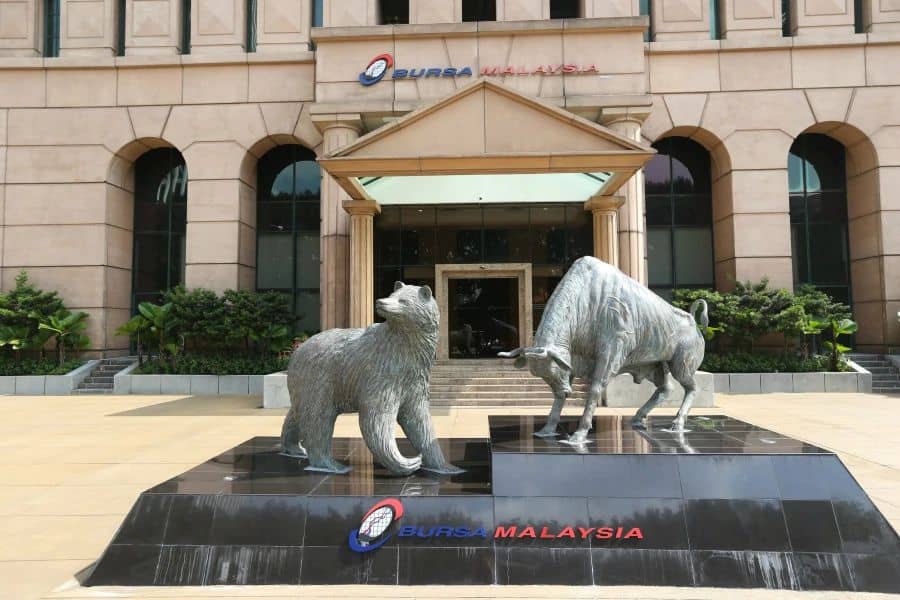
Bursa Malaysia Berhad (“Bursa Malaysia” or the “Exchange”) today launched two new ESG themed indices under the FTSE Bursa Malaysia Index Series which are the FTSE Bursa Malaysia Top 100 ESG Low Carbon Select Index (FBM100LC) and the FTSE Bursa Malaysia Top 100 ESG Low Carbon Select Shariah Index (FBM100LS).
These new indices add to the existing portfolio in the FBM Index Series suite that the Exchange jointly issues with index partner FTSE Russell. These additions expand the Exchange’s benchmarking offerings in the ESG, low carbon and climate risk index space to cater to evolving investors’ demand.
The FBM100LC Index tracks companies in the FBM Top 100 Index based on their ESG and carbon intensity performance, thus providing an opportunity for investors to reduce their investment portfolio’s carbon footprint.
The index methodology addresses ESG and climate change risks from multiple dimensions based on clear, transparent and targeted objectives. It is constructed using the FTSE Russell Target Exposure methodology, which applies succussive tilts to capture target exposure and climate outcomes.
The index aims to achieve a maximum 30% reduction in Fossil Fuel Reserves Intensity, 30% reduction in Carbon Emissions Intensity, and 20% uplift in ESG Ratings. It excludes companies involved with controversial product activities such as weapons, thermal coal, extraction and electricity generation, tobacco, nuclear power, gambling, adult entertainment, and companies involved with controversies related to the UN Global Compact principles.
“We are delighted to expand on our strong partnership with Bursa Malaysia to bring these new ESG themed indices to the market. As sustainable investing continues to be embraced in Malaysia, the new indices provide a powerful tool for investors to increase company ESG transparency and performance,” said Helena Fung, Head of Sustainable Investment, Asia Pacific at FTSE Russell.
The launch of the index aims to further encourage ESG and low carbon adoption within the local capital market ecosystem, in line with the Exchange’s vision to be a leading sustainable and globally connected marketplace.
“ESG has become a staple of the investment management landscape. Clients have started to demand products that make it easier for them to manage their portfolios with better ESG compliance and risk management,” said Datuk Muhamad Umar Swift, Chief Executive Officer of Bursa Malaysia. “We are pleased to again partner with a respected name like FTSE Russell to develop new products that emphasize our commitment towards a low carbon economy.”
A Shariah version of the index is available where further screening is applied on the constituents to only include Shariah-compliant companies.
About Bursa Malaysia
Bursa Malaysia is an exchange holding company incorporated in 1976 and listed in 2005, and has grown to be one of the largest bourses in ASEAN today. Bursa Malaysia operates and regulates a fully-integrated exchange offering a comprehensive range of exchange-related facilities, and is committed to Creating Opportunities, Growing Value. Learn more at www.bursamalaysia.com.
There is a prolonged debate on the superiority of both analyses, or in short: fundamental analysis vs technical analysis. I can recall my days as a derivatives dealer where some clients prefer to read news, while others like to draw charts.
But for sure both types of analyses have their own merits as it measures the price trajectory of the markets.
What Is Fundamental Analysis?
Fundamental analysis refers to analysing the information from the news and reports. The investors will assess the information in hands and make attempts to predict the direction of the asset’s price.
What Is Technical Analysis?
The technical analysis on the other hand is a price action strategy. The investors will evaluate the market breadth based on the readings of price trend patterns, indicators and oscillators; then draw a conclusion on future market sentiment. So, based on the definition, which is more appropriate and why?
The news have heterogeneous impacts on the financial markets. A group of markets may receive the same news, but the investors will react differently. The COVID-19 news for instance, may trigger a bearish sentiment but the magnitude of impacts on the financial markets in the developed and emerging markets will be different. Therefore, it is crucial that the investors to understand how the asset price in their portfolio moves.
According to the empirical finance, generally there are three main stages of asset movement which are called information arrival, co-movement and volatility. At the stage of information arrival, investors receive and react on the information upon receiving them.
In the second phase, the asset influences the other assets or markets. Next, when there is the absence of news, but the price is constantly moving, we call it the stage of volatility.
Fundamental Analysis vs Technical Analysis
To decide on when to use the fundamental or technical analyses, the investors need to know their portfolios well such as the sensitivity to news and the movement of interrelated markets. Applying the fundamental analysis needs a good knowledge of portfolio sensitivity.
The best example is the stock’s beta to index. The fundamental analysis is best to use in the first and second stage. While some commodity markets like energy and agriculture futures, the investors are depending on the EIA and USDA reports however the information on production numbers and demand will not being released so frequently.
In this case, it is preferably to use fundamental analysis to determine the market sentiment thereafter technical analysis is used to time the entry and exit.
By and large, fundamental and technical analyses are tactical in investment and trading. The investors should assess the market sentiment based on the news, and time their entry using the price charts. It is worth to note that regardless of trends, either bearish or bullish, the price will not move linearly.
There must be the phases of corrections, retracement, rebounds and reversals amidst of the major trend. The news may set path for the major trend, but the trading motivations of buyers and sellers determine the intertemporal price dynamics.
So in the case of fundamental analysis vs technical analysis, which one do you prefer? They say if you are an investor, then you should use fundamental analysis. If you are a trader, then you should be using technical analysis. Or can we use both?
About the Author
Dr. Ahmad Danial is a Certified Financial Technician (CFTe) and Senior Lecturer in Finance at Department of Economics and Financial Studies, UiTM Puncak Alam. He has over 10 years’ experience in the financial markets before hopping into the academia. His areas of expertise include financial contagion, trading in stocks and derivatives markets, price discovery, hedging strategy, Econophysics and technical analysis. He can be reached at danialzainudin@uitm.edu.my.
The following story is based on an actual series of events with some names and circumstances fictionalised and any similarity to the name, character or history of any person is entirely coincidental and unintentional. With it, hope that we can understand more about why family business fail.
It was unexpected for Jade. Her late husband, Chee’s family business empire had just fallen in the hands of others!
How wrong Jade was with her assumption that when it came to the crunch, her late husband’s two partners would be sympathetic towards her. Instead they teamed up to make sure that not only she had no say in the business but also for her two estranged step-sons from her late husband’s first marriage.
The two partners combined their equity holdings to ring-fence control and totally keep out the family of late founder Chee (Jade’s late husband) as they were worried and felt strongly that the ensuing family conflicts between Jade and her late husband’s family from his first marriage would be disruptive to the business.
The partners had the advantage of the split equity holding of the Chee family members to stage a takeover of control of the business. Jade had never thought the partners would betray her as they were very supportive of founder Chee, and also empathised with her when they saw how terrible the step-sons treated her after their father passed on.
The partners consoled Jade many times and offered to help in anything. She had the feeling that they would not be inclined to bring the step-sons into the business. She also reckoned that they would not be averse to appointing her as Director of the company so as to maintain the Chee family interest. However, all those so-called partners were fake. Eventually the partners took control of Chee’s family business empire and kicked her out.
How Easily A Family Business Fail
How could Jade’s late husband not foresee this? It became clear to Jade now that her late husband was good in running the business but he had failed miserably in ensuring continuity of the family business empire that he so capably built.
While Jade’s late husband knew of Jade’s capabilities as a successor, he had not planned for it. He had not been communicative and shared with her anything to do with the business. He had been going about in the prime of his life as if he was immortal. And that probably was the reason why he didn’t even have a will!
Only after the cruel blow of being killed in an accident following a drinking session with business associates that Jade found out that her late husband was actually not in control of things, especially his business empire. He was so ill prepared.
Without a will, her late husband’s assets would, according to the intestacy law, be distributed to his parents, spouse and children. Effectively without surviving parents, his estate which included his majority shareholding in the family company is split between Jade and his two sons from the first marriage. That means not only his business but the house that Jade is staying is now co-owned by her step-sons too!
But being on unfriendly terms, the fragmented shareholding of the Chee family members delegated them to be minority shareholders. By not combining their shareholding, they could not match, out-vote and block the combined controlling power of the two partners. What a tragedy!
The Importance Of Succession Planning
Proper succession planning would have ensured smooth continuity of management, control and ownership of a family business. If not, the chances for the family business fail will increase.
It is prudent that succession planning starts as early as possible to avert a situation like the unwanted outcome of the Chee family business. Consult experts in estate planning to make sure a succession plan is achievable and will not have unforeseen pitfalls, even of tax and financial nature.
A viable solution would be a Business Trust which creates a structure for family succession. Through instructions in the trust deed from the owner, the Business Trust can be designed to benefit the family members to ensure the continuity and preservation of the business within the family, even for those who are not on good terms with each other.
Contentious issues such as successor -be it a family member or a business partner – and the delegation of powers could be pre-determined and stipulated in the Business Trust for the appointed Trustee, which is recommended to be a licensed trust company that operates in perpetuity, to carry out the instructions.
Other relevant matters that could be addressed could include triggering event, for example, death, illness, incapacity or disappearance; or legal considerations that include exit arrangements or buy-sell arrangement of shares by other existing partners/shareholders from family shareholders; and also succession structure and process.
With such proper estate planning that also encompasses protection of beneficiaries from unwarranted or future claims from creditors or ex-spouses, or takeover attempts by unfriendly parties, or even possibility of squandering of inheritance by beneficiaries, nothing is left to chance and the interest and future of one’s family business would be safeguarded.
Such comprehensive estate planning solutions can be achieved by consulting an experienced estate planner working with an established company such as Rockwills Trustee Berhad.
About Rockwills International Group
Rockwills International Group, now in its 27th year, pioneered professional will writing in 1995 and has since evolved into the leading estate planning specialist in the country. It is today the largest provider of solutions and support services in the areas of trusts, succession, management and distribution of wealth. It has shareholders’ funds exceeding RM50 million. It has done over 280,000 wills and 15,000 trusts and hold more than RM25 billion in assets under trust.
There are four money personas found across Malaysia according to new research from Wise, a global technology company building the best way to move money around the world, which uncovered that almost half of Malaysians polled are avid shoppers, or “Shopping Pros”, making up 49% of survey respondents, while budgeting geniuses “Financial Controllers” are 38%.
Hidden fee finders “Aunty Powers” are a smaller group at just 12% of Malaysians surveyed, followed up by value driven buyer “Kopitiam Uncles” representing a mere 1% of respondents.
While Shopping Pros and Financial Controllers clearly dominate, Wise’s Don’t Kena Con campaign, which looked to uncover how “wise” Malaysians are with their spending, has determined the majority of Malaysians still have much to learn from Aunty Powers and Kopitiam Uncles on understanding hidden fees and markups while undertaking shopping adventures.
In fact, over one-third (37%) of Malaysian respondents who shop online and spend overseas note they have no idea what the fees and exchange rates are until the transaction is complete. That said, Malaysians show off an impressive understanding of currency exchange, with 60% reporting they know what the mid-market rate is.
Cost-conscious behaviour among Malaysians spurring need for transparency
Aunty Powers and Kopitiam Uncles who seek truth and cost transparency may only make up a small part of the population now, but they’re showing off some influence in Malaysians looking to better understand currency conversions.
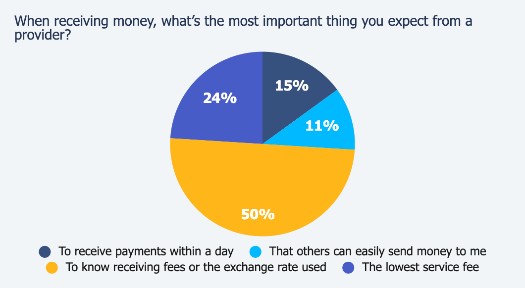
More than half (52%) of all Malaysian respondents have the impression that fintech platforms give the best rates when it comes to foreign exchange, although 38% chose money changers. This may be to their detriment, as half (50%) of Malaysians surveyed want to know if the remittance provider charges a receiving fee or the exchange rate used when receiving money from overseas.
Plus, close to a quarter of respondents (24%) said having the lowest service fee was the second most important thing they expect from a remittance provider.
Given the Aunty Power’s ability to sniff out the prawn behind the rock, many Malaysians still have a lot to learn when it comes to understanding hidden fees, and it’s clear that transparency in fees is something consumers are increasingly looking for.
An earlier independent research commissioned by Wise[1] found that Malaysians had spentRM 10.5 billion in total card fees[2] when shopping overseas from 2015 to 2020 and RM 1.5 billion[3] was paid in transaction fees and hidden exchange rate markups yearly when shopping overseas.
Malaysians are Shopping Pros first, but Financial Controllers keep a keen eye on spending
When it comes to shopping overseas, the Shopping Pros show off their strategic buying capabilities with strong preferences for digital payment methods. Malaysians surveyed choose to use their credit card (39%), followed by debit cards (22%), multi-currency cards (20%) and cash (20%).
Given how many Malaysians use their credit cards when shopping, it’s encouraging to see that two-thirds (69%) are aware when it comes to shopping in a foreign currency with their credit card, they pay more than just currency conversion fees.
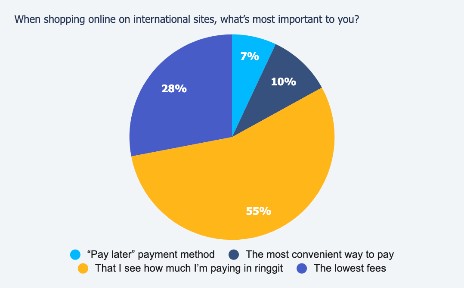
Still, the Financial Controllers are still looking to keep budgets intact and spending on track, as 28% of shoppers noted that whether they are paying the lowest fees is the most important factor of consideration when spending on an international site, and 55% want to know the total cost of the purchase in ringgit.
Importantly, to feel more secure when spending money overseas, Malaysian respondents say they want to know they are protected from fraud (40%), the total amount they have spent (37%), and the exact fees they have to pay (15%).
Lim Paik Wan, Malaysia Country Manager, Wise, said: “As international e-commerce and shopping continues to grow in popularity across the country, Malaysians need solutions that will help them navigate hidden fees and provide an easier way to make international purchases. We know from our research that transparency and convenience are paramount to Malaysian consumers, which is why we’re proud to offer our multi-currency account and card to anyone who needs a better solution for their spending needs. Malaysian shoppers should be able to put their hard earned money toward their purchases, not hidden fees, and we hope they take their financial savvy even further by using Wise.”
The Don’t Kena Con research was conducted from 15 December 2021 to 18 March 2022. It encompasses a sample size of 672 respondents who identify as Malaysian and non-Malaysian. Responses were collected online from the How Wise Are You About Money? Quiz.
About Wise
Wise is a global technology company, building the best way to move money around the world. With the Wise account people and businesses can hold more than 50 currencies, move money between countries and spend money abroad. Huge companies and banks use Wise technology too; an entirely new cross-border payments network that will one day power money without borders for everyone, everywhere. However you use the platform, Wise is on a mission to make your life easier and save you money.
Co-founded by Taavet Hinrikus and Kristo Käärmann, Wise launched in 2011 under its original name TransferWise. It is one of the world’s fastest growing, most profitable tech companies and is listed on the London Stock Exchange under the ticker, WISE.
13 million people and businesses use Wise, which processes over £8 billion in cross-border transactions every month, saving customers over £1 billion a year.
Appendix A: Four money personality types — which one are you?
Shopping Pro
Shopping is always the highlight of your travels abroad. You’re quick to spot the best buys, and even faster to snap them up. You know where the hottest sales are and what cards to swipe with to snag your new favourite buy. Your internet browser has bookmarks of all your favourite shopping sites, and you value speed above all.
Financial Controller
You keep a firm grip on the purse strings. Often the one in charge of money matters in your household, you ensure the bills are paid on time so that the wifi stays connected and Netflix keeps streaming. You’re always on the lookout for financial tools and services that offer convenience and efficiency while helping you to reduce costs.
Aunty Power
Your superpower is seeing through hidden agendas. If a deal sounds too good to be true, you poke and prod until you’re satisfied it’s legit. RM3.99 is RM4.00 lah! You actually read all the terms and conditions and ask as many questions as possible before committing.
Kopitiam Uncle
You look for quality, not Insta-worthy. You don’t go for designer coffee and prefer the humble kopi O from your regular kopitiam. You just want the simple and honest truth — what are you offering me and how much do I need to pay? Your life motto is less frills, more value.
[1] Independent research conducted by Capital Economics in June 2021 for the period between 2015-2020 on fees related to overseas card spend.
[2] These fees include card ownership and miscellaneous fees, transaction fees and exchange rate margin fees.
[3] Yearly average calculated from the total amount on card transaction fees and exchange rate margin fees only on overseas card spend from 2015 to 2020
In the most recent “Making An Impact” podcast episode, Claire Herbert, ESG Manager for Schroders APAC, discusses with Anastasia Petraki, Schroders’ ESG Investment Director, the topic of greenwashing, concerns around this issue, and solutions that address it.
Elaborating on why investors are concerned about greenwashing and the implications of the rise in climate and investment product disclosures in the Asia Pacific, Anastasia Petraki, ESG Investment Investor, Schroders, shared:
“First, if we are talking about greenwashing at an activity or company level, the risk is a misallocation of capital. This means that money intended for sustainable purposes goes to activities that are not really sustainable. This leaves less money for those activities that can create a more sustainable economic system. So, the economy does not progress, which harms confidence in sustainable investing.
Second, if we are talking about greenwashing at an investment product level, then the risk is mis-selling. That is, people buy products that are making promises that they can’t possibly deliver. This is a failure of consumer protection. Indirectly, it also robs sustainable activities of necessary funding.
[Climate and investment product disclosures] have a dual objective here in the Asia Pacific. The first one is to create an environment that makes it easier to channel private investments toward products and services that will make the economy sustainable faster. The second is to help prevent greenwashing.
Regulators and policymakers are making transparency the number one priority for sustainable finance because, similar to investors, they see a lack of common understanding and data as a potential barrier to further growth in the market.”
Adding on to Anastasia’s remarks on disclosures, Claire Herbert, ESG Manager, APAC at Schroders, commented:
“There is also the big question about whether these disclosures and this additional transparency help.
Environmental, Social and Governance cover a broad set of factors, and different metrics will bear different importance depending on the product type you are looking at or the investor’s priorities and preferences. It’s not easy for regulators to decide which metrics to disclose because more information is great. Still, we don’t want to overburden companies and fund managers with administrative disclosures, especially when methodologies and understanding of all of this are still in their early stages.
Even with all the new disclosures, we still see a lack of understanding and trust. Consumer research tends to indicate that retail investors either don’t engage with this information or don’t understand product disclosures and end up looking at the individual underlying holdings as a “shortcut”. So, if you hold company ‘X’ in your fund and I’ve just read an article about a controversy involving company ‘X’, then I might not think you’re sustainable.
In the same vein, many investors turn to third-party ratings as a “second opinion” or to get some external validation on stuff being reported by a company or investment product. If that rating seemingly lines up with what’s being said, then that’s all good, but if not, there is a risk that people assume there’s something wrong with the reporting rather than something wrong with the rating. And let’s not forget here that ratings are just another subjective opinion on ESG, not the be-all and end-all for deciding what is or isn’t sustainable.”
Schroders’ “Making An Impact” podcast series features our thought-leaders sharing their insights on various Environmental, Social and Governance (ESG) investment topics in easily digestible audio content.
All podcast episodes are available on the Schroders website and Spotify.
Get every print issue delivered to your door — fill in your details below to subscribe or renew.
Terms & Conditions and Notice
Terms & Conditions:
No refund policy: all sales are final, please review your order before confirming. We do not offer refunds or exchanges for any products sold through Inovatif Media Asia (IMA), the publisher of The SmartInvestor magazine.
Price subjected to change at Management's discretion.
IMA is not responsible for delays or delivery failures.
Print subscription for overseas readers are subjected to additional delivery charges.
Additional charges apply for courier services.
NOTICE:
IMA has not appointed any sales representatives; all purchases must be made directly by emailing my-circulation@inovatif.com.my. We are not responsible for any transactions made through unauthorised channels.
Please also check with us on the retail price of our magazines if you have not received our renewal/subscription form, before making any payments.