Tuesday, 18 August 2026 Stay informed. No noise.

Bintang Capital Partners Becomes First Southeast Asian Private Equity Firm To Earn B Corp Certification

Bintang Capital Partners Berhad (“Bintang” or the “Firm”) proudly announces its achievement of becoming a Certified B Corporation (“B Corp”), making it the first private equity firm in Southeast Asia to earn this prestigious recognition.

Administered by the renowned global non-profit B Lab, the B Corp Certification recognises businesses that meet high standards of verified performance, accountability and transparency on factors ranging from employee benefits and charitable giving, to supply chain practices and using responsible input materials.

By joining the community of 6,800 existing B Corps operating in 161 industries across 90 countries, Bintang is embracing a common objective of harnessing business as a force for good.
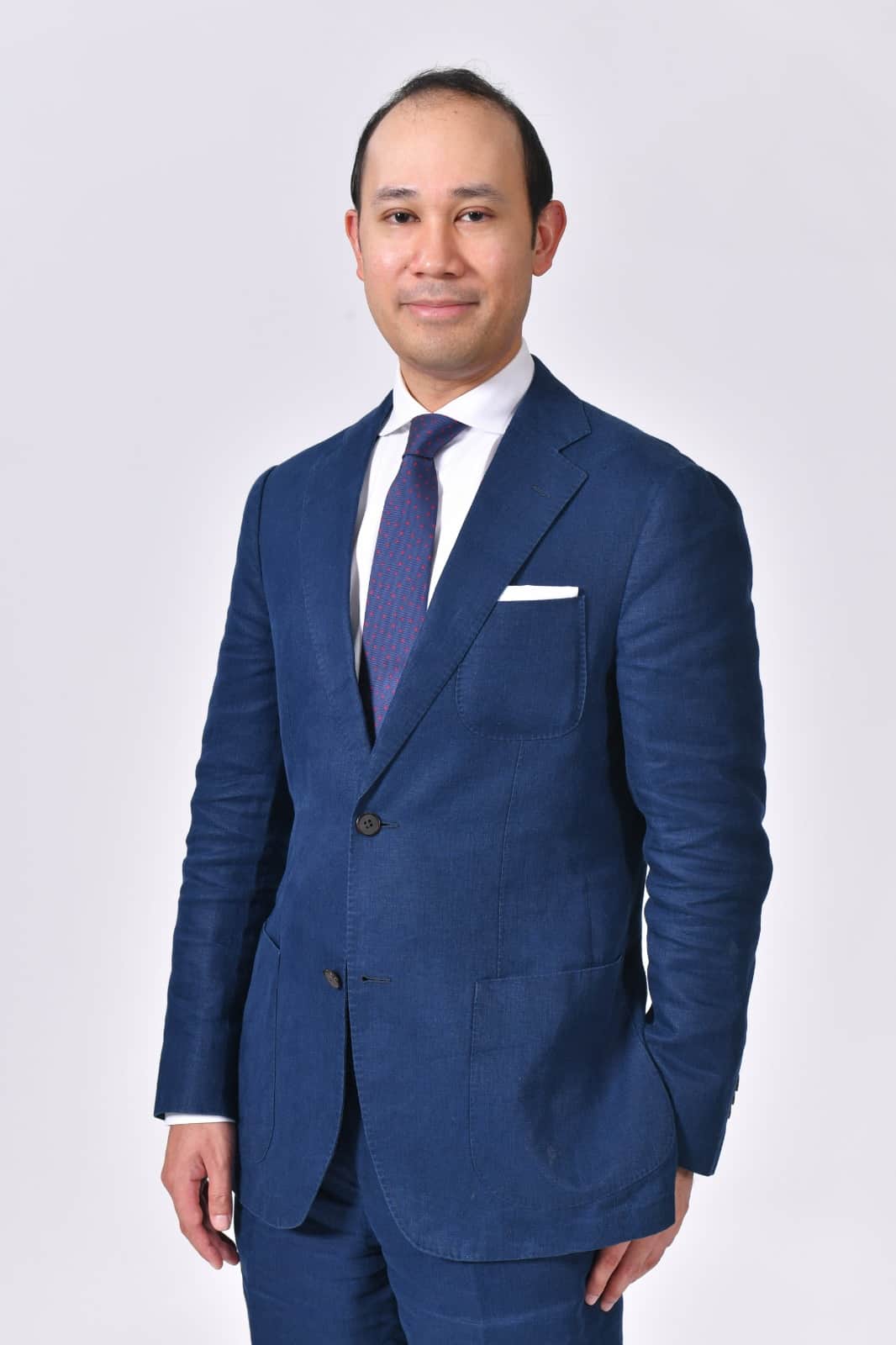
Johan Rozali Wathooth Founder And Chief Executive Officer Of Bintang
Johan Rozali-Wathooth, Founder and Chief Executive Officer of Bintang

Founder and Chief Executive Officer of Bintang, Johan Rozali-Wathooth, shares the reasons behind Bintang’s motivations in pursuing B Corp Certification, stating, “It has always been my dream to establish a private equity firm that integrates purpose with considerations for people, planet, and profit. During the early stages of the COVID pandemic, I had time to think about how companies all over the world achieved this goal. The narratives surrounding the B Corp movement inspired and convinced me that this is the way forward for Bintang.”

Bintang has integrated core values of the B Corp belief system into every facet of its business operations and investment processes. This certification represents a significant leap forward in the firm’s relatively short history, propelling Bintang towards becoming a leading impact investor in the Southeast Asian region, driven by the firm’s core “Triple I” philosophy of “Investing in Impact and Innovation.”

Johan further explains, “This achievement not only demonstrates our commitment to responsible business practices but also serves as an inspiration for our Partner Companies. We aspire to guide and support them on their quests to become Certified B Corps. Additionally, given the under-representation of Southeast Asian companies amongst the global B Corp community, we have a further dream to create at least 150 new B Corps in the ASEAN region within our portfolio of companies by 2050.”

Tan Ee Beng, Director at B Market Builder Southeast Asia (the Southeast Asian chapter of the global B Lab Network) shares that, “Bintang Capital Partners has long been a leader and evangelist of ‘Business as a force for Good’ as demonstrated in their organisation’s core values and purpose. This is aligned with our collective mission at B Lab Network globally to transform our current economic system to be more inclusive, equitable and regenerative. I applaud the Bintang team for their perseverance, commitment and leadership in making their dream of becoming a Certified B Corp a reality.”

To earn its certification, Bintang completed the comprehensive B Impact Assessment, evaluating the firm’s practices and performance across five impact areas: workers, communities, customers, governance, and the environment. This process involved rigorous assessments and verifications, engaging every member of the firm, and spanning approximately one year.

As part of the certification process, Bintang amended its Constitution to embrace stakeholder governance. This commitment ensures the firm’s accountability extends to all stakeholders, including workers, communities, customers, suppliers, and the environment – not only its shareholders. Bintang’s comprehensive Responsible and Sustainable Investment Policy further reinforces the incorporation of environmental, social, governance (ESG) as well as impact considerations into all aspects of its business operations, including the investment process.

Johan added, “Bintang Capital Partners’ B Corp Certification demonstrates its unwavering dedication to responsible business practices and its commitment to making a positive impact. The firm looks forward to continuing its journey as a leader in sustainable investing, inspiring others in the region and beyond”.

About Bintang

Founded in 2018, Bintang is a private equity firm headquartered in Kuala Lumpur, Malaysia. Bintang benefits from a parentage that includes leading independent Malaysian asset management group, AHAM Asset Management Berhad as well as leading global investment managers such as CVC Capital Partners and Nikko Asset Management.

Bintang focuses on deploying capital into fast-growing mid-sized ASEAN companies with proven track records: based on Bintang’s Triple-I Strategy (“Investing in Impact & Innovation”) the Firm backs visionary entrepreneurs who are aligned to Bintang’s twin core investment philosophies of Innovation and Impact.

Bintang is a signatory to the United Nations Principles for Responsible Investment (“UN PRI”). The Firm is also the first Malaysian signatory to the Operating Principles for Impact Management (“the Impact Principles”), an initiative whose development was led by the International Finance Corporation (“IFC”), a member of the World Bank Group.

On the 21st of May, 2023, Bintang became a B Corp, the first private equity firm in Southeast Asia to earn this prestigious recognition. Bintang has an aspiration to create 150 B Corp portfolio companies by 2050 (“150 by ‘50”).

The Firm’s maiden fund, BCP Asia Fund I (“BCPAF I”) is anchored by Dana Penjana Nasional, an investment fund under the Malaysian Government’s Ministry of Finance aimed at catalysing the country’s post Covid-19 economic recovery whilst supporting the local private capital industry.

BCPAF I invests in high performance and high innovation companies who are well-placed to meet the challenges, opportunities and disruption brought about by rapid advancements in technology. The fund focuses on investments in companies who are committed towards delivering impact from environmental, community, employee, customer and governance perspectives.

Recent investments by the firm include Involve Asia, a technology company that operates a performance-based marketing platform; My Care Concierge, a multi-award-winning provider of elderly care solutions; and iHandal, an industry leader in the energy efficiency solutions innovation space.

Further information about Bintang is available at www.bintangcapitalpartners.com.

About B Lab

B Lab is the non-profit network transforming the global economy to benefit all people, communities and the planet.

By harnessing the power of business, B Lab positively impacts companies around the world, helping them balance profit with purpose. Together, B Lab and the B Corp Community are shifting the global economy from a system that profits few to one that benefits all: advancing a new model that moves from concentrating wealth and power to ensuring equity, from extraction to generation, and from prioritizing individualism to embracing interdependence.

Further information about B Lab and the B Corp Certification is available at About B Lab (bcorporation.net).

SC Takes Enforcement Action Against Huobi Global For Illegally Operating DAX In Malaysia

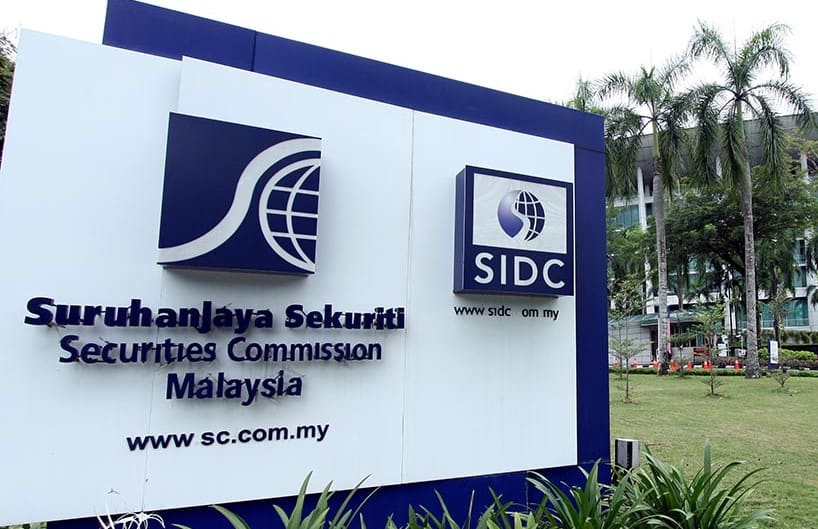
The Securities Commission Malaysia (SC) has taken action against Huobi Global Limited, and its Chief Executive Officer Leon Li for operating a digital asset exchange (DAX) in Malaysia without registration.

Accordingly, the SC has issued a public reprimand against Huobi Global Limited, and Leon Li for operating illegally in Malaysia.

In addition, the SC has ordered Huobi Global Limited to stop its operations in the country, including to disable its website and mobile application on several platforms such as Apple Store, Google Play and any other digital application platform.

Huobi Global Limited has also been directed to cease circulating, publishing or sending any advertisements, whether in email or on social media platforms, to Malaysian investors. 

Leon Li, as the CEO, has also been specifically ordered to ensure that the above directives are carried out.

This decision comes after concerns about the platform’s compliance with local regulatory requirements and protecting investors’ interests. The SC views this breach seriously, as operating a DAX without obtaining the SC’s registration as a Recognised Market Operator (RMO) is an offence under Section 7(1) of the Capital Markets and Services Act 2007.

The SC urges Malaysian investors who have been using Huobi Global Limited to immediately cease trading through its platform, withdraw all their investments, and close their accounts.

Investors are strongly advised to invest and deal with RMOs that are registered with the SC. Registered RMOs have undergone strict regulatory scrutiny and are required to adhere to strict guidelines so that investors are protected under Malaysia’s securities laws. Those who invest with unlicensed or unregistered entities or individuals are exposed to risks such as fraud and may not be protected under Malaysian securities laws.

Investors should exercise caution when choosing investment platforms and to always do their due diligence before making any investment decisions. Additionally, investors should be wary of investment schemes that promise high returns with little risk, as they may be too good to be true. By taking these precautions, investors can safeguard their investments and avoid falling victim to fraudulent schemes.

Siri Penyelidikan ICMR: Milenial Dan Gen Z Mesti Merancang Awal Untuk Persaraan Yang Lebih Baik Dalam Dunia Pekerjaan Yang Berubah

Dunia pekerjaan semakin berubah. Krisis COVID-19 telah mempercepatkan aliran struktur sedia ada dan menyebabkan organisasi memikirkan semula pelbagai aspek pekerjaan. Bagaimana pekerjaan dilakukan, di mana dan oleh siapa menjadi lebih pelbagai dan berubah-ubah. Oleh kerana sifat kerja dan cara kita menjana wang terus berubah, ini secara tidak sengaja akan memberi kesan kepada aspek kewangan peribadi yang lain juga.

Sekiranya anda merupakan seorang anak muda Malaysia yang menabung untuk persaraan, masa depan anda mungkin kurang terjamin daripada apa yang anda fikirkan. Walaupun dekad yang akan datang bakal menyaksikan salah satu pemindahan kekayaan terbesar di antara generasi kepada golongan milenial dan Gen Z, tabiat dan tingkah laku kewangan semasa generasi muda ini, serta perubahan sifat kerja, mungkin akan menjejaskan simpanan masa depan mereka.

Sistem Pencen Sedia Ada Tidak Akan Mencukupi

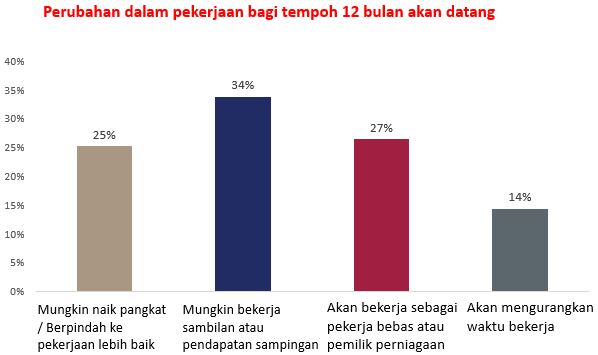
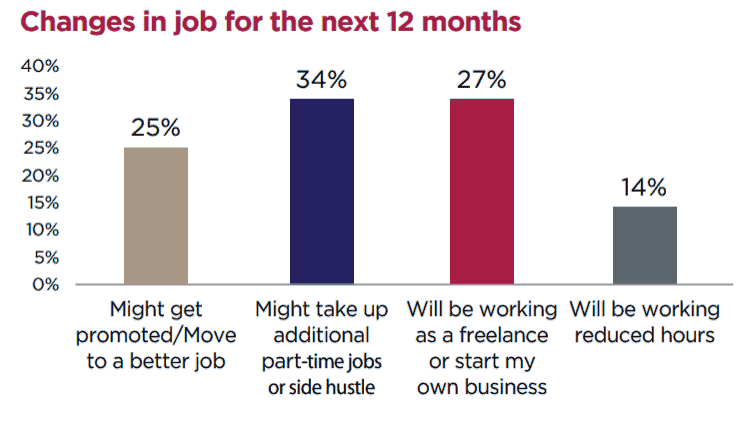
Kajian ICMR di seluruh negara berkenaan golongan milenial dan Gen Z mendapati bahawa 70% responden menjangkakan perubahan dalam kehidupan pekerjaan mereka dalam tempoh 12 bulan akan datang. Daripada jumlah ini, 61% melihat diri mereka menukar modaliti pekerjaan, sama ada mengambil kerja sampingan atau bekerja sambilan, atau bekerja sebagai pekerja bebas atau menjadi pemilik perniagaan.

Perubahan Dalam Pekerjaan Bagi Tempoh 12 Bulan Akan Datang
Rajah 1: Perubahan pekerjaan yang dijangka berlaku bagi tempoh 12 bulan yang akan datang (Sumber Data: ICMR)

Dengan bilangan mereka yang beralih daripada tanggapan tradisional tentang mempunyai satu pekerjaan sepenuh masa semakin meningkat, isu perlindungan dan kecukupan dalam sistem pencen sedia ada akan menjadi lebih parah. Kebijaksanaan persaraan lampau yang bergantung kepada rancangan persaraan tradisional mungkin berkesan untuk ibu bapa dan datuk nenek mereka, tetapi ini tidak mencukupi bagi golongan milenial dan Gen Z untuk mengharungi tahun-tahun keemasan mereka.

Sistem pencen sedia ada di Malaysia sebahagian besarnya adalah berasaskan majikan, dengan sebahagian daripada gaji dipotong secara automatik daripada senarai gaji dan dimasukkan ke dalam simpanan persaraan. Tetapi seperti yang telah kami ketengahkan dalam laporan kami sebelum ini, pekerja gig, pekerja bebas dan pemilik perniagaan kecil tidak dilindungi oleh sistem sedia ada, dan ianya juga tidak mengambil kira pendapatan tambahan dengan tepat daripada pendapatan sampingan atau modaliti pekerjaan lain.

“Saya selesa dengan aturan kerja bebas, dan tidak fikir saya akan kembali bekerja sepenuh masa pada masa hadapan. Tetapi saya sedang berusaha untuk membeli rumah baru-baru ini dan menghadapi kesukaran untuk mendapatkan pinjaman kerana bank tidak mengiktiraf kerja bebas, walaupun saya dibayar secara konsisten setiap bulan.”

– Hussein, 30, perunding bebas

Mengatasi “Present Bias” Untuk Persaraan Yang Lebih Baik

Tanpa akses kepada pelan pencen berasaskan majikan, golongan muda Malaysia akan dibiarkan memikul tanggungjawab merancang untuk persaraan mereka sendiri. Bagaimanapun, tinjauan ICMR mendapati bahawa bilangan golongan milenial dan Gen Z yang tidak menganggap simpanan persaraan sebagai keutamaan adalah membimbangkan. Sebaliknya, mereka mengutamakan pembelian rumah, barangan mahal, dan mengaut keuntungan daripada pulangan pelaburan yang lebih tinggi.

Ini adalah selaras dengan pencerahan daripada temu bual kualitatif kami, di mana hanya seorang responden mempunyai matlamat kewangan persaraan spesifik. Bagi semua responden lain, persaraan adalah tanggapan yang samar-samar dan jauh, atau terdapat kepercayaan bahawa “ianya akan berlaku sendiri” untuk tujuan persaraan. Ramai juga merasakan bahawa mereka mempunyai terlalu banyak komitmen dan perbelanjaan semasa untuk memikirkan tentang persaraan.

ICMR Article 4 Image 2
“Present bias” membuatkan kita memihak kepada masa kini dan kurang bagi masa hadapan – lalu meningkatkan masalah seperti ketagihan, penangguhan, ketidaksabaran, kepuasan segera dan perancangan yang tidak baik (Sumber Imej: Don McMinn)

Contoh-contoh ini menunjukkan “present bias” apabila memikirkan tentang persaraan, atau kecenderungan untuk berpuas hati dengan ganjaran semasa yang lebih kecil berbanding menunggu ganjaran masa depan yang lebih besar. Malah, kajian terdahulu menunjukkan bahawa rakyat Malaysia hanya mula merancang untuk bersara selepas umur 40 tahun, justeru terlepas peringkat pengumpulan jangka panjang yang kritikal yang boleh mengakibatkan perbezaan ketara di dalam simpanan persaraan mereka.

“Saya kehilangan pekerjaan pada Mac 2020. Sekarang saya seorang pemandu Lalamove, dan saya membantu di bengkel rakan untuk mendapatkan pendapatan tambahan. Sukar untuk memikirkan matlamat kewangan atau membuat apa-apa rancangan jangka panjang apabila saya hanya menumpukan terhadap usaha untuk mendapatkannya dari sehari ke sehari. Saya tidak mempunyai masa atau tenaga untuk mengkaji perkara ini ataupun dana yang mencukupi.”

– Zaim, 34, pemandu Lalamove

Bermula Awal Untuk Mendapat Manfaat Daripada Perancangan Kitaran Hayat

Kekurangan persaraan yang mencukupi dalam kalangan anak muda Malaysia melibatkan kedua-dua peringkat individu, dan juga di peringkat dasar negara. Kesan gabungan penuaan penduduk dan kekurangan simpanan persaraan adalah pelbagai segi dan kompleks, dengan implikasi dasar untuk pasaran buruh, produktiviti, serta institusi sosial dan keluarga.

Golongan milenial dan Gen Z bernasib baik kerana mereka yang mempunyai jangka masa yang lebih lama. Ini membolehkan mereka untuk mendapat manfaat daripada perancangan kitaran hayat yang lebih baik berdasarkan tahap risiko mereka sendiri. Oleh itu, adalah penting bagi individu mengambil langkah pertama seawal mungkin dalam menilai keadaan kewangan keseluruhan mereka, dan membuat pelan kewangan dan pelaburan jangka panjang yang sesuai dengan keperluan dan gaya hidup mereka.

Apa yang boleh membantu ialah memikirkan tentang simpanan persaraan sebagai pengumpulan kekayaan. Membina tabung persaraan yang besar menjadi lebih sukar di kemudian hari apabila seseorang mempunyai lebih banyak perbelanjaan, seperti keluarga dan hutang rumah. Tetapi dengan bermula awal, menabung untuk persaraan boleh menjadi sesuatu yang jauh lebih menyenangkan – dan mengujakan. Jumlah sedikit yang disimpan untuk persaraan hari ini boleh membawa perubahan yang besar di masa hadapan.

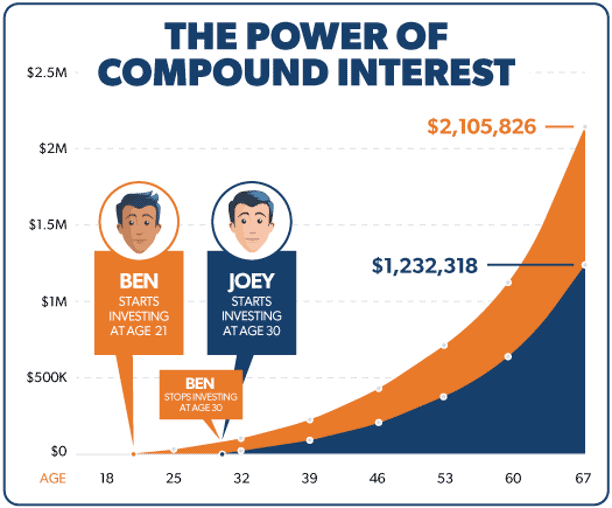
Dengan masa menyebelahi mereka, golongan milenial dan Gen Z  boleh memanfaatkan kuasa faedah berganda dan meminimumkan kesan turun naik pasaran terhadap pelaburan mereka. Mereka juga boleh membuat keputusan yang lebih baik tentang pilihan kerjaya, pendidikan dan gaya hidup mereka, yang boleh memberi impak besar terhadap masa depan kewangan mereka.

ICMR Article 4 Image 3
Lebih banyak masa wang boleh berganda dan berkembang, lebih banyak peluang untuk pendapatan tersebut menjana wang tambahan. (Sumber Imej: Ramsey Solutions)

Mereka Semula Persaraan Untuk Masa Depan

Memandangkan sifat kerja yang terus berevolusi di Malaysia dan di seluruh dunia, adalah penting bagi individu untuk menyedari kesannya terhadap kewangan peribadi mereka, terutamanya yang berkaitan dengan perancangan persaraan. Sementara itu, penggubal dasar juga perlu memainkan peranan mereka dalam memastikan sistem pencen semasa adalah mencukupi dan inklusif untuk semua rakyat Malaysia.

Kesimpulannya, membina masa depan kewangan yang mampan dan terjamin untuk semua rakyat Malaysia memerlukan gabungan tindakan individu dan reformasi sistemik. Dengan mengutamakan perancangan awal dan komprehensif, serta menangani jurang dasar, kita dapat memastikan semua rakyat Malaysia berpeluang untuk bersara dengan selesa dan bermaruah.

Artikel ini adalah sebahagian daripada siri kandungan oleh Institute for Capital Market Research (ICMR). Ikuti laman Facebook ICMR untuk mendapatkan info terkini tentang petua tingkah laku dan pandangan, untuk tabiat pelaburan yang lebih baik. Untuk mengetahui lebih lanjut mengenai kajian ICMR ke atas milenial dan Gen Z, layari www.icmr.my atau muat turun laporan penuh di sini.

Mengenai Penulis

ICMR Datin Aida
Datin Aida Jaslina Jalaludin, Ketua Penyelidik, ICMR
ICMR Nadhirah Ibrahim
Nadhirah Ibrahim, Penganalisis Penyelidik, ICMR

Centre For The Fourth Industrial Revolution Malaysia To Accelerate Green Transition And Digital Transformation

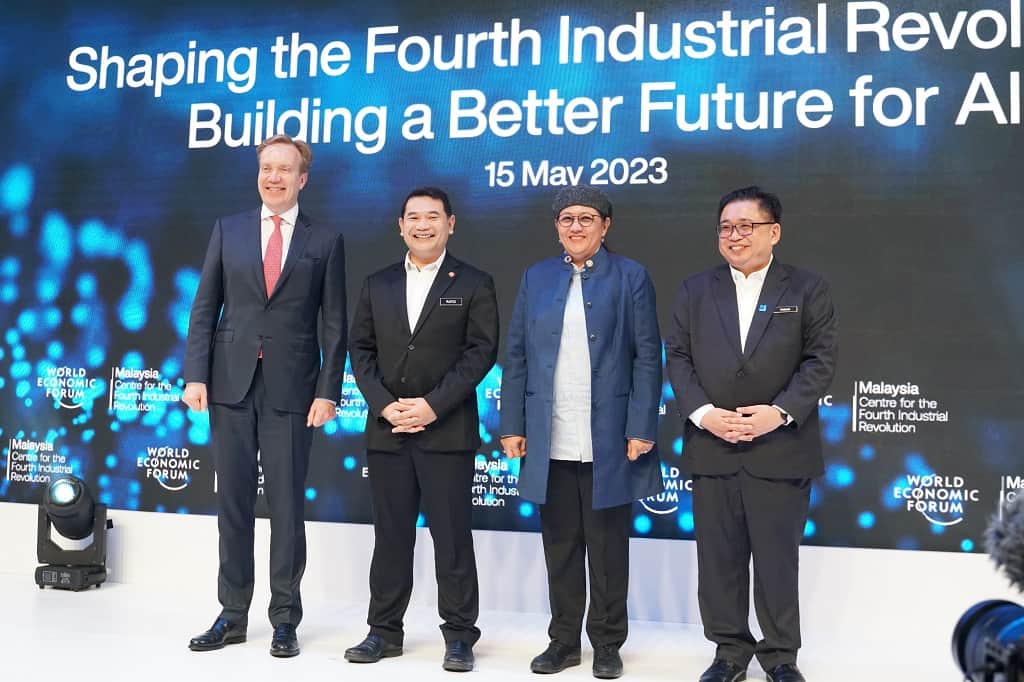
The Centre for the Fourth Industrial Revolution Malaysia (Malaysia Centre for 4IR) was officially launched today by the Minister of Economy, Rafizi Ramli and the President of the World Economic Forum, Børge Brende.

Malaysia Centre for 4IR will play a crucial role in driving the advancement of the digital economy in Malaysia, with a focus on supporting the country’s digital transformation and advancements in fast-growing sectors including green energy transition. The Centre will serve as a public-private platform, bringing together leaders from government, business, civil society, academia and other sectors to advance new partnerships and initiatives that can unlock the value of technology for Malaysia’s economy and society. The Centre is hosted by MyDIGITAL Corporation, a national initiative aimed at transforming Malaysia into a digitally-driven, high-income nation and a regional leader.

This initiative marks a significant milestone in Malaysia’s journey towards becoming a global leader in technology governance and innovation. The Malaysia Centre for 4IR is the first Centre in the Asia-Pacific region as part of the World Economic Forum’s global Centre for 4IR Network. With this launch, Malaysia joins a community of 18 other Centres, where new and innovative approaches to technology governance, adoption and scaling are being developed and implemented at the national, regional and international levels.

The Prime Minister of Malaysia, Anwar Ibrahim said in his pre-recorded opening speech, “Malaysia is honoured to be part of the global network of Centres for the Fourth Industrial Revolution with the first Centre for 4IR  in Southeast Asia. This is a testament to the critical value of Malaysia’s efforts to become an advanced, digitally-driven, high-income nation and a regional digital economy leader fostering innovation, entrepreneurship and collaborations between stakeholders. The Malaysia Centre for 4IR will further strengthen Malaysia’s human-centred policy towards the Fourth Industrial Revolution and contribute towards our target of entering the Top 20 in the Global Innovation Index. We are confident that a resilience-oriented approach will also improve the nation’s People’s Wellbeing Index score and enhance productivity to create inclusive, balanced, responsible and sustainable economic growth.”

Addressing the leaders at the launch event, Børge Brende, President, World Economic Forum said: “Malaysia’s leadership in the region and commitment to driving the Fourth Industrial Revolution is commendable. Through the Centre for the Fourth Industrial Revolution Malaysia, we are excited to work together with the government, business, and civil society leaders to unlock the value of technology for the benefit of all Malaysians. This partnership will not only drive transformation but also help build a more sustainable, inclusive, and resilient future for Malaysia and the region.”

Rafizi Ramli, Malaysia’s Minister of Economy said, “Today’s launch reflects a critical insight in Malaysia’s innovation journey: Innovation is a team sport and collaboration is essential. The economic case for innovation has become indisputable through the decades. The Malaysian Centre for 4IR shall act as a necessary impetus, starting with a dual focus of energy transition and digital transformation.”


Following the official launch, the Centre hosted two roundtable discussions to address its thematic priorities, inviting leaders from business, government and other sectors to share their key priorities and opportunities for the energy transition and digital transformation. These insights will serve as the foundation for the Malaysia Centre for 4IR’s core initiatives, informing its strategic planning and program development.

Fabian Bigar, CEO of MyDIGITAL said, “MyDIGITAL team is proud to be entrusted with the responsibility of making Centre for 4IR Malaysia a success in achieving its goals. Prior to this, we have been dedicating our efforts to driving quality growth in Malaysia’s digital economy guided by the Malaysia Digital Economy Blueprint and National 4IR Policy to spur Malaysia’s transformation into a high-tech nation by 2030. The establishment of the Centre for 4IR Malaysia aligns with and further fortifies our initiatives to catalyse homegrown technology development by enhancing collaborative opportunities among stakeholders to unlock value in 4IR technologies, with a focus on supporting the country’s energy transition and digital transformation.”

From adoption to transformation to regional leadership, the Malaysia Centre for 4IR is a critical establishment that will help drive the country’s transition towards an advanced digital economy. By joining the global ecosystem of technology governance innovators and leaders, Malaysia Centre for 4IR is poised to contribute significantly to Malaysia’s economic and social development in the years to come.


The World Economic Forum’s global Centre for 4IR network is a platform for multistakeholder collaboration, bringing together the public and private sectors to maximize technological benefits to society while minimizing the risks associated with 4IR technologies

About MyDIGITAL Corporation

MyDIGITAL Corporation was established on September 13, 2021, as an agency under the Ministry of Economy to drive and monitor the implementation of Malaysia Digital Economy Blueprint and the National 4IR Policy, as well as to promote the overall objectives of MyDIGITAL’s aspirations. MyDIGITAL is an initiative that symbolizes the government’s aspirations to transform Malaysia into a high-income nation that is digitally-driven and a regional leader in the digital economy. MyDIGITAL Corporation also serves as the secretariat to the National Digital Economy and 4IR Council (MED4IRN), chaired by YAB Prime Minister. MED4IRN is responsible for the leadership and policy direction of digital economy and 4IR-related policies.

Top 20 Malaysia Small Cap Companies For 2023 (20 Jewels)

RHB Research recently published the Top 20 Malaysia Small Cap For 2023 (20 Jewels), which marks the 19th edition that is part of a regional compendium of 80 top small-cap investment ideas from four ASEAN countries. Just as market sentiment was beginning to turn following the worst of the pandemic, as the interest rate cycle entered a matured stage, sentiment took another knock from the banking crisis in the US and Europe in the aftermath of the swift monetary policy tightening by the US Federal Reserve.

Local investor sentiment has remained tentative in the past year as investors were drawn to other regional opportunities and asset classes. Nonetheless, investors continued to show interest in winning small-cap ideas to generate alpha for their respective portfolios – especially as valuations have also retraced. The stock selection remains paramount, and investors should focus on fundamentally strong companies that have the potential to deliver above-industry growth, as well as turnaround candidates.

Notably, the Top 20 Malaysia Small Cap Jewels 2022 outperformed the broad market with a holding period return of 15.7%, beating the FBM KLCI’s and FBM SC’s returns of -8.5% and -5.5%.

Without further ado, let’s look at the list of Top 20 Malaysia Small Cap Companies For 2023 (20 Jewels) by RHB Research:

1. Aemulus Holdings

2. Apex Healthcare

3. Bonia Corporation

4. Hiap Teck Venture

5. Kumpulan Kitacon

6. Kronologi Asia

7. Lee Swee Kiat Group

8. MCE Holdings

9. Malayan Flour Mills

10. OM Holdings

11. P.I.E. Industrial

12. Scicom (MSC)

13. SDS Group

14. Supercomnet Technologies

15. Thong Guan Industries

16. Tune Protect Group

17. Uzma

18. Vestland

19. VSTECS

20. Wah Seong Corporation

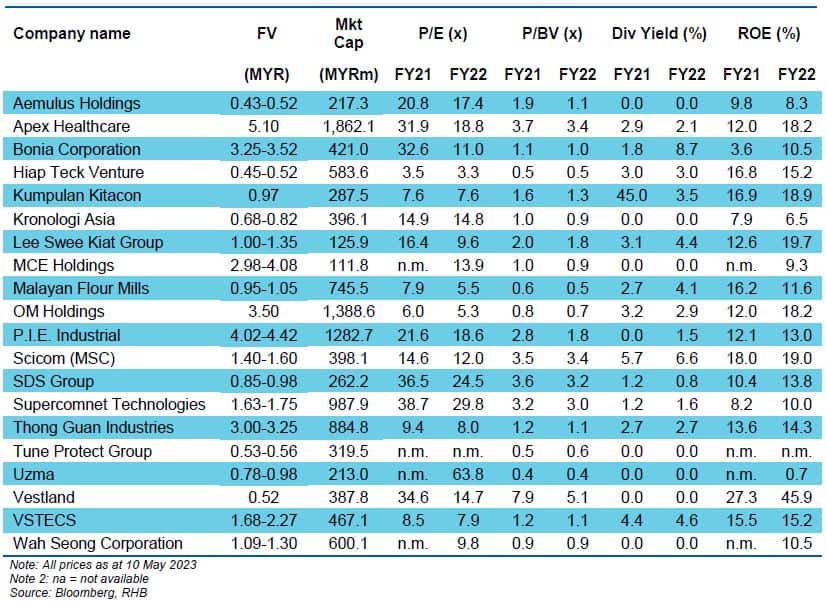
Here’s the Top 20 Malaysia Small Cap Companies For 2023 (20 Jewels) at a glance:

Top 20 Malaysia Small Cap Companies For 2023
Source: RHB Research Team

The Top 20 Malaysia Small Cap Companies For 2023 (20 Jewels) are spread across seven sectors with an average market cap of MYR597m. The consumer and industrial products & services sectors feature prominently, making up 50% of our picks. All but four – which are ACE Market-listed – of the 20 names are in the Main Market. None of the 20 companies featured this year are within RHB Research’s existing coverage as they continue to seek new investment ideas.

*All investors are advised to conduct their own independent research into individual stocks that are listed in the Top 20 Malaysia Small Cap Companies For 2023 (20 Jewels) before making any decision to buy or sell. Investors are also advised that past stock performance is no guarantee of its future price.

ICMR Research Series: Millennials And Gen Z Must Plan Early For A Better Retirement In A Changing World Of Work

The world of work is changing. The COVID-19 crisis has accelerated existing structural trends and caused organizations to rethink many aspects of employment. How work gets done, where and by whom is becoming more varied and fluid. As the nature of work and how we make money continues to change, this will inadvertently impact other aspects of personal finances as well.

If you’re a young Malaysian saving for retirement, your future might be less secure than you think. Even though the next decade will see one of the greatest transfers of intergenerational wealth to millennials and Gen Z, the current financial habits and behaviours of these young generations, as well as the changing nature of work, are poised to put their future savings in jeopardy.

The Existing Pension System Won’t Be Enough

ICMR’s nationwide study of millennials and Gen Z in Malaysia found that 70% of respondents anticipate changes to their work life over the next 12 months. Of this, 61% see themselves changing job modalities, be it taking up additional side hustles or part-time work, or working as a freelancer or business owner.

ICMR Article 4 Figure 1
 Figure 1: Expected job changes in the next 12 months (Data Source: ICMR)

As the number of people moving away from the traditional notion of a single full-time job increases, issues of coverage and adequacy within the existing pension system will become more serious. The old retirement wisdom of relying on traditional retirement plans might have worked for their parents and grandparents, but these won’t be enough to get millennials and Gen Z through their golden years.

The existing pension system in Malaysia is largely employer-based, with a portion of salary automatically deducted from payroll and put towards retirement savings. But as we highlighted in our previous report, gig workers, freelancers, and small business owners are not covered by the existing system, and neither does it accurately capture extra income from side hustles or other job modalities.

I’m comfortable with freelance working arrangements, and I don’t think I’ll go back to full-time work in the future. But I’ve been looking to buy a house recently and it’s been hard to get a loan because banks don’t recognize freelance work, even though I’m getting paid consistently every month for it.”

– Hussein, 30, freelance consultant

Overcoming Present Bias For A Better Retirement

Without access to employer-based pension plans, young Malaysians will be left to take on the responsibility of planning for their own retirement. However, ICMR’s survey found that a worrying number of millennials and Gen Z do not consider retirement savings as a top priority. Instead, they are prioritising to buy a house, high-priced items, and making profits from higher investment returns.

This is in line with insights from our qualitative interviews, where only one respondent had a specific retirement financial goal in mind. For all other respondents, retirement was a vague and distant notion, or there was a belief that “things would fall into place” for retirement purposes. Many also felt they had too many present commitments and expenses to think about retirement.

ICMR Article 4 Image 2
Present bias makes us favor the present and discount the future – fueling problems like addiction, procrastination, impatience, immediate gratification, and poor planning (Image Source: Don McMinn)

These examples indicate a present bias when thinking about retirement, or the tendency to settle for a smaller present reward than to wait for a larger future reward. In fact, past research has shown that Malaysians only start planning for retirement after the age of 40, hence missing out on the critical long-term accumulation stage that could make a significant difference in their retirement savings. 

I lost my job in March 2020. Now I’m a Lalamove driver, and I help out at a friend’s workshop for extra income. It’s hard to think of financial goals or make any long-term plans when I’m just focused on trying to get by day-to-day. I don’t have the time or the energy to research these things, and I don’t have the funds for it.”

– Zaim, 34, Lalamove driver

Starting Early To Benefit From Lifecycle Planning

The lack of retirement adequacy among young Malaysians is concerning both on an individual level, as well as on a national policy level. The combined effects of population ageing and lack of retirement savings is multifaceted and complex, with policy implications for the labour market, productivity, as well as social and family institutions.

Fortunately, millennials and Gen Zs who have a longer time horizon can benefit from better lifecycle planning based on their own risk appetites. It is therefore crucial that individuals take the first step as early as possible in assessing their overall financial situation, and making a long-term financial and investment plan that fits their own needs and lifestyle.

What can help is to think of retirement savings as wealth accumulation instead. Building a sizable nest egg becomes more difficult later in life as one acquires more and more expenses, such as a mortgage and a family. But by starting early, saving for retirement can be a much more pleasant – and exciting – prospect. Even a small amount saved for retirement now can make a huge difference in the future.

With time on their side, millennials and Gen Z  can take advantage of the power of compound interest and minimize the impact of market fluctuations on their investments. They can also make informed decisions about their career choices, education, and lifestyle, all of which can have a significant impact on their financial futures.

ICMR Article 4 Image 3
The more time money has to compound and grow, the more opportunity for those earnings to earn additional money. (Image Source: Ramsey Solutions)

Redesigning Retirement For The Future

As the nature of work continues to evolve in Malaysia and across the globe, it’s important for individuals to recognize the impact this can have on their personal finances, particularly in relation to retirement planning. Meanwhile, policymakers must also play their part in ensuring that the current pension system is adequate and inclusive for all Malaysians.

Ultimately, building a sustainable and secure financial future for all Malaysians requires a combination of individual action and systemic reform. By prioritizing early and comprehensive planning, as well as addressing policy gaps, we can ensure that all Malaysians have the opportunity for a comfortable and dignified retirement.

This article is part of a content series by the Institute for Capital Market Research (ICMR). Follow ICMR’s Facebook page to stay updated on behavioral tips and insights for better investing habits. To learn more about ICMR’s research on millennials and Gen Z, visit www.icmr.my or download the full report.

About the Authors

ICMR Datin Aida
Datin Aida Jaslina Jalaludin, Head of Research, ICMR
ICMR Nadhirah Ibrahim
Nadhirah Ibrahim, Research Analyst, ICMR

Thomson Hospital Kota Damansara – First In Malaysia To Receive Australian Accreditation For Its Cancer Services

Thomson Hospital Kota Damansara (THKD) has become the first hospital in Malaysia to receive accreditation for its Core and Ambulatory – Cancer Services under the Evaluation & Quality Improvement Programme (EQuIP7) from the Australian Council on Healthcare Standards (ACHS) International.

This accreditation involves an internationally recognised evaluation process to assess and improve the quality, efficiency and effectiveness of healthcare organisations. The whole evaluation process on the hospital’s Oncology and Nuclear Medicine facility, its systems and processes were stringently managed by ACHS International’s team of experienced healthcare professionals facilitated by its licensed partner, GlobalHealth Quality and Innovation Accreditation (GHQIA). With the successful completion of audits, THKD’s cancer services proudly holds the EQuIP7 accreditation and ACHS membership for three years.

ACHS International is the third oldest accreditation body in the world and has been at the forefront of developing healthcare standards and assisting healthcare providers to implement safe and quality healthcare in Australia and overseas for nearly 50 years.

Nadiah Wan, Chief Executive Officer of Thomson Hospital Kota Damansara, expressed her delight in having achieved this milestone and was pleased with the team’s dedication to providing quality, compassionate cancer services to patients and customers, adding that the accreditation is a testament to the hospital’s commitment to continuous improvement and innovation. “I trust that being the first hospital in Malaysia to be conferred an accreditation for our Cancer Services will provide even greater peace of mind to our potential customers, patients, friends and family members when selecting a healthcare facility of choice for their treatment. We are committed to provide better service delivery, with improved outcomes and enhanced patient experience,” she further commented.

Thomson Hospital Kota Damansara First In Malaysia To Receive Australian Accreditation For Its Cancer Services2
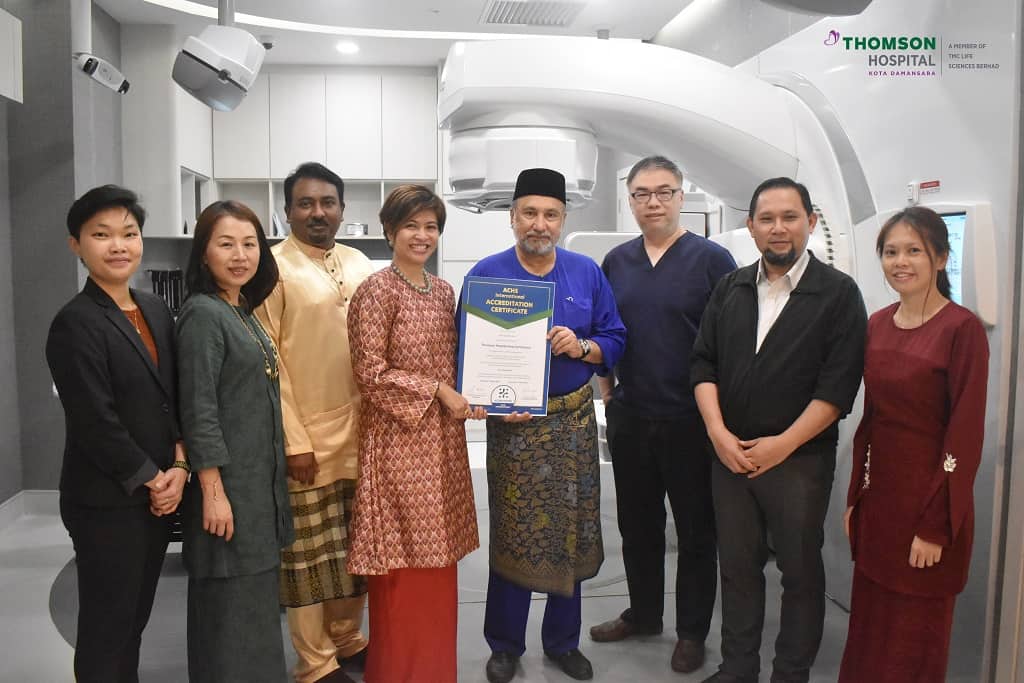
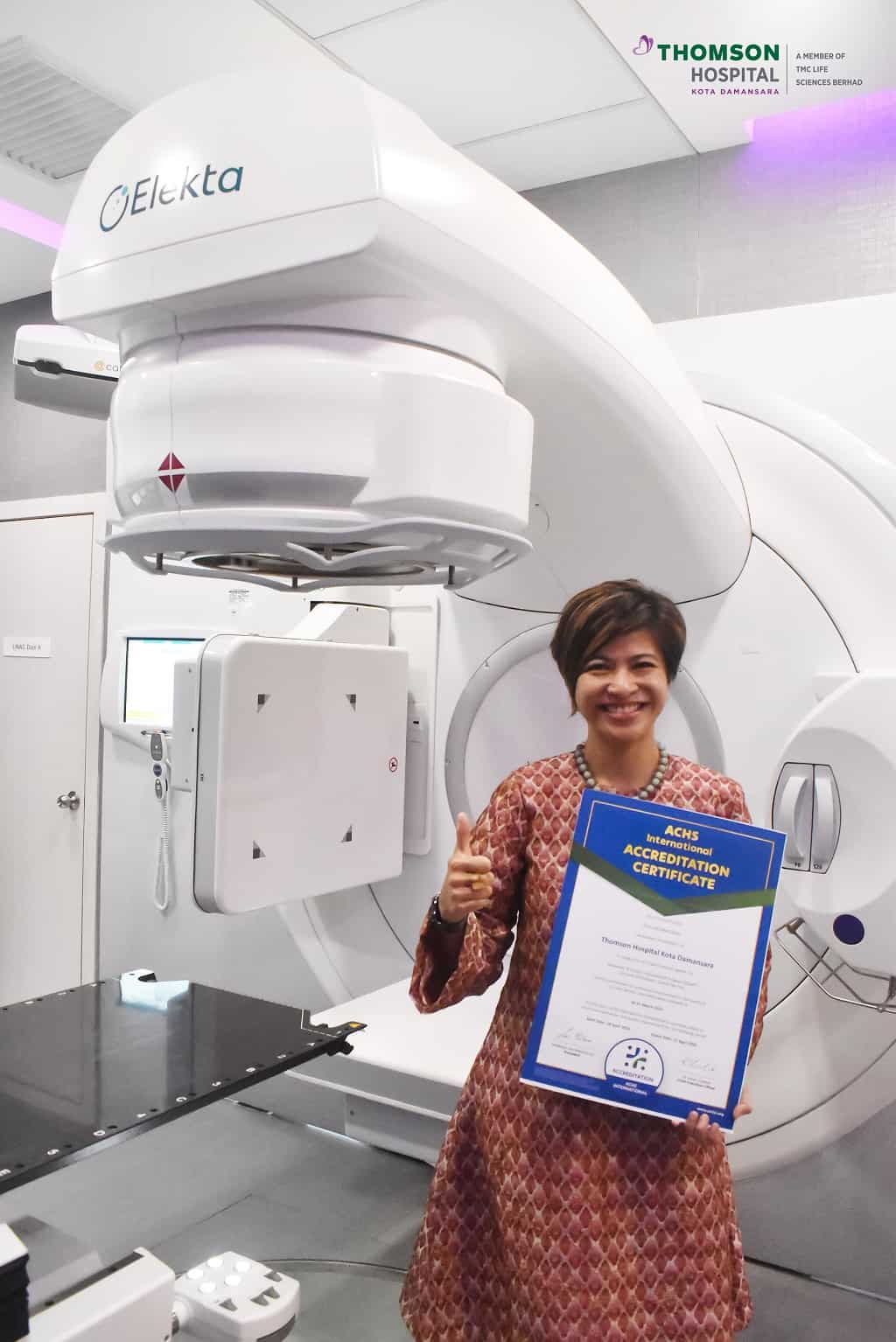
Ms Nadiah Wan, Chief Executive Officer, Thomson Hospital Kota Damansara (THKD) holds the accreditation certificate representing THKD’s achievement of being the first hospital in Malaysia to receive accreditation for its Cancer Services under the Evaluation & Quality Improvement Programme (EQuIP7) from the Australian Council on Healthcare Standards (ACHS) International

Thomson Hospital Kota Damansara is equipped with the latest and comprehensive Oncology and Nuclear Medicine facility which provides both diagnostic and therapeutic capabilities for cancer patients. Its oncology facility also proudly houses the Mediso AnyScan SPECT/CT/PET, the first Tri-modality nuclear medicine imaging equipment in the Asia Pacific region.

“At Thomson Hospital, our promise to our patients is that we will walk with you on your road to recovery. We are confident that this accreditation by ACHS will give further assurance to our cancer patients through our cancer services. We are committed to providing our valued patients the best care throughout their cancer journey; from diagnosis to treatment and during recovery, and aim for better health outcomes through our cancer services,” said Dr. Tan Chih Kiang, Consultant Clinical Oncologist and Head of Clinical Oncology.

Adding on, Dr. Zool Hilmi Bin Awang, Consultant Nuclear Medicine Physician and Head of Nuclear Medicine, said, “We are pleased to be one of the pioneers to offer this Mediso AnyScan SPECT/CT/PET. Thomson Hospital Kota Damansara is constantly innovating to provide the latest diagnostic and therapeutic services for their patients. Nuclear Medicine therapies such as Yittrium-90, Lutetium-177, Ac-225 and high dose I-131 Therapy are in the pipeline, while radiotherapy and radiosurgery services will be further sub-specialised into gynaecology, haematology and paediatric treatments. We also plan on collaborating with other healthcare institutions in Malaysia and other countries in making cancer therapies accessible to them.”

Participating in accreditation processes demonstrates Thomson Hospital Kota Damansara’s commitment to a lifelong journey to attain continuous quality and safety improvements guided by rigorous international standards. ACHS International assessors are highly trained and come from healthcare organisations from Australia and around the world. The assessment process is conducted using the EQuIP Assessment Methodology which utilises a robust structure of cross-referencing, observation and information gathering.

“Thomson Hospital Kota Damansara should be proud of this achievement and the ongoing commitment it has made to continuous quality improvement to provide safe healthcare services to its patients, staff, and community,” said Louise Cuskelly, Executive Director, ACHS International and Consulting.

Also sharing his thoughts was Varun Panjwani, Group CEO of Global Health saying, “GHQIA partners on the quality improvement and accreditation readiness journey, selecting associates with a shared vision and dedication. We are thrilled to work with Thomson Hospital, where everyone embodies the spirit of excellence and exhibits a passion for their patients.”

About Thomson Hospital Kota Damansara

Established in 2008, Thomson Hospital Kota Damansara (THKD), is the flagship hospital of TMC Life Sciences Berhad (TMCLS) located in a prime alcove of Kota Damansara, Selangor. THKD is expected to grow to a 559-bedded hospital with additional specialist centres and an operating theatre as part of the Group’s expansion plan. THKD sets new standards in healthcare through comprehensive facilities and excellent service for both our local and international patients. The Hospital offers medical and surgical services from over 120 reputable specialist consultants covering more than 53 medical and surgical sub-specialties. For more information, please visit thomsonhospitals.com or follow THKD on social media platforms @thomsonhospitalKD.

Book Review: Motherhood

It is rare to come across a book whose title comes in one word. Many books have titles and subtitles that are too many words.  Many such books, in the hope of crafting an exciting title to captivate readers, end up just too long.  However, there is one book on the market now of which the title is just one word, and it is powerful and sufficient.

MOTHERHOOD is a compilation by Jermaine Li Yuen of the sharing of 72 mothers describing their experiences of what motherhood is all about. Each sharing is brief and concise with a range from 200 to 300 words which makes easy reading.

MOTHERHOOD BOOK COVER

This book is dedicated to all mothers and mothers-to-be. Jermaine believes that the real-life stories shared in this book can inspire, motivate and give hope to all mothers in their journey of motherhood.  The book is well illustrated by Alison Lim, with each write-up with a family photo of the mother and her children converted into a photo illustration format. 

The good thing about a photo illustration compared to the actual photo image is that it would not take the attention away from the write-up’s content.  The calligraphed name of each mother at the end of the write-up is elegantly done by Gladys Yowono.

The book’s content is as attractive as its layout, illustration, and calligraphy. The sharing of the insights of each mother comes with varied experiences. As much as there are differences in their journey of motherhood, there is also the common joy, pain, thrill, and chaos experienced by each mother.  

Having read this book I personally understand for the first time much clearer what motherhood is all about and the sacrifice a mother has to go through to bring a newborn to this world and nurture him or her with tender loving care all the way.  This is certainly a valuable book worth reading every page.

The review of this book would not do any justice if I do not share an extract of a two-liner from the book shared by the mothers.  It is certainly not easy to pick 5 from the 72 equally interesting ones.  So, I chose them based on the 5 criteria on being dramatic, hilarious, meaningful, touching and inspiring.   

Dramatic

“A journey of endless possibilities, like having your finger clipped in between the door hinge because your kid got excited and slammed the door while you were trying to grab some ointment to apply on his chest, and before you know it, you are lying on the hospital bed being dragged into the operating theatre because your finger tendon tore.”

-Jermaine Li Yuen, Co-Founder of The Ark and Arkmosphere, Mother of 3

Hilarious

“Motherhood is nights of breastfeeding while your 11 months old baby boy kicks you relentlessly at your caesarean wound as you suffer quietly in pain. Motherhood is watching your husband sleep and snore next to you as you enviously wish how good it is to be a man instead.”

Mei Xin, Corporate Banker, Mother of 1

Meaningful

“Having a child is a gift from God and it is moments like this that you know somewhat God’s love and patience is with us.  I thank God daily for this gift and what my son has taught me about motherhood, patience and humility.”

-Freda Lu, Broadcaster/Author/Emcee/Speaker, Mother of 1

Touching

 “To me, motherhood is not about winning a popularity contest.  If I had come across as a naggy mother, it is because my love knows no bounds. I remember whenever my children had a fever, I would nurse them throughout the night till they recovered. I will do whatever it takes to ensure their safety and well-being.”

Juliet Bee, Marketing Director, Mother of 3

Inspiring

One day, a therapist told me something that changed my parenting approach.  She said, “connect instead of correct”.  Wow! Simple yet powerful.  She explained that when spending time with our children, it is better to connect by talking and listening to them about everyday stuff rather than giving instructions and correcting their behaviour (e.g., constantly saying don’t shout, don’t run, don’t touch).

Emelia Thiran, Artist & Art Educator, Mother of 2

The above two liners excerpts are too short and certainly have shortchanged the value of the full write-up and likewise for the other mothers’ sharing which are not extracted here. So, my recommendation:  go get this book and read these great insights from these wonderful mothers.  

I promise it will take you through the whole gamut of human emotions. This book is not just for mothers; in fact, everyone should read Motherhood to understand what a mother has to go through to bring all of us up and alive.

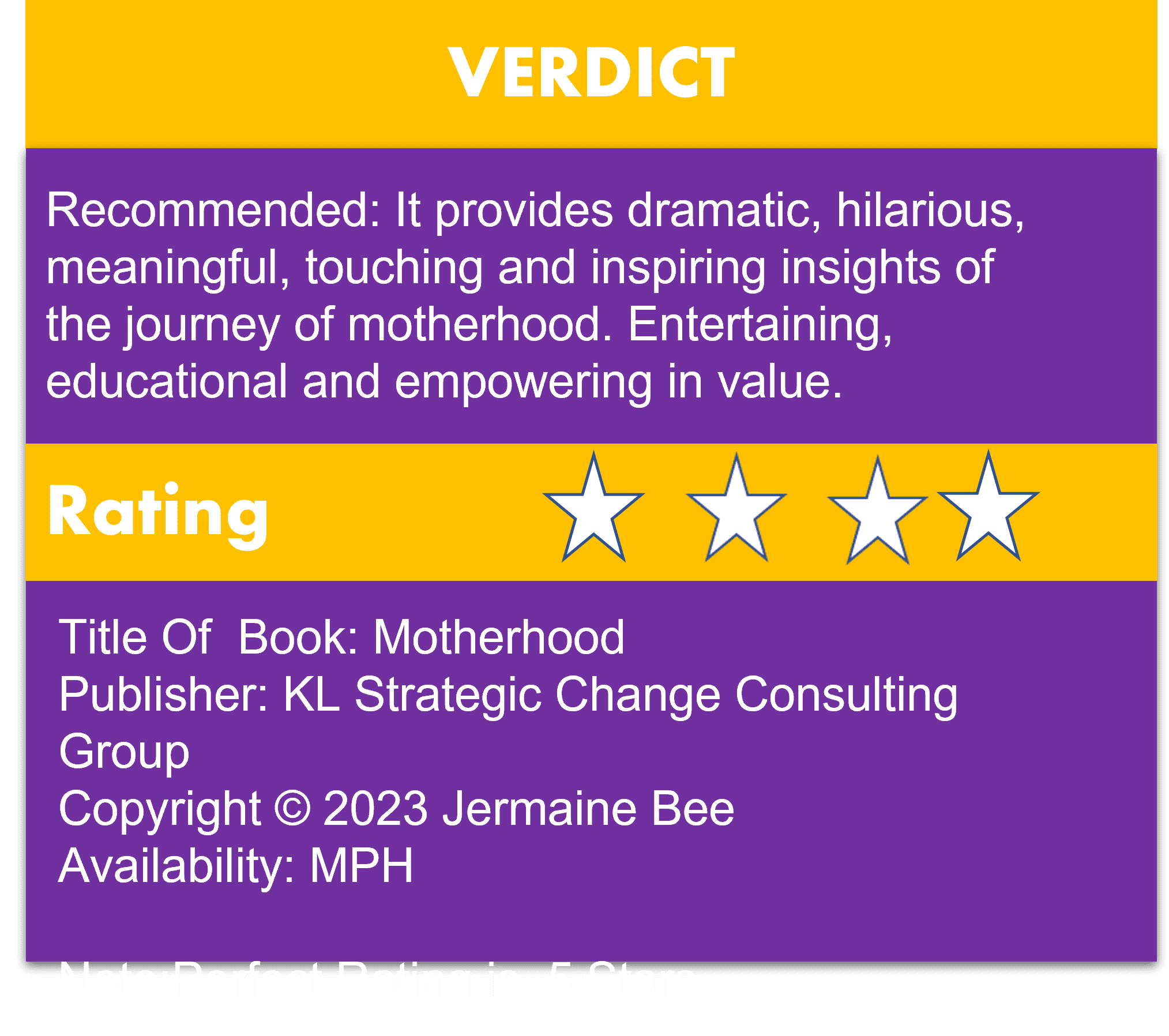
BOOK RATING CHART
Dr Victor Photo With White Background
Dr Victor SL Tan is the CEO of KL Strategic Change Consulting Group and an international change management consultant.  He is the author of 15 books, including management books and biographies. His work has been widely recognized and has recently won 2 awards from The BrandLaureate International for the company and consultant that made the most positive and productive impact for corporations. He can be contacted at 012-3903168 or by email at victorsltan@klscc.com.

The State Of Malaysia’s Education And Financial Literacy Among The Youths

A report by the Department of Statistics Malaysia (DOSM) in 2019 showed that 390,000 out of 560,000 SPM candidates were interested in joining the
workforce immediately after the exam, while only 170,000 students were interested in continuing their studies. The three main factors why youths aged 17 to 18 did not want to continue their studies were:

  • The belief that furthering their studies did not guarantee better-paying jobs;
  • The availability of job opportunities in the gig economy, and;
  • The interest to become influencers on social media.

Such is the sad state that this worrying trend is set to continue over the years. This could potentially impact Malaysia’s future supply of skilled labour, hindering its progress toward becoming a high-tech nation.

But on the other end of the spectrum, the Malaysian government has adopted aggressive measures aimed at internationalising its higher education system, a process it hopes will improve the sector’s dynamism and make it more responsive to the demands of a knowledge-driven world economy. In 2012, the higher education ministry established Education Malaysia Global Services (EMGS) to promote Malaysia as an international education hub and facilitate the movement of international students into the country.

Offering a degree that is well-recognised globally, Malaysian universities rank in the world’s top universities, with a total of 13 in the top 600, according to
QS World University Rankings. Based on QS World University Rankings by Subject 2022, 10 Malaysian programmes were placed among the top 50 universities for studying their academic subject.

As a result, Malaysia was the 13th-largest destination for international students in the world in 2020. According to the UNESCO Institute of Statistics (UIS), in 2020, Malaysia hosted 89,193 international degree-seeking students.

Smart Investor talked to several industry experts to learn more about the state of Malaysia’s education among the youth and their level of financial literacy.

The State Of Malaysia’s Education And Financial Literacy Among The Youths

Raja Edriana Baizura Head Of Career Services Taylors University
Raja Edriana Baizura, head of career services at Taylor’s University

“Education at the very base of it is required for everybody. Having an education will lay the foundation that the youths of today require to be better shapers of tomorrow for society to live in,” said Raja Edriana Baizura, head of career services at Taylor’s University.

“It is said that education and knowledge are two different things. Knowledge is what one knows, and education is how one learns it. Knowledge can be gained by the environment we are exposed to while growing up, while education is acquired knowledge from teaching and learning,” she added.

Terence Ooi The Co Founder Of Wiki Impact
Terence Ooi, the co-founder of Wiki Impact

“Being in Asian culture, the value of structured education has not diminished. In fact, those who can afford it would be looking for alternatives for their children to receive a better education than what is being offered mainstream. The pressure of getting straight A’s is still there as it is perceived that this would be a stepping stone to tertiary education and progress in life,” echoed Terence Ooi, the co-founder of Wiki Impact.

Yeap Jun Rong Market Strategist IG International
Yeap Jun Rong, Market Strategist, IG International

“In the past, a heavy emphasis was on getting higher education to secure a high-paying job. However, current perceptions about having a traditional 9-to-6 job have shifted as youths are more inclined to look for alternative sources of income, such as trading or even growing and monetising their social media. While general sentiments are that higher education may aid one’s chances in securing a better job, the key is to find your niche,” stated Yeap Jun Rong, a market strategist at IG International.

Haida Tahir Director Of Contingent Workforce Central PERSOLKELLY Malaysia
Haida Tahir, Director of Contingent Workforce Central, PERSOLKELLY Malaysia

“Today’s job landscape is so competitive, and while education does not guarantee a high-paying job or that you will land your dream career, it is a fundamental requirement. Nonetheless, it is undeniable that higher education leads to better job prospects in the long-term. Beyond furthering your studies, continuous learning is also very important, more so now as technological advancements shift the demands of what an organisation requires from talents,” shared Haida Tahir, the director of contingent workforce central at PERSOLKELLY Malaysia.

Dr Sanjay Sarma CEO President And Dean Of Asia School Of Business ASB
Dr Sanjay Sarma, CEO, president and dean of Asia School of Business (ASB)

“I have never met a young person disinterested in learning. Curiosity is the most fundamental aspect of learning, and it is impossible to extinguish. I have, however, met many people who are disaffected with how we teach,” explained Dr Sanjay Sarma, CEO, president, and dean of Asia School of Business (ASB).

“At ASB, we are all about action – and I believe classrooms need to have a more engaging, thought-provoking nature for the next generation to be prepared,” he added.

The emergence of new methods of teaching and learning platforms, such as self-learning through learning management systems (LMS), has given students the ease of studying at their own pace. This minimises the effects of constraints they have when pursuing their education and their opportunity cost. They are becoming smarter and gaining skills faster than their predecessors, all at the same time.

For example, Udemy is an online learning platform founded in 2010. According to the company’s website, Udemy has over 155,000 courses taught
by over 70,000 instructors and has served over 50 million students worldwide as of 2021. In terms of growth, Udemy has seen significant expansion over the years. In 2016, Udemy reported that it had over 11 million students enrolled in its courses, and by 2019, the number had grown to over 50 million.

The number of courses on the platform has also grown significantly, from around 30,000 in 2016 to over 155,000 in 2021.

Johary Mustapha Founder And CEO Of Forest Interactive
Johary Mustapha, founder and CEO of Forest Interactive

“Through our foundation arm, Forest Interactive Foundation (FIF), we are trying to bridge this gap by developing future innovators in tech. Our FIF programmes upskills young entrepreneurs and students alike by curating a robust tech-focused hands-on curriculum needed to solve the digital skills shortage and increase the overall employability rate within the country,” said Johary Mustapha, founder and CEO of Forest Interactive.

Nisa Saharuddin The Community Engagement Lead Forest Interactive Foundation
Nisa Saharuddin, the community engagement lead, Forest Interactive Foundation

“Through our various programmes, we provide the younger generation with a varied skill set to help them stay relevant with the progressing economy. Our #SeKODlah programme, partnered with corporations like CIMB Bank and CIMB Foundation, would enable the future Malaysian workforce to explore and develop in-demand skills through e-learning and mentorship. If we are to meet the ever-increasing demand of the economy, it must be a collective gesture of both the private and public sectors,” shared Nisa Saharuddin, the community engagement lead at FIF.

Education is and always will be important. However, the dynamics of learning have changed. Evidently, the younger generation places less value on traditional education as, from their viewpoint, there are multiple ways of achieving economic growth.

Are The Youths Of Today More Financially Savvy?

Bankruptcy cases are a telling point of where we stand regarding financial literacy. The number of bankruptcy cases seems to be declining, but let’s not forget that our government amended the Insolvency Act 1967 in 2017, raising the bankruptcy threshold from RM30,000 to RM50,000. This was followed by another amendment, raising it from RM50,000 to RM100,000.

Personal loans are the highest cause of bankruptcy among Malaysians, contributing almost 42%, followed by hire purchase loans at almost 15%.
Another worrying sign is the high number of cases in the 25 to 34-year-old age group, which makes up more than 21%, with the highest being in the 35 to 44-year-old age group, with more than 37%.

“As information is readily available on the internet, consuming the right information to be financially savvy is important. Not many know how to save or start investing early but those who have early exposure to financial literacy will or may start saving and investing earlier in life,” said Edriana.

“From my observation, they are generally still quite largely ignorant. Many are still unaware of basic investment options and opportunities. However, if compared to generations of the past, they do have greater access to resources on financial tips and investments – thus if you compare apple to apple, they are in a greater state,” added Ooi.

“They are more aware and practical of their financial capacity, so it’s a yes – if we take the literal meaning of financially savvy. However, long-term planning is also important, and that depends on a case-by-case basis,” opined Johary.

Where Do The Youths Invest?

The Institute for Capital Market Research Malaysia (ICMR) recently conducted a nationwide study to better understand their issues, challenges, and behaviours regarding personal finance and investing. The survey was distributed to 1,500 respondents and found that millennials and Gen Z Malaysians can be categorised into three groups, each with unique characteristics.

A higher proportion of respondents from the east coast do not invest (Group A), while Group C has a higher proportion from the Central region. More notably, there are differences in household income levels between all three groups. While 69% of Group A earns less than RM5,000 in monthly household income, 56% of Group B earns between RM3,000 to RM7,000.

Meanwhile, respondents who fall under Group C were found to have significantly higher incomes, with 31% having household incomes above RM10,000.

Financial Literacy And Risk Tolerance

ICMR’s research suggests a link between financial knowledge, financial confidence, and risk tolerance with the likelihood of investing and the products invested in. For instance, someone who does not know much about financial matters and has little financial confidence would also be unwilling to take risks – hence not investing and falling into Group A.

This could also explain behavioural differences between Group B, which invests only in ASNB funds or unit trust products, and Group C, which invests in other capital market products. The first unit trust company in Malaysia was set up in 1959. This might be why retail investors are most comfortable with unit trust products, considering their long history in Malaysia.

Additionally, many investors who only invest in ASNB funds or unit trust products (Group B) tend to be less risk tolerant and financially confident. In contrast, those who invest in other capital market products like shares or cryptocurrency, which are perceived to be riskier, tend to have higher risk tolerance levels and feel more financially confident.

“Based on our data at IG International, with the recent volatility, youths are more inclined to trade major US indices and forex. The Dow Jones Industrial Average and Nasdaq 100 are popular choices. Since the Covid-19 trading boom, youths continue to have their feet in the game in terms of trading,” shared Yeap.

Jason Low Co Founder And CEO Virtualtech Frontier VTF
Jason Low, Co-founder and CEO, Virtualtech Frontier (VTF)

“In addition to the stock market, young people are also investing in alternative assets such as cryptocurrency, NFT’s, and real estate. Cryptocurrency has become increasingly popular among younger generations, with platforms like Coinbase and Binance providing an easy way to buy and sell various cryptocurrencies. Real estate investing has also gained popularity among young people, with crowdfunding platforms like Fundrise and RealtyMogul allowing investors to pool their money together and invest in commercial real estate,” explained Jason Low, co-founder, and CEO of Virtualtech Frontier (VTF).

“Personally, I have seen students who invest in the stock market or even trading to make their money ‘grow’ even as early as their first year of university. We invite speakers from the industry to introduce topics such as financial literacy to students in their final year during Professional Development Week, where they learn the importance of being financially savvy,” added Edriana.

“Most young people I know are investing in insurance and crypto. This is perhaps the access they have to either opening the accounts or someone within the industry educating them,” said Ooi.

“Some common options for youth to invest in are NFTS, cryptocurrency, stocks, fixed deposits, and real estate. Stocks are popular with those looking for higher returns and are willing to take more risk while fixed deposits are a more conservative option that offer guaranteed returns. Real estate is also popular for those who are looking for long-term investment with the potential for appreciation,” mentioned Johary.

The State Of Malaysia’s Education And Financial Literacy Among The Youths Summary

In short, youths of today are more financially savvy than previous generations. But it is important for them to educate themselves about personal finance and investing and seek advice and guidance from trusted sources.

Get your latest copy of Smart Investor Magazine HERE!

FC•SI MayJun 2023 1024

Generali Malaysia Aims Higher Positioning Post Stake Acquisition Of AXA Affin General Insurance

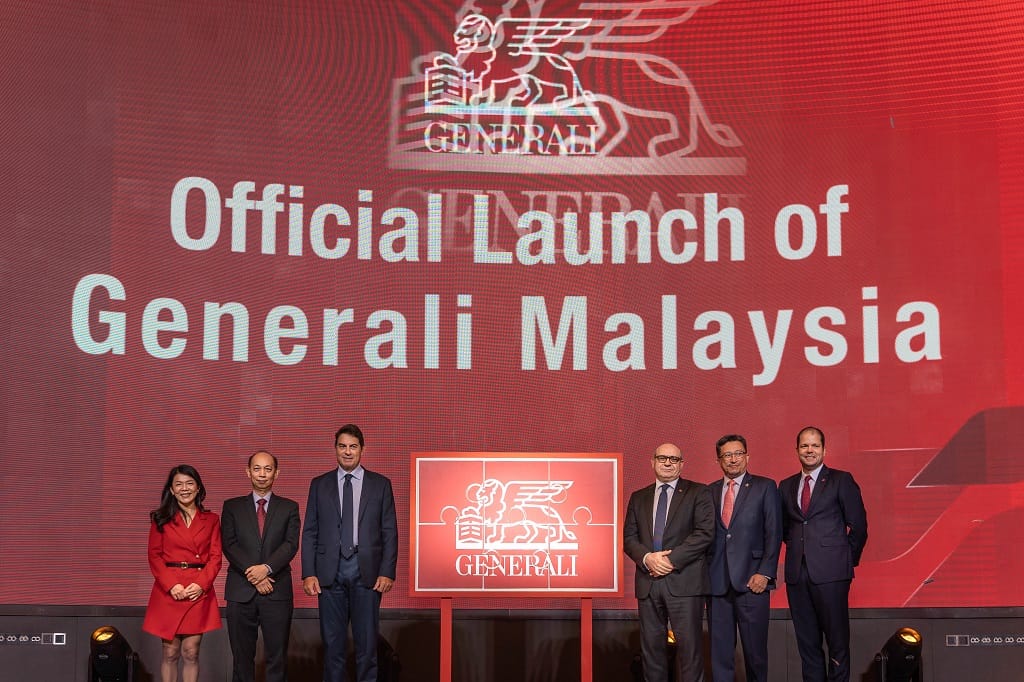
Generali Group, one of the largest global insurance providers, recently launched Generali Malaysia following the acquisition of a controlling majority in AXA Affin joint ventures in Malaysia and 100% purchase of MPI Generali Insurans Berhad. The transaction valued the acquired companies at close to RM1.29 billion (EUR 262 million), making it one of the largest M&A transactions in Malaysia in recent years.

On 1st April 2023, the businesses were integrated under a single, unified brand ― Generali Malaysia. The integration positions Generali Malaysia as one of the largest general insurers and emerging life insurer in Malaysia, broadening its edge in a competitive market.

With its strong expertise in providing comprehensive protection solutions in all areas of general insurance – medical and health, motor and home, travel and personal accident, as well as business and commercial insurance, Generali Malaysia is committed to further expand its offerings and better cater to customers’ growing needs. With a focus on protection, medical coverage, savings, and legacy planning, its Life segment offers customers coverage needs for every stage of life.

Generali Malaysia Aims Higher Positioning Post Stake Acquisition Of AXA Affin General Insurance2
(L-R) Rebecca Tan, CEO of Generali Life Insurance Malaysia Berhad, Raymond Fam Chye Soon, Chairman, Generali Insurance Malaysia Berhad, His Excellency Massimo Rustico, Ambassador of Italy in Malaysia, Roberto Leonardi, Generali International Asia Regional Officer, Abdul Malek Bin Mohamed Said, Chief Corporate Strategy Officer, Affin Bank Group, Fabrice Benard, CEO of Generali Insurance Malaysia Berhad & Country Head for Generali entities in Malaysia

Jaime Anchustegui Melgarejo, CEO, Generali International commented, “This is a significant milestone for Generali in Malaysia and in the region. It highlights our commitment and dedication to Asia and the importance we place on Malaysia as one of the region’s high-potential growth markets.”

Roberto Leonardi, Generali International Asia Regional Officer, commented thatAs a unified entity, we look forward to enhancing the Generali experience and becoming Lifetime Partners to our customers in Malaysia, as well as making a positive contribution to the communities in which we serve.”

“The launch of Generali Malaysia is to create a unified, customer-focused brand that can provide  comprehensive insurance solutions across the full spectrum of products from general to life insurance. We aim to have a significant presence in the market and be one of the top general insurers in the country,” said Fabrice Benard, Chief Executive Officer, Generali Insurance Malaysia Bhd and Country Head for Generali Entities in Malaysia.

The launch is fully aligned with Generali’s ‘Lifetime Partner 24: Driving Growth’ strategy to strengthen its leadership position in Malaysia ― a country with strong potential for growth with its economic development and current low-insurance penetration. Holding a strong vision for the future, Generali Malaysia hopes to play an active role in contributing to Malaysia’s economic growth and development.

Supported by over 1,600 workforce, a wide distribution network of more than 9,000 agents, partners and distributors and 49 branches nationwide, Generali Malaysia is presented with the advantage of a larger market share in Malaysia which is further boosted with a broader range of products and services.

“As an insurer with over 190 years of insurance heritage and experience, we strive to provide better experiences as a whole, by transforming our role to go beyond selling products and to provide more value-added, personalized service in line with our ‘Lifetime Partner 24: Driving Growth’ commitment,” Benard added.

Rooted in Italy, Generali Group has a strong heritage and legacy of protection of more than 190 years. To date, Generali has presence in over 50 countries and a workforce of 82,000 employees serving 68 million customers. The Group has been active in Malaysia since 2015 when it acquired a 49% stake in Multi-Purpose Insurans Berhad – a P&C insurance subsidiary of Multi-Purpose Capital Holdings to create MPI Generali. In 2022, Generali acquired full ownership of the MPI Generali joint venture and purchased a controlling majority in AXA Affin General and Life Insurance in Malaysia. In 2023, Generali unfolded a new growth chapter with the launch of a single, unified brand Generali Malaysia ― one of the largest general insurers and emerging life insurer in Malaysia backed by over 1,600 employees, a wide distribution network of more than 9,000 agents and partners and 49 branches. 

Generali Malaysia Aims Higher Positioning Post Stake Acquisition Of AXA Affin General Insurance3
(L-R) Rebecca Tan, CEO of Generali Life Insurance Malaysia Berhad, Raymond Fam Chye Soon, Chairman, Generali Insurance Malaysia Berhad, His Excellency Massimo Rustico, Ambassador of Italy in Malaysia, Roberto Leonardi, Generali International Asia Regional Officer, Abdul Malek Bin Mohamed Said, Chief Corporate Strategy Officer, Affin Bank Group, Fabrice Benard, CEO of Generali Insurance Malaysia Berhad & Country Head for Generali entities in Malaysia

ABOUT GENERALI MALAYSIA

Generali Group is one of the largest global insurance providers with more than 190 years of heritage. The Group has been active in Malaysia since 2015 when it acquired a 49% stake in Multi-Purpose Insurans Berhad – a P&C insurance subsidiary of Multi-Purpose Capital Holdings to create MPI Generali. In 2022, Generali acquired full ownership of the MPI Generali joint venture and purchased a controlling majority in AXA Affin General and Life Insurance in Malaysia.

In 2023, Generali unfolded a new growth chapter with the launch of a single, unified brand Generali Malaysia ― one of the largest general insurers and emerging life insurer in Malaysia backed by over 1,600 employees, a wide distribution network of more than 9,000 agents and partners and 49 branches.

Now with an expanded scale, breadth, and expertise, Generali Malaysia strives to further its ambition of being a trusted Lifetime Partner and a progressive insurer that safeguards the needs of Malaysians and their future generations.

THE GENERALI GROUP

Generali is one of the largest global insurance and asset management providers. Established in 1831, it is present in over 50 countries in the world, with a total premium income of € 81.5 billion in 2022. With 82,000 employees serving 68 million customers, the Group has a leading position in Europe and a growing presence in Asia and Latin America. At the heart of Generali’s strategy is its Lifetime Partner commitment to customers, achieved through innovative and personalised solutions, best-in-class customer experience and its digitalised global distribution capabilities. The Group has fully embedded sustainability into all strategic choices, with the aim to create value for all stakeholders while building a fairer and more resilient society.