Wednesday, 5 August 2026 Stay informed. No noise.

6 Ways To Deal With Inflation

Inflation literally makes us all poorer by eroding the value of our money. The problems we have been facing in the two-and-a-half years due to the pandemic has made matters worse, as we have find ways to deal with inflation.

As the cost of living continue to rise, what should we prioritize when it comes to our monetary budget? Will we have to retire later? Do we have to change our children’s tertiary education plans?

In a Facebook livestream on 7 September 2022, conducted in conjunction with World Financial Planning Day 2022 (WFPD2022) by SmartFinance (SmartFinance.my) with the support of the Financial Planning Association of Malaysia (FPAM), Rajen Devadason, a licensed financial planner, offers some strategies we can use to deal with inflation.

Here is his tips on how to deal with inflation:

1. If You Don’t Have A Budget, Please Create One

Financial Business Man Accounting Calculating Cost Economic Budget Investment

If a budget only exists in your head, you are strongly urged to have it written down, whether on paper or as lined items on a spreadsheet. Getting the tactile sensation of writing things down will get you more invested in the numbers and provide you with a road map of your finances.

2. Prioritize Nourishment

When it comes to budgeting for yourself and your family, do not compromise on nutrition. Make sure nutritious food that meets caloric content is taken care of and no one goes hungry. Everything else can be set aside.

3. If It Possible To Accelerate The Repayment Of Debt, You Are Advised To Do So

retirement debt free

Many of us have debt that flow. So, when interest rates rise, the cost of our borrowings will go up. One way to deal with inflation is to pay down debt you can, as fast as you possibly can.

Each time you get rid of a liability to your name, the monthly repayment disappears for life (unless you take on an equivalent loan). This will clear up additional cash flow, give you a breathing room and let you do more with your money in an inflationary environment.

4. Exercise Delayed Gratification

Used to changing cars every 5 years or going on two overseas vacation a year? Don’t be too quick to spend your earning on the things you want.

You are likely to have surplus money to save up if you can cut back on some luxuries, until your financial goals are met. Delayed gratification is another way to deal with inflation.

5. Work Harder, Work Longer, Bring In More Money, And Tighten Your Belt Like You Have Never Done Before

Skeptical Diverse Hr Managers Interviewing Female Applicant Bad First Impression
Image by yanalya on Freepik

Unless you wish to stay poor, you cannot stay static. Most of us can only improve on our situation by working harder, and then by working smarter. If you are not earning enough, get a second or third stream of income. One of the saving graces is internet connection is now better than 5 years ago, which enables anyone with online access to participate in the gig economy and earn a side income.

For those who are under the age of 35 and in good health, you’ve got more energy; your youth, stamina and vigor will give you the ability to work beyond your normal 40-hour work week, if you are willing to pay the price.  

6. Save And Invest More

Saving and investing are two different things. We save for peace of mind, knowing we will be able to deal with emergencies. Meanwhile, we choose to invest to try – though without guarantees – to beat taxes and inflation. If you have been successful, you have grown your money faster than taxes eats into it and faster also than inflation. 

With so much going on in the world; the pandemic, geopolitical conflict, economic crisis etc, there is tremendous volatility, especially for the riskier investment spaces. Nevertheless, volatility is the friend of the long-term, life-long, consistent investor and saver.   

As such, those who are wise enough to work harder, rework their budget, build up their surpluses, pay down debt, exercise delayed gratification, and try to save even though it’s very tough. Rajen’s advice is to take advantage of dollar cost averaging.

To stand to benefit in the long-term, invest in a manner that meets five specific criteria:

  1. Invest in an asset of high quality (that are good hedges against inflation)
  2. That asset should fluctuate in price
  3. Invest in equal amounts
  4. Invest at regular intervals
  5. Invest regardless of market conditions

Finally, never put all your eggs in one basket. Diversify your investment across three distinct dimensions: diversify across different asset classes, different geographic regions, and over a very long timeline.

6 Ways To Deal With Inflation

There you go with 6 ways to deal with inflation that you can start implementing in your daily life. It might not be easy, but it will be worth it in the end.

3 Ways To Increase Your Source Of Income

59.7 million results when I searched on Google on ‘multiple streams of income’ on the day this article in written. This is a massive result. With the recent pandemic, many sectors are impacted, and many individuals suffered as a result from loss of their major of source income.

In this article, I am going to share with you some general big ideas on how to increase your source of income.

1. Investment Portfolio

Investment provides you with capital growth or income. Capital growth means the appreciation asset value or difference between the realization value and cost of investment. Income refers to the dividend, rental income or other incomes received by investing in the investment assets.  

There are many investment options to increase your source of income these days. We have Exchange Traded Fund (ETF), Equity Crowdfunding (ECF) and Peer-to-Peer Lending (P2P) apart from traditional investment classes like property or stocks.

With new innovative products, you don’t need huge investment to kickstart your investment journey. Some can start from as low as RM100 or you can have a diversify investment portfolio with traditional assets and new investment asset classes.

Below are some of questions that you can use as guide to ask yourself as follows:

  • What are your financial goals?
  • What is your investment horizon? Is it for Income or Capital Growth?
  • Does the asset class suit my investment profile?
  • What is the amount that I can allocate to start with? Lumpsum or Regular Savings Plan?
  • Can I do it myself or do I need assistance from Licensed Financial Planner or other professionals?


What is the purpose of building an investment portfolio? Different portfolios are to cater for different needs, for example cash/money market is to cater for emergency and or short-term needs.

Whereas for medium-term goals could be for holiday, buying house, for marriage and or starting a new family. For the longer-term goals, it is for replacement of active income and or for retirement. That’s how you build up an investment portfolio as a way to increase your source of income.

Read: 5 Investment Tips For Beginners That You Should Know

2. Business Income

There are several types of business income for you to consider like online food business, selling things at online platforms that can earn you additional income. Yes, many businesses are affected due to the pandemic, but you can still increase your source of income via a business income.

There was 7.5% increase in new businesses being registered in Malaysia year 2020 as compared to prior year based on the information available from Company Commission of Malaysia. Due to many who had lost their jobs or income; therefore, many self-employed or small entrepreneurs have either started their own freelancing or contract services and some had started selling at online social media platforms like Facebook, Instagram and or TikTok.

Gig economy which meaning temporary and flexible jobs have been on the rise and there are close to 4 million freelance workers in Malaysia.

Read: Fall of Family Business Empire, Why Family Business Fail?

3. Leverage On Your Existing Skills To Teach Or Share With Others

If you have certain skills or experience that you are good at which you can use it, teach or share with other individuals, that will allow you to earn additional income. For example, if you good in singing or master certain language, therefore you can create a course to teach others how to sing virtually either in a group setting or individually, as a way to increase your source of income.

It may include creating videos or posting photos with are beneficial to certain market segments may land you opportunity either to be involved as key opinion leaders or in the affiliate marketing. It may be teaching others how to cook food or bake a cake or maybe just a hobby of how to grow certain plants via the online platform.

Read: 5 Different Types of Income

3 Ways To Increase Your Source Of Income

What if these additional sources of income allow you to provide yourself and family with better lifestyle and provide you security in the event of uncertainty, would you think that sacrifices that you make now by building your new sources income worth your effort?

You are the only person is responsible to for your own future rather that relying on others. I would like to end it with a quote from Jeff Bezos, “I knew that if I failed, I wouldn’t regret that, but I knew the one thing I might regret.” Now that you know some of the ways to increase your source of income, which one do you prefer?

About the Author

Goh Chee Yong

Goh Chee Yong is a Licensed Financial Planner under Capital Markets Services Representative License (CMSRL) and Bank Negara approved Financial Advisor Representative (FAR). Prior to becoming a financial advisor, he spent eight years working in Big 4 audit firms and multinational corporations. He can be contacted at cygoh@imaxfinancial.com.my

5 Easy Steps to Achieving Financial Merdeka

On a Facebook livestream held on 31 August 2022 by SmartFinance (SmartFinance.my) in an effort to promote financial literacy on World Financial Planning Day 2022 (WFPD2022), Linnet Lee, the CEO of the Financial Planning Association of Malaysia (FPAM) shares the five steps anyone can take to achieve financial freedom or financial merdeka.

Here are the five steps in a nutshell:

Step 1 – 2:30

For the first two years you start working, set aside 20-30% of your income to invest in yourself (to buy clothes, gadgets, things you need for work etc.) From the third year onwards, start saving 30% of your gross income for retirement. EPF contributions (employer 12% and employee 11%) already make up 23%, leaving 7% left for you to start investing into retirement in other avenues (stocks, private retirement schemes etc).

Now let’s move on to the second step to achieving financial merdeka.

Step 2 – Rule of 72

investment

Dividing 72 by the interest or dividend will give you a rather accurate estimation of how many years your money will either double up or shrink by half. Use the rule to help when managing your finances and keep an eye on inflation rate as well.

For example:

72/6% (interest/dividend) = 12 years (duration for your money to double up)

72/5% (inflation)=14 years (duration for your money to shrink by half)

Step 3 – Rule of 78

Not all loans are created equal, and this rule is a tip to keep in mind when handling your debts. Financing methods that allocate pre-calculated interest charges are meant to favor the lender over the borrower on short-term loans. The borrower would pay a greater portion of the interest rate in earlier part of the loan cycle than regular loans.

A car loan, for instance, is calculated using the Rule of 78 (the number comes from the sum of monthly term on a one-year loan, by adding the numbers 1 to 12). What that means is the lender has calculated the interest and put most of interest in first and second year of your loan. Hence, there’s no benefit to paying the loan off early because the interest has already been calculated and you have paid most of it already.

So, if you have a car loan, don’t be in a hurry to pay it off. It is better to pay on time to avoid the penalty.

This is different with a housing loan. As you pay off your housing loan, the interest will be calculated based on the outstanding amount for the beginning of that year. It therefore makes sense pay it off quickly because you will be paying less interest.

Before you do though, check with your bank if there is any penalty rate for paying off earlier.

Step 4 – Six Months Emergency Money

Emergency Savings Written Jar With Dollars Banknotes Money Concept Money Saving Rainy Day

Have up to 6 months’ worth of monthly expenses saved up. This will buy you time you need to get back on your feet. When you tap into your emergency fund, be sure to top it up again as soon as you can.

That said, a credit card should not be treated as emergency money.

Are you ready for the final step to achieving financial merdeka?

Step 5 – RM1 Million In Retirement Fund

If you add RM500 per month to an initial sum of RM1,000, starting from the age of 25 to 61, with an interest or dividend of 7% and an inflation of 3%, you will have RM1 million in 36 years. Assuming you stay in good health, you will be able to fund 20 years in retirement. Of course, this is just a simple calculation. Over the years, you can always add to your retirement fund as you earn more.

And now we are at the end of the 5 easy steps to achieving financial merdeka.

Congrats, You Are On The Road To Financial Merdeka

If you need help working through the numbers, do not wait too long to seek the help of a licensed financial planner. To brush up on your financial literacy and connect with a financial planner, go to SmartFinance.my. Wish you all the best in your pursuit for financial merdeka. 

Futureproofing Malaysians With Financial Know-How

As Malaysians recover from the COVID-19 pandemic, the topic of money is on everyone’s minds for various reasons. These range from rising inflation, which is quickly eroding our purchasing power, to concerns about retirement security as a result of a significant reduction in our savings after two years of the pandemic.

Many in our community are still struggling to replenish their savings. Those whose savings are at a critical level, have expressed concern about how they will survive when they retire, stating that they need to continue working or start small businesses in order to make ends meet in the years to come. To make matters worse, these vulnerable people are often preyed upon by unscrupulous scammers.

According to the Royal Malaysian Police (PDRM), a total of 71,833 scams were recorded between 2020 and May 2022, with losses amounting to RM5.2 billion. These include bank scams, loan scams, as well as investment scams which fall under the purview of the Securities Commission Malaysia (SC). The SC received 1,800 complaints and enquiries related to investment scams and unlicensed activities in the first nine months of this year.

The SC’s work extends well beyond regulating and developing the Malaysian capital market. They are also responsible for safeguarding the interests of investors, by among others, educating investors on how to make better investment decisions by providing them with key financial knowledge and tools, so they can make informed investment decisions.

They also teach the public how to identify red flags of investment scams and illegal activities in the market. Being more financial literate means that investors can take better control of their own finances and stop them from falling victim to the sweet promises of scammers.

InvestSmart® Fest 2022 ISF 2022 14–16 October At KL Convention Centre1

With these considerations in mind, the SC will be hosting the InvestSmart Fest at the Kuala Lumpur Convention Centre (KLCC) from 14 to 16 October 2022. Themed ‘Silap Labur Duit Lebur’, InvestSmart® Fest is a one-stop event for all your investment needs, showcasing not only a wide array of investment opportunities, but also valuable lessons on financial planning for individuals who would like to improve their financial wellbeing.

Visitors to InvestSmart Fest can take advantage of InvestSmart®’s #Finplan4u initiative, where they gain free consultations by licensed financial planners on how to better plan their investment and retirement.

InvestSmart Fest will also be investing in the youth segment, who are regarded as key stakeholders for the long-term sustainability and success of the capital market. According to the findings of the SC’s survey titled “Youth Capital Market Survey: A Malaysian Perspective 2022”, Malaysian youth tend to prioritise emergency funds and savings to support their families and pay off debts above building wealth and investment. Therefore, it is important for younger generations to have a head start in investing and saving so they can enjoy greater financial stability in their later years.

This year, InvestSmart Fest brings together more than 40 exhibitors, showcasing some of the most cutting-edge technologies, products, services and solutions available in Malaysia’s capital market today. The 3-day event will also feature expert speakers and key opinion leaders, who will share their perspectives on various aspects of Malaysia’s capital market and how investors can stay ahead of the game and plan for the future.

For more information about the InvestSmart® Fest event, please visit www.investsmartsc.my. Additionally, if you would like to get the latest updates, you may follow their various social media channels at:

FB: https://www.facebook.com/InvestSmartSC/

Twitter: https://twitter.com/InvestSmart_SC?s=20&t=QqkJ8M5M1gcp_ANbcJ1Phw

Instagram: https://www.instagram.com/investsmartsc/?hl=en

5 Investment Tips For Beginners That You Should Know

Everyone loves it when it comes to investing. Seems like we can never get enough of it, although our capital might not be that big. Here are some investment tips for beginners that you can apply for a steady growth despite the market’s uncertainties.

1. Set Your Goals

They say if you fail to plan, then you are planning to fail. The first investment tips for beginners, is begin by listing down all your financial goals such as:

  • Saving up for a property
  • Retire at age 55
  • Sending your child to private university
  • Travel the world

Everyone have their own goals in life. Be specific with what you want, and allocate the funds to each goals.

For example you need:

  • RM100,000 as down payment and renovation costs to purchase a property
  • RM5,000 per month living expenses each month when you retire
  • RM100,000 as tuition fees and living costs for your child when entering university
  • RM100,000 fund to be used to travel to Europe and United States during the summer

Read: Best Investment In Malaysia

2. Dollar Cost Averaging Or Regular Savings Plan

Image
Graph 1: The Cost of Market Timing The Risk of Missing the Best Days in Market, 2000 – 2019. Source: Morningstar, 2020

According to a research by Morningstar, investors who stayed in the market for all 5,035 trading days achieved a compound annual return of 6.1%. However, that same investment would have returned 2.4% had it missed only the 10 best days of stock returns.

Further, missing the 50 best days would have produced a loss of 5.5%. Although the market has exhibited tremendous volatility on a daily basis, over the long term, stock investors who stayed the course were rewarded accordingly.

That’s why it is important to invest regularly either each week or each month instead of trying to find the best time to go in the market. Because even the most seasoned professional investors can’t get the timing right, what chances do we have?

Even when faced with an uncertain market, the best thing to do is keep on investing. Allocate a certain amount from your salary to invest. A good figure to start is 10%, if your salary is RM10,000 per month – make sure you invest RM1,000 each month.

3. Portfolio Diversification

“Don’t put all your eggs in one basket”

This words of wisdom can’t be much further than the truth, and is very important as one of the best investment tips for beginners. You should be diversifying your portfolio into several low-risk instruments with low returns, medium-risk instruments with medium returns, and high-risk instruments with high returns.

Still remember the RM1,000 per month investment that you are allocating each month, which is 10% of your salary?

You can split it into:

  • RM250 into crypto
  • RM250 into equity (stock market)
  • RM250 into REIT (property)
  • RM250 into fixed income (fixed deposits)

Crypto and equity are high-risk investments, REITs are medium-risk while fixed income are low-risk.

Read: Follow These 5 Steps For An Effective Asset Allocation In Your Investment

4. Focus On Fundamentals

Young Collage Student Using Computer Mobile Device Studying Online Education Online Learning

Either crypto or stocks, you should be looking at those with great fundamentals. For crypto, the stablecoins are the ones to invest for long term, Bitcoin, Ethereum, Binance Coin (BNB), Ripple, Solana are good choices.

Bitcoin is the grandfather of crypto, Ethereum and Solana are mostly used for NFT, BNB being used on Binance the world’s largest exchange, while Ripple are used for real-time gross settlement system, currency exchange and remittance network.

As for stocks, you can use one of the most popular fundamental analysis – 5 Magic Numbers:

  1. Earnings Per Share (EPS)
  2. Price-to Earnings Ratio or P/E Ratio (PE)
  3. Return On Equity (ROE)
  4. Net Tangible Asset (NTA)
  5. Dividend Yield (DY)

By using the 5 Magic Numbers, you will be able to filter companies with resilient earnings, strong track record and ability to pay dividend.

5. Invest For Long Term

The final investment tips for beginners, is that I can’t emphasize enough on the importance of investing for long term. Instead of looking for short term gains, have a more longer term view when it comes to investing.

Ignore all the hypes of current investment that is making waves, instead go for the tested and tried instruments. All investments have their ups and downs, and if it can go up very fast, it can also go down in a flash.

Read: The 4 Stages Of Side Hustle For A Bigger Investment Capital

5 Investment Tips For Beginners

Well there you go with some of the best investment tips for beginners that you can probably use as part of your investment strategies. Just be patient and keep on investing regularly, you should be able to reap what you sow and meeting your financial goals.

Post 2023 Budget And Q4 Market Outlook Commentary By Rakuten Trade

Rakuten Trade recently held an event for the media and presented their thoughts about Budget 2023 and their market outlook for the remainder of 2022. Kenny Yee, Head of Research and Thong Pak Leng, Vice President of Equity Research were on hand to explain more about their findings.

Budget 2023

A Budget for the whole spectrum of population

Payouts for the underprivileged and more surprisingly, tax cuts for theM40 should ease the burden of prevailing high prices. Though disposable income will improve from tax cuts, intention is to alleviate the impact from prospective higher interest rates environment going forward.

The potential creation of 50,000 job opportunities should lessen worries for the fresh graduates aka the Youths. SME owners should also rejoice by the 2% tax cut.

Contractors will benefit

The record high allocation for development amounting to RM95 billion emphasizes the dire need to revive the nation’s economy. As we are aware, the construction sector offers the highest multiplier effect hence once this sector commences cranking up activities, the positive impact should spread across other subsegments as its linkages are immense.

Post 2023 Budget Q4 Market Outlook Commentary %E2%80%93 Rakuten Trade1

Budget impacts on five sectors

1. Automotive sector

Full exemption of import and excise duty for electric vehicles (EV) for CBU (completely-built-up) extended until 31st December 2024 (CKD exemption is still the same until 31st December 2025).

2. Construction sector

High development expenditure of RM95 billion – a 32% increase from the estimated amount in 2022.

3. Consumer sector

Though higher disposable income is positive from the cash support for M40, B40 and students which are expected to increase consumer spending on goods and services such as F&B and daily essentials. We believe the impact is minimal in view of the prevailing high prices.

4. Property sector

75% stamp duty exemption (from 50% prior) for houses worth RM500k to RM1 million for first time home buyers. The additional 25% stamp duty exemption for houses worth RM500k to RM1 million allows first-time home buyers to save an additional RM2,800 to RM7,100.

5. Technology sector

The allocation of e-money incentives for the M40 group and youths worth RM800 million and RM400 million, respectively, which will further accelerate the adoption of cashless transactions.

Market Will Remain Volatile

Post 2023 Budget Q4 Market Outlook Commentary %E2%80%93 Rakuten Trade2

Performance of the local bourse has been immensely impacted by global uncertainties primarily from the US. The heightened market volatility have had created ripples across the region as well.

Commodities were not spared either as both the CPO and crude oil underwent wild gyrations. The CPO from the high of RM7,200 to now RM3,800 while the Brent crude from around USD130 to now USD98.

As for corporate earnings, we noticed a downward revision for CY22 from 4.3% to now circa. 1% mainly attributed to the cuts for Manufacturing and Utilities sectors.

Nonetheless, CY23 earnings growth should shine with 6.8% due to upgrades for Banks despite lower estimates for both Plantation and Manufacturing.

Regional volatility remains high with some above the last 2 years. Unlike the rest, Malaysia’s volatility remains below the region as the local bourse is a captive market. Nonetheless, we expect volatility to heighten in view of the anticipated “hard landing” in the United States.

Regional Currency Turmoil

Due to the incessant rate hikes by the Federal Reserves, the USD has had strengthened against all regional currencies. The USD movements has instigated most central banks to be on defensive mode to tame prevailing turmoil amongst the global currencies.

Why This Economic Cycle Is Different?

No two economic cycles are the same, but as the American writer Mark Twain eloquently put it, “history doesn’t repeat itself, but it often rhymes”. This cycle is proving to be particularly different, however, which makes it even more challenging to draw parallels with the past.

Depending on which indicators you look at, the US economy could be categorised as being in any one of the business cycle’s four phases. These are expansion, slowdown, recession and recovery.

If we use the textbook definition of recession – two consecutive quarters of negative real GDP growth – the US is in one. Recessions, however, are usually accompanied by a meaningful pick-up in the unemployment rate, and this has not occurred.

Instead, the unemployment rate is at a multi-decade low. Indeed, the strength of the labour market speaks of an economy in its expansion phase, albeit now clearly pushing at capacity limits.

Other economic indicators, however, such as business surveys (deteriorating) and the rate of change in inflation (still accelerating), suggest an economy already experiencing that particularly difficult type of slowdown, stagflation. Certainly, the sharp de-rating of US equities seen this year is in keeping with stagflation.

In short, this economic cycle can’t be easily categorised.

Unique Circumstances Have Created Two-Speed Economy

As the rapid pace of rate rises by the Federal Reserve (Fed) continue to take effect we expect economic indicators to become less contradictory. This should occur next year when we anticipate the US economy to be in a recession.

Since the post-war period, every time there has been two consecutive quarters of negative real GDP growth, recession has been confirmed by the NBER (National Bureau of Economic Research). The NBER is the official authority on dating US recessions based on monitoring a variety of macro-economic indicators.

So far, they have not announced recession.

The weakness in second quarter GDP was also distorted by a significant fall in inventories after strong stockpiling in previous quarters. So, it seems premature to call the end of the cycle based on recent disappointing GDP releases.

Why This Economic Cycle Is Different1

In contrast, the Schroders Output Gap model, which measures the amount of spare capacity in the economy, suggests that the US economic cycle remains in the expansion phase (see chart 2, below). This is because the output gap is positive and rising.

The output gap is the difference between an economy’s actual output and its potential output, a positive output gap suggests the economy is running out of spare capacity, which adds to inflationary pressures.
Ordinarily, monetary policy would be tightened at this stage to bring actual output back to its potential (the maximum level of output an economy can produce without generating inflation). The Fed is currently attempting to engineer just this.

As activity slows down the positive gap begins to shrink, and the economy enters the slowdown phase – although this is not yet occurring following a blistering pace of interest rate rises.

Schroders Output Gap model and phases of the economic cycle

Expansion – output gap is positive and rising
Slowdown – output gap is positive and falling
Recession – output gap is negative and falling
Recovery – output gap is negative and rising

Why This Economic Cycle Is Different2

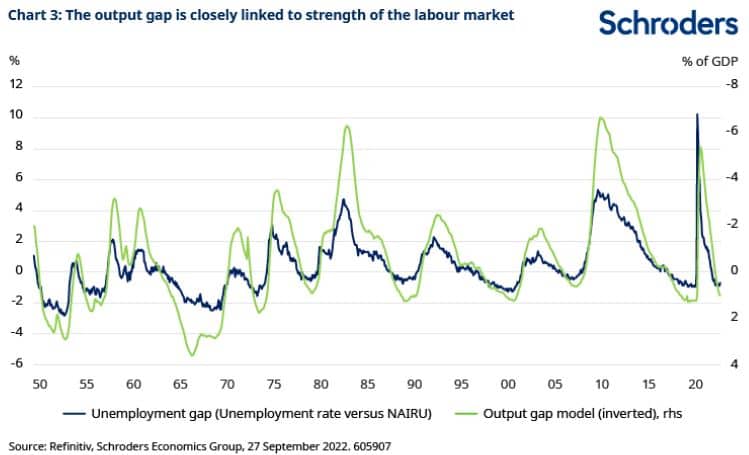
Instead, a presently positive and rising output gap reflects labour market strength, as captured by the ‘unemployment gap’ (chart 3). The unemployment gap is one of the key inputs into the output gap model and tells us if there are less unemployed workers compared to trend levels.

Monetary policymakers make a judgement on what is the NAIRU (Non-Accelerating Inflation Rate of Unemployment), being the lowest level of unemployment that can be achieved before inflation begins to rise in the economy.

So, there will need to be a meaningful rise in the unemployment rate before the positive and rising output gap begins to shrink.

Why This Economic Cycle Is Different3

US Economy And Markets Showing More Late Cycle Traits

While we expect our output gap model to move into slowdown at the start of 2023, we recognise that other areas of the US economy are already showing late cycle characteristics. Growth momentum has peaked, and business surveys have eased while inflation has accelerated.

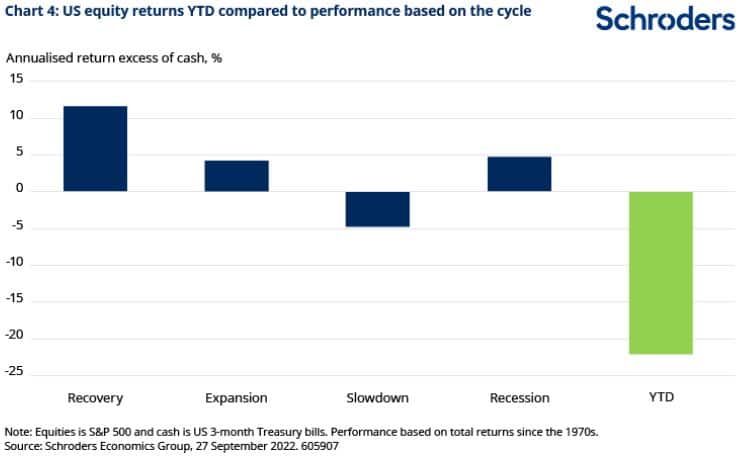
Even the particularly poor performance of markets is typical of a stagflationary environment. The performance of the S&P 500 year-to-date (YTD) is more consistent with past slowdowns as defined by our output gap model (see chart 4, below).

Equities typically suffer during slowdowns as corporate profitability gets hit by weaker growth and rising costs from higher wages and interest rates.

Why This Economic Cycle Is Different4

But the magnitude of equity losses this time around has been greater compared to past slowdowns. Despite robust corporate earnings, valuations have significantly de-rerated.

This is because the high levels of inflation have led to more aggressive expectations of policy tightening by the Fed.

This Cycle Is Proving Rather Different

We’re in rather unusual circumstances in that the contraction in economic activity this year has come after a very sharp recovery in growth from Covid-19 lockdowns. So, macro data has eased back to more normal levels. At the same time, US inflation at 8.5% is usually high relative to past cycles. This has led to comparisons with the stagflationary period of the 1970s as inflation back then surged to record levels prompted by an oil price shock.

Unlike the 1970s, the imbalance between supply and demand for goods, resulting from the Covid-19 pandemic, is the root cause of inflation in this cycle. This has been further exacerbated by the Ukraine-Russia war and the impact on supply chains resulting from China’s zero-Covid policy.

So, it is not straightforward to draw parallels with the 1970s, particularly given the robust labour market (see chart 5, below).

The tightness in the labour market has also been driven by factors resulting from the pandemic. In particular, the decline in the number of workers participating in the labour force.

Firstly, more people in the older cohorts have decided to take up early retirement due to health concerns. Secondly, some workers have chosen to exit the labour force due to a reassessment of priorities such as caring for relatives. Thirdly, long Covid has hit the workforce and according to the Brookings Institute accounts for 15% of 10.6 million unfilled jobs in the US.

Some of these factors could ease over time as higher wages incentivise workers to return to the labour force. But more importantly, the tightening in monetary policy by the Fed to bring inflation back to target should result in a more significant slowdown in growth and a rise in the unemployment rate. This would lead to a return to a more normal economic cycle.

Semblance Of Normality To Return, But Not Quite Yet

We expect some semblance of a normal cycle return in the coming quarters as the US economy goes into recession. Not only would GDP growth likely to be contracting, but the pick-up in the unemployment rate would first lead to the output gap shrinking, then turning negative. Inflation should also have eased from lofty levels.

For investors, it would mean a return to more familiar territory where equities offer attractive valuation opportunities in recessions. At the same time, despite dismal corporate earnings, US stocks have typically been lifted by the re-rating in the market.

This occurs thanks to the central bank cutting interest rates in response to the worsening growth and inflation landscape. We saw with the rally this summer how investors (prematurely) anticipated a Fed ‘pivot’ to a less restrictive policy stance in support of economic growth and its second mandate of maximum employment. This drove a powerful re-rating, which abruptly reversed when Fed chairman Jerome Powell dashed hopes of a looser near-term policy.

He warned that the central bank would ‘keep at it’ in relation to raising interest rates.

We do, however, expect there to be scope for a Fed pivot toward the end of next year as the policy is likely to be eased to counter the impact of a recession.

By Tina Fong, Strategist, Schroders

Crypto Investment: A Very High Risk Game, Are You Sure You’re Up To It?

“Wen lambo?” or “Wen moon” are just some of the phrases that is quite common in the crypto world. It is a way to ask crypto investors on when they are going to get rich with their crypto investment. The misspelling looks cool in a way, but investment is actually serious business.

Crypto investment is considered to be a very high risk investment with a very high potential return, the question is do you really want to invest your hard-earned money into it?

Top 10 Cryptocurrencies Of 2021
Source: https://www.coindesk.com/markets/2021/12/31/here-are-the-top-10-cryptocurrencies-of-2021/

Fancy yourself a return of 16,000% per year? It is possible with crypto investment, in fact there were two cryptos that managed to achieve this staggering return on crypto investment in 2021.

Imagine putting in RM100 in 1st January 2021, your crypto investment would be worth RM16,365 by 31st December 2021. Now imagine investing RM1,000, by the end of the year the crypto investment in The Sandbox will be worth RM163,653.

Sounds too good to be true, right? But that is what happened last year.

99.99% Loss In 2 Days

Collapse Of Luna
Source: https://www.bbc.com/news/technology-61552030

On 9th May 2022, the whole world was shocked when Luna comes crashing down – losing 99.99% percent of its value in just 48 hours. Who would have thought that Luna was once a top 10 cryptocurrency in terms of market capitalisation, would be brought down to its knees in a way that was unimaginable.

Well, that’s crypto for you. You can make big money, and you can also lose it all. We managed to talk to a few financial planners for their advise on crypto investment.

“I won’t advise my clients to invest into crypto investment unless they are higher risk investor and I see they are matured enough for this type of investment. Normally even if they are, we would work out a small portion of their assets or net worth to be invested in alternative investments, which is not more than 10%,” says Ng Ka Hoe, Founder of J Advisory, a personal finance academy.

Ng Ka Hoe J Advisory
Ng Ka Hoe, Founder of J Advisory

Before You Start Investing In Crypto

According to Ka Hoe, he would ensure that his clients understand the following before embarking on their crypto investment:

  • What are the alternative investments’ underlying assets?
  • What are the risk involved?
  • Have they invested into traditional investments such as property, stocks and unit trusts? If they haven’t, why not?

It is important not only for the financial planner to understand what makes their client’s emotional ticks, but it is more important for the client
themselves to know and understand their own emotions, as it is truly the investor’s emotions that makes or breaks their investment.

Don’t Go All In With Crypto

Essentially, crypto assets are assets that are non-income generating but more for the crypto investment objective for capital gain. While it is undeniable that crypto currency has helped make many new millionaires, for this wealth to be sustained into the future, one may want to explore how this new wealth can be protected or kept, so that even if the value of the asset class reverses its course, this person will not be knocked back to the ‘pre-crypto’ life.

“Of course, it is perfectly fine if we remain having 100% of our wealth be invested in crypto assets. However, that will also mean we tie our future
financial health and possibility in life to a single asset class,” opines Kevin Neoh, a licensed financial planner and NextGen Money Coach.

kevin neoh
Kevin Neoh, licensed financial planner and NextGen Money Coach

Don’t Invest In Crypto

Meanwhile there are also opinions on the other side of the fence that warns against investing in crypto.

“Ask yourself when it comes to crypto, are you investing, trading, speculating or gambling?” says John Chan, CEO of YES Financial, a financial advisory firm.

John Chan Yes Financial4
John Chan, CEO of YES Financial

Apparently, we ourselves are confused with the terms. Trading or investing in crypto may incur a significant level of risk, even worse if you are using an unregulated or an unlicensed platform.

Conventionally, when a person is betting on horse racing, they will tell you all sorts of stories and logic with regards to horse riding. When a person is speculating on crypto, they may tell you all kinds of fintech and futuristic tech stories about blockchain or even the recent hot topic of Metaverse and NFTs to push up prices.

In conventional gambling, there are licensed casino and the underground operators. Why do some governments grant casino a license? The most common reasons are due to profit making, demand and the need to safeguard public interest through monitoring and control.

The Myth Behind Decentralisation

Everyone wants to have freedom, and nobody likes to be controlled. Some level of freedom is good but it would be a disaster if there is absolute freedom.

Imagine that you are living in a place with no government in power What would be the scenario?

“When there is no effective government, there are bound to be warlords or mafias controlling the area. Is it a safe place to stay then?” mentions John.

Instead, there would be chaos all over as everyone will be fighting for power.

Scarcity, Really?

Bitcoin is called Digital Gold as there is a maximum supply of 21 million Bitcoins. This means that Bitcoin has a unique feature of scarcity. This is
where people seem to illustrate the scarcity of Bitcoin to Gold, as there is a limited supply of Gold available on our planet.

However, gold exist and play its role in civilization since ancient times as precious metal, jewelleries, commodity, storage of value, medium of transfer, barter trade, technology components, currencies etc. It is kept by government and central banks as reserves.

“Gold is a natural resources and is not created by human beings. Unlike cryptocurrencies that are created by humans and there are now more than
19,000 cryptocurrencies in existence,” shares John.

Ask yourself, is ‘scarcity’ real then?

Crypto As Legal Tender?

According to BIS Annual Economic Report 2018, for cryptocurrencies with decentralised trust model such as Bitcoin, each user needs to download and verify the history of all transactions ever made. This has the effect of slowing down transaction processing time, making it not scalable to facilitate day-to-day retail payments.

Compared to major international cards networks which is able to process 2,000 to 3,500 transactions per second, Bitcoin is only able to process 3.3 transactions per second.

“Most cryptocurrencies are not likely to be used as payment instruments primarily because they do not exhibit the universal characteristic of money. Not to mention the price volatility, vulnerability to cyber attack, lack of scalability, not a good store of value, payment method and medium of exchange,” John emphasized.

As of March 2022, 87 countries are exploring the issuing of Central Bank Digital Currency (CBDC), according to the Atlantic Council. While CBDC may
adopt blockchain or Distributed Ledger Technology (DLT), CBDC differs from normal crypto as CBDC is legal tender and is backed by a claim on the central bank. Unlike cryptos that are not legal tender and have no intrinsic value.

Bank Negara Financial Sector Blueprint 2022-2026 stated that they are looking into CBDC through multiyear exploration, starting with Phase One via Project Dunbar.

Comparison Of CBDC Stablecoins And Non Backed Digital Assets
Comparison of CBDC, stablecoins and non-backed digital assets. Source: Financial Stability Board (2020), “Enhancing Cross-Border Payment
System: Stage 1 Assessment Report to G20”

Asset Allocation Is Important

At the end of the day, there is no one investment that suits everyone. It will be best if you diversify your investments into several asset classes, such as stocks, properties, unit trusts, robo-advisors, fixed deposits, bonds etc.

There should be a mixture of low risk investments with low returns, some in medium risk investments with medium returns, and some in high risk
investments with high returns such as crypto investment. Because you never know with crypto, you can go big but you can also go home with nothing.

Is It Relevant To Be Investing In Uncertain Times?

Think about it. When are times ever ‘easy’? At the time of writing, we face inflation, COVID-19, wars, trade tensions, the ups and downs in interest
rates, currency exchange rates, and commodity prices.

On top of all that, there is the ever-evolving political, economic, and social instability around
the world. It only makes sense to say that ‘uncertainties’ is a certainty in present times.

So, is it still relevant to be investing in uncertain times?

Well, it depends. Some may react by not investing altogether. But that approach is likened to an ostrich burying its head in sand. It is impractical. Today, the awareness to invest has largely increased among the general public.

However, investors may lack a plan to navigate their investments through the stormy seas of the markets today.

Here, I have observed two different approaches to navigating the market and investing in uncertain times. They resulted from having a different mindset towards investing.

Read: 5 Investing Mistakes to Avoid During a Downturn

Let me explain:

Approach 1: Market Predictions

This refers to investors who believe that wealth is about having more money. To them, if they invest in an investment, be it stocks, properties, ETFs, cryptos, so on and so forth, and its price had appreciated, they will consider it to be a good investment.

If its price had fallen, it would be deemed as a failure. Thus, it is common for them to measure investment success based on the following:

Price Goes Up = Good Investment

Price Comes Down = Bad Investment

Hence, they tend to invest during good times, as prices of investments tend to rise in line with heightening optimism. Also, they would avoid investing in uncertain times due to falling investment prices. Some would sell off investments as they have a pessimistic outlook on the future.

In extreme cases, this could lead to manias and panics in the investment markets. Basically, their guiding principle is to buy in good times, sell in bad times.

So, how do they know where the market is heading in the future?

Well, the answer is to try predict the markets. Many would speculate. Some will be checking on the macros and technicalities if they are more sophisticated.

Generally speaking, they are always trying to find the ‘best time’ to invest or to dispose of their investments. To me, that is trading or speculating.

If you are in this group, you will always be anticipating if today or tomorrow may be a ‘better time’ to invest. Even after you have invested, you would always want to find out when would be the ‘best time’ for you to sell off your investments.

That is not my approach when it comes to investing in uncertain times.

Read: Are High-Risk Investments Suitable For Me?

Approach 2: Income Productivity

Unlike the aforementioned approach, this group of investors believe that wealth is about owning assets that are income-productive. Thus, the measure of investment success would be based on the income productivity of the assets.

The more income they produce over time, the more successful the investment.

Income Rises Over Time = Good Investment

Income Falls Over Time = Bad Investment

For this group of investors, they are focused on the assets’ fundamental quality. They want to know if the asset can generate more income in good and bad times.

To them, it does not matter if the stock market, the economy, the Ringgit and the interest rates are going up or down. What matters is this: Is the asset in consideration profitable and sustainable in all economic conditions, particularly in tough times?

By focusing on income productivity, this group of investors would tend to invest differently from the market predictors. Normally, in good times when asset prices are rising, this group of investors would have difficulty in finding income productive assets that are offered at attractive valuation.

Thus, they invest less in good times. This would be different in tough times when asset prices are falling. In this situation, this group of investors will have an easier time acquiring such assets at discounted prices. So, they invest more in bad times.

Therefore: “The answer lies in your belief system when it comes to investing in uncertain times.”

Buy Less / Don’t Buy = Good Times

Buy More = Bad Times

If you are in this group, you would have less tendency to do market predictions. Instead, your focus is on the asset’s fundamental qualities and its valuation, which makes predicting market movements irrelevant.

So, should you be investing in uncertain times?

The answer lies in your belief system when it comes to investing. As for myself, my interest is in the accumulation of fundamentally strong stocks, if they are offered at attractive valuations. This is because I believe wealth is about the income productivity of my assets and thus I had invested accordingly.

If your beliefs on wealth are different from mine, you would invest differently. Ultimately, it is up to you to be navigating the market and be smart when it comes to investing in uncertain times.

Read: 9 Reasons Why You Should Invest For Dividend Yields

About the Author

Ian Tai Edited

Ian Tai, Financial Content Machine. Dividend Investor. Produced 200+ Financial Articles featured in KCLau.com in Malaysia. Co-Founded DividendVault.com, an online membership site that empowers retail investors to build a stock portfolio that pays rising dividends year after year in Malaysia and Singapore.

6 Ways To Manage Overthinking

One survey from the University of Michigan indicated that 73% of adults between the ages of 22 and 35 overthink, and 52% of 45 to 55-year-olds do too. While it is important to engage in thinking in our work, overthinking on the other hand affects our effectiveness in getting things done. 

What is overthinking and what are some of the ways to manage overthinking? Overthinking is a process where people engage in excessive thinking to the extent that it impedes their actions and productive results.  It becomes a justification for procrastination and inaction.  

On the surface, it would seem legit for one to gather more information for analysis prior to making a decision and taking action. However prolonged thinking and rethinking can be a wasteful habit and can stop people in their tracks. 

The way forward is to strike a healthy balance between thinking and action.  To do that we need to come up with effective strategies to avoid overthinking and engage in the right thinking and take the right actions to achieve the desired results.

Over the last 25 years in leading various projects in my consulting work for organizations, I have developed a framework to ensure that our team avoids overthinking but engages in productive thinking to enable practical execution to achieve the desired results.

Let’s check out some of the ways to manage overthinking.

6 Ways To Manage Overthinking

1. Set A Time Frame

Close Up Businessman Looking His Modern Wristwatch

To ensure that we do not get into paralysis by analysis mode, we need to  set a clear time framework for various tasks such as gathering information, analysis and diagnosis, decision-making, recommendations, and a clear action plan with specific measurable goals and deadlines.

Having a clear time frame is important and requires one to be more practical and balanced without getting carried away with a long engagement in one task that one loves to do more than others. It is not uncommon that some leaders love to debate over the smallest of stuff which is often more intellectual than practical.  

There are many root-causes of why some leaders engage in overthinking. Some are perfectionists who are never contented until they explore everything to the fullest. Others lack courage in making decisions, so they avoid them by prolonging thinking and analyzing. 

By setting a deadline for each task in each of the phases of work, one becomes compelled to move forward without being stuck in the thinking phase. This is certainly one of the ways to manage overthinking that you can try.

2. Ascertain The Necessary Information

There is no end to getting more information. It will be useful to choose the criteria needed to make a  good decision and then go about collecting information about them. 

The more data and information we collect, the more analysis and thinking will be involved. We do not live in a perfect world where we can have all the information needed to draw a perfect conclusion.  

One of the ways to manage overthinking is by making sure we need adequate information that enable us to make a reasonable decision to move forward. Often more information creates overload and crowds one’s thinking. What is needed is relevant information to help make a sound conclusion that is directive enough to spell out the correct actions to be taken.

3. Analyze To Come To A Decision

Top Viewtop View Manager Employee Doing Teamwork Business Office Looking Charts Laptop Display

One needs to be aware that we need not reinvent the wheel. We only need analyze the information to achieve better understanding in the areas that lack clarity. In those areas in which we are already clear, there is no need for more analysis. 

The purpose of our thinking and analysis is to help make a decision. It should not be analysis for analysis’ sake. A better way is to set specific areas where clear decisions need to be made. Then go ahead with  the thinking and analysis to arrive at those decisions.  

4. Moving From Negativity To Positivity

A lot of overthinking may arise from negative mindsets with constant worrying about the past as well as concerns about the future. Often worrying about what could go wrong will get one to stall under the pretext of waiting for more information or analysis.   

Too much negativity will certainly dampen one’s courage to take action. Many would  justify that  in view of the risks of what could go wrong, they need more thinking and rethinking on various issues. While a little caution with an exploration of contingencies is a good measure, taking an over-cautious stance with great doses of pessimism will wreak havoc on good decision-making.  

Worrying forward leads to overthinking which is just creating problems that do not even exist. One of the ways to manage overthinking is by moving from what could go wrong to what could go right with the right strategies is a good way to move out of overthinking.

5. Execute To Achieve Productive Results

Close Up Two Runners City

Thinking and more thinking would not create results. The missing link in most organizations is concrete actions. There are many leaders who love to have meetings after meetings to discuss over many things. The ills of overthinking are that they create a comfortable habit of inaction. 

Inaction provides temporary refuge and comfort but over time it dents the credibility of leaders as they are eventually judged by the results they achieve. Without execution, there will be no results and without results, a leader is deemed to have failed.

In one of the ways to manage overthinking, is to execute what was planned.

6. Recognise And Reward Results

To discourage people from engaging in overthinking, organizations should realign their recognition and rewards towards result based. Assessing one’s work based on concrete and measurable results directly or indirectly is a good way to get people to move from overthinking to taking the right actions to get the desired results.

So there you have it, some of the ways to manage overthinking.

You need to stop overthinking, be a realist and not a perfectionist. Focus on getting things you want to be done right instead of things that could be done wrong. 

About the Author

Dr Victor Portrait1

Dr. Victor SL Tan is the CEO of KL Strategic Change Consulting Group.  He undertakes change management consulting and training. He is also the author of 14 management books. His bestseller books include Leading Positive & Productive Change and The Secret of Change. For more information email him at victorsltan@klscc.com or contact him at 012-3903168.