This is one of the most heated debate in the financial industry, saving vs investing. Before we get into it, let’s first take a look at the definition of saving and investing.
“Saving is income not spent, or deferred consumption. Methods of saving include putting money aside in, for example, a deposit account, a pension account, an investment fund, or as cash. Saving also involves reducing expenditures, such as recurring costs.”
-Wikipedia
Saving is your income, either from your monthly salary or sales commission, being put aside somewhere. This could be in your savings account or cash.
“Investment is the dedication of an asset to attain an increase in value over a period of time. Investment requires a sacrifice of some present asset, such as time, money, or effort.”
-Wikipedia
Whereas investing is putting in your money in an instrument where you can watch it grow. The longer you invest, the bigger returns from your investment.
Saving vs Investing
As you can see from the above, you won’t be able to invest if you don’t have money in the first place. Which also means that if you don’t have any savings, then you can’t invest.
And did you know that according to statistics, 75% of Malaysians can’t even come out with RM1,000 for any emergency? The culture of saving is sorely missing in our community.
In case anything untoward happens such as meeting with an accident, car repairs, or dengue fever which requires hospitalization, then you may have to resort to borrowing money from family members or friends. Worse if there’s no one to help, then you turn to ‘ah long’ and be trapped in a vicious cycle.
So in the case of saving vs investing, make sure you have sufficient savings first.
RM5.2 Billion Lost To Scammers
According to the Inspector-General of Police, Tan Sri Acryl Sani Abdullah Sani, there were 71,833 fraud cases recorded since 2020 until May 2022, with a loss amounting to RM5.2 billion.
Hang on a minute, but didn’t you say that Malaysians don’t save but they have tons of money to invest, and ultimately gets scammed in the process?
It goes to show how poor we are in managing our finances. We don’t have savings, and we invest in investment that is not legitimate or scams. When we lose it all to scammers, then we don’t have anything to fall back on – because we don’t have any savings.
Of course everyone wants the fastest way to getting rich, myself included. But bear in mind that investment should be a long-term game. For example you want to build up your retirement fund, and you have 30 years until you hit the retirement age of 60. That means you have time on your side, and still can afford to make mistakes.
Compared with someone in his 50’s and have less than 10 years to retire, he/she needs to invest for a shorter time period and take lesser risk.
So again, get your priorities right when it comes to saving vs investing.
Save Before Invest
That’s why you need to get your priorities right. Save at least 3-6 months of your monthly salary. If your salary is RM5,000 per month, have at least RM15,000 in an emergency fund for rainy days ahead. Best if you can have RM30,000, to better prepare for any emergencies.
If there’s anything that the pandemic has shown us, is that no plan can prepare us for something of that magnitude. Even if you have done the necessary preparation, you should still feel the effects of it.
Let alone those who didn’t have any savings. Thankfully the government came out with many schemes to help us out.
Now you know what to do when faced with the dilemma of saving vs investing?
Invest In A Diversified Portfolio
I’m sure we all have heard of the phrase, “High risk high return”. Which literally means that in order to get a high return, you need to take a high risk.
And I’m also pretty sure that you have heard of “Don’t put all your eggs in one basket”.
Combine the two of them, and you should be investing in a diversified portfolio – some in low-risk instruments (with low returns) such as fixed deposits or money market funds, some in medium-risk instruments (with medium returns) such as unit trust or property, and some in high-risk instruments (with high returns) such as stocks and crypto.
By having a diversified portfolio, should any ‘basket’ were to fall and break all the eggs inside it, you will still have other basket of eggs that can compensate for your loss.
But in the case of saving vs investing – make sure you have some savings first before deciding to invest.
What About The Upcoming Recession Next Year?
In a recent survey on saving vs investing that was carried out by Palindrome Communications, 40 percent of respondents said that they thought that investing is more important in a recession than holding on to cash. 60 percent of the respondents said that holding on to cash is more important than investing.
The data displayed a cautious sentiment among professionals in Malaysia as we head into what might possibly be an upcoming recession. Respondents were made up completely of professionals in the fintech and tech sectors.
Palindrome helps finance companies communicate more effectively in the market. More info here.
Over the years, Malaysian corporations have grown and expanded their business footprint, not only to neighbouring countries, but also to other continents in many parts of the world. It is not uncommon to see many Malaysian companies receiving income from their business and investment ventures in foreign countries, hence we need to understand about the issue of tax on foreign income.
These income sources include sales from exports of goods and services, dividends and interest income from foreign investments, royalty fees from licensing of intangible assets, rental from properties located overseas, and commission from acting as agents.
Generally, income received from out of Malaysia has been exempted from tax. However, in the Budget 2022, the Government announced removal of the tax exemptions on such income.
The rationale quoted for the removal, other than a measure by the Government to raise revenue collection, is that it is a step taken by the country to comply with the global tax standards on harmful tax practices.
Tax On Foreign Income
Malaysia adopts a territorial principle of taxation in that only income accruing in or derived from or received in Malaysia from outside Malaysia, is subject to income tax in Malaysia pursuant to Section 3 of the Income Tax Act, 1967 (ITA). Nevertheless, Malaysian tax residents enjoy tax exemption on the “income received in Malaysia, from outside Malaysia”, also called foreign sourced income (FSI), under Paragraph 28, Schedule 6 of the ITA (Para 8).
In short, while the FSI received by Malaysian tax residents are taxable under the Section 3 of ITA, the amount are exempted under Para 28. (Note: the exemption excludes those engaged in banking, insurance or sea or air transport businesses)
However, not all FSI income received are exempted as it has to be truly “sourced from outside Malaysia”.
Generally, whether the income is sourced within or outside Malaysia would depend on the location where the related income-generating activities had taken place. For example, export sales of goods by a trader are not exempted because the personnel who carried out the various business functions are located in Malaysia.
In contrast, it is argued that interest income from investment funds placed and managed outside the country is foreign sourced and thus, exempt under Para 28.
Tax Treatment On FSI From 1 January 2022
Effective 1 January 2022, the tax exemption for FSI received by Malaysian residents provided for under Para 28 was removed, following the Budget 2022 made on 29 October 2021. The implementation of the legislation is staggered into two remittance timeline of FSI into Malaysia:
January to June 2022 @ 3%:
Taxpayers are given this 6-months transitional period to remit their foreign sourced income in order to enjoy the lower tax on foreign income rate of 3% calculated on the gross income remitted (Part XX, Schedule 1 of the ITA)
Subsequent to 30 June 2022:
Remittance will be subjected to the normal tax rates.
In summary, the tax treatments for the income of a person residing in Malaysia are depicted as follows:
Special Remittance Programme Terminated
In November 2021, the Inland Revenue Board of Malaysia (IRBM) introduced the Special Income Remittance Programme (Program Khas Peremitan Pendapatan or PKPP) to help taxpayers in the transition to the new FSI regime.
The FSI remitted during the PKPP period (between 1 January 2022 and 30 June 2022) would be accepted in good faith by the IRB without any audit nor investigation be conducted on the taxpayer. In addition, there will be no penalties imposed for the remittance during the PKPP period.
However, this programme is shortlived and was revoked on 11 March 2022, as it is deemed not relevant, after the Ministry of Finance (MOF) announced in December 2021 on a concession to exempt certain categories of FSI for a period of five years from 2022 to 2026.
Concession: 1 January 2022 – 31 December 2026
The removal of exemption under Para 28 has been highly debated and criticised with regard to, among others, its timeliness of implementation, vagueness on the scope of FSI, and lack of clarity on claiming of double tax relief if the income had suffered foreign tax.
It is also seen as a stumbling block to attract foreign direct investment (FDI) in Malaysia, thus affecting Malaysia’s competitive position in the global trade map.
On 30 December 2021, MOF made an announcement to defer the full implementation of the new Para 28 to 1 January 2027. The official rules were issued by the Government by way of exemption orders dated 19 July 2022, in the Income Tax (Exemption) (No.5) Order 2022 and Income Tax (Exemption) (No.6) Order 2022 (“Exemption Orders”), applicable to individuals, partners in conventional partnerships, limited liability partnerships (LLP) and companies.
The exemption period granted is from 1 January 2022 to 31 December 2026.
Individuals are exempted on all categories of income including income from employment, dividend, rental and interest. Meanwhile companies and LLPs are exempted on foreign dividend income only.
However, there are the preconditions set in the Exemption Orders to qualify for the exemption during the fi ve years concession period, whereby:
FSIs received by individuals, LLPs and companies “shall have been subjected to tax of a similar character to income tax under the law of the territory which the income arises”.
For foreign dividends received by individuals from conventional partnerships, LLPs and companies, the added condition is that “the highest rate of tax of a similar character to income tax charged under the law of the territory which the income arises at that time is not less than 15%”.
IRBM is to issue the relevant guidelines on the applicable tax treatments, which are yet available at the time of writing. Clearly, taxpayers will need to meet certain conditions to enjoy the tax exemption during the five years concession period as it may not be as straight forward to qualify.
The limelight is now on the IRBM to expedite the issuance of the relevant guidelines, which are expected to provide the much-needed administrative details surrounding the reporting of FSI, including documents required to provide evidence for exemption of FSI, tax calculations of non-exempt FSI, the claiming of double taxation relief on FSI, especially foreign dividends, etc.
Tax Exemption Of FSI From 1 January 2022 To 31 December 2026
Taxable FSI Received By Corporate Investors
For now, FSI other than dividend income received by Malaysian corporate tax residents will be subject to tax in Malaysia. Notably, where the foreign dividends are received by a legal corporate structure other than a company incorporated under the Companies Act 2016, there is no exemption provided during the 5 years period on the income.
A list of the more common situations of tax on foreign income is set out below:
Common Situation Of Taxable FSI
Double Tax Relief On Foreign Tax Suffered
The tax on foreign income received in Malaysia may be reduced by the foreign tax credit paid. Where a Malaysia tax resident has suffered foreign tax on the FSI, the taxpayer is given bilateral or unilateral tax credit relief against the Malaysian tax payable on the same FSI.
Bilateral relief is given under Section 132 of the ITA when the foreign country has a double tax agreement with Malaysia eg Singapore, Indonesia, Japan, China, Australia, South Africa, United Kingdom, France, etc. Under a double tax agreement, a full relief may be possible based on the calculation of a prescribed formula, but the relief amount is only up to the Malaysian tax suffered.
On the other hand, unilateral relief is given under Section 133 of the ITA when there is no or limited double tax agreement by Malaysia with the foreign country eg British Virgin Islands, Taiwan, United States of America, etc. For such relief, the foreign tax recognised is automatically halved.
One is required to substantiate the amount of tax paid overseas with the relevant supporting documents from the tax authorities in the foreign countries, in order to claim the aforementioned tax relief in their tax return.
Capital Receipts Are Non-Taxable
The tax on foreign income will only affect gains that are “income” in nature. Receipts that are “capital” in nature (also known as capital gains) will not be subject to Malaysian tax. Capital gains include proceeds from the disposal of foreign stocks, foreign properties, foreign assets, foreign currencies, and foreign investment papers. However, these assets have been held as long-term investments.
Whether the gains are “income” or “capital” in nature, the onus of proof lies with the taxpayers. If the remittances are found to be income in nature instead of capital as claimed by the taxpayers, the same shall be subject to income tax.
Action Plan
The year 2022 marks an impact on investors with foreign asset holdings, in navigating a new tax landscape going forward with the removal of tax exemption under Para 28. The imminent measures include evaluation of the financial returns on their existing overseas investments, net of all tax costs. In sourcing new investment opportunities overseas, such investors shall need to factor in the additional tax costs in Malaysia.
Here are a few suggestions on the action that affected investors should look into:
1) Review the Malaysian tax impacts on all taxable FSI from investments outside Malaysia- tax simulations may be useful for the investment selection process.
2) Maintain proper records of the foreign assets, including tracking of the funds retained in foreign bank accounts vis-à-vis those repatriated to Malaysia. On the amount remitted into Malaysia, ascertain the nature as to whether they belong to “income” or “capital”, which will have different tax implications.
3) Where the funds are mixed, distinguish between foreign source income and domestic source income for proper reporting of taxable income for Malaysian tax purposes.
4) Conduct a comprehensive review of the current investment structure and strategise the most optimal approach to undertake future investments. This review may involve international tax planning to mitigate tax exposure involving multiple countries.
5) Examine the existing intercompany loans and undertake possible steps, including debt restructuring exercises, or rescheduling repayments to reduce the tax impact on remittance of interest income into Malaysia. On this note, any proposed changes will need to include transfer pricing considerations to avoid tax pitfalls in the future.
If guidance is required on the issue of tax on foreign income, consider seeking professional advice from a tax consultant. This would help you avoid stepping into potential tax landmines that could be uncovered in the future, when the company is audited by the IRBM.
The renminbi has depreciated by about 8% against the US dollar so far this year and, at RMB6.96 per US dollar, is already homing in on our year-end target of RMB7 per US dollar.
China’s central bank, the People’s Bank of China (PBoC), has begun to resist further depreciation, cutting its reserve requirement by two percentage points to 6% last week and setting the daily fix for the official exchange rate at stronger-than-expected rates in recent days. But with the US dollar still surging and probable recessions in most developed markets set to weigh heavily on external demand, there is a clear risk that the exchange will overshoot to somewhere in the region of RMB 7.10-7.20 per US dollar.
A weaker renminbi is often associated with delivering a deflationary impulse to the rest of the world. After all, as the currency depreciates, imports of Chinese goods become cheaper for the rest of the world. So has the recent depreciation of the renminbi relieved pressure on global central banks in their quest to tame inflation?
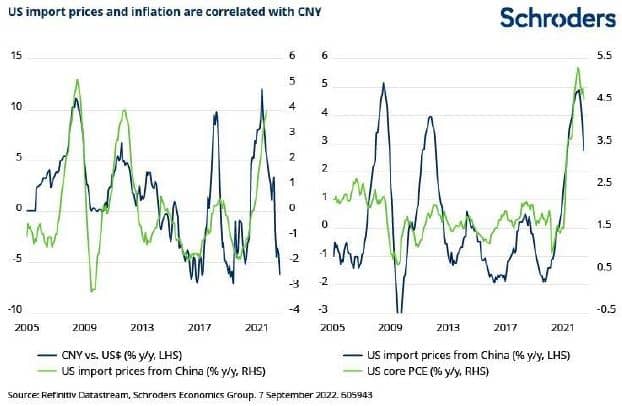
There certainly does appear to be a link between movements in the renminbi and rates of inflation experienced by its trading partners. For example, as the charts below show, US import prices from China fluctuate with the exchange rate. And these import prices are closely correlated with core goods inflation in the US. This makes intuitive sense, and similar relationships are observed in other economies, such as the eurozone.
However, there are a couple of reasons to doubt that renminbi depreciation has solved the global inflation crisis.
For a start, the correlation between currency movements and prices only applies to the core goods portion of inflation in other countries.
The renminbi has no major impact on other key drivers such as owners equivalent rent, local services or indeed international commodity prices, all of which account for the bulk of inflation in markets such as the US.
As such, the relationship between the renminbi and headline inflation, in this instance in the US, is relatively weak, with several periods of currency volatility failing to follow through into headline inflation.
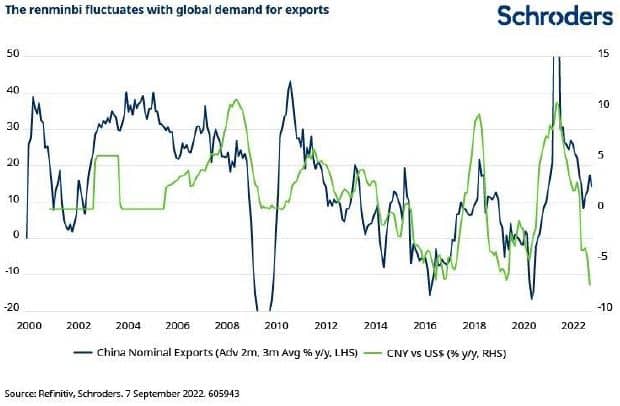
More generally, we need to be careful about assuming that correlation means causation. After all, the renminbi tends to be very cyclical. When exports are growing strongly, the currency tends to appreciate, and when exports are coming off – as is the case now – the currency tends to depreciate. And, of course, when global demand is strong, China’s exports are performing well, and the renminbi appreciates, firms can pass on higher costs to consumers and fuel inflation.
On this basis, global inflation dynamics are still a function of the strength of demand and movements in the renminbi are largely a by-product of its impact on trade. Indeed, an expected slowdown in exports as demand for manufactured goods softened has been a key reason for our bearish view of the renminbi since the start of the year.
The upshot is that, barring an unlikely large one-off depreciation, the weaker renminbi neither significantly changes global inflation dynamics nor needs developed market central banks to keep raising interest rates.
About the Author
David Rees, Senior Emerging Markets Economist, Schroders
Investment is a very hot topic among us Malaysians. If there’s one investment that has been picking up in recent years, it is peer-to-peer financing, or better known as P2P financing.
In a nutshell, P2P financing – a type of digital financing – is an alternative financing raised through crowdfunding that allows businesses to get financing from individuals via a digital platform. Smart Investor speaks to Chai Kien Poon, Country Head of Funding Societies Malaysia, the largest SME digital financing platform in Southeast Asia.
Inflation Is Rising Fast
Chai Kien Poon, Country Head of Funding Societies Malaysia
Investors and businesses alike are facing great challenges due rising inflation. Latest figures show that Malaysia’s inflation has increased by 3.4% to 127.4 in June 2022 from 123.2 in the same month of the preceding year. The Food Index has increased by 6.1% and remained as the main contributor to the rise in inflation during the month of June 2022. This results in a lower purchasing power and greater pressure to increase one’s income.
Concerns surrounding inflation are coupled with the heightened uncertainties brought forward by geopolitical conflicts and other global issues. Hence, investment diversification is more crucial than ever to maintain a stable portfolio.
“The P2P financing, or SME digital financing portfolios, are not publicly traded and hence, sheltered from daily market fluctuations. SMEs will still be making fixed repayments regardless of short term FTSE Bursa Malaysia KLCI movements or interest rate fluctuations,” Chai says.
With a variety of SME debt investments offered on digital financing platforms, it can cater to investors with different investment objectives and risk appetites. It is a win-win situation too, as investors will be able to directly support local SMEs needing additional working capital for further growth or meet cash flow requirements, and earn returns.
“Businesses can expect a more challenging period ahead, driven by persistent supply chain disruptions, inflation (rising wage and materials costs) and longer repayment cycle from customers. This has put pressure on margins (as cost increases while consumers lose purchasing power) and impacted cash flows,” says Chai.
To some extent, a rising rate environment also leads to higher monthly payments (for variable rates financing), adversely impacting SMEs’ overall expenses and pose a threat to their cash flow. Moving forward, lenders such as traditional financial institutions may also tighten their lending criteria.
Subsequently, this will lead to a larger group of creditworthy SMEs to be further underserved, or unserved as the already significant SME financing gap continues to widen during this critical moment as businesses return to their full economic potential.
Why Should Malaysians Invest In Digital Financing?
“Malaysians are more familiar with equity investments: stock market, unit trusts, etc. On Bursa Malaysia, there are about 1,200 publicly listed companies being traded,” shares Chai.
“In contrast, there are 1.2 million micro, small and medium enterprises (MSMEs) in the country, and a huge bulk of these numbers are always looking for financing opportunities to fulfill their business obligations and objectives.”
These underserved, yet creditworthy MSMEs turn to Funding Societies to seek tailored financing solutions for their businesses. They represent a large volume of potential transactions which investors can invest in, and receive the principal invested plus returns upon the maturity or repayment of the financing facilities.
To protect investors, rigorous rounds of background checks are performed based on proprietary evaluation matrices before approval for financing, while simultaneously raising the investment notes for investors.
As we are now in a period of heightened uncertainty, Funding Societies is constantly innovating to offer more investment products to meet the needs of investors’ investment objectives and risk appetite across business cycles.
Its recently launched Guaranteed Investment Notes (GIN) offer more consistent (albeit lower returns), where the non-repayment or default risk are guaranteed by an appointed guaranteeing entity instead of the investors themselves. This may appeal to investors having a more cautious outlook in the short to medium time horizon.
By having less disposable income, we will be more cautious with our investment – often looking for the diamonds in the rough. So, how well are the businesses being filtered before they are on-boarded onto the digital financing platform?
“When SMEs submit an application through the digital platform, they will be assessed through our Know-Your-Clients (KYC) process that identifies and validates the SME’s existence and business, and its proprietors or directors,” Chai explains.
Credit and risk assessment on an SME is based on a combination of factors which includes financials, nonfinancials, and behavioral data. A risk rating will then be generated for each SME. Only qualified SMEs will be placed on Funding Societies’ platform for the crowdfunding process. A
s for investors, the investments start from as low as RM100 per note. To help investors build a diversified portfolio, investors can limit their exposure to each SME on the platform via the website and mobile application.
Moreover, investors are also provided with a factsheet which they can refer to evaluate the investment opportunities further. These factsheets include information like tenure, paid-up capital, SME credit score, payment behavior, entity type, and number of guarantors.
Digital Financing Is Booming
Launched in 2015, Funding Societies has been doing very well and has since achieved a lot of success. Some of their notable milestones within this year include crossing the RM1 billion in financing disbursement in Malaysia, its multi-million Series C+ fundraise, its investment in Indonesia’s Bank Index, its expansion into Vietnam as the Group’s latest market entry, as well as its acquisition of regional payment solutions provider, CardUp.
Along with these accomplishments, Funding Societies Malaysia also introduced more new products including the Islamic Trade Financing and BizFund, an enhanced SME-focused term financing product. In terms of businesses, the digital financing platform saw more than 60% increase in MSMEs compared to the same period in 2021. During the same period, total disbursements also grew by more than 60% compared to the same period last year.
As for investors, in the first half of 2022, there was around 10% increase in investors compared to the first half of 2021. Over 60% of its investors comprise Millennials and Gen Zs, with more than 40% of the investors are based in the Klang Valley.
In just seven years, the platform has helped finance over five million business deals, with over RM11 billion in funding. What is even greater, Funding Societies’ default rate remains stable – between 2% to 3% – despite having to navigate the pandemic for the past few years.
Minimising Risks While Maximising Gains
Rainbow Chan
The ‘high risk, high return’ concept rings true when it comes to investment. But with technology on our side, here’s what existing investors have to say about digital financing investment:
“I wanted to diversify into a more convenient asset class, something which I can monitor using a device. After investing through Funding Societies, I find it to be a platform that empowers users to direct their own funds, minimise risks, while maximising the gains. Returns are predictable and stable, such as with the Guaranteed Investment Notes (GIN). Funding Societies is a great place to start your second stream of income without much hassle or big capital,” says investor, Rainbow Chan.
Getting The Much-Needed Capital Without Much Hassle
As for the SMEs, digital financing has certainly helped in getting capital in a much easier and faster way.
“We saw an increase in our sales during the pandemic and needed to increase our inventory to cater to these demands. Having been turned down by traditional financial institutions, we turned to Funding Societies for a term financing. We found the application process to be smooth and seamless and we were able to receive the capital that we needed to replenish our stocks quite fast,” say Abdul Hadi Wisman, Co-Founder & CEO of Sellection Sdn Bhd, a 5-year-old e-Commerce retailer selling imported branded handbags and leather accessories.
Looking For Guaranteed Returns?
Going forward, Funding Societies intends on focusing on providing more Guaranteed Investment Notes (GIN) for investors. GIN is Funding Societies’ first investment product that provides investors with guaranteed principal and interest returns on their investments.
Investors can start with a minimum investment amount of RM100 for a duration of between one to 24 months. GIN investors can enjoy net returns of up to 6% per annum before fees.
The platform is also looking to expand their offerings to include Shariah-compliant financing and investment opportunities. Following the launch of its Islamic trade financing facility in May, there were encouraging responses and high demand on the expansion of Shariah-compliant products, both from the SMEs as well as investors’ sides.
This is in line with the Islamic ECF and financing markets’ performance last year, which saw RM225.9 million being raised. For comparison, only RM1.5 million was raised through this avenue in the previous year.
For those on the lookout to diversify their investments and are considering alternative investment options, it is definitely worth taking a closer look at what digital financing has to offer. Just make sure you do your due diligence and understand the risks involved before diving in. Perhaps start small, just to get your feet wet, and take it from there.
Each year in October, the global financial planning profession comes together to help raise awareness of financial literacy, the importance of having a financial plan, and working with a trusted financial planner to formulate plans towards one’s long and short-term financial goals for financial stability.
Smart Investor takes a look at the current state of financial literacy in Malaysia, how the past two pandemic-fueled years have impacted Malaysians, and why a financial planner is an invaluable ally in working towards your financial goals.
Tough Times Called For Financial Stability
Vincent Kwo, President of the Malaysian Financial Planning Council (MFPC)
“The recent pandemic drove home the fact that financial planning and literacy are essentials, not options. This came about as many people lost their income unexpectedly and matters were made worse for those who did not have a comprehensive financial plan. Unfortunately, financial literacy is very low among Malaysians,” says Vincent Kwo, President of the Malaysian Financial Planning Council (MFPC).
Furthermore, Kwo reveals that, “Various studies, including the Capital Market Development Fund (CMDF) report on Financial Literacy and Utilisation of Financial Advisory Services in Malaysia, reveal that Malaysians generally have a worrying low financial capability, do not know how to manage their money, and do not plan ahead. This does not bode well for their financial sustainability, making them prone to falling into the bankruptcy trap, and becoming prey to loan sharks and get-rich-quick scams. The problems arising from the low level of financial literacy have been magnified by the recent pandemic, which greatly affected the financial well-being of many Malaysians.”
As the body representing financial planning and service providers, MFPC’s objectives – along with developing and enhancing the financial planning profession in the country – include elevating financial literacy among Malaysians with various initiatives for the public at no cost.
One of the initiatives of note to promote financial planning and literacy, observed globally on 6 October each year, is World Financial Planning Day (WFPD). This year’s theme, ‘Live Your Today, Plan Your Tomorrow’, is very relevant to Malaysians as we continue to face various challenges requiring better financial literacy and planning for a better financial stability.
Ooi Beng Cheang, Financial Literacy Manager at the Financial Planning Association of Malaysia (FPAM)
“As we live with post-COVID challenges, many are now faced with uncertainties as they might have drained their EPF savings, facing difficulty in servicing their loans again after the end of the moratoriums, dealing with rising healthcare costs, and overall inflation causing cost of living to rise. Adjustments must be made to our current personal finances to adapt to these challenges for us to achieve our future goals,” explains Ooi Beng Cheang, Financial Literacy Manager at the Financial Planning Association of Malaysia (FPAM).
As an affiliate of the Financial Planning Standards Board (FPSB), the global organizer of WFPD, FPAM has rallied its stakeholders and financial planners to take part in this year’s WFPD2022 to promote financial literacy and the financial planning industry.
Licensed Financial Planners Are Here To Help
In the forest of questions about money, a licensed financial planner is an invaluable guide in finding the best path for your life’s journey. No one path is alike, and a financial planner will be able to chart the best roadmap for each individual as they aim for financial stability.
“Malaysians are dealing with many pressing issues related to inflation that may derail their life goals. Plans for retirement or their child’s education fund may not seem feasible anymore. Will they have to push back their retirement age by working longer? Will their child still be able to afford tertiary education overseas? These are pertinent questions that one should sit down with a financial planner to hash out a plan together,” says Ooi.
He further adds that, “Financial literacy is a life skill that if not picked up early on, may result in personal finance mistakes that may have lifelong repercussions. The earlier one engages a financial planner in their life, the better, as they will have a proper financial road map of where they are headed in life. With a proper financial plan, one is much more prepared in facing the variables and uncertainties of the future as opposed to someone stumbling along, making knee-jerk reactions to major changes in their life. Should they encounter adversity, the financial planner will be there to guide them through the storm.”
Kwo concurs, saying, “A licensed financial planner can help one establish a personal financial plan, set measurable goals to work towards, track progress, reduce doubt and make better financial decisions. This will help one manage cash flow and debt efficiently. Planning can be tailored to suit every personality type and meet different needs, at different times of one’s life stages. A licensed financial planner can provide the necessary advice on changes and adjustments to support one’s lifestyle, resulting in peace of mind and general wellbeing.”
If one is looking to engage a financial planner soon, make sure that the financial planner is licensed under Securities Commissions Malaysia (SC) to practice as a Licensed Financial Planner (LFP). This can easily be done by going to SC’s website (https://easy.seccom.com.my:8222) and searching for the full name of the LFP under Licensed and Registered Persons.
The result should show their license number and the name of their financial planning firm. As for the other qualities in a financial planner, Kwo suggests the following should be considered: trustworthiness, ability to provide evidence of a good track record of success, ability to provide independent advice, compatibility with the client, the ability to provide up-to-date information, and the ability to refer to other specialists if required.
“In short, one should look for professionalism in a financial planner,” he concludes.
It won’t be easy to achieve financial stability, but it is also not impossible to do so.
World Financial Planning Day (WFPD) on 5 October 2022 is a global event organized by the Financial Planning Standards Board (FPSB). The Financial Planning Association of Malaysia (FPAM) as an FPSB affiliate, has rallied its stakeholders and financial planners to take part in this year’s WFPD2022 to promote financial literacy and the financial planning industry.
Ooi Beng Cheang, Financial Literacy Manager at the Financial Planning Association of Malaysia (FPAM), answers some questions regarding financial literacy and planning, and what it means to ‘Live your today, plan your tomorrow’.
Smart Investor: This year’s theme for WFPD is ‘Live your today, plan your tomorrow’. Who does it pertain to the most, and why the message is more relevant at this point in time?
Ooi Beng Cheang: It is a relevant theme for Malaysians as we continue to face various challenges requiring better financial literacy. With the rising cost of living, adjustments must be made to our current personal finances for us to achieve our future goals. Malaysians are faced with many pertinent questions today such as:
How do we setup a realistic monthly and yearly budget?
How will inflation affect my retirement plan?
How do I deal with rising healthcare cost?
There are many other questions with no easy answers.
In the forest of questions about money, many will need a licensed financial planner to serve as a guide to find the best path through life’s journey. No one path is alike, and a financial planner will be able to chart the best roadmap for each individual.
SI: What is FPAM’s plan to promote financial planning and financial literacy this year and how the public can make the most of it?
OBC: FPAM has organized a much larger campaign for WFPD this year compared to last year. This year, FPAM has engaged with its corporate and chartered members, financial planners, and the media to help promote financial literacy since July 2022. We realize it is important to get the financial planning firms and financial planners involved early so that they will be seen as a source of authority for financial literacy in Malaysia.
Financial Planners were encouraged to post financial literacy content on social media from 31 August to 5 October and use the hashtag #wfpd2022 and #MYwfpd2022 to increase visibility of the campaign. Postings were also shared by the financial literacy website SmartFinance.my on Facebook and Twitter.
To ensure that the campaign reaches as many people as possible, financial planners were also encouraged to post content in a variety of languages.
Besides the promotional campaign, FPAM is also working with the Securities Commission Malaysia (SC) on making #FinPlan4u a success this year. The yearly event allows the public to speak to a licensed financial planner in a one-to-one financial consultation session.
As the time is limited to one-hour for #FinPlan4U, one should prepare some talking points ready on what they want to address with the financial planner. This could be questions about their life goals like retirement or children’s education fund. In the session, the financial planner is not allowed to sell products and will advise the public in general about personal finance.
This year’s #FinPlan4u kicks off in Kuching, Sarawak on 17 to 18 September. After that, the event will continue with online sessions from 11 to 13 October. It will then continue on ground at KLCC from 14-16 October. FPAM is working with the state chapters, corporate and chartered members to rally our financial planners to take part in #FinPlan4u.
SI: Tell us more about smartfinance.my. Specifically, what function does it serve and how can those seeking the help of a licensed financial planner can make the most of it?
OBC: Besides the #FinPlan4U sessions for this year in September and October mentioned earlier, the public can also arrange to meet other financial planners by searching for one on smartfinance.my. The website list licensed financial planners that have been vetted to ensure they have the proper credentials. The public can search for a financial planner based on location of specialty area and then arrange for a free one-hour consultation to see if the financial planner is a good fit for them. This way, the public can screen several financial planners and only work with the one that best suits them.
The public can also read articles and watch videos about financial literacy. These will give them a good basic understanding if they are on the right path. These articles and videos will also give the public some talking points with the financial planner if they notice some areas of concerns.
SI: Why does one need a financial planner in their life and how can one go about looking for the right professional?
OBC: Financial Literacy is a life skill that if not picked up early in life, may results in personal finance mistakes that may have lifelong repercussions. For example, going into credit card debts and not paying it off in time will affect one’s credit rating. A financial planner will work with their client to help set a disciplined payment schedule, putting their client on the right path again.
The earlier one engages a financial planner in their life, the better as they will have a proper financial road map of where they want to go in life. If they should encounter any costly adversity, the financial planner will be there to guide them through the storm.
To be a licensed financial planner, the person must hold either of these credentials – CFP, IFP, ChFC, RFP, or Syariah RFP. The public should ensure that the financial planner is licensed under SC to practice as a Licensed Financial Planner (LFP). This can easily be done by going to SC’s website (https://easy.seccom.com.my:8222) and searching for the full name of the LFP under Licensed and Registered Persons. The result should show their license number and the name of their financial planning firm.
Ooi Beng Cheang, Financial Literacy Manager at the Financial Planning Association of Malaysia (FPAM)
The following story is based on an actual series of events with some names and circumstances fictionalised and any similarity to the name, character or history of any person is entirely coincidental and unintentional. It can’t be emphasized enough on the importance of estate planning.
The woman lunged forward, grabbed the hair of the man and screamed: “You influenced daddy to keep me out of the will!” That shattered the solemn atmosphere at the wake of the head of the family.
What started with three sisters huddled together next to the casket listening to their brother-in-law holding court, turned chaotic. Their murmurs grew louder and louder as it turned into a heated argument.
All eyes at the Funeral Parlour were now on the mourners. Daughter No 1, Cheng, held back by relatives from attacking her brother-in-law, continued berating the man. “I was in daddy’s will. He showed me…” she said in between sobs.
Daughter No 2 countered for her shocked husband saying, “You deserve it! It’s all your own doing!”
From a corner, a voice commanded: “Enough! We’ve not sent off daddy yet and you’re already fighting…”
The voice trailed off. Tears streamed down her cheek as she watched unbelievably at how the family was starting to break apart.
She was soon lost in her own thoughts as the altercation stopped. “Have we raised our children right?” she questioned herself.
She looked at Cheng, who was now crying quietly. She was more of a problem among her three children. Probably being first born, and the apple of Daddy Hock’s eyes, she was spoilt. Her gambling habit and getting into debts were what got her father angry most of the time in the past one year.
So, was disappointed Daddy Hock right in rewriting his will? Was Cheng right in saying Beng influenced Daddy Hock to leave her out of the will, she wondered.
“Ah, that Beng, he likes to show off that he knows-it-all! How much of an influence did he have over my Hock?” her thoughts went racing. Out of the corner of her eye, she could see Beng smirking.
She wondered why Hock ended up with making Beng the executor of his will and also letting Beng keep the will. The matriarch of the family was at a loss as to restoring the bonds between the daughters.
This is crucial why we need to understand the importance of estate planning.
The Importance Of Estate Planning
This family drama at the wake highlighted several pertinent issues which are valuable pointers to note for in the importance of estate planning.
Re-writing of Wills
The Last Will and Testament is an important legal document giving clear instructions for wealth distribution.
While the will can be re-written as many times as one wishes according to change in circumstances, it is nevertheless important that the document be kept private and confidential to avoid occurrences of tampering or being damaged and rendering the will invalid.
In the case of Hock, he has divulged the contents to his Daughter No 1, giving rise to possibility of squabbles among family members even before he is gone.
It is also prudent that the reading of the will be held at a conducive place and time. In the family drama above, Beng, a related party, who was appointed Executor and Custodian of the will, had – whether by design or coincidence – divulged the contents of the will at the wake. Stemming from this, things could get ugly.
Executor
Appointing the right Executor is crucial to ensure that the estate is administered professionally and efficiently to carry out the wishes of the deceased and avoid the bereaved family members and dependents having to deal with issues arising from the estate such as creditors chasing for payment and tedious administrative matters such as preparation of accounts and filing taxes.
With the right Executor in place, the administration can be carried out efficiently where the beneficiaries would have fast and easy access to their inheritance.
It is a common practice for testators to appoint, out of convenience, their spouses or children or trusted friends as executors to handle their estate administration. This is not wrong or prohibited but it could be counter-productive for the effective administration of the testator’s estate if the appointed executor is unfamiliar and inexperienced with the tasks at hand.
A trust company is a recommended option as unlike the individual, the company will exist in perpetuity and has experienced and dedicated skilled staff with the time, capability and resources on hand to perform the function of the Executor.
Custody
It must be the borne in mind that equally as important in having a will is the safe custody of the will. A will that cannot be found is as good as not having a will. Safe custody from possibility of being tampered or damaged is also essential.
Keeping the will in a Will Custody Centre is a recommended option to being in one’s locked cabinet or safe. Worse if the will is kept in a bank safe deposit box because it cannot be retrieved without probate, which cannot be obtained without the deposition of the will in court.
A dedicated Will Custody Centre can ensure that the will is easily located and retrieved; is in safe storage in a humidity-controlled environment that ensures the document’s good condition over time; and is in secure vault with appropriate tight security system in place.
It is hoped that we now understand the importance of estate planning and to avoid any last rites drama.
About Rockwills International Group
Rockwills International Group, now in its 27th year, pioneered professional will writing in 1995 and has since evolved into the leading estate planning specialist in the country. It is today the largest provider of solutions and support services in the areas of trusts, succession, management and distribution of wealth. It has shareholders’ funds exceeding RM50 million. It has done over 280,000 wills and 15,000 trusts and hold more than RM25 billion in assets under trust.
As more consumers embrace digital banking and faster, simpler ways to send money, it has created opportunities for fraudsters and increased the risk of digital fraud in Malaysia, particularly fuelled by the adoption of real-time payments.
Smart Investor recently got in touch with CK Leo, FICO’s lead for fraud, security and financial crime in Asia Pacific to find out his views.
CK Leo, FICO’s lead for fraud, security and financial crime in Asia Pacific
Smart Investor: What are some of the growing fraud threats that consumers need to be more aware of?
CK Leo: According to Malaysia’s Commercial Crime Investigation Department, the top fraud threats reported this year include impersonation scams, e-commerce crime, and phishing, which could lead to account takeovers and unauthorized transactions. At the same time, consumers should be mindful of Authorized Push Payment (APP) fraud, where fraudsters manipulate consumers or individuals at a business to transfer money to a bank account controlled by the fraudster.
APP fraud is rising globally, fueled by the adoption of real-time payments, such as DuitNow in Malaysia, which enables fraudsters to flee with the money at speed.
Threats such as APP fraud are particularly difficult to detect and prevent, and show how traditional safeguards such as authentication checks, a common security measure used by banks in Malaysia, are insufficient in protecting customers.
One tool that can be used to help protect real-time payments is to use analytics that look for changes in customer behavior, such as using accounts or devices outside of their usual habits, as well as standard anomalies, such as time-of-day or frequency of a transfer. FICO has found that the use of targeted profiling of customer behavior to spot scams has yielded some impressive results, with 50 percent more scam transactions detected.
SI: Why do we still fall for investment scams, when there are a lot of legitimate investments out there?
CKL: The answer is that people want to believe that there are easy ways to make money. We are influenced by social proof in the media and online with stories of overnight crypto millionaires, stock wizards and real estate moguls. The pandemic helped to super charge the problem, as people spent a lot more time online, unable to go anywhere or spend money.
While in this state many were enticed by greed and schemes peddled by scammers that promised easy money. It is, however, worth remembering that with a clever amount of social engineering used against us, anyone can become a victim of fraud. Some schemes out there are very sophisticated at mimicry of real investment companies, setting up spoof websites and advertising on Google to attract potential victims.
Although banks and authorities are in a constant race to update and upgrade their security measures, this is simply not enough to prevent all investment fraud. There is a paramount need to educate consumers on new and emerging threats and what checks to make before investing.
SI: What are the driving factors for the rise in fraud in recent years?
CKL: Today’s technology has enabled fraudsters to undertake globally pervasive scams with shocking ease, constantly shifting in approach to find new vulnerabilities. Malaysia’s digitally savvy population and banking penetration of 92%, is expected to grow significantly in the coming years and along with it the opportunities for scammers. Criminals are attracted to both the increase in money flows and the growth in the number of inexperienced users.
Fraudsters have also been making use of technology to scale up both the complexities and the scope of their operations. Automation and bots, for example, have been exploited by criminals to gain data and create fake consumer identities for application and card fraud. In Malaysia, scammers have even created their own applications to trick consumers into giving up valuable personal information.
So, the driving factors in fraud growth are that technology has enabled the reach, scope, volume and low cost of creating scams. While a growth in digital services has increased the attack surface and the number of less educated users as well. Plus, the honeypot, or the sheer amount of money that can be made from online crime means there is an arms race going on.
For banks, this means staying on top of their banking security game and evolving to prevent new fraud types like the growth in real-time payment fraud.
SI: How must banks’ fraud detection and prevention strategies change to minimize fraud risks?
However, this verification method can be easily compromised, through scams like SIM swap fraud. Banks will need to consider more robust or multiple factors of authentication for a layered approach to security. This includes tools available to them, such as biometric authentication, a method FICO found a preference for among Malaysians.
The reduction of information silos is equally key. Banks with different solutions for transaction monitoring and fraud must remove these separate silos and work collaboratively to create an integrated solution able to read data holistically, leading to timely detection and the prevention of fraud.
Thirdly, consumer education must remain a top priority for banks. Banks must maintain regular communications with their customers to assist them in preventing fraudulent transactions. They can do this by encouraging customers to keep their contact information updated to receive timely fraud alerts.
These three approaches can be realized through advanced analytics which enable real-time decision-making to prevent fraudulent attacks from taking place.
In contrast to siloed, single-focus solutions, an integrated, enterprise-wide fraud platform enables banks to have a more comprehensive approach to minimizing fraud risks. Banks will be able to dynamically adapt to emerging fraud types, while using machine learning models based on targeted profiling of customer behavior to separate between fraud, scam and normal behavior.
This shift away from siloed solutions also enables banks to choose the best channel when communicating with customers to ensure that they are safe and aware of possible fraudulent activities.
SI: What are some steps consumers can take to protect themselves from fraud and scams as they increase use of real-time digital payments?
CKL: Consumers need to be aware of the risks of APP fraud. They should always stop and think if something unusual happens, like someone messaging to say their bank account has changed. It is always worth contacting the person directly to check things like this to minimize the risk of fraud. Consumers should also be wary of downloading new applications, and scanning QR codes, which scammers are increasingly exploiting for fraud.
Above all, consumers should always be diligent about performing background checks before revealing their personal information and credentials, and always keep track and check their transactions.
SI: What’s your view on the adoption of digital currency (crypto) in the next few years?
CKL: While the technology behind digital currency has seen interesting developments over the past few years, the region has understandably been apprehensive about its adoption, especially considering the recent cryptocurrency crash and bad actors that use it to try and support criminal activity.
No matter where digital currency is headed in the next few years, stronger security and trust will need to precede its wider adoption.
SI: What makes FICO unique from others?
CKL: When it comes to fraud protection, we believe in an integrated approach that combines industry-proven advanced machine learning and artificial intelligence with real-time cross-channel fraud prevention. Our decades of investment in fraud research and innovation have yielded over 100 patents for fraud-specific machine learning innovation.
Our analytics expertise is trusted to protect 3 billion global payment cards and 65 percent of the world’s credit cards.
About FICO
FICO (NYSE: FICO) is a leading analytics software company, helping businesses in 90+ countries make better decisions that drive higher levels of growth, profitability and customer satisfaction. FICO’s groundbreaking use of Big Data and mathematical algorithms to predict consumer behavior has transformed entire industries. The company provides analytics software and tools used across multiple industries to manage risk, fight fraud, build more profitable customer relationships, optimize operations and meet strict government regulations.
When it comes to investing, you can either do it yourself (DIY) or you can rely on a professional.
The DIY approach requires you to take the time to study each investment asset and search for a brokerage firm or platform that will allow you to build your own portfolio.
However, the DIY approach can be very time-consuming. It also comes with increased responsibilities and worries. On your own, you will be more sensitive to shifts in the market and you may feel pressured into buying or selling the wrong asset at the wrong time, which can lead to heavy investment losses.
Additionally, certain investment products may be out of your reach. You may also be required to put up more capital than you are comfortable with.
The second option, relying on a professional, offers a safer investment experience. For investing in Unit Trusts, this means engaging the services of a Unit Trust Consultant, or a professional fund manager at a Unit Trust Management Company (UTMC) or at a funds distributor, such as at an Institutional Unit Trust Adviser (IUTA) or Corporate Unit Trust Adviser (CUTA).
What Can A Consultant Do For You?
Generally, Unit Trust Consultants are there to assist investor/client in establishing his/her investment objectives and to propose Unit Trusts products that are suitable to the investor/client based on his/her risk appetite. Additionally, Consultants are expected to provide prompt, efficient and continuous service to their investors/clients.
In short, Consultants have the necessary skills, relevant experience and dedicated resources to help you with your Unit Trust investments. They can help guide you towards your financial goals by helping you choose the right funds that suit your needs.
In addition, they can introduce investors to Unit Trusts that invests in assets/options that would otherwise not be accessible to an average DIY investor, vastly increasing your investment opportunities.
If you feel any hesitation about placing your trust – and your money – in the hands of another person, you can rest assured that legitimate Consultants are bound by FIMM’s Code of Ethics.
A good Consultant should have the following characteristics: honesty and integrity, professionalism, acting in the best interest of investors, deal with investors in good faith, comply with all requirements, avoid any conflicts of interest, provide accurate, timely and adequate information, and maintain investor confidentiality.
All these are meant to ensure that the Consultants’ ultimate duty is to help you reach your financial goals in the best way possible. Similar requirements are also applicable to the Private Retirement Scheme (PRS) Consultants.
The Benefits Of Choosing A Consultant
First-time investors, or those who have a particular financial goal in mind, would especially benefit from the advice that a Consultant can provide. The Consultant’s job is to educate you and help guide you along your investment journey.
A Consultant can also deliver a more personal touch, especially for investors that are new to or less familiar with Unit Trusts and Private Retirement Scheme (PRS).
Investors can engage a Consultant via the UTMC, IUTA, CUTA or even search for one themselves on the internet or through social media.
However, it is important to keep in mind that all Unit Trust and PRS Consultants are required to be registered with FIMM prior to them being able to market and distribute Unit Trusts and PRS. And it is easy to find out if your Consultant is legitimate.
By visiting FIMM’s website, anyone can check if a Consultant is authorised by FIMM or not. All he/she has to do is search the Consultant’s name or registration number. Additionally, anyone can reach out to FIMM – just send an email to info@fimm.com.my to make enquiries or to complaints@fimm.com.my to lodge a complaint.
This allows you to have a safety net while you embark on your investment journey. It also assures you that all your interests are safeguarded.
Bring Confidence To Investors
There are various channels to buy Unit Trusts, and investors who feel that they do not need advice may choose the DIY option without having to pay a sales charge or advisory fee.
One of the most common reasons for people not wanting to engage a Consultant has to do with the increasing amount of freely-available investment information over the internet.
Nonetheless, Consultants can provide a wealth of resources that investors doing DIY may lack. As investors become more aware of personal wealth management, continuous efforts in upskilling Consultants in advisory (goal-based investing) and client servicing (after-sales service) will add value and bring confidence to investors.
Regarding the issue of costs, in the form of consultant fees, it should be noted that all fees are clearly disclosed in the funds’ offering documents (i.e. prospectus), which is lodged with the Securities Commission Malaysia. Consultants cannot simply charge any fee that is not disclosed in the offering documents.
Furthermore, ongoing after-sales services from Consultants can also help investors achieve their financial goals by monitoring and keeping the investor informed of their progress, and reviewing the investment portfolio regularly and recommending changes where necessary.
The Final Word
Ultimately, the decision on how you wish to proceed with your investment is in your hands. Nonetheless, you must understand your investment objective and equip yourself with basic investment knowledge before you start investing.
Visit www.fimm.com.my for more information on Unit Trusts and Unit Trust Consultants.
The 2022 Budget was short on outlining any initiatives to enable Malaysia to build a more sustainable tax revenue base. The review of the tax incentives regime has yet to be finalised and hopefully, some progress will be announced in the coming Budget.
We expect the 2023 Budget to outline a more structured mid to long term reform of the tax system, so that we can have a more sustainable tax system. Malaysia needs to, in the medium term, broaden the scope of the existing Sales and Service Tax (SST), and ultimately make it a broad-based consumption tax with added features such as tax invoicing similar to a Value-Added Tax.
We should also have a more inclusive capital gains tax and move quickly on an efficient integrated national tax agency, in order to have a more sustainable tax.
Tax Treatments To Review
Currently, fees paid to tax advisers and company secretaries for the various services rendered on tax and corporate compliance matters are subject to restriction. Furthermore, the Inland Revenue Board of Malaysia (IRBM) recently issued the Corporate Tax Governance Framework (Framework) to enhance companies’ processes and governance on income tax matters.
The Framework expects the involvement from the board of directors, audit committee and senior management to set up appropriate checks and balances on tax reporting.
However, the IRBM states that costs incurred for advice and assistance to develop the Framework are considered to be capital in nature and therefore not tax deductible. This further irks businesses as such expenses are incurred to encourage corporate governance.
For a more sustainable tax, another area to review is the exclusion of Intangible Assets from the definition of the term “Plant” in the 2021 Budget. This has resulted in cost incurred such as computer software, licences, trademarks, patents, films, copyrights etc are no longer eligible for capital allowances or tax depreciation, despite these being assets utilised in the production of taxable income.
This is truly surprising, given the Government is leading the push from brick-and-mortar businesses to a digitalised and knowledge-intensive economy. Engagements have been held among various parties and it is hoped that in the upcoming Budget, the IRBM would review those tax treatments.
A More Sustainable Tax Structure
As a country, we cannot keep on borrowing and servicing debt. We should remove unnecessary exemptions and deductions, and simplify things to enable all to be part of the tax net. There is a need to push on towards a reliance on consumption taxes, in order to achieve a more sustainable tax.
The Ministry of Finance (MOF) has stated in the Pre-Budget Statement in June that tax reform initiatives with the objective of broadening the tax base, as proposed by Tax Reform Committee, will continue to be implemented.
The initiatives include:
a) Undertaking a review of broad-based incentives, reliefs and deductions
b) Improving tax administration through comprehensive registration of taxpayers
c) Better training of tax personnel
d) Improved registration of cross-border trade
e) Strengthening the tax audit and investigation
f) Enhancing legal certainty for taxpayers
Necessary details on the aforementioned will need to be spelt out in the 2023 Budget.
On the international front, Malaysia has committed to implement several agreed upon tax standards to create a competitive business environment for investors and to counteract cross-border tax evasion activities. To date, we have implemented four minimum standards of the Base Erosion and Profit Shifting (BEPS) Action Plans, while continuing to review the rest of the Action Plans under our domestic tax law.
Domestically, the tax net can be widened by tracking down those who should be within the tax net. That means curtailing tax evasion, curtailing smuggling, registering those who should be registered as taxpayers, and devising strategies using the tonnes of data that various agencies accumulate to ensure that all who should be taxable are indeed taxed.
In the Budget 2022, several initiatives were introduced to manage revenue leakages, including:
a) Removal of tax exemption on foreign-sourced income received in Malaysia by a Malaysian tax resident
b) Introduction of the Tax Compliance Certificate as a precondition for tenderers to participate in Government procurement
c) Implementation of a Tax Identification Number (TIN)
It was a surprise when a five-year exemption of the tax on foreign income was announced subsequently. Even Singapore and Hong Kong, which have similar tax systems to Malaysia do not have such a time-based exemption period.
However, the implementation of Tax Compliance Certificate and the TIN are very good compliance initiatives to reduce leakages, but more details are needed.
In line with the 12th Malaysia Plan to strengthen digital services infrastructure, the digitalisation of the tax function will be implemented with e-Invoicing to be done in stages. This will enhance the efficiency of the country’s tax administration, reduce compliance costs to taxpayers, and increase the efficiency of business operations. E-Invoicing will also support the use of TIN as a measure to expand the income tax net.
The Auditor General’s report has stated time and time again about losses and waste in the public sector. Greater accountability on where our tax ringgit goes and how it is utilised is essential to further narrow the trust deficit that exists, which is a factor why some are reluctant to pay their taxes.
A more sustainable tax structure for the future is probably in the pipeline. But such matters can be excruciatingly slow in coming into fruition, due to the lack of political will and vested interests.
All said, the 2023 Budget may turn out to be an election budget, with a slew of populist measures to score brownie points that may damage the country’s rather fragile fiscal momentum. Against this backdrop, debt and inevitably debt service charges, will rise.
Given that Malaysia’s narrow tax base means high concentration revenue risk to the overall economy, its fiscal vulnerability could increasingly become a trigger factor for sovereign rating downgrades by international credit rating agencies. Here’s to a more sustainable tax structure for a better Malaysia.
About the Author
Dr Veerinderjeet Singh is a tax observer who is the Non-Executive Chairman of Tricor Malaysia. He is the Immediate Past President of the MIA and MICPA, and a Past President of CTIM. He is a strong advocate of tax reforms and sits on the boards of a few public entities. He is also an Adjunct Professor at Monash University Malaysia, as well as a Vice Chair of the Global Tax Commission at the International Chamber of Commerce based in Paris.