The death of your loved ones is a terrible event, but it can’t be avoided and it’s a reality that we have to face. If you are married, it is your hope and wish that you and your spouse will get to grow old together.
But if it is fated that he or she passes away prematurely while we are not ready, here are 5 things that you should know.
1. Can I claim alimony (nafkah) for maintenance of myself or for my kids from my late husband’s estate?
It is a man’s obligation to provide for his wife and kids while he was still alive. But once he passes away, you can only demand for alimony from his estate are those that are overdue only while he was still alive.
Any claim of the unpaid alimony can be filed in the Shariah Court. You will then need to present the court order to the estate’s Executor/Administrator for the purpose of payment.
2. I have access to my husband’s bank account. Can I withdraw the money inside and use it to carry on with my life?
All the wealth of the deceased is considered as inheritance. The priority is to pay off all debts and for the expenses for giving out the inheritance. If there is balance, then it will be distributed to the next of kin.
If a family member needs the money to carry on living before the above is taken care of, then it requires the approval from all the heirs before it can be used. The amount that can be taken is the one allowed for her share of Faraid entitlement out of the total estate.
If it exceeds her share, then she needs to repay it or get consent from all heirs to allow it to be used.
3. My husband puts my name as the nominee for his Employee’s Provident Fund (EPF)/Tabung Haji/Takaful, can I use the money for my own benefit?
A nominee for his EPF does not make you the beneficiary. A nominee can only act as Executor/Trustee for the money and it can’t be used for your own benefit. Instead, it must be used for the administrative part of the estate and if there are any balance left, then it must be distributed according to the Syariah law inheritance to the respective heirs.
If an Executor/Administrator for the deceased’s estate have been appointed, it is better to surrender the money to ensure the transparency in administration and distribution of the estate, as well as to avoid conflicts.
Whereas a nominee for his Tabung Haji or Takaful depends on the type of nomination. If it being named on the basis of Hibah, then you can receive the money as beneficiary. But if the nominee is on the basis of Executor/Trustee, then you need to act in accordance of a nominee for EPF as mentioned above.
4. What are the steps to get a bigger portion from my share of Faraid?
Husband or wife of the deceased can make a claim for Matrimonial Asset (Harta Sepencarian) in the Shariah Court for the wealth that was acquired while you are both married. Through these claims, you are able to get a portion from the Matrimonial Asset that is decided by the Shariah Court as well as the portion based on Faraid.
5. What should I do if I was appointed as a trustee for my children’s estate who is still a minor?
All immovable property that is inherited by under-aged children needs to be registered under your name as a trustee.
For cash, it is best that you open a trust account for the children to be transparent. You need to ensure that the money will be managed and used for the welfare of the children. A trustee must be meticulous and make records or keep receipts on its usage and it must be used for the benefit of the children.
A Huge Burden
In managing the estate of someone who has passed away, the main objective is to ensure that the debt and expenses needs to be administered first, before the distribution can be made of what is left. Therefore, estate planning is very important, not only to ensure that the estate is managed well, but also to ensure the well-being of heirs is taken care of.
About the Author
The article is written by Ms Rahimah Binti Sazali, Assistant Manager, Estate Management Department of as-Salihin Trustee Berhad. as-Salihin offers full-fledged Islamic Estate Planning products and services such as Wasiat writing, declaration of Hibah, jointly acquired asset agreement, takaful trust and living trust.
Many investors are familiar with the concept of risk vs reward. There is risk in any investment, whether large or small. For bearing that risk, you expect a return that compensates potential losses.
In theory, the higher the risk, the more you should receive for holding the investment, and the lower the risk, the less you should receive.
High-risk investments can come in many different forms; some examples of high-risk investments include cryptocurrencies, options, forex, starting a business and venture capital. Although the potential return of these high-risk investment assets are higher, one must always be aware that they carry a higher possibility of losing money as well.
As an investor, one must always look at the big picture and decide what is your investment objective and your investment duration. Examples of common investing objectives for investment can include:
Building a passive income stream
Retirement planning
Children’s tertiary education
Purchasing a property
Before investing, remember to ask yourself three things:
What are you investing for?
Can I afford to lose this money?
Is it for short term (1-3 years), medium term (5-10 years) or long term, (>10 years)?
Different investment objectives would determine if high-risk investments are suitable for you. For example, a retiree would generally be more concerned about preserving his accumulated wealth rather than risking his capital.
He would be more focused on ensuring his accumulated wealth will be sufficient to maintain his desired lifestyle for the rest of his life rather than risk it to get higher potential returns. Thus, high-risk investments might not be suitable here.
Another example would be children’s tertiary education. When investing for children’s tertiary education, one would not want to take too much risk as any reduction in the value of the investment due to market fluctuations might mean that the child has to delay their education, or in the worst scenario, there might not be enough for them to continue their tertiary education.
Millennials As A Case Study For High-Risk Investments
As of 2021, millennials and Gen Z now make up the largest demographic in the workforce. As their disposable income increases, they would have more surplus income to invest. One observation I have made is that younger investors are more inclined towards higher risk investments.
This is probably not due to higher risk tolerance, but because they want to achieve their goals faster. For a generation used to instant gratification, waiting for one year to get 1.8% return on a fixed deposit is much too slow!
Fear of missing out (FOMO)
Millennials and Gen Z have grown up in the age of social media and one impact of that is the desire to keep up with their peers. Seeing the luxurious lifestyles of their peers may make some millennials want to take on higher risk as a method to grow their wealth. Do remember that what we see on Instagram and Facebook may not reflect reality, and taking excessive financial risk just to keep up is unwise.
Millennials are digital natives and have grown up in the information age. We can now find any information we want with a quick Google search and that includes information about investing. This abundance of information can give millennials and Gen Z the confidence in having the knowledge on investing.
However, it is important to be able to filter out what is accurate and up to date information when making an investment decision as there are many websites and blogs which are keen to promote their products and investment ideas. One must differentiate knowledge from wisdom and applied wisdom will keep one grounded and clear headed when making an investment, especially when it comes to high-risk investments.
Always remember to ask yourself, is this in line with my investment objectives and can I afford to take this risk?
Be aware of greed and fear
Greed and fear relate to an old Wall Street saying: “financial markets are driven by two powerful emotions – greed and fear.”. This applies to cryptocurrencies as well. The fundamentals of investing are to buy low and sell high, but greed and fear has caused many investors to behave in the exact opposite manner.
For example, Bitcoin has delivered returns of 224% in 2020 alone. There are also many other cryptocurrencies in the market which have given even higher returns than bitcoin last year. These sky-high returns have encouraged many investors to invest in the crypto market in hopes of getting ever more returns.
As an investor, we must always remember that returns are never guaranteed and one must always remember to not let greed blind us to that fact.
When an investment has given you the returns which you have set for yourself, it is important to have the discipline to sell or lock in your profits. In this way, you can minimise your risk and will be able to enjoy the profits.
Are High-Risk Investments Suitable For Me?
High-risk investments can be part of one’s investment portfolio as they can help grow one’s wealth. However, it is crucial to have an understanding of the existing risks involved in high-risk investments and decide if it is aligned with your investment objectives. Finally, remember not to put all your eggs into one basket to ensure you minimise risk to your capital.
Do take note that your risk profile, commitments and requirements may also change through the years and you may want to adjust your investment portfolio and exposure to high-risk investments accordingly.
There are strategies you can employ to help manage your portfolio’s exposure to risks, minimising your risks whilst still offering exposure to the potential of sizeable gains. If this is something you find difficult to undertake alone, you can speak to a financial planner or advisor to learn more.
A financial planner offers a variety of services associated with wealth management, covering a large spectrum of services, from wealth generation, wealth protection, to wealth distribution and can serve as a professional in guiding one in investing their money.
About the Author
Nicholas Wong is a licensed financial planner of IPP Financial Planning Group that specialises in advising professionals and millennials to achieve their financial goals. He can be contacted at nicholas.wong@ipp.com.my
Perhaps, if you are reading this, you might be in the midst of making some financial decisions. They could be:
Should I use EPF Account 2 to settle my mortgage?
Should I invest my bonus first or settle my liabilities?
Should I invest in unit trust, stocks, or properties?
Should I buy a new fancier car or a bigger house?
And, the list goes on. You get the idea.
Most people may be overwhelmed by them as a decision either way will move you forward or backward financially. Understandably, many will choose to procrastinate because it will seem to be the “safer” option since many financial decisions can be irreversible.
However, here’s the real problem: How do you make smarter financial decisions if you are not equipped with the right tools to make them?”
Here is a straightforward technique that we believe will be helpful for you to make sound personal finance decisions. The tool is known as the “Return on Net Worth Analysis” or RONW.
What is RONW?
RONW tells you how efficient you are in using capital. It is quite similar to the ROE (Return on Equity) ratio we often look at when analysing corporate financial statements.
Calculating Your RONW
Here is how to calculate it:
Step 1: List down all your assets and its value, including the projected return rate of each asset, such as “REITs − RM10k − 6%”, “Cash − RM20k − 3%”, “Rental Property − RM300k − 8%”, etc.
Step 2: List down all your liabilities, including the effective interest costs, such as “Credit Card − RM5k − 18%”, “Mortgage − 200k − 4.5%”, etc.
Step 3: Calculate the RONW
RONW = (Total return – total interest) / Net Worth
We have a full video demonstration. You can google “RONW KCLau” to find it on my website.
What does RONW Tell You?
If you have calculated your RONW and discovered:
Your RONW is Negative:
It means your net worth will shrink every year. You may start by clearing out debts with high interest rates such as personal loans and credit card debts to ease your financial burden. Then, you may follow up by adding productive assets to further improve your RONW figures from negative to positive.
Your RONW in Positive:
Congratulations! You have more productive assets than liabilities. If your net worth is still small, then, you may continue to grow both your net worth and your RONW. If both your net worth and RONW is significant, most likely, you are wealthy and are enjoying financial freedom.
Let’s say you have RM30,000 in your EPF account 2 and you are considering withdrawing it to clear RM30,000 off your mortgage. Is this a smart financial move? Let’s see. Based on the RONW, we would consider:
Returns from EPF:
RM30,000 x 6.9% = RM 2,070.
Interest Payable from Mortgage:
RM30,000 x 4.5% = RM 1,350
If you withdraw EPF to clear mortgage, we would save RM1,350 in interest payment but will forgo RM2,070 in EPF dividends. Thus, you would net out RM720 per annum if you go for it. Hence, the answer is a straight “No” based on the RONW formula.
2: Should I Invest or Settle my Liabilities?
First, it depends on how good you are as an investor and what liabilities you owe currently.
For instance, let’s say, you are a good stock investor who knows how to make 6% dividend yields from your stock investments. You have the following debt such as credit card debt of RM10,000 where the interest rate is 18% and PTPTN loan of RM10,000 where the interest rate is 1%. Today, you are given RM10,000 to either invest in stocks or pay off any of the two debts mentioned. What should you do?
The answer is obvious. You pay off the RM10,000 in credit card debt because its interest rate is higher than the 6% dividend yield from investing in stocks.
But, if there’s no outstanding credit card debt, then, you may invest in stocks that pay 6% in dividend yields as it is higher than the 1% interest charged by your PTPTN loan.
3: Should I invest in Unit Trust, Stocks or Properties?
Your investment objective is to maximise your RONW safely without taking unnecessary risks. So again, it depends how good you are in investing in unit trusts, stocks and properties. Some seasoned investors go all out to invest in stocks and properties.
4: Should I Buy a Fancier Car or a Fancier House?
Let’s start with a fancier car. Apparently, a car depreciates over time. But, the amount of your car loan and interest payment will increase after you’ve purchased or upgraded to a new fancier car. So, should you refrain from getting a brand new car? If you are now into improving your RONW, then, don’t do it. But, if you are not, then, you may go for it if it makes you happier.
Meanwhile, a fancier house might not affect your RONW as severely as having a more elegant car as properties appreciate over time. Nevertheless, you will still end up with lower RONW after upgrading to a bigger house.
Again, there is nothing wrong with upgrading your home as it does bring more joy to your family. RONW is a measurement of the efficiency of your capital and not the level of your happiness.
In conclusion, RONW is very similar to the way we look at the ROE of a company. Value investors love to hold shares of stocks with high ROE because that shows the efficient use of shareholder’s fund. On the personal level, if you know how to maximise your RONW, you will be doing way better than 95% of the population.
About the author
This article is co-written by KC Lau and Ian Tai.
Ian Tai is a Dividend Investor. Financial Content Machine. Producer of 200+ Articles, Weekly Host and Presenter at KCLau.com. Co-Founded DividendVault.com, an online educational membership site that empowers retail investors to build a stock portfolio that pays rising dividends in Malaysia and Singapore.
KCLau is a financial educator, having published seven books including the current bestseller Money Smart, and co-created a dozen online financial courses. He gives away his popular Money Tips e-book volumes free at his website: https://KCLau.com
In the wake of the massive crash of the Luna stablecoin that brought the crypto industry to its knees, people everywhere are demanding justice. There are memes comparing it to the notorious Bernie Madoff, right next to McDonald’s job ads for those who lost their life savings.
Blame It On Stupid!
The creator of Luna which lost almost 100% of its US$40 billion value at one point, told the Wall Street Journal that it’s not a scam: “I made confident bets and made confident statements on behalf of UST because I believed in its resilience and its value proposition. I’ve since lost these bets, but my actions 100% match my words.”
He emphasized: “There is a difference between failing and running a fraud” (italics added).
There is an age-old wisdom called the Hanlon’s Razor which states: ‘Never attribute to malice that which can be adequately explained by stupidity’. What this means, reductively, is that not everything is a fraud. People can and do make dumb mistakes.
So don’t automatically assume that everyone is evil. The world is not out to scam you. Sometimes sh*t happens! You just have to accept that as a part of life.
If the Hanlon’s Razor is applied to the context of Luna, it suggests that stupidity is to blame: Not everyone is smart enough to manage a multi-billion-dollar crypto fund. Sorry to the investors who lost everything. Do you buy that?
Law enforcement investigations are now underway. Unfortunately for Luna, stupidity is not a great legal defence. There might not be an intent to defraud investors, but failure could mean negligence which is punishable by law. Were proper measures taken to safeguard investor monies? Was there a duty of care to do the right thing? Did they fail to do so, chose not to react in time, or were wilfully ignorant of the fallout?
Stupidity Is A Big Risk
What is not obvious to most investors, and which Hanlon’s Razor elucidates, is that that the risk of stupidity is as serious as the risk of scams! But investors tend to mix up the two even though incompetent or dumb management is a much more outspread problem than perceived. While scams are intentional, stupidity is not and generally can’t be helped (‘if you are dumb, you are dumb, so help you God’).
One reason is because so much of the crypto DeFi space is unregulated. DeFi or “decentralised finance” with their anonymous operations and offshoring structures are still beyond the reach of national laws. Furthermore, in a traditional financial firm, the management has to be ‘fit and proper’ with deep requisite experience and board oversight.
But with most DeFi projects, you are stuck with the founding team. Even if they can’t perform, you can’t fire or remove them. And while they claim to be decentralised, their decision-making flows often indicate otherwise.
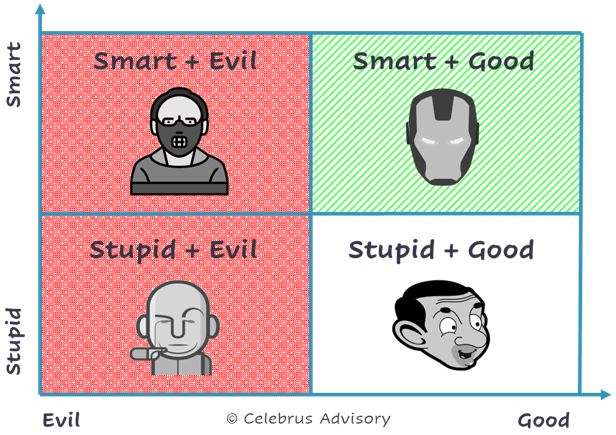
We created a quadrant to illustrate this. In a very simplistic world where investment projects are ranked on two factors – only 1 in 4 (or 25% chance) have the rare combination of competency and virtue (green area). There is a possibility that 2 out of 4 projects (50% chance) are led by those who are incompetent, or by those with malice (red area). In other words, there is an equal chance of project failure due to either stupidity or scams.
Each quadrant can be profiled by these fictional ‘straw men’:
a. Smart + Evil: For instance, pure villains such as Gordon Gekko (the fabled Wolf of Wall Street) or Hannibal Lecter.
b. Stupid + Evil: This could be like the Dr. Evil and Mini Me characters, or the bumbling burglars in Home Alone movies.
c. Stupid + Good: A classic case is Forrest Gump, or when Mr. Bean tries to save the world.
d. Smart + Good: The most relatable is Ironman, a genius and philanthropist, in the Marvel Universe; or Dr. Manhattan in the DC Universe.
For the Smart Investor, there are two things to take away from this. First, while there is moral hazard or malice everywhere, it particularly thrives in an unregulated environment. Second, never underestimate the power of stupidity. Dumb management can do a lot of damage. If you want to invest your life savings with a bunch of college dropouts and young punks who genuinely want to make the world a better place, please don’t cry fraud when you lose.
Disclaimer: Contents above are for educational purpose only.
About the Author
Edmund Yong is the managing partner of Celebrus Advisory and appointed by MDEC as part of its Talent Expert Network (formerly known as Digital Expert Panel) for blockchain technology. He is also the resident consultant for GLT Law, a multi-award-winning legal practice with specialisation in digital assets.
For many Malaysians approaching retirement or already retired, one of their biggest fears is having a massive hole blown through their nest-egg which they have painstakingly built up over the decades to see them through their golden years.
For many people, the situation becomes even more tenuous as their retirement funds are barely sufficient to provide a comfortable level of living or last till end of life.
Two of the major risk factors that can reduce individual retirement savings are health and income shocks, says Mohd Sedek Jantan, head of Investment & Financial Planning / Investment Unit at UOB Kay Hian Wealth Advisors Sdn Bhd.
Health shocks are defined as unpredictable illnesses that diminish health status, he says. “Individuals facing health shocks are often affected by significant out-of-pocket (OOP) healthcare expenditures incurred to obtain healthcare and the income loss from an inability to work.
“The OOP spending has particularly serious effects on poor households, who tend to spend more on healthcare as a share of their income compared to their richer counterparts,” he says.
On the other hand, income shocks are referenced by how many significant drops in income a person has suffered over their working career, says Mohd Sedek.
“For example, the current Covid-19 pandemic has caused the unemployment of large numbers of people, while others are facing pay cuts. The income shock during the pandemic is more severe among young adults.
“Income shocks are strongly associated with an expected spending reduction and, at a certain level, the individual will liquidate their savings in order to put food on the table.”
Mitigating Against The Risk Factors
Mohd Sedek says like other expenses in retirement, planning can make a difference in managing such risks. He says healthcare costs influence retirement income planning, and as such, the impact of rising healthcare costs should be a priority consideration.
“The most economical way to absorb the health shock is by changing lifestyle,” he adds.
He says research studies on people’s behaviour have shown a causal relationship between unhealthy lifestyles and healthcare expenditure, where individuals who practise unhealthy lifestyles need more healthcare services, forcing them to spend more on healthcare expenditure.
Taking steps to improve health can reduce annual medical expenses, he adds. In the case of Malaysia, hypertension stands as an important area of worry for economic evaluations because of the wide range of issues involved for the individual and for society.
“It is one of the most expensive diseases as far as treatment is concerned, as it generates higher healthcare expenses than those produced by individuals with normal blood pressure.”
However, he notes there is a reduction in total direct costs of the hypertension population if each patient’s blood pressure becomes controlled.
“This reduction in direct costs can be achieved by changing lifestyle habits, for example: reducing dietary sodium intake, decreasing body weight, quitting smoking, and reducing alcohol intake. In addition, anti-hypertensive medications can lower the risk of cardiovascular mortality in hypertensive individuals,” he adds.
High Cost Of Medical Insurance
R. Sathia, co-founder and CEO of GFlex40, a Malaysian insurance technology company, concurs the highest risk factors that would lead to reduction of wealth for a majority of Malaysians are health issues, either for themselves or their closest family members.
“As it has been well researched, the cost of medical insurance in Malaysia is among the highest in Asia and continues to rise,” he adds.
He points out that Malaysia also suffers from among the highest obesity rates in Asia. “The risk factors increase chances of individuals falling ill, and when combined with the cost of healthcare can quickly result in depletion of any savings that have been built by individuals,” he adds.
To reduce the risk of this happening, Sathia says that apart from investing in maintaining one’s own health by way of exercise, diets, etc, another supplementary and important mitigant would be investment in the appropriate health or medical insurance plans.
“By procuring such a plan early in life, individuals can ensure they are covered for unforeseen circumstances later in life,” he advises.
For the individual there is little they can do to prevent the rising healthcare cost across the board in the market. “However, on a personal level, everyone can work towards limiting their exposure to such costs by living a healthy lifestyle from early in their life,” he says, adding this would include proper healthy diets and exercise.
Sathia notes that exercise is a particularly interesting topic when it comes to health/medical insurance.
“More and more insurance and Takaful companies are investing in health and exercise related insurances that track the lifestyle and exercise habits of customers through the use of electronic gadgets and apps.
“By availing oneself to such an insurance early and leading a healthy lifestyle, not only would the average person be able to improve on their overall health but they can also potentially reduce their own premiums as a result of their healthy lifestyle.
He also says there have been efforts across the world to factor in lifestyles and exercise behaviours through electronic monitoring as inputs in pricing health and medical insurance by technology driven insurance companies.
“These efforts coupled with efforts to optimise operations of third party administrators and hospitals would eventually be able to lead to a reduction of pricing,” he adds.
Wealth Protection Measures
So, whatcan we do to prevent rising healthcare costs from eroding our retirement nest-egg?
UOB Kay Hian Wealth Advisors’ Mohd Sedek says reviewing one’s current insurance plan is vital to ensure it does not eat up the retirement saving.
“As healthcare costs continue rising, it is important for each individual to have life and medical insurance. According to the Employee Benefit Research Institute (EBRI), healthcare expenses are the second largest component, and these expenses steadily increase with age.”
Further, it is important for the policyholder to review their insurance policy from time to time, to ensure having adequate protection for the future and safeguard the income-earning abilities.
Sound financial advice also plays an important role when it comes to retirement planning.
“Individuals, regardless of their income level, should engage with a certified financial planner to ensure the retirement saving is not just sufficient but also sustainable, to hedge it against healthcare cost,” advises Mohd Sedek.
A financial adviser, he says, will review the individual’s overall financial situation and address the solution based on their needs. From the analysis, the financial planner will help the individual to address the challenges by:
Estimating their expected out-of-pocket healthcare expenses, such as insurance premiums;
Creating contingency plans for unexpected expenses such as long-term care; and
Working closely with the client to help protect their wealth by integrating healthcare costs into the overall retirement plan.
He adds there are a number of insurance types and riders that can help to hedge the rise in healthcare costs, such as investment-linked products, medical card, critical illness coverage and specific elderly insurance.
In addition, the financial planner can explain the cost–benefit for each insurance plan, creating trust funds and other advanced planning strategies.
Risk Management Needed To Absorb Income Shocks
To mitigate against income shocks, individuals should do planning that includes matching up income streams, including guaranteed income, to fund recurring healthcare expenses such as insurance premiums.
Individuals may also plan on maintaining an emergency health savings fund for non-recurring health expenses, says Mohd Sedek Jantan, head of Investment & Financial Planning / Investment Unit at UOB Kay Hian Wealth Advisors Sdn Bhd.
Also, delaying withdrawal from the EPF can create a larger monthly benefit. “Hence, personal budgeting is important to achieve a clearer vision of personal finances so you can begin to plan your spending and saving and take control of your money.
“In short, budgeting helps you to ensure you have the right amount of money at the right time.”
And when doing budgeting, both regular events and extremely uncertain events must be dealt with. It is advisable for individuals to set aside at least six to nine months of living expenses in a money market account, one that offers liquidity and the safety of the principal.
“An emergency savings fund should be established so you don’t have to consider tapping your retirement savings,” he adds.
Dealing With The Medical Insurance Conundrum
If they can afford it, it is prudent for senior citizens to have medical insurance as it can help offset the medical expenses that they’ll incur as they age.
However, the flipside is that medical insurance premiums increase dramatically as we grow older, ironically at a time when we are no longer generating income.
So, is there a way out of this predicament?
Mohd Sedek Jantan, head of Investment & Financial Planning / Investment Unit at UOB Kay Hian Wealth Advisors Sdn Bhd, notes that age is one of the prime elements in the health insurance premium calculation because it impacts the medical support a policyholder may require.
It is significant to understand that an elderly insured individual will possess medical conditions quite different from those of a young or adult insured individual, he says.
“Typically, the premium amount increases on average about 5% to 8% for every year of age; it can be as low as 5% annually if you’re in your 40s, and as high as 12% annually if you are over age 50,” he says, adding that high-risk health status also has the potential to greatly increase costs.
As such, Sedek says it is advisable to buy health insurance “at a young age to avoid high insurance premiums”, as the policyholder is able to lock in lower premiums and reduce the total amount they will spend on life insurance over the course of a lifetime.
Advancement in technology is changing the way care is delivered; allowing elderly consumers to apply self-directed care, while availing healthcare professionals access to information essential to the healing cycle in an instant. Furthermore, technology allows for aged care businesses to answer consumer demand in areas that were previously difficult to access.
Frost & Sullivan stated (Major Trends & Attractions In The Global Aged Care Market, 2015), that increased use of technology in the aged care market not only has economic benefits, but enables the ageing populace to enjoy better quality of life. Consumers and care workers alike would have a smoother journey in the care experience when care is delivered to where and when it is needed.
Ageing populations around the world are rapidly growing and aged care businesses need to capitalise on this technological boon to succeed in the future. Hence, increasing attention is being given towards developing new technologies that will help capture quality data.
Taking stock of the local environment, let’s look into three key areas in healthcare that technology progress will enhance and propel news levels of consumer demand and quality service.
Living at Home Longer and Safer
For elderly people to live longer in their homes, wearable devices – such as smart bands, intelligent insoles, and so on – and smart home technologies are being developed in order to support them through improved remote monitoring.
Sensors will regularly track the individual’s health readings and feed data into a central monitor point for the overseeing healthcare professional to keep track in real-time and provide feedback/support from distant locations. In the event a possible fall or mishap occurs, an immediately response could be mobilised.
With the development of the Internet of Things (IOT), technologies that integrate various devices together have become increasingly sophisticated, to the point where sensors can alert a central monitoring system of a possible mishap if a resident of a home has not left a particular room for an unusual amount of time.
Lost and Found
Alzheimer’s Disease International reported that the number of dementia cases in Malaysia were estimated to double every 20 years. That is one new dementia case in every three seconds. Depending on the stage of the disease, persons with dementia may require 24-hour supervision.
In these cases, wearable technology is invaluable. Apart from tracking vital signs and providing reminders for the wearer to take their medication, some wearable devices incorporate GPS to track children and seniors alike, or detect if a user has been immobile for a prolonged period – in this case, it will call for emergency services or pre-set contacts numbers.
Assisted Daily Living
In Frost & Sullivan’s report, competition in robotics development is expected to grow intensively between 2020 – 2030. There are many benefits robotics could bring to aged care.
Robots can provide help with daily living activities such as cleaning and cooking, as well as assistance with exercise and transferring (for example: from chair to bed). They can also be companions, analyse emotional well-being and act to mitigate feelings of loneliness amongst the elderly.
In Japan, senior care robots are already being piloted. Therefore, we can expect to see more sophisticated robots in the future that could help elderly people do more and achieve better quality of life.
Technology Enhancing Care Quality
Melinda U, General Manager of Managedcare Sdn Bhd, says the ability to access and analyse well-documented information is crucial to making sound decisions for the best possible health outcomes, not only when care is needed but also for prevention.
“These technologies give empowerment to individuals by helping them to self-manage their health and to take action when alerted about a potential crisis early. For medical and healthcare professionals, it enables them to provide more timely interventions and efficient support.”
Integrating new technology into the aged care industry will create smoother processes in care delivery, provide better insights and establish superior customer care. Naturally, consumers will seek out businesses that can effectively showcase their ability to provide the best care to their clients.
Currently, there are many gaps within Malaysia’s care delivery process and aged care ecosystem in terms of efficiency and cost of care. Despite being in its infancy, Malaysia’s aged care industry is in a unique position to integrate and grow these technologies alongside its developing ecosystem.
“These technologies could cover the gap in service delivery, but they aren’t mainstream in Malaysia yet. There is still a lot of research and development going on in this area. However, Managedcare recognises its potential to complement our mission in making care more easily accessible and we are exploring these options” says Melinda.
Dear Mr Neoh, I was hoping that you can give me some advice on my situation, below is a bit about me:
I am Malaysian, now 62 years old. I am currently single, and I am still working for a living. My take home income is about RM3,000. I do have two children who are now already working and in their late 20s/early 30s. I am feeling a bit insecure because currently, I only have about RM40K in savings with me, and this represents the only money (savings) that I have. What should I invest in order to get extra when I am no longer able to work for a living? Recently, I was approached by a Unit Trust person from a reputable unit trust company who invited me to take up a scheme with her in order to grow my wealth. Since I have never had any investment experiences in life, I honestly think that I lack knowledge about investments. I don’t feel confident about this investment. In fact, I feel a little confused. Can you please give me some advice?
Mr Ng
Answer:
Hi Mr Ng,
Thank you for your email, I hope after reading this response, you will feel less confused but empowered to make a decision regarding the above.
I understand that you are still working, and I am assuming that the take home pay of RM3,000 mentioned here is a net income, consistent month-to-month.
While I agree that you should actively look for options to invest your money, it is very important for you to ensure that you make a good, quality decision.
This is because, if you invested into something that is too risky for you, or into something that is not what it seems to be, your chances of losing your money will be higher. This will be very dangerous for you, considering that you are now in your sixties.
Based on the illustration above, let us assume that you invest all RM40,000 but you suffer a loss of 50% in the first year. You will end up with just RM20,000. If this misfortune happens, you will then need a long time to get back to the original amount of RM40,000, assuming you are able to rebalance the remaining RM20,000 to an investment or portfolio that can grow at 10% pa.
The above projection shows that if invest RM20,000 into something that can generate 10% a year for the next few years, you will need seven years and four months before you can get back to the original amount of RM40,000; and by that time, you will be 69 or 70 years old.
Of course, if you can only feel comfortable investing into a “safer” investment generating 5% a year, you will need 14 years to get back to the original amount of RM 40,000 as can be seen in Illustration 3. By then, you would be 76 years.
The above example is why it is very important for us to ensure we don’t lose our money by investing into things that we do not understand, or are too risky to match our risk profile.
At the age of 62, and with RM40,000 being your total savings at this point, you may want to be conservative with your money. Having said this, it does not mean that you should just keep all the money in a savings account or all of it in Fixed Deposit. Because this is also dangerous since our purchasing power will decrease every year due to inflation (where you need to pay more to buy the same or even lesser amount of the item you need).
Therefore, you should consider investing not more than 20% of your money into equity (stocks or shares). But investing in shares requires knowledge, time, effort, and you will also need a bigger capital to have a reasonable holding of stocks that are properly diversified.
I suggest you invest into stocks or shares through a Unit Trust fund. You can invest into a Unit Trust fund that invests in “Blue Chip” stocks as it is more stable and less volatile compared to other stock funds. An alternative to a blue-chip stock fund, will be a Balanced or Moderate fund. This type of fund typically invests 50% of the money into stock and 50% into fixed income instrument, so it will be quite safe, since we limit your exposure to not more than 20% of your wealth.
I do not know the kind of fund or scheme the unit trust agent recommended that you invest into, therefore, I cannot comment on the suitability of the fund for you.
It is however very important for us to note that no matter what you will eventually invest in, the investment has to be one that suits your current needs, your capacity for risk-taking, and if things go south, will not put you into a position that will likely lose most if not all of your savings.
About the author
Kevin Neoh is a NextGen Money Coach who works with people to help them transform their relationship with money to improve their lives with the money they have. Kevin can be contacted at kevin@nextgenadvisors.my and www.kevinneoh.my.




















 Kevin Neoh is a NextGen Money Coach who works with people to help them transform their relationship with money to improve their lives with the money they have. Kevin can be contacted at