Wednesday, 5 August 2026 Stay informed. No noise.

Fired Up: A Look At Southeast Asians Pursuing The Financial Independence, Retire Early (FIRE) Movement

Having an early, secure retirement is a dream of many, and a small, but growing number of people are striving to turn this dream into reality. The FIRE movement, acronym for Financial Independence, Retire Early, is essentially about aggressively tightening belts, and finding multiple sources of income in order to achieve early financial freedom.

Milieu Insight released the results of their ‘Financial Independent, Retire Early’ study, which aimed to find out how common the FIRE movement is among Southeast Asians, and the steps they are taking to achieve their goal. The survey was conducted in May 2022 with N=1500 employed respondents, aged 18-49 years old, each from Thailand, Singapore, Malaysia, Indonesia, and the Philippines.

FIRE Article Image

Do Southeast Asians want early retirement?

  • The bulk of respondents expect to retire in their 50s or 60s (62%); Indonesians tend to expect earlier retirement, with only 52% expecting to retire in their 50s or 60s
  • Retiring early (defined as retiring before 50s) is a possibility for 60% of respondents, but only 14% think that they are on track for early retirement – Singaporeans seem most pessimistic about being able to do so, with only 9% indicating that they are on track
Financial Independence Retire Early FIRE Article Charts 1HD

Steps towards early retirement

  • Most common strategy towards early retirement is regular saving (71%), followed by ‘being careful with how I spend my money’ (63%) and ‘investing’ (63%).
  • Finding additional employment is much less common (37%) as part of strategy to retire early, but tends to skew towards Thais (54%)
  • Insurance – one way of investing – is also more common among Singaporeans (56%) and Filipinos (53%)
  • Perhaps due to vast amount of resources on the Internet, most people are hands-on for retirement planning, with only 31% of those who plan to retire early saying that they have a financial consultant to help plan for retirement
Financial Independence Retire Early FIRE Article Charts 2HD

A look at the most common strategies for early retirement: Saving and investing

  • Among those who save regularly for early retirement, 43% save more than 20% of their incomes
  • Among those who invest, 36% indicated that more than 20% of their incomes go towards investments
  • The most common investment types are:
  • Investment funds (56%)
  • Stocks (53%)
  • Real estate (52%)
  • Cryptocurrency and NFTs, which are gaining momentum but have yet to enter mainstream investing due to their volatility, registers at 41%, and seem to be more popular in Thailand (57%) and the Philippines (54%)
Financial Independence Retire Early FIRE Article Charts 3HD

How do people feel about FIRE?

  • 57% feel very or somewhat positive about their journey towards achieving early retirement
  • Comparing those who are on track to early retirement, and those who are planning to retire early but don’t think they are able to, the former tends to feel more positive about it (83% vs 49% who selected very/somewhat positive)
Financial Independence Retire Early FIRE Article Charts 4HD

Methodology

Based on Milieu Insight surveys with N=1500 employed respondents, aged 18-49 years old, each from Thailand, Singapore, Malaysia, Indonesia, and the Philippines, conducted in May 2022.

About Milieu Insight

Milieu Insight is a consumer data and analytics company that connects businesses directly with their target audience. Milieu’s platform offers businesses a wide range of tools for accessing, analyzing, and visualizing high-value and timely consumer opinion data to help power better decision-making and strategy. For more information about Milieu Insight visit: www.mili.eu

From Almost Being Murdered To Setting Up A Digital Marketing Agency, To Branding And NFT

The story that we are about to share with you is truly an interesting one. It is about an individual who bounces back after a tragic event to reach greater heights.

Let’s meet Mr. Sanz Teoh, Chief Executive Officer and Founder of Jumix and his inspiring story below.

Smart Investor: Thanks for taking the time to talk to Smart Investor. Can you tell us a little bit about yourself, about Jumix, and what makes you started the company?

Sanz Teoh: Hi, I’m founder and CEO of Jumix. In 2014, I was almost murdered by a local gangster group. That inexperienced me was trying to work a side hustle while having a full-time digital marketing job.

It was at that moment, I decided that I have to fully commit my time, effort, and energy to my own business. I promised myself that no one else in this world should go through the same experience as I did, and I set out to make this my business mission.

Combining my educational knowledge in marketing and my personal passion in creating digital products, I founded Jumix. It started off as a web design & digital marketing agency, now we also do Branding and NFTs for businesses.

nft

Smart Investor: We heard about your recent foray into the NFT scene with BeU, care to elaborate on that?

Sanz Teoh: Yes, and I’m very excited about this. There’s a story behind why we are doing NFT. Previously during the MCO, we have a long discussion with a creative agency to come out with a ‘Virtual Influencer’ that is set for a launch in late 2020.

My entire team put a lot of effort and commitment into that project. But due to some contractual dispute, the plan didn’t work out. It is then we decide to take things into our own hands, and is determined that we are going to create something new all by our own instead of working with another agency.

This is why we decided to dive into the NFT scene. Being a seasonal cryptocurrency investor and familiar with blockchain technology myself, I proposed to my team that we can use utilize our creativity to create characters, which will then be a set of collectibles on the blockchain.

Starting from scratch, my team brainstorm, sketch, draw, produce and code the entire BeU NFT project. Throughout the entire journey, we learnt a lot more about NFTs and how NFTs can really help brands and creators to bring a lot more to the table.

People who are interested in an NFT project can ‘own’ it and enjoy the benefits or utilities that the NFT project gives.

For example, people who own BeU NFT will get another NFT for free, which is the ‘egg’ of the original character, which will ‘hatch’ and revealed later on. It would remain a mystery for now.

All owners will also get to involve in the roadmap of BeU project, which include deciding on which charity foundation that we will donate our money to, getting access to exclusive BeU merchandise, stand a chance to win life-size BeU figurine, and ultimately, be the first to access the virtual world that BeU created – BeUtopia.

nft

Smart Investor: How big is the NFT industry in Malaysia and are Malaysians ready to get on board the NFT phenomena?

Sanz Teoh: I would say that the NFT industry in Malaysia is still pretty new. But so far I’ve already seen quite a number of artists, creators and brands that have dived into NFTs.

Things are just going to get more interesting for Malaysians, but just like any other market, there’s always a stigma when it comes to adopting or investing into something new.

I believe with more brands and creators embracing NFT with more following suit, this is why Jumix is going to bring more both brands and creators into this industry, and drive the growth of Malaysia’s market together.

Smart Investor: With the recent crash of the crypto market, does it have an effect on the NFT market?

Sanz Teoh: Crypto market has its ups and downs over the years. While I’m not talking about cryptocurrencies trading, the price crash of crypto does affect the NFT market as well.

When prices of crypto drops, it actually makes NFTs more appealing, as you can now purchase NFTs at a much lower price. This makes collecting or investing in NFTs much more approachable to the public.

Sanz Teoh Jumix1

Smart Investor: Can you share with us your plans for the future?

Sanz Teoh: BeU is only the first NFT project that Jumix pushes out, we’ll have more NFT projects in collaboration with other brands, which would include more utilities, features and more creative concepts.

For the next 6-12 months, other than growing the BeU community, I’m also looking to work with brands who are interested in NFT to build new projects with them.

Smart Investor: What is your advice to Malaysians out there who wants to get involved with NFT?

Sanz Teoh: There will be two groups of people here. The first ones are the brands and creators.

For brands and creators, my advice is to get involved as soon as possible, as the trend is rising rapidly and the attention in this space is high. But please do not take this opportunity as a money grab, NFT is still very community-driven and it should be created for the community, not for your own profit’s sake.

The second group of people are the owners and investors. For investors, don’t take this as a get-rich-quick investment, but something more like a long-term investment. But before putting in your hard-earned money, make sure that you believe in a particular NFT project and do your own due diligence.

For smaller NFT owners, go ahead and support your favourite creators and brands while enjoying the benefits that the NFTs provides, experience how blockchain and cryptocurrency work, and have fun at the same time.

nft

Smart Investor: Can we really make money from NFT, is NFT a good investment to venture into?

Sanz Teoh: I’m not one to tell people that we can ‘earn money’ from NFT. I would tell them to first, truly understand as to what, why and how cryptocurrency, blockchain and NFT exists.

Once you fully understand the benefits of blockchain and NFT, then, like any venture or business, you have to be creative, committed, and create something that people want, or of interest, to be able to ‘make money’ from it.

For the general public, some NFTs project are really good, and has good utilities, visionary founders, responsible project team and for a good cause. These are NFT projects that you can invest into.

For brand and business owners, investing in creating NFTs is a good way to differentiate your brand and business, raise funds, or to offer additional utilities and benefits to your fans or loyal customers.

The potential of NFT is vast. With proper strategy and ethical purpose, NFT is definitely the way to go.

5 Reasons Why You Should Invest In REITs

Real Estate Investment Trusts (REITs) can be simply put as shares of commercial properties that are listed in Bursa Malaysia stock exchange.

REITs are being managed by property developers or professionals. There are many categories for REITs that will convert into a great profitable investment such as malls, residentials, factories, offices and many more.

You may want to read this : Best Reits In Malaysia. Which One Is Better? Is It Time To Invest Now?

Simply put, we can say that an amount of monies being pooled together from many other investors to invest in properties. This may be a good alternative rather than you have to buy physical properties which can cost you a fortune.

Investors who buy REITs’s shares entitled for dividend payments which will be distributed quarterly or semi annually. This is mostly contributed by the rental performance of the properties.

5 Advantages of REITs Investment

1. Invest in REITs With As Low As RM100

Whattt?? You don’t want to risk a lot of your money to your property investment?

No worries! By REITs investment, you don’t need a huge capital to start. With RM100, everyone give it a go in property investment via REITs.

Property investment using REITs in stock market
Source : Bursa Malaysia

As from the list above, you can see the price per one unit of REITs shares which most of them are below RM1.00. You will need to buy at least one lot which equals to 100 units as fixed by Bursa Malaysia.

Still, it’s way much cheaper than buying a physical property for investment.

2. Tax Exemption

REITs tax exemption

You don’t have to worry about tax. REITs investment in Malaysia are exempted from tax. If you own a physical property, you will have to pay for taxes, stamp duties and many more during your purchases or disposal.

You don’t have to pay for Real Properties Gains Tax (RPGT) which will affect your investment returns.

These taxes exemption are a huge savings where you can save a significant amount of money.

3. REITs Investment Is Easy

Don’t get yourself into property investment messes. REITs provides you peace of mind while investing.

REITs are traded on the Bursa Malaysia stock exchange. You’re not tied to a huge amount of mortgage. REITs are very liquid as they can be bought and sold easily.

You can have your CDS account, the transaction can be done via your platform. Easy, right?

4. REITs Being Managed By Professionals

reits managed by professionals

Newbies in stock market? Worry no more with REITs investment. Why? Did you know that your REITs investment are managed by professionals?

Yeah. You heard it right! Managed by professionals unlike investing in physical or conventional property. You don’t have to deal with tenants, local authorities or many other things out there.

Sit back, relax and enjoy your dividend! (Still, you need to study stocks potentials before deciding to invest)

5. Higher Dividend Payouts

Did you know that REITs will distribute at least 90% of their earnings to investors in order for them to qualify for tax reliefs?

The investors may enjoy 5% to 7% of dividends every 3 months or twice a year depending on the company.

Well, we can say that the dividends rate is higher that most of the rental properties return.

In a recent survey of Malaysians carried out by Palindrome Communications, 14 percent of respondents said they thought that REITs were good investments and 29 percent thought they weren’t. The majority of respondents (57 percent) were unsure and opted to ‘sit on the fence’. This could signify a lack of education regarding REITs in Malaysia and mean that members of the public are more familiar with other investment options. Respondents included professionals in technical fields such as engineering, and solar.

3 Alternative Ways To Teach Teenagers About Money Management

Are you worried about your teenage children’s safety, health, social life, future, and education? In addition, they are constantly bombarded by advertisements, online shopping, peer pressure and “Instagram culture”.

Various surveys have shown that Malaysian millennials (aged from mid-20s to 40) have a tough time when it comes to money management:

  • 70% of Malaysian millennials do not live within their means – Asian Institute of Finance, 2015
  • 74% of millennials in Malaysia are struggling to meet day-to-day expenses during the Covid-19 pandemic
  • 53% of Malaysian millennials cannot survive with their savings beyond three months
  • Lower income millennials spend 48% on food, 27% on entertainment

Looking at the situation above, we should plan forward and ensure that the next generation – our teenagers – will have a better start in money management. Here are three alternative ways parents can teach their teenagers about money management.

1. Joining Them Instead Of Stopping Them

Young Woman Wear Glasses Shop Smart Phones

Online shopping has enabled spending like never before, especially during the pandemic. Most teenagers will want to buy and own things if they have the means, although more often than not, such purchases are due to peer influences.

Being the financial provider for teenage children, it is important that as parents, we instill the importance of self-control and wisdom about leisure shopping. Yet, this is the phase where teenagers become more rebellious, it is simply not enough to just tell or nag them. The old saying has never been truer – “If you cannot beat them, join them”.

Go on Shopee or Lazada with them. Teach them about vouchers, free shipping and sales. Or maybe it will be them teaching you instead! Shopping online with them has its benefits, such as:

  • Bonding time and relationship building with your child
  • Slotting in some advice about quality vs quantity, self-control and impulsive buying behaviour
  • Monitor your teenagers’ shopping behaviour, what is in their shopping cart, wishlist and their shopping history
  • Share your experience and mistakes about shopping and spending

2. Give Praise And Advice

It is so true, that it must be repeated again. Teenagers are rebellious creatures!

Nagging and telling them what to do just will not cut it. It did not work for teenagers during the 80s, 90s, and 2,000s and it certainly will not work today. However, they do seek your approval and appreciation, especially on things of importance to them. We often hear “my parents do not understand me” or “my parents are just not cool”. One way to avoid such comments are to acknowledge and sometimes praise what they are doing right (or vaguely right) financially.

“Boy, it looks like you did not spend too much money at the mall today. Good job!”

“Girl, you really found a real bargain with the dress you bought online. You certainly know how to shop.”

After praise is given, teenagers will be more receptive towards advice. The acknowledgement that they did something right, gives them a sense of pride, and the urge to do it better.

3. Let Them Make Mistakes

Young Man Covering Face With Hands White T Shirt Looking Sad

If you recall how you sharpened your money management skills, more often than not, it was not taught or told by your own parents. You learnt them either by experience, hardships, or through mistakes that you have made. Depending on your generation, we grew up in a different time and culture than the teenagers of today.

One way that we can teach our teenage children about money management is not by teaching or telling, but by letting them experience mistakes of their own. Here are ways you can set the stage for your teenagers to learn some money management:

The salary and lending method

The Salary And Lending Method

The delayed gratification lesson

We are spoilt with instant gratification. What we want, we can get it very fast, if not, almost instantly. Think Netflix (movies), Grab (food/transport), Shopee/Lazada (shopping) and WhatsApp (communication). The Generation-Z of today are born into a life of instant gratification. However, the culture of savings and investments are more often than not, a slow and disciplined process.

Thus, it is even more crucial that parents practice delayed gratification with teenagers and resist buying things they want versus what they really need. For example, if they ask you to buy something they want (big or small), try and ask them to wait for a few weeks or months. Suggest that if they want it sooner, they have to contribute part of the cost too. You may even notice a change that as time passes, they will realise that the purchase is not worth their allowance, and their desire may even fade.

The compounding interest lesson

Open a bank account for your teenager with some sort of interest element and allocate your teenager’s allowance in it. Alternatively, some e-wallets currently have an interest element as well. This allows them to learn about the compounding effect of interest on interest.

With this method, you can teach them about saving their allowances, and watch their savings grow every month. Take this opportunity to teach them about inflation and other forms of investments that can make their savings grow even faster, such as fixed deposit or a bond fund. Although they are too young to invest into unit trusts themselves as a primary applicant, you can create a joint unit trust account with your teenager being the secondary account holder.

As parents, we do our best to teach our child the important elements in life. Early money management is something that is important and should be deeply rooted into their young minds. However, this is easier said than done as there is only so much we can do as parents.

Their personalities and spending patterns are an amalgamation of a variety of influences, from friends, to TV, to the internet and also by observing their parents’ money behaviour. That said, as parents, we should learn and practice what we preach about healthy money management.

About the Author

Alvin Kwan

Alvin Kwan, CFP CERT TM is the executive director and head of financial planning at Redvest Wealth & Asset Management. He has over 12 years industrial experience in the financial industry, specifically in wealth advisory, private banking and stock broking. He was also a lecturer in areas of investment management, derivatives, and financial markets.

We at Smart Investor and Redvest is committed to help you better manage your financials. Get a free consultation from an expert by filling in your details here: https://www.smartinvestor.com.my/SIxRedvest

Vital Role Of Insurance In Wealth Preservation

Wealth preservation is about managing your assets in such a way to make sure that it does not decrease in value. And after a lifetime of hard work, you want to ensure that as much of your wealth is protected.

Of course, optimising and growing your existing wealth is also a key task unless you plan to work for money all the time.

Wealth, just like your health, must be carefully preserved, and successful planning will help make your wealth last for you and your future generations – in case the unexpected happens.

One of the means that we can ensure our wealth is preserved in case something happens to us is insurance.

Demand for insurance as a low risk wealth management tool has seen a spike in recent years. The approach to insurance is also changing, with people from the middle-income group to wealthy families shifting perceptions on the need to protect their potential future income, as well as preserving their wealth for their next of kin.

When you read that insurance is a good instrument to preserve wealth, what exactly can it help you preserve?

Preserving Your Current And Future Income

insurance

The Covid-19 pandemic has made a strong case on the notion that nobody really knows what is coming around the corner.

Just imagine that if you pass away during your good earning years, your family could suffer a severe economic loss as a result of losing your current and future income to support them. In this unfortunate ‘fictional scenario’, your family would still have to pay their regular bills, including mortgage(s) and your outstanding debts.

They will also still have to continue accumulate funds for your family life goals, such as children’s education and retirement funds for your spouse. If you did not insure against this, you may leave your spouse or children in a very tight spot.

Preserving Your Dreams / Life Goals

For some people, this is also as good as preserving your family dreams. In this instance, insurance acts as a financial safety net that helps you financially protect your loved ones.

It also enables them to continue living with minimal worry, especially when large financial burdens like medical bills, mortgage, debts and others would easily change the financial status of your family.

Preserve Lifestyle During Difficult Times

We never know what life has in store for us especially while we are still feeling fit and healthy. No one likes to think that something bad will happen to us, and when something bad does happen, the first thing we usually say is “Oh no, he / she is so young”.

insurance

Illnesses and accidents are not age-specific. These are random events that could affect anyone.

But if you could not work due to a serious illness or accident, how would you manage financially? If the worst does happen, insurance helps you to minimise the financial impact on you and your family.

For example, if you need to give up work to recover from illness or if you are permanent disabled, the insurance could be used to help pay the household bills, mortgage, or even supplements, giving you and your family a peace of mind when you need it the most.

Recovery Takes Time

In a good ending, a person who is seriously ill may triumph in the fight against the illness, but, this person may not able to return to work immediately. All of these could incur many costs.

It is kind of heart-breaking to contemplate a situation where you survive a serious illness but fail to survive the financial hardship. This may be a time this person might have hoped he or she did not conquer the illness.

Obviously, you do not want an unexpected event that could easily change the financial status of you and your family. Preparing for the worst is not something we want to think about when we are feeling fit and healthy.

However, you will not suffer for thinking about it and preparing for it first. It is much better to be prepared, than to be in despair.

Preserve Your Legacy And Wealth

Businessman Protection Money Table With Tree 1

People are also promoting insurance as a tool to ‘create’ wealth, not just preserving it. Having adequate insurance that can help to repay your debt the moment you kick the bucket, can help ensure your assets get to pass down to the rightful beneficiaries.

Your family do not have to lose the assets such as your house due to their inability to redeem the loan from the financier. In time when the estate of the deceased is frozen pending the estate administration procedure, the proceed from insurance can help ensure life goes on for the surviving family.

If you are concerned your family may mis-handled the insurance claim, you can also have a proper legal structure to preserve this wealth. Through an insurance trust, you can decide the way how and when you distribute your wealth without actually physically transferring to your next of kin in a lump sum payment.

The trust assets are actually placed under trust to avoid your next of kin spending all of your wealth in few years when it took a lifetime to accumulate it.

Insurance And Your Life Stage

As you move on to different stages or wealth status in your life, the need for insurance will inevitably change.

One of the common questions people usually ask is “How much insurance I need?”

It really depends on your circumstances. There is no one size fits all solution and the amount of cover and how long it lasts for, all these will vary from person to person.

There are some events when you should consider reviewing your insurance needs:

  • Buying new house with your partner;
  • Building a family;
  • Having children;
  • Change of lifestyle i.e. salary increases;
  • Covering loans;
  • Reaching retirement;
  • Starting a new business;
  • Entering into a civil partnership;
  • Changes in business ownership;
  • Creating wealth to next generation;
  • Transferring wealth; and
  • Others

Clarify What Insurance You Need

Safeguard and preserve your wealth and then look at what types of insurance that you need to preserve your financial status.

It is important to manage your wealth and ensure you set aside a portion of your income to buy insurance, but don’t overcommit too.

It is advisable to seek for advice on how to optimally insure yourself and preserve your wealth against all the possible events that could disrupt your life.

About the Author

Keah Eewen

Keah EeWen is a licensed financial planner with VKA Wealth Planners Sdn Bhd

How Do We Safeguard Digital Assets?

Digital technology is now an integral part of our lives and, with the advent of fintech, more people are investing in digital currencies and cryptocurrencies.

Currently, digital assets and planning legacy for such assets tend to be overlooked by many Malaysians in their estate plans. The result is a potential loss of valuable assets and data, some of which are of immense emotional meaning to family members, with money and time spent to track them down.

While data protection and digital security are important when we are alive, how do we make sure that our digital assets can be accessed by our loved ones when we pass on? The answer is to include them in our inheritance plan. As digitalisation and its adoption continues, planning will become more important.

What are Digital Assets?

digital assets


Digital assets are a collection of binary data online rather than actual physical objects where it is created, stored, recorded in digital devices and/or online services, for example, websites, social media sites, emails, cloud services, mobile phones, laptops, hard drives and computers.

The most well-known digital asset is digital currency. Other popular digital assets of monetary value are e-wallets, e-commerce accounts, internet domain names, online business platforms and even online storage such as google drive and dropbox as it may contain valuable data.

These days for creative professionals, their photography and works of art are often found in various online platforms such as shutterstock.com and istock.com. Such platforms allow their work to be sold or used for a limited period. Their work product stored in such platforms are digital assets which generates income and the royalty payments to the account holder.

In order to gain access to any digital asset stored online, it requires the username and password. If there are multiple accounts for different types of digital assets, the account owner should have an inventory of usernames and passwords for each account. Unfortunately, many people do not bother have such an inventory to organise their digital assets meticulously.

If an estate plan did not account for digital assets properly and without an inventory list, the executor would not be able to access them. They may not even be aware of the existence of such digital assets. These assets will be lost forever and the heirs might not receive all the money and/or the precious memories that the deceased have wanted to leave for them.

Digital Assets Inventory

Jon Moore BBavss4ZQcA Unsplash

How then do we safeguard our digital assets?

First and foremost, prepare a list of your digital assets using a digital assets memorandum (DAM), including cryptocurrency accounts, social media accounts, e-wallets, online securities trading accounts and e-commerce account such as Lazada and Shopee.

As you would only want a trusted person to have access to your digital assets’ user and password details, you would need to appoint a Digital Facilitator in your Will.

In your Will, you should state the type of digital assets you own and the beneficiaries who will be entitled to them. You may include the user details, but the passwords must not be included in the Will.

Your passwords should be stored separately from the DAM and your Will. It may be kept in an encrypted thumb drive in your home safe or safe deposit box or in some secure manner. However, it must be made known to your Digital Facilitator where it is kept and how to gain access to it.

As you may change passwords from time to time, it is important to update the list of passwords. Otherwise, your Digital Facilitator will not be able to gain access to your digital assets.

Accessing Digital Assets

digital assets

Gaining access to digital assets is difficult. Each online service has its privacy or end-of-life policy and a court order will not count.

Even if the local court where the owner of the Will resides grants the families access to the digital assets, the laws where the company resides could prevent the families from getting access to them.

The laws that govern digital assets vary from country to country, and online sites have widely different terms and conditions that sometimes lock out executors. There may even be difficulty to determine which jurisdiction to apply for the court order to let the company allow your heirs to gain access.

Therefore, it is best to make sure that your estate plans are prepared and executed by lawyers or professional trust companies because it is a specialised area.

Malaysians aged 18 and above who reside in Peninsular Malaysia and Sarawak are eligible to set up a Will, while people in Sabah are required to be 21 and above.

This article is contributed by Azhar Iskandar Hew, Group CEO, Rockwills International Bhd.

5 Factors To Consider When Choosing Your Financial Planner

It is very easy to get financial advice nowadays, especially with the boom of the internet and social media. If you visit financial related Facebook groups or forums, everyone is eager to give their opinion on the best ways to manage your money.

However, one downside of these free online advice is bypassing of important safeguards such as ensuring the person seeking advice is subject to a detailed financial health check and understanding their current financial position.

So, choosing your personal financial planner can be one of the most important decisions you can make. Your financial planner is your partner to guide you through many decisions about handling major financial and life decisions.

To find the best financial planner who is right for you, here are five important factors to keep in mind:

1. Make A List Of Financial Planners

Tyler Nix 0XrXeb4pUMM Unsplash 1

Start by creating a list of potential financial planners. Ask your friends or family if they have engaged with any financial planners. Take the time to check if the planners have the required license from Securities Commission Malaysia’s database (). Then, call each financial planner to see if he or she is accepting new clients and arrange a meeting with the planner.

2. Research The Financial Planner’s Credentials And Experience

In Malaysia, most financial planners do not start their career as a financial planner. Some are trained lawyers and accountants. Knowing the background of the financial planner allows you to understand whether the financial planner has the resources to help you in your financial decisions. The more experience a planner has, the better your results are likely to be.

If you need a specific form of planning, such as the involvement of business or family offices, ask the financial planner if he or she has any experience handling the matter.

3. Evaluate The Financial Planner’s Communication Style

Two Content Business Partners Discussing Issue

Choose a financial planner with whom you are comfortable talking to. Do you feel that the financial planner understands your situation? Find a planner who shows an interest in getting to know you and will respect your decision-making process.

Also think of the convenience of meeting your financial planner. In the beginning of the financial planning process, you may need to meet your financial planner several times in a month. Can you reach your planner online, especially during the COVID-19 pandemic?

4. Evaluate The Financial Planner’s Company/Team

Take the time to research the company and team behind the financial planner. Is the financial planner working alone? What are the credentials of the team behind the financial planner?

As finance is a very broad topic, a good financial planner usually specialises in a particular field and works with another financial planner or other professionals (such as lawyers and accountants) to handle other parts of the planning and solution implementation. Think of it like the case of a hospital, where a patient may get treatment from different specialists.

5. Understand How The Financial Planner Is Getting Paid

There are 3 main types of fee-structure when it comes to financial planners:

  • Commission only;
  • Fee-based; and
  • Fee-only.

In Malaysia, we usually see commission only and fee-based planners. Fee-only financial planners are extremely rare.

A financial planner that receives commissions only works great with someone that wants a product that they already have some idea in mind. The relationship is usually transactional in nature and heavily focused on advice with a product-based solution.

A fee-based financial planner earns a fee for developing a financial plan for you, while also earning a commission if you require him or her to service your insurance policies or investment portfolios.

Make sure that your financial planner is transparent on the fee for their services.

Summary

Just like when making any major purchases, it is important to do your homework when it comes to choosing your financial adviser. Not every financial planner has the same level of training or offer the same range of services. It is important to talk to several financial planners and choose someone that meets all the above-mentioned criteria.

Finally, it is important to understand that financial planning takes a long process. Find a financial planner that you feel comfortable talking to and feel he or she is helping you work through your problems.

About the Author

marshall wong insurance

Marshall Wong is a financial planner holding licenses from the Securities Commission Malaysia and Bank Negara Malaysia. He can be contacted via email at Marshall@plannerd.io

Will Initial Exchange Offerings (IEOs) Change the Crowdfunding Game?

In this final part of our article series, we explore the viability of the new IEO model. Two IEO operators have been announced so far.[1]

From the aspect of the platform, how will these operators perform as a capital formation channel i.e., how will they raise serious money? This has traditionally been the domain of licensed investment banks, so all eyes are on these operators. The business community is eager to hear its first success stories.

And from the aspect of the market, how will these IEO assets be structured to appeal to investors? These are exotic financial products that befit a narrow risk profile. They have often been compared as alternatives to IPO. Suitable investors who are seeking digital asset exposure in their portfolios might consider this.

Given that IEO is a major innovation, there are bound to be problems when we look under the hood. They are not operational yet, generally high risk, and involve novel points in law. Many things could change, including regulatory positions over time. Hence our opinions too are tentative.

Is There Enough Local Investor Base for This?

Close Up Businesspeople Working With Documents

The IEO operators’ role is to draw investors into the platform. But they do not underwrite raises. In other words, they do not guarantee results.

When you do the math, you will understand that this is not retail play. Here is a simple back-of-envelope calculation: Retail investors can only invest up to a limit of RM2000 per project. If a project has a RM100 million target, it will need to raise from at least 50,000 retail investors – assuming every single one of them maxes at RM2000, passes background checks, and nobody backs out during the cooling off period.

Imagine the sheer marketing cost and investor relations effort needed to convert such a large group. Imagine the due diligence work to onboard 50,000+ names.

And there is a further rub: According to the Securities Commission (SC), the total number of investors that have collectively used ECF and P2P financing platforms since 2017 is only about 31,000 investors![2] So IEO operators – if they focus only on the retail segment – will need to be able to recruit new adequate investor bases to cover the demand, presumably within Malaysia itself.

This is the reason why institutional participation and sophisticated investors will be crucial to the success of IEO. They are the main target.

But it remains to be seen whether the IEO operators will take an active role in building the order books i.e., sourcing investor demand; or whether they will merely facilitate the offering like an ECF model.

Rather than setting a blanket investment limit on all retail investors, the regulators should consider marketing restrictions and ensure IEO operators perform suitability assessment on all investors. This could ease the fundraising burden of IEO operators. Even with the investment limit, vulnerable investor groups like the elderly and financially illiterate can still be indiscriminately targeted by IEO marketing.

What Would IEOs Look Like Without Crypto?

Man Holds Different Crypto Coins His Hands White

At first thought, the local digital asset exchanges (DAX) may seem to provide some low hanging fruits and serve as the addressable market for IEOs. The number of DAX accounts has been growing phenomenally and may well cross 1 million this year.

But investors who are used to trading highly liquid digital currencies like Bitcoin and Ether might not have the same appetite for tokenised private securities like IEOs.

The biggest impact will come from the restriction on the use of crypto (or digital currencies) to pay for IEO investment. This effectively turns off the crypto segment and the entire trillion-dollar global crypto capital pool. While it is possible to cross-sell IEOs to third party DAXs in Malaysia, DAX customers cannot use their crypto holdings to invest in IEOs.

Foreign-based crypto investors including hedge funds and venture capitalists will have to convert into Malaysian Ringgit, wire through the correspondent banking system, and be subject to exchange control rules.

Why is crypto restricted? Perhaps from a compliance viewpoint, this mitigates the money laundering and terrorist financing (MLTF) risks associated with crypto. Unlike DAXs, the IEO operators are not equipped to screen and surveil illicit cross-border flows in crypto.

There are other substantive implications. In a standard ICO or IEO, the crypto received is used to activate the ‘smart contract’ for the automatic distribution of digital tokens to investors. Without the crypto element, this step is removed.

In the Malaysian modified version, it is basically just an ‘asset tokenisation’ process. What this means is that digital assets are programmed and recorded on a blockchain ledger and issued as tokens.

Also, there will be no need for digital asset custodians (DAC) as there are no crypto funds received and handled. The digital tokens, minted by the IEO operator on behalf of the issuer, don’t require custody as they are proprietary, remain in a closed loop, and all settled in fiat currency.

The reality is, IEOs without crypto is a rather hollow proposition. IEOs may end up like another vanilla ECF platform – but with more investor risks!

If Something Goes Wrong, Where Do I Seek Help?

Depressed Woman Mental Hospital

If digital tokens are not well-defined legally, it will be tough for both aggrieved investors to litigate and for regulators to prosecute. In our opinion, the current taxonomy does not provide sufficient clarity on the status of stablecoins, DeFi lending, and non-fungible tokens (NFT) – what more private tokenised securities that can be designed in so many ways?

It will be good to have legal certainty and a path of recourse if things go awry. Having to go to court to enforce an ambiguous investment contract is the last thing any investor wants. In the absence of such, you can expect IEO operators to prop up the legal paperwork.

Despite the use of ‘smart contracts’ for IEOs, it is very likely that investors will be required to physically sign subscription agreements, including the acknowledgment and acceptance of all instrument risks, and even limitation of liability!

Conflicts of interest need to be properly disclosed if any, where the IEO operator approves the project, develops the token, promotes to the public, and gets paid in tokens. Whose interests is the operator beholden to – the issuer, investor, or its own? If the tokens purport to be asset-backed, the collateralisation agreements and prudential policies should rightfully be shown.

For the smart investor, this is the Achilles heel of IEOs: Wouldn’t he or she be better off putting their money in normal shares or loans (via ECF or P2P), where there are more legal safeguards, investor protection, and formal dispute resolution?

For the impatient investor, please be reminded that there is currently no linkage between the primary (IEO) and secondary markets (DAX) locally. The digital tokens are unlisted products for time being. Angels and early investors cannot take money off the table. Investors cannot transfer their tokens between one another.

Note: Remarkably, the IEO guidelines do not state any prohibition of foreign DAX listings, which could be something to watch out for.

Will IEOs Be Around a Few Years from Now?

Bitcoin Is New Concept Virtual Money Graphics Digital Background Coins With Image Letter B

The race for global crypto capital has become heated. The major economies in ASEAN have rolled out crypto licensing regimes which are capital-friendly, competitive, and compliant. Regulators expect market operators to keep the pace of innovation, sustain the interest of investors, and remain relevant.

The face of global crypto capital is also evolving rapidly. IEOs can already be offered on normal centralised exchanges like DAXs (in Singapore), through licensed intermediaries (like ICO portals in Thailand), or without going through DAXs at all e.g., through an Initial DEX Offering (or IDO) on open decentralised platforms. There are even DAICOs where decentralised autonomous organisations are created as the token issuer.

Investors and issuers will be spoilt for choice as this space matures. IEOs will morph into the next in-thing. There will be more regulatory uniformity and cooperation across jurisdictions. New bespoke laws will be created instead of relying on extant securities laws. This article series surely won’t outlive its purpose.

About the Author

Edmund Yong

Edmund Yong is the managing partner of Celebrus Advisory and appointed by MDEC as part of its Talent Expert Network (formerly known as Digital Expert Panel) for blockchain technology. He is also the resident consultant for GLT Law, a multi-award-winning legal practice with specialisation in digital assets. All opinions expressed are the author’s own.

[1] https://www.sc.com.my/resources/media/media-release/sc-registers-two-initial-exchange-offering-ieo-operators#

[2] Securities Commission of Malaysia, Capital Market Masterplan 3: 2021-2025 (2021).

5 Different Types of Income

Since childhood, parents advise us to study hard, get good grades, go to college and graduate so that we can land a job with great benefits. It has been our only concrete financial plan until we faced the reality of adulthood. here are many types of income which easy.

We became students of financial matters ever since and have begun to explore many types of income from books, workshops, online media, and casual chats over coffee. It has led us to build multiple streams of income, instead of relying solely on a single job for pay.

In this article, let’s explore these income types. Each has its unique attributes, requirements, and usages to build wealth for the long term. We’ll examine five different types of income, discuss their pros and cons, and how they can contribute progression towards your financial life.

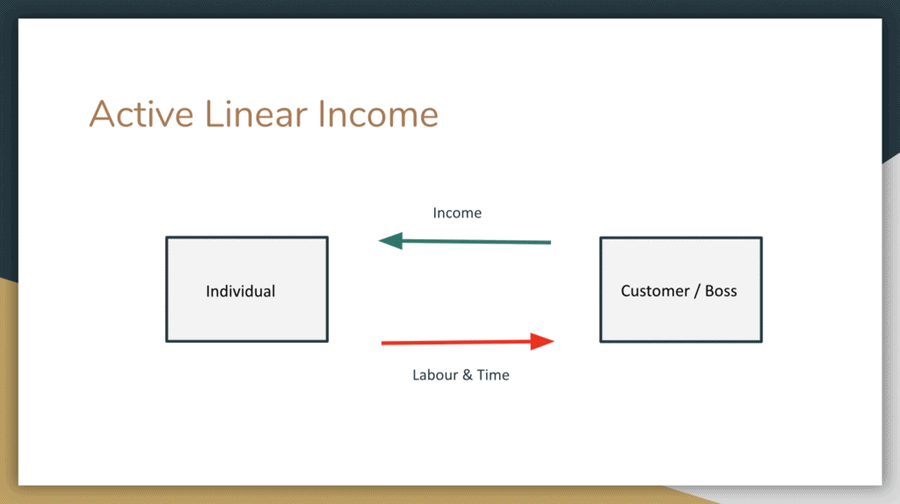
1. Active Linear Income

types of income

It is income derived from an exchange of physical labour and time with a single paymaster. This type of income is most common for it is the fastest means that one uses to make money as it requires the least time, effort and investments to establish this source of income.

For instance:

  • You are an employee working for $ xxx per period (hour, day, week, month, shift, etc.).
  • You are a freelancer who charges a fixed fee of $ xxx per project.
This type of income is useful when one is starting off. After all, everyone has bills to pay. With that being said, this income is dependent solely on your effort physically.

So, it may be limiting in terms of growth for all of us possess only one physical body, 24 hours a day, 365 days a year, and can only be at one place at a time. As such, this leads us to explore our next few sources of income.

Maybe this worth your read : 4 Lessons I Learnt on Wealth And Life As I Enter My 30s

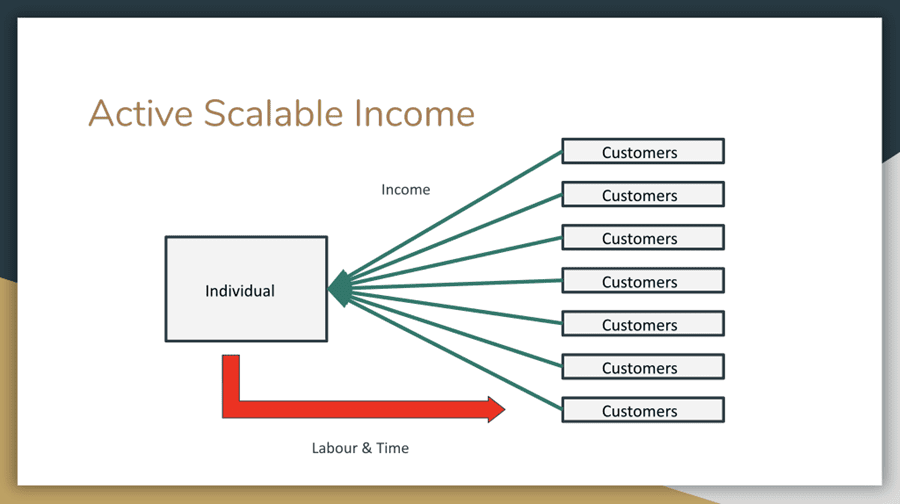
2. Active Scalable Income

types of income

Likewise, it is also income earned from an exchange of physical labour and time but to a network of paymasters. It involves one having built a system or a team or multiples of both to increase income exponentially via scale.

It includes:

  • You earn x% in overriding commission from sales generated from your sales team.
  • You are a freelancer who makes x% profit share from project undertakings.
  • You sell products or services via a network of distributors and retailers.
  • You sell digital products to an online community consisting of xxx people.

This type of income is expandable because the number of clients you serve can increase significantly without you substantially increasing your efforts at work. In other words, a 100% growth in your customer base may bring 100% more income without you increasing your workload by 100%.

This is usually the type of income that propels one from earning 4-figures to 5, 6, or, 7-figures per month, hence, raising more significant capital faster for investments.

But, if it is that good, why not more people earn this type of income?

This is because it requires people to invest time, effort, and money to first learn about marketing, branding, leadership, and system building. Upon which, there might be no immediate payoffs.

For instance, you may have a desire to make millions from pitching your products to a broad audience in a mega preview event. The money sounds enticing. But, you would need first to master effective public speaking and closing.

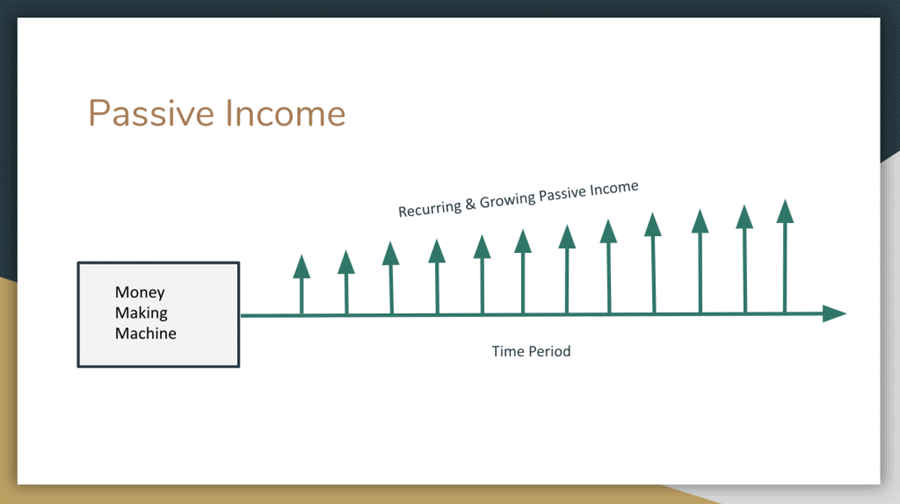
3. Passive Income

types of income

It is recurring income derived from ownership of profitable assets. It includes:

  • Interest income from fixed deposits, P2P lending, and other forms of credits.
  • Coupons from bonds.
  • Dividend income from a portfolio of stocks that pay dividends.
  • Rental income from tenanted properties.
  • Royalty income from intellectual properties.
  • Passive income from owning businesses that you don’t physically manage.

This type of income is awesome because cash is flowing into your bank account without physical labour. In essence, receiving passive income is earning time as it frees your time to pursue what you like. Besides, there are many tax benefits if you have any of the above sources of passive income.

If you are earning $ 100,000 in active income, you will be paying more income tax on as compared to another person who makes $ 100,000 in passive income. He may even pay literally zero in income taxes in Malaysia.

However, you need higher financial intelligence to create passive income effectively. One inevitably has to learn about investing and be a skillful investor with a great temperament.

Therefore, although passive income doesn’t require much physical labour, you need to study a lot (mental labour) before being good at it. Besides, without huge capital, you can’t survive on meagre passive income to do it fulltime.

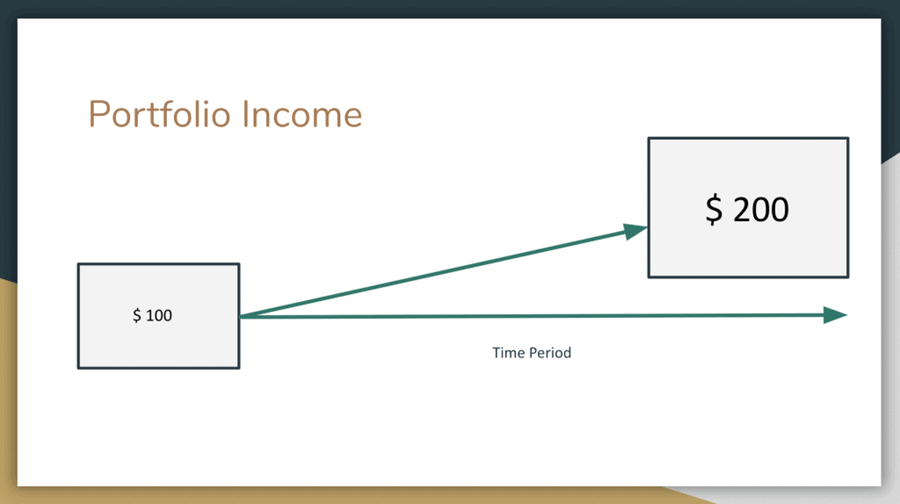
4. Portfolio Income

types of income

It is income derived from market value appreciation of your assets, also known as a capital gain. Alternatively, you can earn this profit via investing in assets at prices below their market valuation. Some examples include:

  • Your stock has appreciated from $1.00 to $2.00 in x period of time.
  • You bought a property for $80,000. Now, it is worth $100,000.
  • The value of your home is $200,000. You bought it for $80,000 7 years ago.

Many people find investing appealing because of the prospects of earning portfolio income or capital gains. It is even more attractive as compared to making passive income for the money is more significant. After all, eating steak immediately is more appealing than having milk every day.

I find there are two types of people who want to earn portfolio income.

First, it is people who are focused on money. They intend to make more money via selling assets at higher prices than their cost of purchasing them. This group of people are either traders if they can make money consistently or speculators and gamblers if they lose money consistently from their activities.

Second, it is people who are focused on accumulating assets. They are not ones who will kill their golden goose as they treasure them. For instance, they would invest in stocks or properties and hold onto them for long-term capital growth. Their mindset is to keep them and not sell them for a profit. In most cases, they would build massive net worth from their investments over time.

5. Phantom Income

It is income derived through the leverage of tax benefits, corporate entities and debt. It is known as Phantom Income as the income is not receivable via cash. It is an income of the rich as it requires a higher degree of financial intelligence to grasp the concept and utilise it fully.

We won’t list down its examples for its explanation is more technical. Here, suffice to say, the best way to use this income efficiently is to surround yourself with a team of advisors such as investors, consultants, accountants, lawyers, bankers and other related professionals.

Looking for financial freedom? 8 Healthy Financial Habits To Build Your Financial Freedom Fund

Conclusion

There you go, the five different types of income that one could earn for himself to increase financial wealth.

If you think about it, the five types of income is an income progression of most wealthy people who began with very little. You would begin with earning active linear income first to survive, expand your income through scale, invest your capital for passive income and portfolio income and roped in a team of advisors to make phantom income by setting up corporations to save on tax payments and use low interest rate debt to accumulate more assets that would build even more wealth.

Now you know how it works. Go work on it!

About the author

This article is co-written by KCLau and Ian Tai

Ian Tai is the founder of DividendVault.com, a platform that analyse and filter stocks that pay increasing dividends year after year.

KCLau is a financial educator. He had published 6 books and co-created a dozen online financial courses. After conducting more than 461 hours of free webinar and 2000 articles published online, he gives away his popular Money Tips e-book volumes absolutely free at his website: https://KCLau.com

Picking the Best Time to Invest

Since the start of the market rout in mid-March 2020, when benchmark gauges worldwide plunged due to pandemic fears over COVID-19, investors are probably wondering if it’s a good time to invest.   A sea of red across equity markets certainly has attracted the attention of bargain hunters looking to scoop up stocks that are trading at a discount to their premium.

However, the vagaries of market timing can make it challenging for investors trying to pick this elusive bottom.

Of course, the biggest question is whether these gains are sustainable or just a dead cat bounce. The reality is that there are too many market variables to know for sure, and what’s more, we are in uncharted territory. The world has never seen an economic shutdown on such a scale before due to a pandemic.

It is likely that the economy is already in a recession as a result of this clampdown on business activity and consumption. The depth and length of this economic slowdown still unclear given the many variables at hand.

But what is absolutely certain is that volatility is poised to persist. 

So What Should Investors Do?

Keeping perspective for one. It may seem like uncertain times, but this isn’t the first time that stock markets have gone through a recession before. History shows that every bull market cycle ends at a higher point than the previous one by subsequently recovering and notching higher gains.

For instance since the MSCI World Index plummeted by -13.5% in March 2020, the index has retraced losses by climbing +10.8% in the month of April.  Similarly the MSCI Asia ex-Japan index recouped back gains of +8.9% buoyed by stimulus hopes as central banks eased monetary policy.

Gains during expansionary periods have also far outpaced losses suffered during a downturn. As such, it is important that investors remain disciplined and stay on track towards achieving their investment goals. Adopting a long-term approach and staying diversified is important in this regard to weather the turbulence ahead.

More defensive asset classes such as fixed income tend to hold up better compared to equities during periods of market stress.  But that does not mean investors should overlook equities completely.

The stock market will eventually recover and it is important that investors stay invested to be in a position to capture that rebound. Similar to sell-offs, market gains often occur in short bursts at high velocity. Timing precisely for such moments require more than a stroke of luck and is highly unlikely.

As can be seen in Graph 1 below, missing out on the best days in stock markets can significantly undermine an investor’s long-term financial success.

Graph 1: The Cost of Market Timing The Risk of Missing the Best Days in Market, 2000 – 2019  
Capture
Source: Morningstar, 2020

According to research by Morningstar, investors who stayed in the market for all 5,035 trading days achieved a compound annual return of 6.1%. However, that same investment would have returned 2.4% had it missed only the 10 best days of stock returns.

Further, missing the 50 best days would have produced a loss of 5.5%. Although the market has exhibited tremendous volatility on a daily basis, over the long term, stock investors who stayed the course were rewarded accordingly.

This underscores the peril of market timing that could lead to significant opportunity loss. 

The appeal of market-timing is obvious by avoiding periods of poor performance to improve portfolio returns. But the truth is timing the market consistently is extremely difficult that even the savviest investor can get wrong.

As aptly put, history does not repeat itself, but it often rhymes. The COVID-19 pandemic may be unprecedented with little clarity yet on outlook, but some of the strongest rebound often occur when the market is at its most bearish.

The ideal approach to invest in such a period then is by staying disciplined and investing consistently by sticking to a regular investment plan to ease one’s way into the market.

Over the long-term, this would reduce the impact of volatility by spreading out your investments over periodic time intervals by dollar cost averaging. This ensures that one do not buy at inflated prices as well as seize the opportunity to acquire more units at lower prices.

Best Time For You, Not The Market

stock chart candlestick

Instead of looking outward and trying to time the market, investors should turn inward to decide when the best time for them to invest is. 

An easy way for investors to do so is by asking themselves basic financial questions such as:-

  • Do I have enough in my emergency savings to cover necessities?
  • What about future commitments and liquidity needs?  
  • Can I take a long-term view on my investments?

The global economy is undoubtedly in a fragile state as businesses grapple with closures due to nationwide lockdowns to stem the spread of the coronavirus. With companies embarking on cost-cutting measures, the likelihood of pay-cuts, redundancies and job losses may be inevitable.

That is why the importance of having enough in emergency savings cannot be emphasised enough. A rule-of-thumb is that one should have at least 3-6 months’ worth of living expenses in a rainy day fund for precisely in times like these.

Similarly, investors should also look at their time horizon and liquidity needs. Do you require cash to pay any outstanding debt or expenses in the near future? Also, can you afford to hold your investments without withdrawing for at least 3 years?

These are important points because no investment can churn out returns overnight.  Patience is needed for investment success and history has proven to be kind to investors who do sit through market cycles and stay invested.

Waiting for the perfect time to invest should not be an external exercise and what happens in the market.   Rather, it should be an introspective one by taking into consideration your own financial standing, investment horizon and risk appetite.

About The Author

Sheungun

Lee Sheung Un is the Communications Officer of Affin Hwang Asset Management. A former business journalist, he is an ardent investor who is passionate about markets and is working towards building his dream portfolio.