My wife and I are both accountants. We have two children, one of them is a child with special needs. I’ve always known the importance of getting our family’s financial planning done, but never quite came around to it due to our busy schedule.
We were lucky to have met Pauline, our Financial Planner. She was interested in finding out our goals and how she could help us to achieve them. After taking the time to understand us, she helped us in assessing where we are now and what actions we need to do in order to achieve our goals. She helped us to come up with our financial plan.
I’m very happy that we engaged Pauline for her services. Truth be told, it is actually a tedious process to get the plan done. It requires perseverance and knowing how to go through each of the steps. Luckily, with Pauline’s help, she guided us through it and gave us the options and suggestions which helped us a lot during our financial planning journey.
Once we have completed our financial plan, we now know our financial standing, and what our spending is like. When we first saw our cash flow, we were surprised that we have been running a deficit. Within a month, Pauline helped us to identify the key areas which can be improved.
Through financial planning, we also realized that some of our insurance plans did not match with our family’s needs. Pauline was non-biased and was very objective in her advice to us. She helped us to streamline and optimize our current policies to meet our objectives. With this, we are able to save a substantial amount of money on insurance premiums alone.
Pauline also helped us with our estate planning. We initially had our Wills and Trust drawn up. After reviewing it, we realized there were many areas that were left hanging and no longer matched our needs. Pauline highlighted the areas which we never considered before and it was extremely helpful for my wife and me to consider restructuring our Will and Trust.
This was especially true for our special needs child. This area has always been a major concern for us as we want to ensure that both our children are taken care of, in the event something happens to us.
I’m glad we did our financial plan with Pauline. Once you are her client, she puts your interest first and lets you know the best way to manage your finances even if it means she’s not going to get anything out of the recommendation.
This is what I call “professional” and doing her business with “passion” and “from the heart”. She is also very detailed and tactful on how best to resolve the issues by giving us options for us to consider.
The best thing about getting my family’s financial planning, is that me and my wife are clear on what our needs are and how much we need to save to achieve our goals. We no longer need to second guess like before. After going through this process, I feel that having a financial plan is very important. Especially if you have a family to take care of, or if you are unsure whether you are saving enough for the future.
About the Author
Pauline Teoh loves to coach busy professionals to achieve their financial independence. She is a Licensed Financial Planner, Childpreneur Coach and is an expert in Risk Management, Investment Planning and Estate Planning
“Losing your loved ones is tough, but having a financial planner in your life does help”
I am Monica, a widow aged 52 years old. I came from a poor family and didn’t know anything about finance or money management when I was growing up. I have been working hard with my late husband Andy, in the trading business for the past 20 years and we managed to grow our assets along the way.
Initially we thought that buying a simple life insurance is all there is to financial planning. That was until I was introduced to Stanley back in 2013.
We were skeptical and delayed our meeting with him as we thought he is another salesman coming over to sell financial products. I am a person who does not believe in investment and financial planning. Instead I believed that holding cash is the right thing to do.
Stanley spent many hours meeting us and patiently listening to our financial concerns. He is then able to understand and identify our life and financial goals. Stanley shows the financial pitfalls that we are facing and help us to visualize our cash flow and net worth at that time, while being able to identify our financial gap and estate planning concerns on multiple different scenarios.
After his careful review, he restructured our existing insurance portfolio and managed to increase my late husband’s insurance coverage substantially from what we have based on our limited cash flow. His integrity and process-oriented independent review, and ability to access all types of financial products in the market really impressed us.
Stanley also advised us to set up a complete testamentary trust in our will for resource preservation. Using resource liquidation strategy, we are able to avoid estate shrinkage and potential resource squandering by anybody who is not good at financial management. I am fortunate to follow the advice from Stanley which makes the estate execution process very efficient.
My husband was diagnosed with terminal cancer in 2017 and passed away a year later. Stanley did a good job with timely and efficient claims process. I was able to sail through the difficult period smoothly. He even visited my late husband almost every week in the hospital and accompany us until his last breath. Some of the big insurance policies that we bought a few months before the diagnosis date, Stanley is able to help us claim the insurance payout within a short period of time.
Our family benefited a lot from the insurance payouts. We managed to pay off our mortgages and ensure that our children’s tertiary education is fully funded. Our life and dignity is improved by using the resource optimisation strategy recommended by Stanley on a conservative money management. I am holding a well-diversified investment portfolio and received timely fixed payment to cover our living expenses. We are also being updated regularly on the market’s movement.
I am glad that Stanley is also able to provide my children with solid financial knowledge. Now all my children have graduated and they are back at my company to help me run the business. Stanley also provided my children with tips on business resource optimisation strategy to weather the pandemic and it has helped us tremendously.
I am comfortable knowing that we have a financial peace of mind under Stanley’sgood hands. We are very much on track to achieve our family’s financial goals!
About the Author
Stanley Hon is Practice Group Director at FA Advisory Sdn Bhd. He is a Licensed Financial Adviser, MDRT & Speaker, Will & Trust Specialist.
Anwar reached out to me in 2018 as he needed help with his personal finances. As the only son in his family, he was the executor of his late father’s inheritance. His father passed away many years ago due to cancer, and he remembered clearly the financial drain from cancer treatment.
34-year-old Anwar is a lecturer at one of Malaysia’s largest universities. His wife is a housewife taking care of their two children, aged 7 and 4.
“Although my father’s death hit us badly, we were thankful that he did not leave us with massive medical bills. This is because our prudent father had a healthy emergency fund,” shared Anwar.
Being the main breadwinner of his own growing family, he needed to prepare for such emergencies. Just like his father, he wanted to ensure that his wife and children are well-provided for in case anything happened to him.
Anwar’s father was a banker and had taught his children about saving money. Anwar also has a keen interest in personal finance and investment, and had read books and attended a Do-It-Yourself (DIY) course from a financial guru.
However, he found that the information was too overwhelming and didn’t know where to start with regards to his own personal finances. Having been approached by unit trust and insurance agents, he was wary as he recalled, “They were more interested in pushing their products for commission rather than to put a roadmap and direction for me to achieve my financial goals”.
Here are the 3 values of a full financial planning.
1. An Expression Of Love
Anwar and his wife know how dire their financial situation will be if Anwar passes away prematurely. People tend to forget verbal reminders easily. But if it is written in the form of a will, wishes, hopes and dreams; it helps tremendously.
Furthermore, the engagement allows him to translate his expression of love, his long-term and short-term goals into actions, and not just a wish. During our discussion, one of Anwar’s goals is to support his wife’s pastry business once his financial situation has improved.
After the third year of our advisory engagement, Anwar manages to make his wife’s goal into a reality. (You can check it out on Instagram Pastreen; it’s really delicious)
2. Aligning Strategy With Financial Goals
We provided insights to help him map out the strategies to reduce the Debt-to-Service Ratio (DSR), ideal asset allocations for his financial resources and guidance on financial products he should consider getting with the time horizon he needed in order to achieve his financial goals.
Since he was willing to start early, he will have more options and opportunities to optimise his wealth. As his financial planner, my role is to guide him with the options available so that he can take ownership in his financial planning by making an informed decision.
Anwar now understands the importance of building a healthy cashflow, and how to lead his ideal life within his means.
3. Financial Needs And Wants
A common situation is the relationship between savings for building cash reserves and other goals in life such as buying an asset. Many are unsure if they are over-committing one financial goal at the expense of another.
With a holistic financial plan, we can see how extra commitments will affect other financial goals. It helps to adjust our actions, weighing the pros and cons before deciding. Most importantly, it is a tool to effectively communicate your financial situations and life goals.
Conclusion
Anwar is a real-life story of “It is not about how much income you make, but how well you manage your income”. Without a roadmap and direction, we might spend unnecessarily and make poor financial decisions. Financial mistakes are painful.
Similar to inflation, financial goals and financial freedom are a challenge to understand and to manage, because it is intangible. Only after acknowledging what an ideal life is, you can move on to support your goals in life.
About the Author
Saidah Asilah started her career as a graduate trainee with Securities Commission Malaysia. Then, with a deep interest in investments, she furthered her studies in MSc in International Business and Emerging Markets, graduating in 2013 from The University of Edinburgh, UK. She is a Licensed Financial Planner, CFP Professional & IFP Certificant and describes herself as a multi-talented adventurer with a positive impact to whomever she meets. She can be contacted at saidah@wealthvantage.com.my.
We at Smart Investor and Wealth Vantage is committed to help you better manage your financials. Get a free consultation from an expert by filling in your details here: https://www.smartinvestor.com.my/SIxWealthVantage
“Given the nature of these alternative investments at this juncture – where price discovery remains a challenge, volatility is high, and long-term values remain uncertain – it would be more appropriate to classify them as part of your high-risk investment bucket.”
It is almost impossible to miss the headlines these days about the next new investment idea. Chances are those new ideas are likely related to digital assets (e.g. cryptocurrencies) or online funding intermediation (e.g. peer-to-peer lending or equity crowd funding) and the like.
These options seem to be the most attention-grabbing ones, attracting both seasoned and novice investors alike. This begs the all-important question – are these investments suitable for you?
To help us get a grip on this question, let us briefly take a look at what each of these alternative investments are, how it works and how can you benefit from it.
1. Digital Currencies (a.k.a. Crypto Currencies)
Digital currencies as the name suggests are an alternative means of a financial exchange in a non-physical format. This is unlike fiat currencies that are government issued and regulated such as the US dollar, British pounds or our own local currency – the Malaysian ringgit. Among digital currencies, bitcoin remains the most well-known and sought after.
The rise (and fall) in value of digital currencies has been nothing short of phenomenal. However, apart from scarcity, it would seem that speculation (partly fueled by celebrity tweets) and regulatory risks seem to be main drivers of price movements for now. This could change as digital currencies start to gain a foothold as a medium of exchange, potentially replacing fiat money in the future.
For now, an investor will monetise any returns by selling the investment, hopefully at a profit.
2. Peer-to-Peer (P2P) Lending
As the term suggests, this involved the lending of funds between individuals, supported by a platform as an intermediary to facilitate the process. It is effectively a way of cutting off the middleman’s role which has long been played by financial institutions.
In P2P lending, also known as “social lending”, investors are offered a socially attractive value proposition by borrowers who might otherwise find it challenging to fund their enterprise via traditional channels. Investors receive returns in the form of interest payments at the end of the loan period.
Given that these often represent higher risk lending, the interest payment will likely be higher than bank fixed deposit rates.
3. Equity Crowdfunding (ECF)
ECF works similarly to P2P lending in that it provides an alternative source of funding for budding companies. However, the main difference is that ECF investors will receive a stake in the business instead of an interest payment. This might be an attractive proposition for those looking to discover the next unicorn investment.
However, investors should also be aware of their exit strategy before committing their hard-earned money.
What’s Your Risk Profile?
Now that we have some high-level idea about these alternative investments – are they right for you? Instead of limiting your analysis to the investment idea itself, I would suggest that the question is better answered by firstly determining your investment risk profile, followed by your ideal strategic asset allocation. Only then should one take the plunge to invest.
Investopedia defines risk profile as “an evaluation of an individual’s willingness and ability to take risks”. Are you a risk taker by nature, fully aware of how investment values fluctuate depending on market condition and are ready to ride out any storm that come your way?
Or are you the more conservative type – preferring to err on the side of caution by placing your hard-earned money in risk-free assets?
Secondly, how long can you remain invested? If you need to use the fund in the next one to two years, then investments should not be on your mind. However, if your investment duration is between three to five years, perhaps you can consider moderate risk rated investments.
If your funds can remain invested for over five years, then you are in a better position to weather the ups and downs associated with higher risk assets.
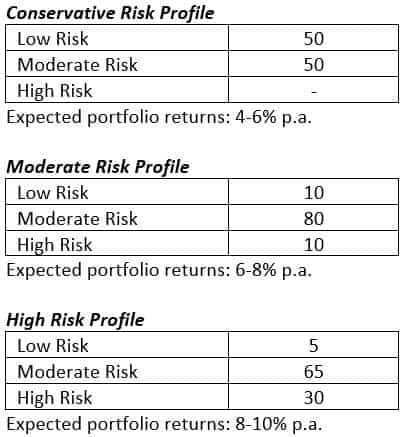
Answering these two questions will give you an idea of your risk profile – conservative, balanced or aggressive. Next, you should determine your ideal asset allocation. The strategic asset allocation is a breakdown of your investment allocation into three simple investment asset classes – low risk, moderate risk and high risk.
Low risk assets would comprise of risk-free assets that hold their values and likely have a pre-determined rate of return. Examples would include deposits place in financial institutions and government issued bonds like Malaysian government securities (MGS).
Other fixed value assets with variable expected returns or those with minimal price fluctuations that fit this category include our Employees Provident Fund (EPF) savings, certain fixed priced Amanah Saham funds and low risk fixed income securities like money market funds or capital protected products.
Moderate risk assets on the other hand have the potential of generating a higher variable return (e.g. between 4-6% p.a. above the risk free rate) and could comprise of assets such as blue chip dividend stocks or a balanced diversified portfolio consisting of shares and bonds. Property assets and REITs that offer both regular income and potential long-term capital appreciation can be categorised here as well.
Lastly, we have growth or high-risk assets that are made up of stocks in a diversified portfolio of expansion-focused companies, small to mid-sized businesses in developing countries, commodities and perhaps alternative assets such as private equity investments or collectibles like wine, luxury watches and paintings.
These may fluctuate a lot more in value but offer potentially better long-term returns.
Let us look at a simple approach to asset allocation for one’s investable assets:
A moderate risk investor would probably place the bulk of his investable assets in moderate risk assets and only around 10% in the high-risk space. From this allocation, he should expect a blended overall return of around 6-8% p.a. As such, the strategic asset allocation gives you an idea on how you can select a combination of different assets classes and the corresponding expected returns on your overall portfolio.
Given the nature of these alternative investments at this juncture – where price discovery remains a challenge, volatility is high, and long-term values remain uncertain – it would be more appropriate to classify them as part of your high-risk investment bucket.
Back to the question of whether investing in those alternative assets in the examples given are suitable for you, firstly consider where it fits in based on the suggested strategic asset allocation.
Perhaps a 10% allocation in each of these strategies would be sufficient for most. In simple terms, this means roughly 1-3% allocation of one’s investable assets would be about right for the balanced to aggressive profile investor.
In conclusion, the next time you encounter an innovative investment option that comes across as the best invention since sliced bread, the first thing you need to do is to increase your knowledge and understanding of that product instead of signing the dotted line simply based on a herd mentality or the fear of missing out.
Should you decide to proceed thereafter, then invest based on your ideal strategic asset allocation in line with your risk profile. This golden rule should keep you in good stead for a long time to come.
About the Author:
Felix Neoh CFP CERT TM is the Director of Financial Planning at Finwealth Management Sdn Bhd and is a certified member of FPAM. He can be contacted at enquiry@finwealth.com.my
We at Smart Investor and Finwealth is committed to help you better manage your financials. Get a free consultation from an expert by filling in your details here: https://www.smartinvestor.com.my/SIxFinwealth