
Wednesday, 5 August 2026 Stay informed. No noise.

Alternative Investments for Individual Investors

Alternative investments for individual investors are financial assets that do not fall into conventional asset classes and often tend to attract younger investors. Firstly, what are alternative investments? They are labelled as such because these financial assets do not fall into the more conventional asset classes of equity, bonds, properties, or cash investments. Alternate investments can be further divided into subcategories such as commodities, private equity, collectibles, and cryptocurrencies. Typically, alternate investments do not form the core of your investment portfolio but instead form less than 10% of your overall portfolio.

No matter what you call alternative investments, this asset class has been grabbing headlines. At the forefront is cryptocurrency with bitcoin having skyrocketed to new highs above US$40,000 (RM160,000). Another increasingly popular alternative investment is gold which has gained some new followers with fintech now allowing you to buy fractional gold via an app. Lastly, we have P2P financing which allows investors to legally lend money to small businesses and entrepreneurs via an online P2P platform.

Why Do Alternative Investments Appeal to Young Investors?

Alternative investments are generally viewed as high risk and highly volatile. These investments are also more often embraced by younger (and young at heart) investors who are comfortable with technology, while older (or more risk averse) investors may shun away from investing online or via an app into an investment that talks about blockchain or fractional investing. Older investors may also have a preference towards more traditional investments such as stocks and property.

Younger investors tend to find investing in alternative investments, especially those powered by fintech, as more transparent and are often attracted by the lower fees. Alternative investments also provide higher potential returns while allowing investors to diversify and own assets that aren’t correlated to the stock market. As it’s more volatile, alternative investments also provide an avenue for trading which allows investors who like trading to scratch an itch!

How Do Alternative Investments Perform?

Along with the higher risk and volatility, alternative investments also enjoy potentially higher returns. For example, bitcoin’s price rise in 2020 was over 300%, towering above most if not all other asset classes, while the YTD rise for gold is around 23%. For P2P financing, returns can range from 10% to 18% according to data provided by P2P financing operators in Malaysia.

While alternative investments appear to be doing well, it’s a double-edged sword as investments could potentially go downwards significantly as well. For example, the Great Crypto Crash of 2018 saw the price of bitcoin drop 80% from its peak which is an even bigger magnitude of loss than the dot-com crash. 

Gold is also often falsely perceived as a low risk asset and a safe investment during times of crisis. In fact, gold is highly volatile with an average volatility moving upwards (or downwards) of 16% a year! P2P financing investors on the other hand face risks in the face of rising default rates whereby borrowers are unable to pay and the losses affect investor returns.

What You Need to Know about Investing in Alternative Investments

This comes with its fair share of risks and know-how. For example, a common question when investing in alternative investments is whether you will be taxed in Malaysia. Cryptocurrency is not taxed if you are not trading crypto as your primary source of income. 

However, for P2P financing, investors are required to declare gains and will be taxed. For gold investing if you are a Muslim, you will need to pay zakat, a mandatory form of Islamic obligation tax, if you hold gold above 85 grams. This applies even if you cannot see or touch the gold physically as halal gold must be backed up by actual physical gold to be Syariah compliant.

Let us narrow down good rules of thumb for investing in these alternate investments. Bitcoin is a highly speculative investment with massive gains and drops thus you may want to hold no more than 5% of your investment portfolio in cryptocurrency. It’s also important to note that cryptocurrency is not viewed as legal tender in Malaysia but there are three digital asset exchanges (cryptocurrency exchanges) recognised by the Securities Commission. 

P2P financing also faces the risk of defaults, so you may want to ensure you spread your risk across different borrowers (or even different P2P financing platforms). Do read up on the borrower’s financial information before investing in any P2P financing notes. Gold has its fair share of criticism as well as it does not generate any returns but is a good hedge against times of crisis. Do be aware of the gold spread, which is the difference between the buying and selling price of gold, and any fees charged which will reduce your returns.

What Lies Ahead for Alternative Investments

Cryptocurrency especially is an interesting alternative asset to watch. It’s increasingly being viewed as a store of value, thus earning the nickname of digital gold. Digital payment platforms PayPal and Venmo announced that they will support transactions in bitcoin and other cryptocurrencies driving an increase in usage and liquidity. There is also a growing number of institutional investors in bitcoin as a reserve asset and an alternative to fiat currency such as the US dollar which is showing a decline in value.

Overall, alternative investments are becoming increasingly popular with financial technology and slick, shiny apps appealing to young and young at heart investors. Increased competition, lowered costs with fintech, and an increasingly global investment market will further spur growth in these risky but promising investments.

About the author 

Stephen Yong (MBA, CFP cert ™) is a licensed financial planner and can be contacted at stev.yong@wealthvantage.com.my.

How to: Achieve Financial Independence in 5 Years

In the digital age, many young Malaysians are eager to invest and grow their hard-earned money.

Through information, they have obtained on the internet and through their peers, they understand the importance of growing their wealth through investing and have a desire to achieve financial independence as early as possible.

There are also young adults who find it more comfortable to not invest until their financial situation becomes more stable or they have more money to invest.

For this category, they are looking to invest and will do so when they have the extra disposable income to set aside.

There are also others who have embraced the YOLO lifestyle, looking to live in the present and are accustomed to instant gratification.

They spend every ringgit they earn, and perhaps even more by borrowing through their credit card or personal loans and choosing to let tomorrow worry about itself.

Whichever category you may fit in, one key point to take home is that if you’re in your 20s, you have a big advantage over many others when it comes to investing.

Here are three reasons why your age can be your biggest advantage:

1. Time and Compounding Interest

There is a famous saying attributed to Albert Einstein where he called compound interest the “8th Wonder of the World.”

Whether Einstein said this or not, compound interest is the key that allows young investors to grow their wealth over time.

Compound interest requires only two things: the reinvestment of earnings and time.

  • Compound interest can be thought of as “interest on interest,” and will make a sum grow at a faster rate than the simple interest which is calculated only on the principal amount.
  • Interest can be compounded on any given frequency schedule from daily, to annually.
  • When calculating compound interest, the number of compounding periods makes a significant difference.

Assuming a 6% interest rate per annum, the table below shows the stark difference in the final amount based on how long an initial investment of RM10,000 is put to work:

Starting Age Compounding Period (Years) Final Amount at Age 60
20 40 RM 102,857
30 30 RM 57,434
40 20 RM 32,071

The longer money is put to work, the more wealth it can generate in the future for you.

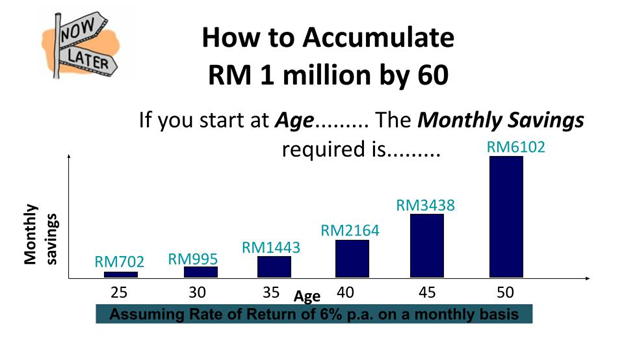
Here’s another chart that demonstrates how much you would need to set aside every month at different ages, assuming you are looking to accumulate RM1 million for your retirement.

As shown below, if you start investing at an earlier age, it is much easier to hit your financial targets through the sheer power of compounding interest.

How to Accumulate RM1 million by the age of 60

2. The Ability To Take Risk

It goes without saying that higher-risk investments that are more volatile yield the highest return. Simply put, the higher the risk, the higher the return and the lower risk, the lower the return.

Younger investors are usually focused on growing their wealth and should invest in higher return investments.

This is because you have the time to recover if something were to go wrong, giving you the opportunity to make riskier moves. For example, when you are in your 20s, even if you suffer a loss today, you’ll be working for the next 25-40 years and have many years to earn an income. In short, you’ll likely recover from that investment loss.

Those who begin to invest late in life are often inherently more cautious with how they invest their money.

As one nears retirement, one usually starts allocating their investment portfolio to lower risk assets which correspondingly have lower returns. By starting late and having lower returns, one might fall short of their financial goals.

3. Learning by Doing

As a younger investor, you have the flexibility and time to study investing and learn from both successes and failures.

Since investing has a fairly lengthy learning curve, young adults are at an advantage because they have years to study the markets and refine their investing strategies.

You will make money, and lose money on some investments.

Examples of things one needs to learn can include opening a stock trading account, opening a mutual fund account, buying real estate, or even calculating investment returns – these are all best learnt through experience.

There are many other aspects when it comes to investing such as understanding how the market works, how the economic cycle affects your investment, or how mutual funds and Robo-advisor fees can affect your returns.

Gaining this experience at a younger age will give you the confidence and knowledge to invest and grow your wealth to achieve your financial goals in the long term.

Capitalise on Your Biggest Advantage

There are many factors that one looks at when designing an investment portfolio. Ultimately, it should be designed to allow you to achieve your financial goals, be it short-term such as planning for a wedding, or long-term such as retirement.

It cannot be overstated how beneficial it is to start early. In today’s information age, it’s your responsibility as a young investor to educate yourself on investing and take action to capitalise on the key advantage you have, which is time.

Time cannot be bought and unlike investment losses, lost time cannot be recovered.

Every day you delay is an opportunity loss to capitalise on the power of compounding interest and the ability to take risks.

When one starts early, you get to learn from experience and make mistakes when they are less costly (ie. you have less money to lose) compared to when you get older.

About the author

Nicholas Wong is a licensed financial planner and can be contacted at nicholas.wong@ipp.com.my.

A Multi-Generational Wealth Manager for HNWIs

For many high-net-worth individuals (HNWIs) in the region, managing and growing their wealth has become ever more complex with the heightened uncertainties and volatility of recent times.

This is especially so given the Covid-19-induced global economic shock, US-China trade tensions, rising geo-political risks and prospect of Black Swan events. This is where the value of family offices and private wealth managers come to the fore in helping these HNWIs strengthen the pillars of their wealth.

And this is a business segment that Affin Hwang Asset Management has seen growth in recent years. In fact, the wealth segment will be a key business focus over the next five years for the asset management firm, which has total assets under administration of RM60 billion as of 30 June 2020.

“With more focus and resources, we can continue to grow this segment in line with Affin Hwang AM’s aspirations to be a distinguished wealth manager in Malaysia and the region,” says Shawn Kong, senior director, Institution, Corporate & High-net-worth individuals (HNWI) Business.

It also sees a transfer of wealth across generations with more millennials becoming high-net-worth individuals in the coming years. In reaching out to this group, Kong says Affin Hwang AM will continue adapting to become “a multi-generational wealth manager” by listening to their needs and growing together with its clients. Here are excerpts of our interview with Kong on the company’s fast-growing private wealth business.

Smart Investor: Wealth structuring whether it’s wealth creation, capital preservation or intergenerational planning has become more complex in light of heightened volatility and black swan events like Covid-19. What is your take on this and how do you think the private wealth landscape has evolved in the new normal?

Shawn Kong: Investments and markets today have evolved. Market cycles are a lot shorter and more volatile, as we saw this year with the pandemic. Interest rates are low and overall economic growth is slow. As such, investment and wealth management has become more complex and challenging.

In a world of complexity, the team at Affin Hwang AM is all for simplifying wealth management to our clients. It is crucial to first understand the objective of the wealth structuring for a person or a family before putting in wealth planning tools or products. Upon understanding the investment objective and risk tolerance, we can then craft a suitable diversified portfolio for our clients.

With heightened volatility, it is essential for clients to first understand the risks of their investment to ensure they are comfortable with the risk they are taking. A litmus test question that I always find helpful would be to ask clients if they are able to sleep at night with the level of risk or volatility that they are taking.

SI: What have your conversations been with private wealth clients and their main concerns today?

SK: As we enter a historically low interest rate environment, our recent conversations with clients have centred around the search for yield. There is renewed interest in fixed income and dividend yielders as investors seek to enhance portfolio yields to beat long-term inflation.

On the other end of the risk spectrum, another common conversation would revolve around the sharp equity recovery since the rout in March due to Covid-19. Many would have felt that they might have missed out on the strong rebound in markets.

A divergence between how well global and regional equity markets have performed due to ample liquidity versus poor economic fundamentals on the ground presents a dilemma for equity investors. Is it too late? Is the rally sustainable? Those are the questions that keep cropping up.

Eventually, our client engagements would lead to crafting a well-diversified core portfolio that would provide long-term exposure to a broad range of asset classes, investment strategies and regions. We would overlay that portfolio with some tactical ideas or strategies to capture shorter-term opportunities. It is also crucial to have an on-going portfolio monitoring and review with clients regularly.

SI: Is there strong appetite for risk including alternative asset classes? How are you guiding asset allocation for your private wealth clients?

SK: Alternative asset classes like private equity, private debt/ mezzanine funding or private real estate can be very attractive diversification opportunities aside from public equity and fixed income.

Private equity will provide clients with the opportunity to participate in the growth of a business in the earlier stage before it goes public, thus enhancing the long-term returns.

On the other hand, private debt or mezzanine funding, which behaves more debt-like instruments, will give recurring income via coupons (typically higher than tradable bonds in the market). The trade-off for these asset classes would be liquidity and usually a longer investment horizon, compared to the public markets.

We would guide our clients to invest into these asset class according to their risk profile and investment horizon. A more aggressive client may have a higher allocation to private equity while a more conservative client would be more suitable to private debt.

It is key to know what t he underlying investment is and to understand the risks as well as how the returns are generated. In the case of investing into private funds, it is also important to understand the style of the manager and their track record.

We have recently provided clients with access to private real estate related deals, from asset-backed securities (ABS) to private REITs; whereby the listing of the asset 3-5 years down the road would give investors a decent total return. All these alternative options provide ways for investors to gain further diversification especially from traditionally listed equities or fixed income that are publicly traded.

SI: We are seeing a massive transfer of wealth across generations with a larger number of millennials becoming high-net-worth individuals. How is Affin Hwang AM adapting to this demographic shift and catering to the needs of a new generation of wealthy investors?

SK: The millennial generation has access to infinite amount of information via technology. How Affin Hwang AM can add value is to make sense of all that information or data to help clients translate them into investment decisions. Digitalisation is also important to enhance their investing experience whether it is portfolio monitoring or smoother execution of transactions.

We have also been running various “future leaders” programmes which include seminars, workshops, study visits and networking sessions to create value for the younger generation of our investor base. Seminar topics range from investment and market updates, wealth preservation concerns as well as leadership and business innovation.

We are mindful of the large transfer of wealth that is going to take place across Asia (Malaysia included) over the next 20 years. Thus, it is imperative that Affin Hwang AM continues to adapt to be a multi-generational wealth manager over time by listening to their needs and growing together with our clients.

SI: What further plans does Affin Hwang AM have to grow its private wealth segment?

SK: This wealth segment is one of our key business focus over the next five years. We have made some encouraging initial progress and growth over the past five years. With more focus and resources, we can continue to grow this segment in line with Affin Hwang AM’s aspirations to be a distinguished wealth manager in Malaysia and the region.

Among our plans is to continually expand our investment offerings and solutions (e.g. asset classes, strategies, regions and currencies) to help our clients achieve optimal diversification in their portfolios.

Within the wider wealth management ecosystem, we can then also build other pillars of our client’s wealth including wealth preservation and distribution. We are also continuously upskilling our people and talents as we grow the team.

Our key proposition as a wealth manager is that we are investment-led, given our roots in asset management as well as client-focus, where we strive to live up to our mantra to always put our client’s interests first.

Our long-term growth and success has been anchored by this singular trust that we have built with our clients over the years.

This article was originally published in the September-October 2020 issue of Smart Investor.