
Wednesday, 5 August 2026 Stay informed. No noise.

Morningstar Awards Highlight Quality of Investments

This year, Morningstar Asia Limited announced the winning funds and fund houses for its Morningstar Fund Awards Malaysia in a rather unconventional way. The awards ceremony, which is typically held annually in Kuala Lumpur, was instead hosted via a special webcast on March 19 in light of the Covid-19 outbreak globally. 

Nevertheless, the change in the awards ceremony format did not prevent Morningstar Asia Limited, a subsidiary of Morningstar, Inc., a leading provider of independent investment research, from recognising retail funds and fund houses that have added the most value for investors within the context of their relevant peer group in 2019 and over longer time periods. 

Morningstar selects the winners using a quantitative methodology, along with a qualitative overlay. Weightings to one-, three-, and five-year risk-adjusted performance are factored into the methodology.

Public Mutual Bhd was the biggest winner, sweeping four out of the five awards on offer. Malaysia’s leading unit trust company took home the awards for Best Asia-Pacific Equity Fund, Best Malaysia Large-Cap Equity Fund, Best Malaysia Bond Fund and Best Malaysia Bond (Syariah) Fund. 

Principal Asset Management Bhd’s Principal Islamic DALI Equity Fund (formerly known as CIMB Islamic DALI Equity Fund) won the Best Malaysia Large-Cap Equity (Syariah) Fund. 

In his speech delivered via the webcast, Morningstar Asia chief executive officer Nick Cheung said Morningstar’s Annual Awards highlight the quality and breadth of investments available for investors in each region. “Our 2020 winners have been great drivers of investor success. It is our honour to recognise their outstanding achievements and commitments to investors.” 

Cheung pointed out that every year, Morningstar presents awards to more than 30 countries globally to recognise exceptional fund managers and investment teams who deliver value to investors, and put investors’ interest at the first place.

“This is in perfect alignment to Morningstar’s vision, which is to empower investors to make more informed investment decisions, and make better investment outcomes. Morningstar has a long history of helping investors.

“Despite the current diff cult environment, we continue to invest to allow investors to have more and expanded research coverage on equity, fund, ETF, ESG and private investments,” Cheung said. 

For example, he said Morningstar will soon roll out a new web-based analytic platform of Morningstar Direct which has new features and data sets to allow investors to make better informed investment decisions. 

Delivering market-beating returns

Wing Chan, Morningstar’s director of Manager Research Practice, EMEA & Asia, said the 2019 rally in both equities and bonds has rewarded investors handsomely. “However, it was also one of the more unpredictable periods in history, with low interest rates, heightened geopolitical uncertainty, and stretching asset valuations continuing to worry investors. 

“The awards winners, across our equity and fixed income categories, have proved their ability to deliver market-beating returns over the long term without undue risk,” he added. 

On what Morningstar looks for when picking the winning funds for the annual awards, Andrew Daniels, senior analyst, Equity Strategies, Manager Research for Morningstar Asia, said the goal is to recognise those funds that have added the most value within the context of a relative peer group for investors over the past year and the longer term. 

On how Morningstar plays a key role in helping bring about better outcomes for investors, Daniels said Morningstar offers a global reach and has earned investors’ trust through its unbiased and independent research, investor-centric mission, and thought leadership.

“Since its founding more than 35 years ago, Morningstar’s mission has been to empower investor success. We believe that by taking something nebulous, such as the financial services industry, and making it transparent, investors gain the knowledge to make better decisions. 

“As a result, Morningstar builds unique products and services that connect people to the investing information and tools they need, because when investors are successful, so are we.”

Sidebar

By Lee Min Keong

Please click here to read the full article in the digital edition of Smart Investor (April 2020 issue).
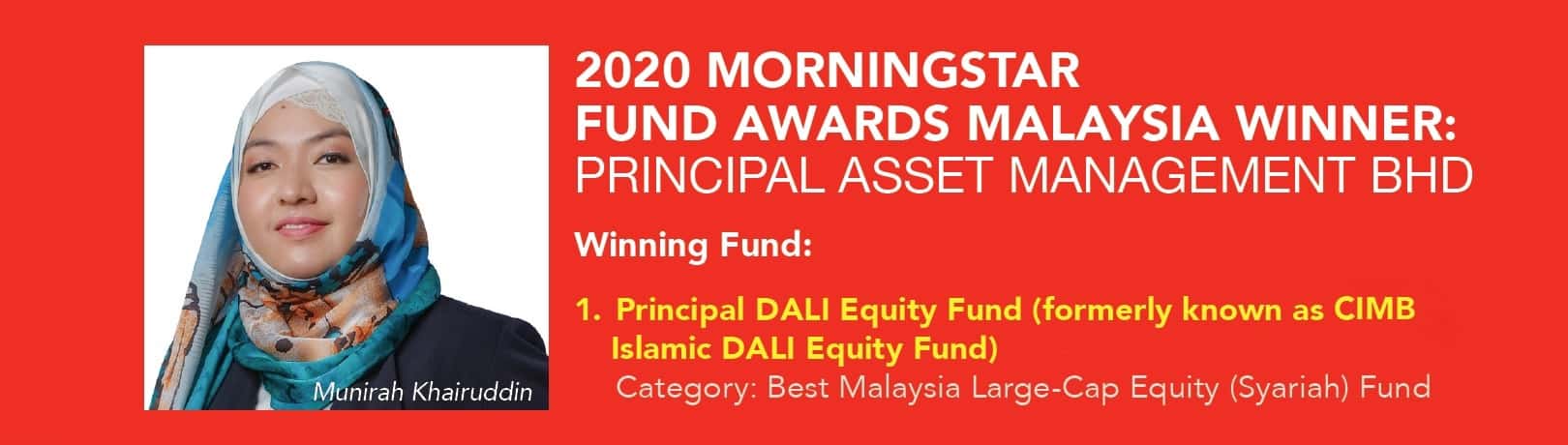
Principal Asset Management Bhd Wins Morningstar Fund Awards Malaysia

WInnig Fund

Principal Asset Management Bhd took home the Best Malaysia Large-Cap Equity (Syariah) Fund award at the 2020 Morningstar Fund Awards Malaysia for its Principal DALI Equity Fund (formerly known as CIMB Islamic DALI Equity Fund).

Smart Investor speaks with chief executive officer Munirah Khairuddin on the fund’s performance and how Syariah-compliant funds are gaining traction with investors.

Despite the strong headwinds buffeting the equity markets, Munirah sees opportunity in adversity, adding that Malaysian equity evaluation is already cheap. While taking a defensive stance, she says Principal Asset Management will take the opportunity to accumulate selective stocks within the plantation, construction, and oil and gas, and healthcare sectors.

Smart Investor: Congratulations on your win! What were the major changes made to the portfolio in 2019? What key factors drove your winning fund’s performance?

Munirah Khairuddin: Thank you! I believe the right asset allocation strategy has helped the fund’s performance in 2019. As you may know, the fund consists of 70% Malaysia and 30% Asia Pacific markets, and we manage the fund based on our proprietary top-down FTV and bottom-up FMV Research Process.

We adopted the Barbell Portfolio structure approach that emphasises on capital preservation and/or growth and have a rigorous portfolio optimisation process that focuses on the Beta, Active Share, and Sharpe Ratio. On top of that, we also run continuous data analytics to ensure that the portfolio is been managed within the optimum risk parameters.

Fund Info 1

Are Shariah-compliant funds like Principal DALI Equity Fund gaining traction with investors?

Yes, we are seeing Islamic Asia Pacific funds gaining traction with investors. This is part of the asset allocation/risk diversification strategies that we are advising investors to consider.

Historically, Islamic investments are less volatile than their conventional counterparts, especially during periods of uncertainty. During the subprime crisis in 2008, Islamic investments were not as greatly impacted compared to the conventional investments. The Islamic financial markets do not rely on the subprime assets or excessive leverage which caused difficulties for many conventional institutions in the past.

What are the major risks or challenges facing the financial markets in 2020? How do these risks affect your investment decisions?

We are in a unique situation in Malaysia. Our markets have been impacted by the Coronavirus outbreak and the US-China trade war. However, for the right investor, we believe there is an opportunity to invest in Malaysian equities and fixed income products because of the value.

In terms of equity, Malaysian equity valuation is already cheap. We are taking a defensive stance and focusing on stocks which are resilient to the expected slowdown in the domestic economy and/or not exposed to domestic political and regulatory uncertainty. We prefer sectors that benefit from interest rate cuts and are USD earners. This would include stocks in the consumer staples, healthcare, energy, plantation and the REITs sectors.

On the fixed income side of things, the impact of the Coronavirus outbreak may result in growth in 1Q2020 softening to below 4%. As a conservative move, our fixed income funds are taking a neutral view on benchmark duration. If government bond yields start to rise, we may take advantage of it to extend duration at an opportunistic level.

Info

Given the current headwinds, which sectors do you see as resilient and can thrive, and how would you position your funds to take advantage of opportunities and/or mitigate risks?

As I mentioned earlier, we prefer sectors that benefit from interest rate cuts and are USD earners. This would include stocks in the consumer staples, healthcare, energy, plantation and the REITS sectors.

As always, we advise investors to consider their long-term financial goals and risk tolerance when it comes to investing. Our investment team has recommended the following based on our asset allocation mix (as of Feb 2020):

Malaysia

Malaysian equity valuation is undervalued, making it attractive. It’s a great time to take advantage of the opportunity to buy low. We will continue to buy Malaysia on weakness and keep our barbell approach on high yield stocks. We’ll take the opportunity to accumulate selective stocks within the plantation, construction and oil and gas sectors.

When it comes to the Covid-19 outbreak, we will look at sectors impacted by this event. We’ll tactically underweight the aviation sector, while taking opportunities to trade the glove and healthcare sectors.

Asia Pacific Region

A market sell-off during an event like the Coronavirus outbreak usually offers great buying opportunities. Much like Malaysia – it’s a great opportunity to buy low.

We are taking advantage by buying into structural names with good management and strong business models. We also like companies that are emerging as the key players in the fourth industrial revolution.

Even though e-commerce may be a relatively more resilient sector with Chinese consumers choosing to spend more time at home and online shopping demand may increase, stocks of these companies are likely to also be sold off indiscriminately in a knee-jerk reaction. We will also be taking the opportunity by adding companies that are capable to lead in the growing consumption space in China.

By Bernie Yeo

Please click here to read the full article in the digital edition of Smart Investor (April 2020 issue).

What is Millennial Wealth Management?

While millennials may sometimes be seen as flippant in their attitude towards wealth, this is far from the reality as many young adults are financially aware and understand the importance of saving and investing for the future. When it comes to millennial wealth management, this tech-savvy generation also expects convenience and automation in their investments while demanding top value for their dollar and solid returns from their investments, says Affin Hwang Asset Management chief marketing & distribution officer Chan Ai Mei.

In an interview with Smart Investor, Chan gives her take on Malaysia’s millennial investors.

Smart Investor: Technology and innovation have altered the investment landscape, especially for millennials. How has the investment landscape evolved?

Chan Ai Mei: Millennials are certainly more discerning when it comes to investing. A product of their environment, this digital-savvy generation desires much more convenience and automation in their investments without necessarily going through a financial adviser. 

Most millennial investors instead prefer a DIY-approach and doing away with face-to-face meetings or phone calls. Also known as a generation of instant gratification and speed, you would be hard-pressed to find millennials which aren’t glued to their smartphones.

As a result, asset managers today have to evolve together and cater to the needs of this new generation through a rich front-end digital platform (whether through an app or an online portal). The objective here is to create a seamless investing experience from the process of on-boarding, selection of funds, making a deposit, fund transfers, portfolio monitoring and financial advisory.

How do you think millennials differ in their investment approach and what do they desire from their investments?

Millennial investors are very savvy consumers and they do pay a lot of attention to cost. These includes not just consumer goods and services, but also extends to financial products. However just because an item is cheaper, it does not mean that they are willing to forgo quality. They still demand top value for their dollar and want solid returns from their investments. 

Another area that millennial investors might differ are their value systems and openness towards championing a cause that they believe in. Most millennials would only invest if it is aligned to their own personal values and they can see sustainable outcomes. This has also led to the rise of impact investing as well as the growing importance of environmental, social and governance (ESG) considerations. 

Millennials sometimes get a bad rap about their attitude towards wealth and can be rash in making financial decisions. What’s your take on this? 

We think more credit should be given to millennial investors. There are a lot of assumptions about millennials being reckless about their finances and only knowing how to live in the moment. However, most are financially aware and understand the importance of saving and investing for the future. 

A key factor that may be hindering millennial investors from achieving their goals is perhaps in striking a balance between immediate and delayed gratification. Learning to control one’s impulses and practicing self-control would ultimately help investors achieve their long-term goals. However, striking a perfect balance may be difficult to achieve with competing priorities.

That’s why it’s crucial that investors first sit down and properly plan their investment goals (both short-term and long-term) and then draw up a financial roadmap towards achieving them. Don’t be afraid of setting ambitious goals, but the plan should also be realistic by incorporating measures to meet your short-term needs and lifestyle.

For instance, if you do enjoy forms of entertainment like movies, concerts or social events, you should also ‘treat’ yourself and consider allocating a portion of your budget towards these forms of discretionary expenditure. 

What are some healthy investing habits millennial investors should adopt?

It’s first important to have this realisation that investing is a marathon and not a sprint. Millennial investors living in the digital age may find this paradoxical, when they are used to getting everything quickly at the tip of their fingertips. 

But investing is a different ball-game altogether and rewards the patient.  As legendary investor Charlie Munger puts it, “It is waiting that helps you as an investor, and a lot of people just can’t stand to wait”.

For millennial investors just starting out in their investment journey, our advice is for them is to stay disciplined and stick to their investment plan regardless of how markets behave. Dollar-cost averaging is a simple yet effective technique to ease one’s way into the market over periodic intervals and helps reduce the impact of volatility in one’s investment. 

Newer investors’ nerves can be easily rattled when faced with choppy market conditions and this may drive them to making impulsive decisions in their portfolio and selling too early. However, our advice is for them to stay invested and avoid timing the market. 

Let the professional fund managers make adjustments to the portfolios when market conditions warrant them. For individual investors, you should stay focused on your goals and rebalance annually to correct any portfolio drifts that will ensure you are on track towards achieving your goals with a level of risk you are comfortable with. 

What should a millennial’s ideal investment portfolio look like? 

Time is on the side of millennial investors and they should make the most of this finite resource. Whilst some millennials may be wary of taking too much risk and getting jittery quickly, they should also realise they have a much longer investment horizon to recoup back losses and compound returns further.  

Thus, if circumstances allow, a millennial investor’s portfolio should be tilted more aggressively towards capital growth via equities and growth funds. The remainder of the portfolio can be diversified through allocations in fixed income that can provide stability and consistent income with lower drawdowns when market conditions turn more volatile. 

For tactical exposure which constitutes a smaller portion of the total portfolio, millennials can also seek exposure in more thematic and structural growth funds like China consumption or disruptive technology for example. 

By Bernie Yeo

Please click here to read the full article in the digital edition of Smart Investor (April 2020 issue).

2020 Morningstar Fund Awards Malaysia: Public Mutual Bhd

Winning Funds

Public Mutual Bhd took home four awards at the Morningstar Malaysia Fund Awards 2020, namely Best Asia-Pacific Equity Fund, Best Malaysia Large-Cap Equity Fund, Best Malaysia Bond Fund and Best Malaysia Bond (Syariah) Fund.

Smart Investor met up with Public Mutual chief executive officer Yeoh Kim Hong to discuss the out-performance of its winning mutual funds, risks in the market risk, and the technologies the fund house has adopted to make its business more appealing and
efficient to investors.

Smart Investor: Congratulations on your win! Public Mutual won four awards this year. What are the key factors behind the winning funds’ successful performance?

Alpha 30

Yeoh Kim Hong: Despite volatile market conditions in 2019, our winning funds continued to adopt a fundamental approach to investing by selecting stocks and bond/sukuk which have sustained earnings, strong financial positions and proven management track records.

Public Far-East Alpha-30 Fund (PFA30F), which is a regional equity fund that invests in a concentrated portfolio of a maximum of 30 stocks, won in the Best Asia-Pacific Equity Fund category. In 2019, the fund generated a return of +19.9% to outperform the regional equity markets, as proxied by the MSCI All Country Far East ex-Japan Index, which rose by 15.2% (in ringgit terms).

The fund’s performance was driven mainly by the out-performance of regional technology stocks which are leveraged to the increasing adoption of digital products and services globally, as well as the secular growth trends in online financial and e-commerce services.

The second equity award achieved is for the Best Malaysia Large-Cap Equity Fund category. Public Strategic Growth Fund (PSTGF), which focuses its investments on growth stocks in the Malaysian market, achieved a return of +4.3% in 2019. In comparison, the FBM KLCI, which tracks the performance of the domestic equity market, declined by 6%.

Despite challenging market conditions, the fund was able to achieve a commendable performance, as it focused on fundamentally-strong companies within the consumer, healthcare and technology sectors. These stocks benefitted from sustained consumer spending as well as the trade diversion arising from the US-China trade tensions.

Public Enterprises

Public Enterprises Bond Fund (PENTBF), which invests mainly in ringgit-denominated bonds, won the Best Malaysia Bond Fund category. In 2019, the fund achieved a return of +8.2% due to its focus on long-duration bonds with sound credit fundamentals, primarily in the infrastructure and banking sectors. Bonds in these two sectors saw strong buying interest on the back of easing monetary policies globally, which contributed to the fund’s strong performance.

The second bond award achieved is for the Best Malaysia Bond (Syariah) Fund category. PB Aiman Sukuk Fund (PBASF), which mainly invests in ringgit-denominated sukuk, registered a return of +9% in 2019.

The fund’s strong performance was due to its focus on long-duration sukuk with sound credit fundamentals, especially in the infrastructure and banking sectors. The fund also benefitted from its sukuk holdings issued by the Malaysian government, which performed strongly in 2019 as sukuk yields compressed.

Moving forward, how can your bond funds outperform in a volatile yet increasingly low-yield environment?

The low global interest rate environment as well as the accommodative domestic monetary policy is anticipated to underpin the domestic bond/sukuk market in 2020. Our bond/sukuk funds will continue to seek investment opportunities in bonds/sukuk with strong credit fundamentals while adopting an active portfolio rebalancing approach and maintaining reasonable portfolio yields to ride through periods of volatility in the domestic bond/sukuk market.

How will market risks like the US-China trade war, geopolitical tensions, and Covid-19 outbreak impact your investment decisions moving forward? What are some of the under-reported risks that could surface this year?

In light of the uncertainties pertaining to the US-China trade relations, our investments in sectors deemed to be susceptible to increased trade tariffs or restrictions have been reduced. In addition, our funds have largely avoided tourism-related sectors which are directly impacted by the slowdown in travel activities amid the Covid-19 outbreak.

Public Strategic

Other uncertainties include the upcoming US presidential election in November 2020, the Brexit negotiations as well as the sharp fall in oil prices following the Organisation of the Petroleum Exporting Countries’ (OPEC) move to hike oil production despite weak global demand.

However, accommodative monetary policies by major central banks and various fiscal stimulus measures by global and regional governments should help lend support to global economic activities. The volatility in financial markets will provide opportunities for our equity funds to add to their positions in fundamentally-backed stocks with positive long-term growth prospects.

Meanwhile, there could be volatility within the domestic bond/sukuk market in the run-up to September 2020 when FTSE Russell is anticipated to announce its decision on the retention of Malaysian bonds in the FTSE World Government Bond Index (WGBI).

To navigate such market uncertainty, our bond/sukuk funds will continue to focus on high-quality bond/sukuk issuances and rebalance the funds’ portfolio duration accordingly. Our focus on fundamental research and long-term investment strategies should help both our equity and bond/sukuk funds to ride through market cycles as well as through periods of elevated market volatility.

What measures or strategies has Public Mutual put in place to deal with these market risks?

In addition to the aforementioned measures, we will continue to be vigilant to developments within the economic and financial markets so as to proactively manage the exposure of our investments to these risks.

In this respect, we believe our adherence to fundamental research and long-term investment strategies will serve us well in delivering consistent returns to our unitholders over the long term.

Aiman Sukuk

With Malaysia gravitating towards a digital economy, what are some advanced technology that Public Mutual has adopted to make its business more appealing and efficient?

Among our technological offerings for investors is a dedicated online investment platform, Public Mutual Online (PMO), which provides them with easy access to our products and services on a 24/7 basis. Its key features include a Fund Analytics feature that allows investors to easily review the different features and performance of our available funds.

Meanwhile, our PMO landing page allows investors convenient access to stock market performance data and fund reviews, as well as a quick overview of their portfolio holdings.

We also recently revamped our website with improved functionality as well as enhanced user navigation. Investors can now use the website to explore funds, view fund performance and discover the right funds for their investment needs. It also allows investors to conveniently access articles on the financial markets and financial planning.

New investors can use the Digital Onboarding facility to sign up without need for physical documents, while existing investors can leverage on other facilities to top up their investments and register for the Direct Debit Authorisation (DDA) facility within a few clicks.

We have also designed several digital tools as part of our efforts to facilitate our unit trust consultants (UTCs) in servicing investors. For instance, the CAMS software allows UTCs to present to investors their investment account details including returns.

Meanwhile, the U@Bis$ app allows UTCs to guide investors in answering a risk-profiling questionnaire, before subsequently building a unit trust portfolio based on the recommended allocation.

By Bernie Yeo

Please click here to read the full article in the digital edition of Smart Investor (April 2020 issue).